
Key takeaways
- North Delhi’s heritage colonies have old, rough-walled tanks holding years of sludge and pipe rust.
- High-turnover student PGs in Kamla Nagar and Mukherjee Nagar refill constantly but rarely clean — a real health risk.
- Outer North pockets on borewell water need a descaling wash added to the standard clean.
- Old asbestos or corroded tanks should be assessed for relining or replacement, not endless cleaning.
- Home tanks from ₹699; sumps ₹1,500–2,500; multi-tank buildings quoted on site; AMC saves 15–25%.
This guide speaks to North Delhi realities: ageing tanks and pipes in the old colonies, high-turnover PG buildings, hard water in outer pockets, and heavy sediment in tanks that have not been opened in years. We cover why these tanks foul, what a real mechanised clean involves, what it costs, and how landlords and RWAs should schedule it. Local water tank cleaning pages are linked so you can book directly for your area.
Old plumbing, old tanks, decades of sediment
In heritage colonies like Civil Lines, Model Town and Kingsway Camp, many tanks and sumps have not been fully emptied in years. Old cement or asbestos tanks develop rough, porous walls that grip sludge and rust from ageing iron pipework, and the sediment layer at the bottom can be several inches deep. That is not something a quick rinse touches. The first proper clean of an old tank is often the biggest job — expect substantial sludge removal — but after that a regular cycle keeps it easy. If your water carries a faint rusty tinge or leaves sediment in a settled glass, your legacy tank is overdue.
Student PGs and high-turnover buildings
Kamla Nagar, GTB Nagar and Mukherjee Nagar run on student PGs and packed rentals near the university. These buildings draw and refill their tanks heavily every single day, yet cleaning is often ignored for years because no owner takes responsibility. High usage does not mean self-cleaning — it means constant fresh sediment settling on old sludge. Landlords running PGs carry a real duty of care here: dozens of young tenants drink and cook from that one tank. A twice-yearly clean on an AMC is cheap insurance against a waterborne illness outbreak and the reputational hit that follows.
Hard water in the outer North pockets
Move out toward Adarsh Nagar, Jahangir Puri and the outer North-West and borewell dependence rises, bringing hardness and grit into the mix. Scale builds on tank walls and pump inlets just as it does in the south and west, and it traps organic matter that feeds bacteria. Signs to watch:
- White chalky deposits on taps, geysers and tiles.
- Reduced flow as pump inlets and float valves crust over.
- A gritty residue when you wipe the inside of a bucket.
Book your water tank cleaning
Trained crew, food-grade process, before/after photos and a service record every job. ₹699 onwards, same-day where possible across Delhi NCR.
What a genuine clean covers
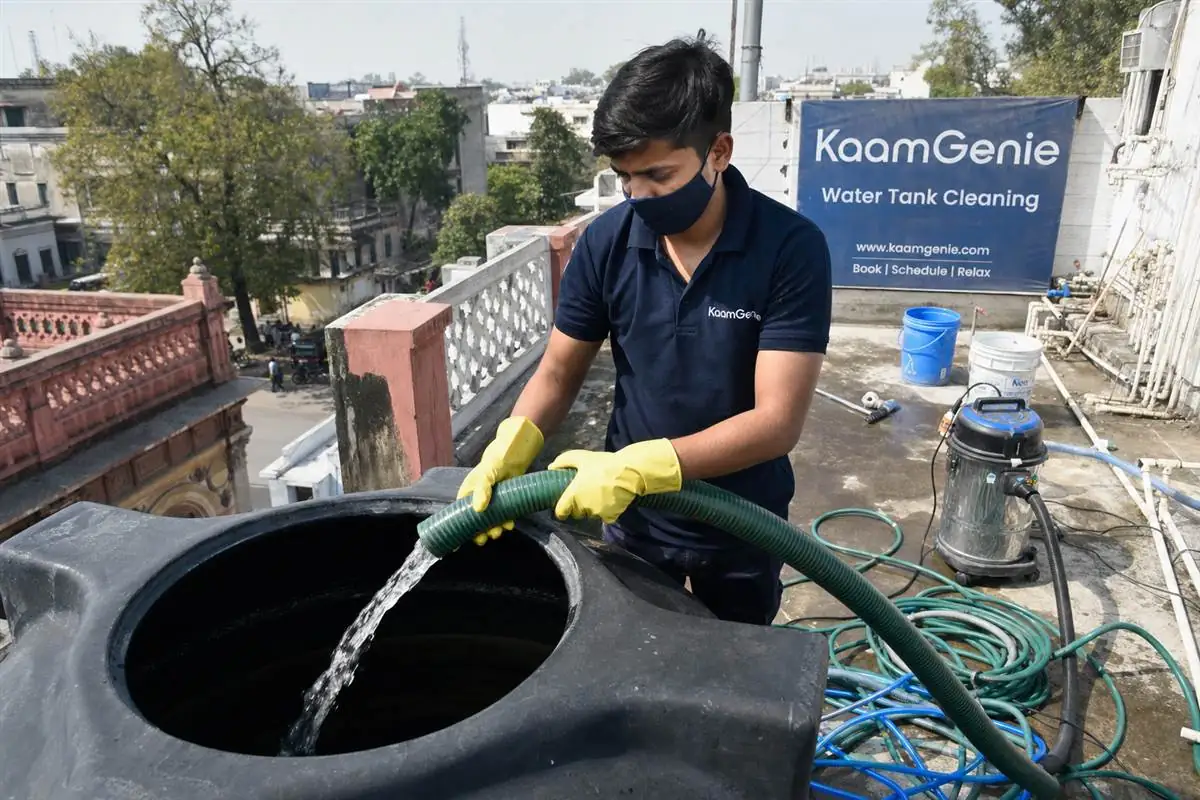
A proper North Delhi clean is a full mechanised cycle. We drain the tank, vacuum out years of settled sludge and rust with a dewatering pump, scrub the walls and floor mechanically — important on rough old cement surfaces — apply a food-grade anti-bacterial and anti-fungal treatment, high-pressure rinse, then fog or UV sanitise before refilling. For old asbestos or heavily corroded tanks we will also flag whether replacement or relining makes more sense than repeated cleaning. A home tank runs 45–90 minutes; a large legacy sump takes longer. Always ask for before-and-after photos and a look at the sludge removed.
Costs and AMC for landlords and RWAs
Pricing depends on tank size, sludge load and access. A single home overhead tank starts from ₹699, an underground sump runs ₹1,500–2,500, and multi-tank PG buildings or societies are quoted after a quick site look. A first clean of a badly neglected legacy tank may sit higher because of the sheer sludge volume, but subsequent cleans are cheaper. Landlords and RWAs benefit most from an annual maintenance contract — 15–25% off each visit plus a fixed calendar so a busy PG never gets skipped. For a quote, call 95603 66362.
Schedule and booking in your area
For North Delhi we recommend twice a year for standard DJB homes, quarterly for high-turnover PGs and borewell-fed outer pockets, and always one clean after the monsoon. If your tank has not been opened in over a year, book that overdue first clean now — it is the one doing the most harm. Reserve a slot via your area page such as Ashok Vihar, Timarpur or Shakti Nagar, or call and we will time the crew to your supply-off window.
Frequently asked questions
My old Civil Lines tank has never been fully cleaned — is it a big job?
The first clean of a long-neglected legacy tank is usually the biggest, because years of sludge and pipe rust have settled several inches deep and old cement walls grip it. It may cost a bit more upfront due to sludge volume, but once done, a regular twice-yearly cycle keeps future cleans quick and cheap.
I run a PG in Mukherjee Nagar — how often must I clean the tank?
At least twice a year, and quarterly is better given the constant refilling and the number of tenants relying on one tank. High usage brings constant fresh sediment, not self-cleaning. An annual maintenance contract keeps you on a fixed schedule and protects you from a waterborne illness outbreak among your tenants.
Should I replace an old asbestos or rusted tank instead of cleaning it?
Sometimes yes. Very rough, porous or corroded tanks keep re-fouling no matter how well they are cleaned, and old asbestos is best phased out. During the visit our crew will flag whether relining or replacing a food-grade poly tank makes more sense than paying to clean the same failing tank repeatedly.
Does outer North Delhi borewell water need special treatment?
Yes. Areas like Adarsh Nagar and Jahangir Puri lean on borewells with hard water, which scales tank walls and pump inlets. We add a food-safe descaling wash to the standard clean so the crust actually lifts off rather than being sealed over. Pairing it with an inlet filter keeps future grit and hardness out.
What does cleaning cost in North Delhi?
A single home overhead tank starts from ₹699 and an underground sump is ₹1,500–2,500 by capacity. A badly neglected first clean may be higher due to sludge volume, and PG buildings or societies are quoted on site. An AMC cuts 15–25% per visit. Call 95603 66362 for an exact quote for your building.
My Civil Lines house has a very old tank — will cleaning crack it?
Mechanised scrubbing is gentle on the tank surface, so a sound old tank cleans up fine. If yours is brittle, cracked or an ageing asbestos type, our crew will flag it and suggest replacement rather than force it. We would rather tell you honestly than clean a tank that needs retiring.
Can you fit around student tenants’ timings in a Mukherjee Nagar PG?
Yes. In student PGs we book mid-morning or early afternoon when most residents are out at coaching or college, so the water cut barely affects anyone. Give us your quietest hours on 95603 66362 and we will schedule the crew to isolate and finish the tank inside that window.
Do old North Delhi houses often have a hidden underground tank too?
Very often, yes — many older Kamla Nagar and Civil Lines homes have a masonry underground tank that has not been opened in years and holds decades of silt. We locate and clean it along with the overhead tank, because that buried store is usually the dirtiest part of the whole system.
As a landlord, can I get a record proving the tank was cleaned for tenants?
Yes. We provide before-and-after photos and a dated, signed service record every visit. Landlords use it to reassure tenants, settle disputes about water quality, and show upkeep at renewal time. If you run several properties, an AMC keeps all of them on schedule with paperwork for each address.
Is hard borewell water in outer North Delhi safe once the tank is cleaned?
Cleaning removes the sludge, scale and rust that hard water dumps in your tank, which fixes smell and cloudiness. But it does not lower the hardness or TDS of the incoming water itself — for that you need a softener or RO. We will tell you honestly what cleaning fixes and what needs treatment.
Sources & references
- Bureau of Indian Standards (BIS) — IS 10500:2012 is the canonical Indian Standard for drinking water specification, defining acceptable limits for physical, chemical and biological parameters.
- WHO Guidelines for Drinking-water Quality, 4th edition — the global reference for water quality standards, including guidance on safe storage and disinfection.
- Food Safety and Standards Authority of India (FSSAI) — defines water quality requirements for food businesses, including hygiene standards for stored water and acceptable disinfection chemicals.
- WHO Fact Sheet on Drinking Water — overview of safe drinking water requirements and contamination risks.
- CPHEEO — Manual on Water Supply and Treatment — the Government of India’s engineering manual covering tank design, cleaning protocols and disinfection practices.
Last verified: 6 July 2026. If you find any of these links broken, please let us know.