
Quick price answer by tank type (Delhi 2026)
- Overhead tank cleaning: ₹699-1,499 (depending on size 500L to 3,000L)
- Underground sump cleaning: ₹1,500-3,500 (kothi sumps 2,000L to 10,000L)
- Combo (sump + overhead together): ₹2,500-3,000 — the most common kothi booking
- Society reservoir + rooftop tanks: Custom quote, usually AMC
- Restaurant FSSAI commercial: Quoted on visit with documentation
- Plastic vs concrete: Same price — difference is in scrubbing technique, not billing
If you live in a Delhi flat with no kothi, you almost certainly only need overhead cleaning. If you live in a kothi or bungalow, default to combo.
Which tank type does your Delhi home have? (Quick identification)
Before booking anything, take two minutes to figure out what storage system you actually have. Most Delhi customers get this wrong on the first call — they ask for "tank cleaning" without knowing whether they have one tank, two, or a society-scale reservoir. Here’s how to identify your setup in under five minutes:
- Rooftop visible tank only = overhead. Walk up to your roof. If you see a single black, blue or white plastic tank (500L, 1,000L or 2,000L are the common sizes) sitting on a brick stand or directly on the slab — you have an overhead tank. No ground-level hatch in your courtyard. Likely a DDA flat, apartment, or builder floor. Your booking is straightforward overhead cleaning.
- Ground-level concrete hatch = sump. Look in your front courtyard, driveway, parking area or rear utility patch for a square concrete lid or steel manhole cover flush with the ground. Lift the corner — if you see water below, you’ve got a sump. Sumps are below ground because they store municipal supply at line pressure before pumping it up.
- Both visible = combo (most kothis). If you have a rooftop tank AND a ground hatch, you have the classic Delhi kothi setup. Municipal water lands in the sump, a motor pumps it up to the rooftop tank, and taps draw from the overhead. Both need cleaning, ideally on the same visit.
- Multi-tank reservoir + rooftop array = society type. If you live in a society or apartment complex, walk down to the basement or boundary wall. You’ll usually see a much larger concrete reservoir (15,000L+) plus separate rooftop tanks on each tower. This is a society/RWA contract job, not a single-home cleaning. Forward this article to your RWA — the pricing logic is different.
Still unsure? Send us a photo on WhatsApp. We’ll tell you in 5 minutes what type you have and what it should cost.
Overhead tank cleaning — what it is and who needs it
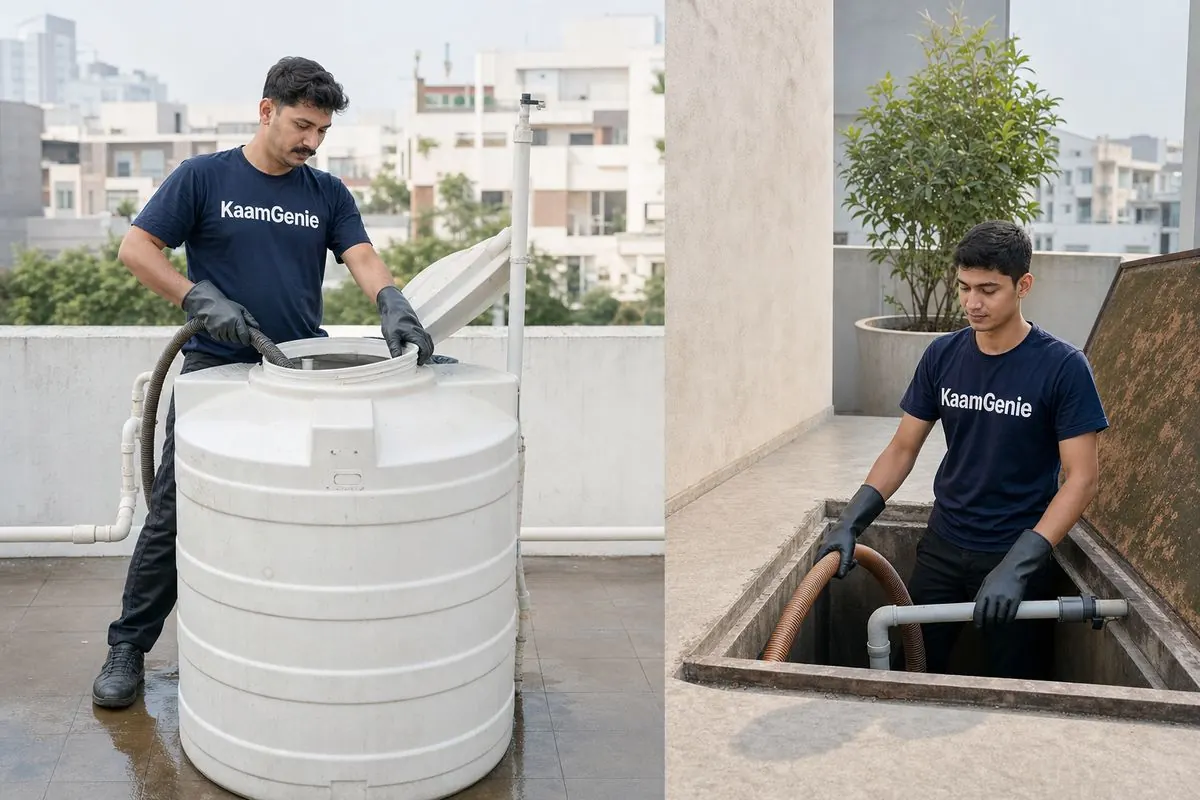
An overhead tank is the rooftop water storage every Delhi home has — plastic in 95% of cases, sometimes RCC (reinforced concrete) in older bungalows. The municipal supply or your sump pumps water up to it, gravity does the rest, and your taps run off it. The standard sizes you’ll see across Delhi are 500L, 1,000L, 1,500L and 2,000L for residential, with bigger 3,000-5,000L tanks for kothis or smaller commercial setups.
Cleaning an overhead tank is the more accessible of the two jobs. The crew opens the lid from the top, drains the existing water, descends or reaches in to scrub walls and floor, jet-washes biofilm and mineral scale, chlorinates with food-grade sodium hypochlorite, and rinses. No confined-space gear is needed because the open lid plus ambient airflow keeps oxygen levels safe throughout. The work takes 45-90 minutes depending on size.
Who needs overhead cleaning? Honestly, everyone in Delhi. If you have a rooftop tank, you need it cleaned every 6 months — the BIS guideline isn’t a marketing line, it’s based on biofilm doubling time at Delhi temperatures. You can see our full water tank cleaning services for what a standard visit covers. Skip cleaning for a year and you’ll see the difference: tank water has a slight green tint, faint algal smell, and a layer of slime when you run your finger along the inside wall. Skip it for two years and you’re feeding your family a microbial broth.
The reason overhead cleaning runs only ₹699-1,499 across Delhi is simple: it’s open-top work, the crew doesn’t need a gas meter, harness or standby person, and the tank volume is smaller so less chlorine is consumed. Everything that pushes sump cleaning into the ₹1,500-3,500 band is absent here.
Underground sump cleaning — what it is and who needs it
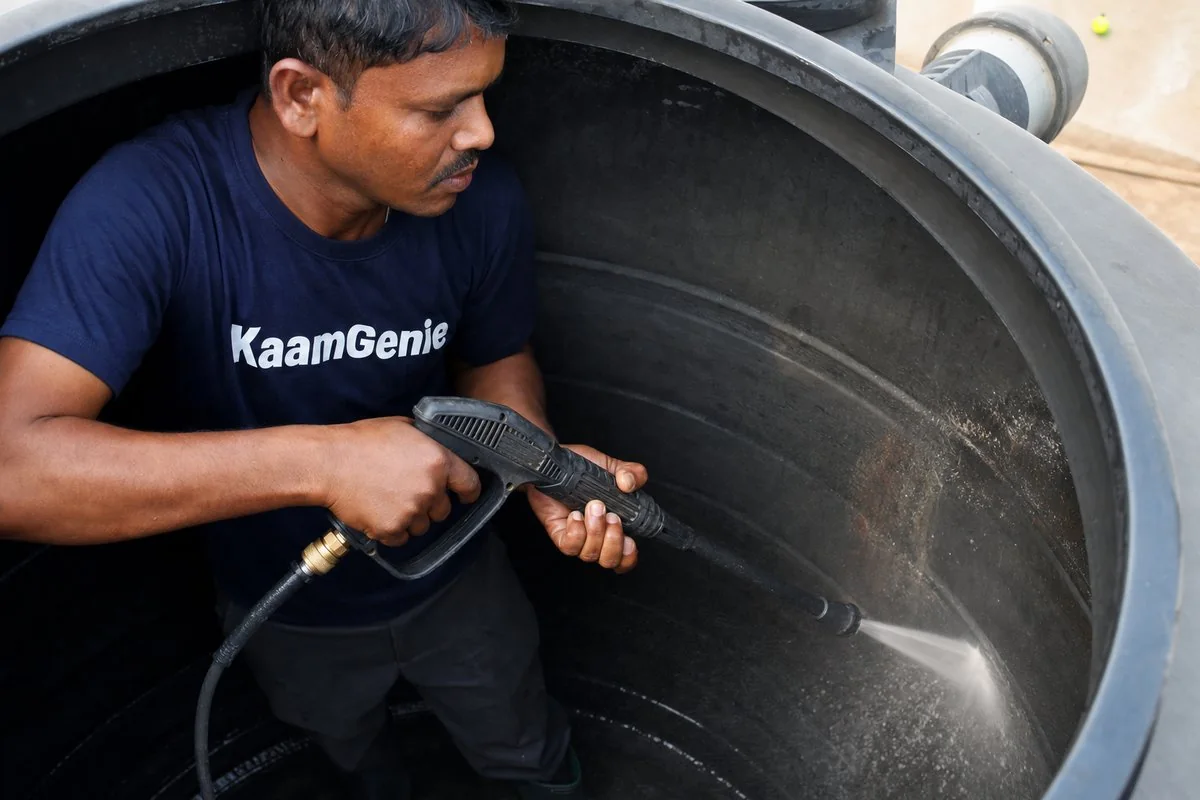
A sump — or underground tank — is a concrete or fibreglass reservoir built below ground level, usually outside or under a kothi. It receives the municipal supply at line pressure, holds 2,000-10,000 litres for a typical Delhi kothi (15,000-50,000L for societies), and a motor pumps that water up to your rooftop overhead. Restaurants, schools, factories and societies almost always have one. DDA flats and small builder floors usually don’t.
The reason sump cleaning is more expensive than overhead has nothing to do with markup. It’s three real factors:
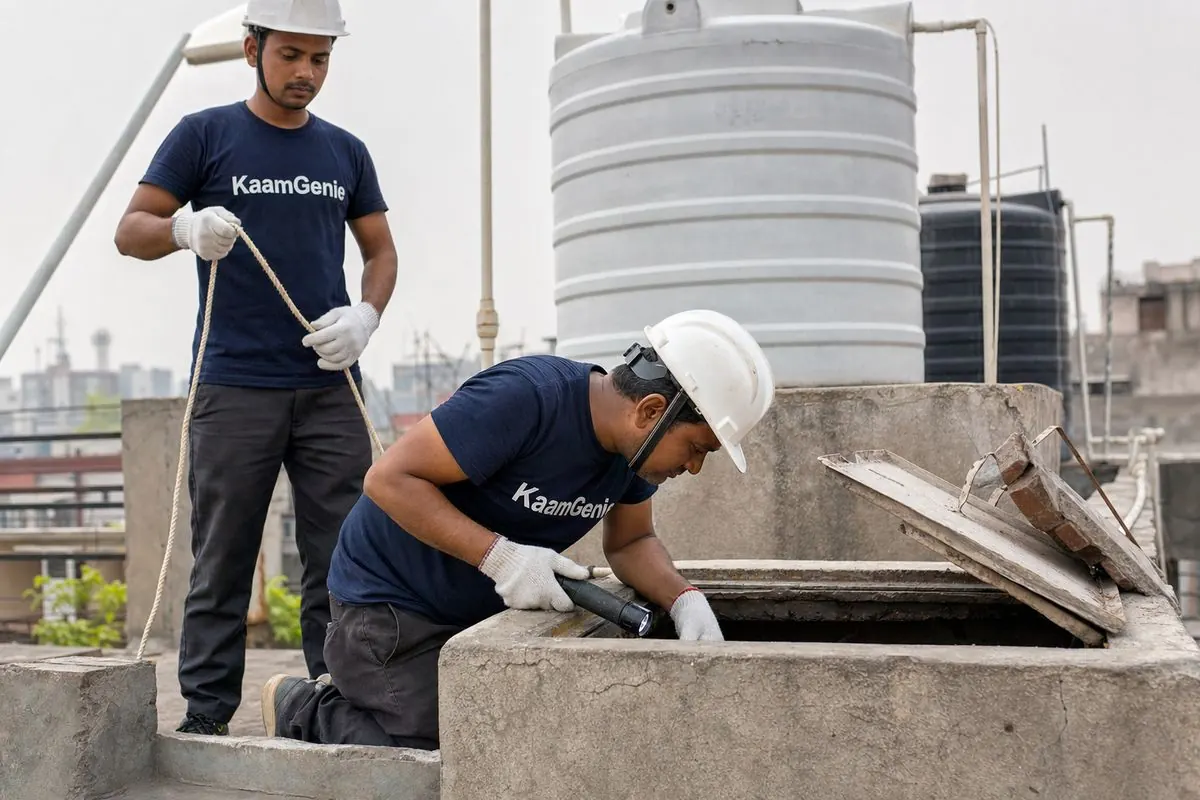
- Confined-space safety gear. A crew member has to descend through the hatch into an enclosed concrete box. Without proper gear, this kills people. Harness, gas meter (reads hydrogen sulfide, methane and oxygen levels), hard hat, gloves, and one standby crew member outside holding the safety rope are all non-negotiable. That’s an extra person on the payroll and equipment that costs real money.
- Larger volume = more chlorine and more time. A 5,000L sump takes 30-45 minutes longer to clean than a 1,000L overhead tank. Drainage alone is slower because the volume is larger. Chemistry needs to be dosed at a higher absolute amount even though the ppm is the same.
- Heavier sediment. Months or years of silt, sand, mineral scale and biofilm settle to the sump floor. Sumps don’t get the natural agitation rooftop tanks do (rain, sun-induced thermal convection), so the sediment cakes harder. Removal needs vacuum extraction, jet wash and proper chlorine contact time — not just scrubbing.
The big risk factor in sump cleaning is gas accumulation. Without sunlight or oxygen circulation, sumps grow sulphur-reducing bacteria that produce hydrogen sulfide — the "rotten egg" gas. At 700+ ppm a few breaths are fatal. Methane and CO₂ from organic decay displace oxygen. People die in India every year descending into sumps without testing the air first. This is why the ₹500 "sump cleaning" quote you sometimes see on Justdial is genuinely dangerous — that vendor is skipping the gas test and harness to keep the price low.
Combo (sump + overhead) — most Delhi kothis need this
Combo cleaning means the crew cleans your sump AND your overhead tank in a single visit. For most kothi customers, this is the right answer — and pricing reflects that. Booked separately, you’d pay roughly ₹1,500 for the sump + ₹999 for the overhead = ₹2,499, plus you’d have to call for a second visit, pay another travel charge, and wait. As a combo booking, it’s ₹2,500-3,000 in one trip.
But the bigger reason to combo is hygiene, not money. Water flows in a closed loop: municipal supply → sump → motor → overhead tank → taps. If you only clean the sump, the next pumping cycle drags freshly cleaned water through a still-contaminated overhead tank and the overhead recontaminates the sump-conditioned water within 48 hours. The reverse is also true: cleaning only the overhead means pumped sump water carries fresh sediment up within days.
Combo solves this by cleaning the full water path in one go. The crew empties and treats the sump first (so the chlorine residue gets flushed before the overhead refills), then moves to the overhead. By the time the system is refilled, both reservoirs and the connecting pipework are simultaneously clean. That’s the cadence change you’ll feel in your taps within 24 hours — cleaner taste, no slight chlorine smell, no faint mineral aftertaste.
Combo bookings make sense for: independent kothis with rooftop tank + ground sump, builder floors where the building has a shared sump and you have a rooftop tank, small commercial setups (clinics, gyms, salons) with both, and FSSAI restaurants where regulators want documentation that both reservoirs are clean. They make less sense for: DDA flats with no sump, top-floor apartments with no separate ground storage, and standalone shops with a single rooftop tank.
Kothi owner? Combo cleaning is what you actually need.
One visit, both tanks done, full water path cleaned. Fixed-price ₹2,500-3,000. Real safety gear, before/after photos on WhatsApp, GST invoice.
Process differences — 8-step side-by-side
The cleaning process is similar in spirit across all three but differs meaningfully in execution. Here’s the step-by-step comparison so you can see exactly what your money is buying:
| Step | Overhead tank | Underground sump | Combo (both) |
|---|---|---|---|
| 1. Initial assessment | Check tank type, size, lid condition | Check hatch access, inspect for cracks | Both checks plus pipework inspection |
| 2. Gas / air safety | Not required — open top | Gas meter test before any descent | Gas meter on sump only |
| 3. Drainage | Open tap valve, gravity-drain | Pump out, then wet-vacuum residual | Sequential: sump first, then overhead |
| 4. Entry & sludge removal | Top-down access, scoop sediment | Harness descent, scoop + wet vacuum | Both methods used on respective tanks |
| 5. Scrubbing | Food-grade brushes on walls + floor | Heavier brushing of caked sediment | Done twice — sump scrub, overhead scrub |
| 6. High-pressure jet wash | 80-100 bar from open top | 80-120 bar — harder pressure for scale | Same equipment used on both |
| 7. Disinfection | 5% sodium hypochlorite, 20 min contact | Same chemistry, larger absolute dose | Sump treated first, then overhead |
| 8. Rinse & refill + photos | Flush, refill, before/after photos | Flush thoroughly, refill, photos | System-wide flush, full set of photos |
The biggest single difference is step 2 (gas test) and step 4 (descent). Everything else is similar in shape. If a vendor quotes you a "sump cleaning" and you watch them skip step 2 and 4 protocols — no harness, no standby person — that’s not a sump cleaning, that’s a liability event waiting to happen. Send them home.
Cost differences — clear comparison
Below is a market-checked Delhi NCR cost comparison across South Delhi, West Delhi, East Delhi and Gurgaon vendors. The "typical range" is what you’ll see across Justdial / Urban Company / local vendors. The "KaamGenie" column is our published fixed pricing:
| Tank type | Size | Typical Delhi range | KaamGenie price |
|---|---|---|---|
| Overhead (plastic) | 500L | ₹600-1,200 | ₹699 |
| Overhead (plastic) | 1,000-1,500L | ₹800-1,500 | ₹999 |
| Overhead (plastic) | 2,000-3,000L | ₹1,200-1,800 | ₹1,499 |
| Overhead (RCC concrete) | 1,000-3,000L | ₹1,200-2,000 | ₹1,299-1,699 |
| Underground sump (kothi) | up to 2,000L | ₹1,200-2,000 | ₹1,500 |
| Underground sump (kothi) | 2,000-5,000L | ₹1,800-3,000 | ₹2,000-2,500 |
| Underground sump (kothi) | 5,000-10,000L | ₹2,500-4,500 | ₹2,800-3,500 |
| Combo (sump + overhead) | Kothi standard | ₹2,500-4,000 | ₹2,500-3,000 |
| Society reservoir | 10,000-25,000L | ₹4,000-6,500 | ₹4,500-5,500 |
| Society reservoir | 25,000L+ | ₹6,500-10,000+ | Custom quote |
Notice that combo cleaning is priced cheaper than sump + overhead booked separately. That’s deliberate — the crew is already on site with the equipment set up, travel time is already paid for, and chlorine batch is already mixed. We pass that efficiency to the customer because it’s the booking pattern we actively want more of (it produces cleaner end-result water).
Frequency differences
How often each tank type needs cleaning is set by BIS guidelines plus what we’ve learned across 2,000+ Delhi visits in 2024-2025. The cadence varies by usage volume, water source, and whether the property is residential or commercial. Here’s the practical guide:
| Tank type | Individual home | Society / RWA | Commercial / FSSAI |
|---|---|---|---|
| Overhead tank | Every 6 months | Every 4-6 months per tower | Every 6 months (FSSAI) |
| Underground sump | Every 6 months | Every 3 months (high turnover) | Every 6 months minimum |
| Combo cleaning | Twice a year (recommended) | Quarterly on AMC | Every 6 months |
| Borewell-fed sump | Every 4 months | Every 3 months | Every 4 months |
| After construction | Immediately + repeat at 3 months | Immediately + repeat at 3 months | Before opening + at 3 months |
| Post-monsoon (Sept-Oct) | One extra visit | Mandatory annual visit | Mandatory FSSAI documentation |
The reason sumps need cleaning more often than overhead tanks in commercial / society contexts is simple turnover. A society’s sump cycles 10,000-25,000 litres of water through it daily; a rooftop tank cycles 1,500-3,000 litres. More water through the system means more sediment deposited, even at the same input quality. For an individual kothi, the turnover is similar enough that both tanks settle into the same 6-month rhythm.
Society / RWA — when do they need both?
Societies almost always have both: a ground-level (or basement) reservoir that holds the bulk municipal supply, plus rooftop tanks on each tower for gravity-fed distribution. The reservoir is treated as an oversized sump — same confined-space protocol, same gas test, same harness — just scaled up. Rooftop tanks on towers are standard overhead jobs but multiplied.
A 100-flat society with 4 towers typically has: one 25,000L basement reservoir + four rooftop tanks averaging 5,000L each. AMC pricing usually bundles quarterly reservoir cleaning + twice-yearly rooftop visits. Per-flat economics work out to ₹100-150 per month covering the entire society contract — far cheaper than individual flat-by-flat cleaning would ever be, and gives the RWA proper documentation (cleaning logs, water-quality reports, GST invoices) for resident transparency and any insurance/audit requirement.
If you’re on an RWA committee reading this, the right question to ask your current vendor is: "Can you show me the gas meter and harness used last visit?" If they hesitate or shrug, they’re billing for sump cleaning but doing rooftop-only work. We’ve taken over 30+ society contracts in 2025 from exactly this kind of underdelivery.
Real Delhi customer scenarios
Three patterns come up repeatedly across our bookings, and they illustrate when each tank type combination is the right answer:
Defence Colony kothi — the combo customer. A 4-bedroom kothi with a 5,000L underground sump in the front courtyard and two 1,000L plastic overhead tanks on the rooftop. The owner had been cleaning only the overhead annually because a previous vendor never mentioned the sump. After two years, water started smelling faintly metallic and the cooks were complaining. We did a combo cleaning on the first visit (sump took 2 hours because of accumulated sludge, overhead was straightforward 45 minutes). The bill was ₹3,000 because the sump was first-time-after-years; subsequent combo visits at the bi-annual cadence are now ₹2,500. Water taste changed within 24 hours.
Vasant Kunj society — reservoir + booster pump. A 60-flat society in Sector C with a 20,000L basement reservoir, a booster pump system (hydro-pneumatic), and individual rooftop tanks on each of three towers. The old RWA contract was ₹800/month for "tank cleaning" but on inspection only the tower rooftops were ever touched — the reservoir hadn’t been opened in 14 months. We re-did everything on a 2-day weekend job: reservoir on Saturday with full confined-space protocol, rooftops on Sunday. New AMC: ₹14,000/month covering quarterly reservoir + twice-yearly rooftops + free TDS testing. Works out to ₹233/flat/month and the RWA finally has water-quality reports for the residents’ AGM.
Karol Bagh restaurant — FSSAI combo. A 40-cover restaurant with a 3,000L underground sump in the rear utility area and a single 1,500L rooftop tank. FSSAI inspector visit notified 5 days in advance. We did a combo cleaning + post-clean TDS test + chlorine residual test + photographic documentation + GST invoice. Total bill ₹2,800 plus ₹500 add-on for water-quality testing. Restaurant passed inspection. They’ve since moved to an annual AMC at 6-month cadence so the documentation is always current.
Not sure which type you need?
Send us a photo of your roof and your courtyard. We’ll tell you in 5 minutes whether you need overhead, sump, combo, or society pricing. No obligation.
What KaamGenie charges for all three
For full transparency, here’s our published fixed pricing across all three tank-type categories. No hidden add-ons, no "deep clean" surcharges, no "after-photo" fees:
- Overhead tank cleaning (500L): ₹699
- Overhead tank cleaning (1,000-1,500L): ₹999
- Overhead tank cleaning (2,000-3,000L): ₹1,499
- Underground sump (up to 2,000L): ₹1,500
- Underground sump (2,000-5,000L): ₹2,000-2,500
- Underground sump (5,000-10,000L): ₹2,800-3,500
- Combo sump + overhead (kothi): ₹2,500-3,000
- Society / commercial: Quoted on visit, AMC discount 15-25%
- Restaurant FSSAI documentation: ₹500 add-on, optional
Detailed pricing on the water tank cleaning service page and underground sump cleaning page. To book, call +91 95603 66362, WhatsApp us, or use the booking form on this site.
Frequently asked questions
Which tank type does my Delhi home have? How do I identify?
Walk up to your roof — if you see a black, blue or white plastic tank sitting on the terrace, you have an overhead tank. Check your front courtyard or driveway for a square concrete hatch flush with the ground — that’s a sump. Apartment flats usually only deal with overhead; independent kothis almost always have both.
Can I clean my overhead tank myself? What about sump?
Overhead — technically yes for a small 500L plastic tank, but you’ll struggle with biofilm and chlorine dosing. Sump — absolutely not. Sumps are confined spaces with toxic gas risk. Hydrogen sulfide kills DIY cleaners every year in India. The ₹1,500 saved is not worth the risk.
Why is sump cleaning more expensive than overhead?
Three reasons. Sumps need confined-space safety gear (harness, gas meter, standby crew). Sumps are larger so more chlorine is used. The job takes 30-45 minutes longer per visit. Overhead tanks are smaller, open from the top and need no descent — so it stays in the ₹699-1,499 band.
What’s a combo cleaning and when do I need it?
Combo means we clean your sump and your overhead tank in a single visit. Most Delhi kothis need this because water flows sump → motor → overhead → taps. Cleaning only one means the other re-contaminates it within days. Combo pricing is ₹2,500-3,000 — cheaper than booking the two separately.
How often should each tank type be cleaned?
Overhead tanks — every 6 months (BIS recommendation). Sumps — every 6 months for kothis, every 3 months for societies. Borewell-fed sumps in outer Delhi need cleaning every 4 months due to higher TDS. Restaurants and commercial kitchens follow FSSAI 6-month cadence regardless of type.
Do societies need both overhead and underground cleaning?
Yes — and they’re billed differently. The ground-level reservoir (10,000-50,000L) is treated like a sump with confined-space protocol. Rooftop tanks on each tower are overhead jobs. AMC pricing usually bundles both with quarterly cadence on the sump, twice-yearly on the rooftops.
What about kothi homes with separate booster pumps?
Booster pumps don’t change the cleaning logic. Water still flows sump → pump → overhead → taps. We clean the sump and the overhead; the pump itself we flush during chlorine contact time. If you have a pressure tank or hydro-pneumatic system, mention it when booking — we drain and treat it as part of the combo.
What’s the difference in safety gear used?
Overhead — gloves, anti-slip shoes, mild PPE. The crew works from the top hatch and doesn’t fully enter. Sump — full-body harness, gas meter, hard hat, standby crew member outside, safety rope. The cost gap between overhead and sump cleaning is largely this gear and the extra person.
Why should I book combo together — is there a saving?
Two reasons. First, money — combo is ₹2,500-3,000 vs ₹1,500 sump + ₹999 overhead = ₹2,499 separately, plus you avoid a second visit fee. Second, hygiene — cleaning only one tank means the other recontaminates it within 48 hours. Combo cleans the full water path in one go.
How long does each type of cleaning take?
Overhead 500-1,500L — 45-60 minutes. Overhead 2,000-3,000L — 60-90 minutes. Sump 2,000-3,000L kothi — 90-120 minutes. Combo sump + overhead — 2-3 hours. Society reservoir 25,000L+ — half a day. Add 15-20 minutes for before/after photos, chlorine contact time, and walking the customer through the result.
Sources & references
- Delhi Jal Board (DJB) — municipal water supply authority and recommended cleaning cadence for residential storage.
- Bureau of Indian Standards (BIS) — IS 10500 drinking water specification and tank maintenance guidelines.
- Food Safety and Standards Authority of India (FSSAI) — commercial kitchen water storage and inspection requirements.
Last verified: 4 June 2026. If you find any of these links broken, please let us know.
About the author: Raj Babbar is KaamGenie’s Senior Water Cleaning Specialist with 12+ years of field experience across Delhi NCR — from DDA flats in Dwarka to large kothi sumps in Defence Colony and society reservoirs in Vasant Kunj. He has personally led 2,000+ overhead, sump and combo cleanings and trains the crew on confined-space safety protocols. This article was editorially reviewed by Prateek Shrivastav.