
Key takeaways
- Dwarka is society-driven — shared underground tanks feed whole towers, so cleaning is a managing-committee responsibility.
- Supply varies by sector; borewell-fed societies need a descaling wash and a tighter cycle than DJB ones.
- Large underground tanks are a confined-space job needing ventilation and gas checks before entry.
- Clean the underground storage AND every overhead tower tank together, or clean water recontaminates on the way up.
- Flats from ₹699; sumps ₹1,500–2,500; society systems quoted on survey; AMC saves 15–25% with full documentation.
This guide is built for Dwarka’s society-driven layout: big shared underground tanks, tower overhead tanks, sector-wise supply differences, hard borewell water and monsoon silt. We explain why Dwarka tanks foul, what a proper mechanised clean of a large society tank involves, how managing committees should schedule and document it, realistic costs and AMC savings. Sector water tank cleaning pages are linked so your society can book directly.
Why Dwarka’s society tanks need a committee plan
In Dwarka, a single large underground tank often stores water for an entire tower or block, then feeds overhead tanks that serve dozens of flats. That efficiency comes with concentrated risk: one neglected tank affects every family above it. Because no individual owner controls the shared tank, cleaning has to be driven by the managing committee on a fixed calendar — not left until residents complain of smell or illness. Societies in Sector 6, Sector 10 and Sector 12 that run a documented annual schedule consistently have cleaner water and fewer complaints at AGMs.
Sector-wise supply: DJB versus society borewells
Supply is not uniform across Dwarka. Some sectors get reliable DJB water, while others still lean on society borewells that draw hard, high-TDS groundwater. That difference decides your cleaning approach. Borewell-fed societies get a heavy calcium and iron scale on tank walls and pump inlets, so they need a descaling wash and a tighter cleaning cycle. To gauge your situation:
- Check whether your society’s water is DJB, borewell or a blend — the committee will know.
- Take a TDS reading; consistently high readings point to hardness that scales tanks.
- Match the cleaning frequency to the source, not a generic yearly default.
Cleaning a large underground society tank properly
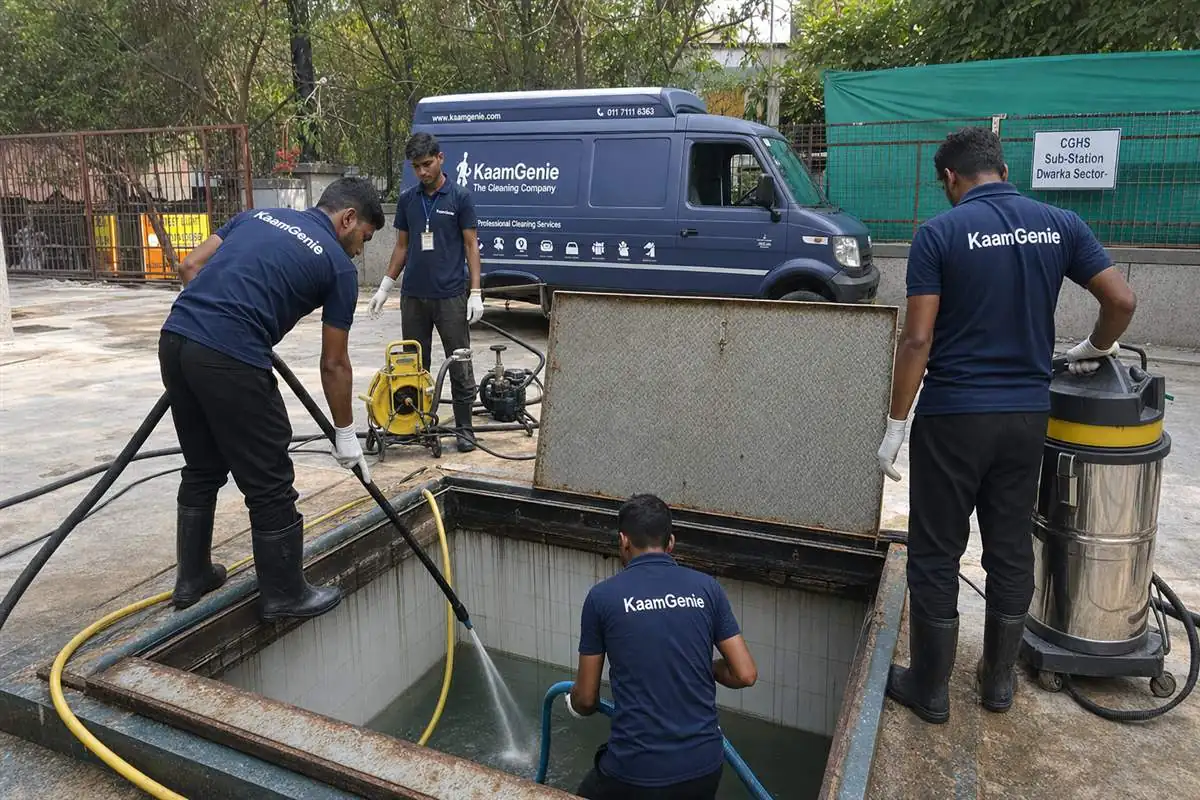
Big underground tanks are a specialist confined-space job, not a domestic rinse. Our Dwarka crews first isolate and drain the tank, then use dewatering pumps to clear the slurry. Before anyone enters, we run ventilation and gas checks — large sealed tanks can hold unsafe air. Walls and floor are mechanically scrubbed, treated with a food-grade anti-bacterial and anti-fungal solution, high-pressure rinsed and then fog or UV sanitised before refill. A large society tank is a multi-hour job planned around the society’s pumping schedule so residents keep supply. The committee receives dated before-and-after photos and a service record for its files.
Book your water tank cleaning
Trained crew, food-grade process, before/after photos and a service record every job. ₹699 onwards, same-day where possible across Delhi NCR.
Overhead tower tanks and the full system
Cleaning only the underground tank is half the job. Each tower’s overhead tanks also collect sediment and biofilm, and if they are skipped, clean water from a fresh underground tank simply picks up contamination on the way to the tap. A complete Dwarka clean covers the underground storage plus every overhead tank in the block, done in a coordinated sweep. Sectors with many towers — like Sector 7 and Sector 18 — benefit from a phased plan across a day or two so no tower loses supply for long. Book the whole system together and you avoid recontamination.
Monsoon silt and Dwarka’s dust
Dwarka’s open, wide-sector layout and ongoing construction mean plenty of airborne dust that settles into tanks through imperfect lids. When the monsoon arrives, rooftop silt and grit wash into overhead tanks and overflow lines, and underground tank chambers can take in seepage if covers are not sealed. A post-monsoon clean is essential for every Dwarka society. It clears the gritty layer that otherwise clouds water for days and gives biofilm a fresh surface to grow on. Pair it with a check of tank lid gaskets and overflow mesh across all towers.
Costs, AMC and booking for your society
For individual flats with their own small tank, cleaning starts from ₹699, and a home sump is ₹1,500–2,500. Large society underground and overhead tank systems are quoted after a site survey, since capacity, tower count and access all vary. This is where an annual maintenance contract pays off most: 15–25% off each visit, plus a fixed multi-tank calendar and documentation your committee can present at the AGM. We suggest twice-yearly cleaning for DJB societies, quarterly for borewell-fed ones, and always one clean after the monsoon. Book via your sector page — for example Sector 3 or Dwarka Mor — or call 95603 66362.
Frequently asked questions
Who is responsible for cleaning our Dwarka society tank?
The managing committee. In Dwarka’s CGHS layout, one large underground tank feeds a whole tower, so no single owner controls it and one neglected tank affects every family above. Committees should run a documented annual calendar rather than waiting for complaints. We provide dated before-and-after photos and a service record for AGM and audit files.
Do all Dwarka sectors have the same water?
No. Some sectors get reliable DJB supply while others rely on society borewells with hard, high-TDS groundwater. Borewell-fed societies build heavy calcium and iron scale, so they need a descaling wash and a shorter cleaning cycle. Check with your committee whether your water is DJB, borewell or a blend, and set frequency accordingly.
Is cleaning a large underground society tank dangerous?
It is a confined-space job that must be done correctly. Large sealed tanks can hold unsafe air, so our crews run ventilation and gas checks before anyone enters, and use dewatering pumps to clear slurry first. The work is planned around your society’s pumping schedule so residents keep supply throughout. Never let an untrained person enter a big tank.
Should we clean the overhead tower tanks too?
Yes, always together. If you clean only the underground tank, the fresh water picks up sediment and biofilm from neglected overhead tower tanks on its way to the taps. A complete clean covers underground storage plus every overhead tank, often phased across a day or two in multi-tower sectors so no tower loses supply for long.
What does it cost and does an AMC help our society?
Individual flats start from ₹699 and home sumps are ₹1,500–2,500. Large society systems are quoted after a site survey because capacity, tower count and access vary. An annual maintenance contract saves 15–25% per visit and gives a fixed multi-tank calendar with documentation for the AGM. Call 95603 66362 to arrange a survey.
How does our Dwarka society committee organise cleaning for hundreds of flats?
Most societies appoint the RWA or facility manager to book one scheduled drive covering every tower’s sump and overhead tanks. We survey the tank count, give a single combined quote, and plan tower by tower so supply stays running. Call 95603 66362 and we will walk your committee through a phased plan.
Do you carry confined-space safety gear for large Dwarka underground tanks?
Yes. Big society sumps need proper precautions, so our crew uses ventilation, lighting, a standby technician outside and safe entry practice rather than sending one person in alone. This is exactly why societies should use trained crew instead of an untrained handyman for a deep underground tank.
Can you schedule Dwarka tower cleaning without cutting water to residents?
We isolate one tank at a time and coordinate with your pump operator so other towers or lines stay supplied while we work. Residents may see a short cut only for their own tank’s window. Sharing a notice a day ahead so people store a little water keeps everyone comfortable.
Is an AMC cheaper than calling you each time for a Dwarka society?
For a multi-tower society, yes — an annual contract locks in the six-monthly cleans at a better per-tank rate and saves the committee from rebooking each cycle. It also keeps consistent records for audits and handovers. We will quote both one-time and AMC pricing based on your total tank count.
Should Dwarka societies time cleaning around the monsoon?
A clean just after the monsoon is smart, because rain drives extra dust and silt into rooftop and underground tanks. Many Dwarka societies do one clean before summer, when storage runs hardest, and one after the rains. That rhythm keeps water clear through both the dusty and the humid parts of the year.
Sources & references
- Bureau of Indian Standards (BIS) — IS 10500:2012 is the canonical Indian Standard for drinking water specification, defining acceptable limits for physical, chemical and biological parameters.
- WHO Guidelines for Drinking-water Quality, 4th edition — the global reference for water quality standards, including guidance on safe storage and disinfection.
- Food Safety and Standards Authority of India (FSSAI) — defines water quality requirements for food businesses, including hygiene standards for stored water and acceptable disinfection chemicals.
- WHO Fact Sheet on Drinking Water — overview of safe drinking water requirements and contamination risks.
- CPHEEO — Manual on Water Supply and Treatment — the Government of India’s engineering manual covering tank design, cleaning protocols and disinfection practices.
Last verified: 6 July 2026. If you find any of these links broken, please let us know.