
Hard Water Tank Cleaning in Delhi
Raj Babbar · 9 min read
Home › Water Tank Cleaning › Society / RWA Tank Cleaning › Ghonda
Society and shared building tank cleaning for the old riverside lanes of Ghonda, where ageing tanks with worn lids run on hard, humid supply. We clean the whole building's tanks in one visit. Bulk pricing for the whole building.
Ghonda is an old riverside quarter of trans-Yamuna near Bhajanpura and the Yamuna embankment, decades-old lanes of plot houses and builder floors. The supply mixes DJB with borewell that runs hard near the river, so the rooftop tanks pick up scale along with the ordinary sediment. The low-lying riverside humidity is the local factor that stands out: it speeds up algae and scale inside the tanks faster than in drier parts of the city. And because Ghonda's buildings are old, the tanks here often sit on ageing roofs with worn, ill-fitting lids, so dust and sediment reach the water easily on top of the algae and scale. The storage is commonly shared across floors, and with the tanks aged and out of sight, they go long stretches without a clean while the humid air keeps the buildup coming.
KaamGenie cleans the shared tanks a Ghonda building runs, the ageing rooftop tanks and any ground cistern, in one coordinated visit arranged with the owner or the residents together. We clear the algae and scale, lift the sediment from the base, re-check or advise on the worn lids, finish with an anti-bacterial / disinfectant wash and photograph each tank before and after for a dated record. For single-flat work, see water tank cleaning in Ghonda. This page focuses on society and shared building tanks, cleaned together so one invoice covers the building.
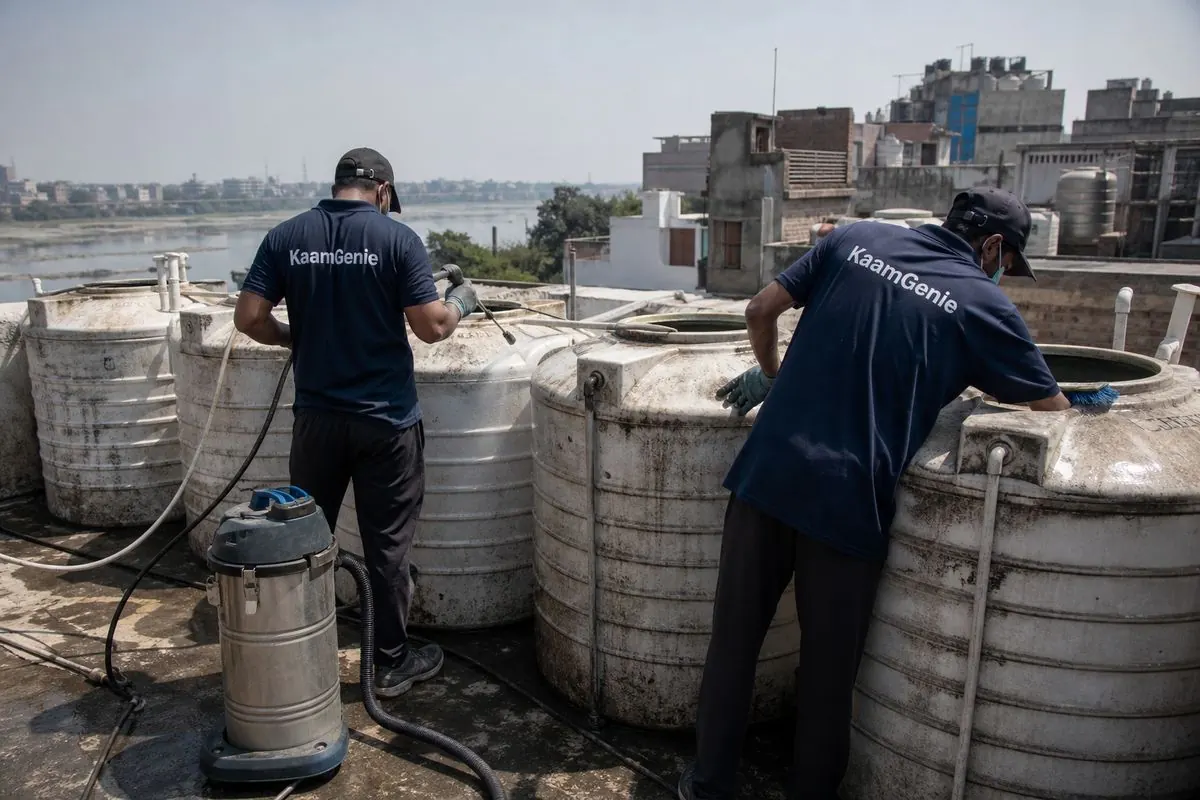
Ghonda's riverside humidity is what accelerates everything. The damp, low-lying air speeds algae and scale inside the tanks, the hard borewell share near the river adds a mineral crust, and the worn lids on the old roofs let dust and sediment drift in on top. When a shared tank feeds several floors and carries all three at once, the water clouds and takes on an off taste faster than in drier belts. Left uncleaned, the algae film and scale thicken into a layer that affects every floor the tank serves. In this humid riverside pocket a clean every three to four months does more than it would elsewhere.
These tanks get skipped because they are old, shared and out of sight, and the worn lids make the buildup feel like a losing battle. We make it one booking. The survey checks the ageing tanks and their lids, counts the storage and confirms access, and one visit clears the whole building while we advise on the lids so less gets in next time. Doing every tank together is bulk-quoted below the per-tank rate, and a yearly plan is well suited to the humid conditions here, keeping the algae and scale from ever building back to a thick layer.
No travel charge anywhere in Ghonda. The final price is confirmed on the call before we come — it depends only on tank size and access.
See it done in 45 seconds
Watch our web story on how a tank is really cleaned — drain, de-sludge, jet-wash, disinfect.
We reach every pocket of Ghonda — and there’s no travel charge to any of them:
Every locality in Delhi stores different water, and that decides how fast a tank fouls. This is Ghonda’s profile from The Delhi Water Index, built from our field observations across 250+ localities.
Indicative field characterisation, not a certified lab test. BIS IS 10500: TDS 500 mg/L acceptable, 2,000 permissible. Check any Delhi area →
“Do you clean old shared tanks with worn lids in Ghonda?” Yes. The ageing tanks here often have worn, ill-fitting lids that let dust in, and they are usually shared across floors. We clean the whole building's tanks in one visit and advise on the lids so less gets in afterwards.
“Our tank grows algae quickly. Why is that?” Ghonda's low-lying riverside humidity speeds algae and scale inside the tanks, and worn lids let more in. We clear the algae and scale during the clean, and regular visits in this humid belt keep them from building back up fast.
“What does a whole-building clean cost in Ghonda?” Each shared tank of 2,000 to 3,000 litres is ₹1,500 to ₹2,000. We quote the building's shared tanks together with a bulk discount, normally 15 to 20 percent off the per-tank rate for one visit.
“Will supply be cut during the clean?” No. We clean one tank at a time and keep the others in service, so the building keeps supply. We note your fill timing during the survey and confirm normal flow to each floor before we leave.
“Do you offer a yearly plan for Ghonda buildings?” Yes. Our annual care plan covers scheduled visits for all the building's shared tanks at 20 to 25 percent off the per-visit rate. Given the humid riverside conditions here, regular cleans keep algae and scale in check, with before-and-after photos each time.
See our complete water tank cleaning services in Delhi NCR — pricing, process, tank types and full city coverage.
Beyond water tank cleaning, KaamGenie is rolling out a full lineup of home services across Delhi NCR — see our complete list of 12 home services we offer or will be launching through 2026. New to tank cleaning? Read our guide on how to pick the right water tank cleaning service in Delhi — what to look for, what to avoid, and the questions that separate trustworthy crews from quick-job operators.
Rooftop plastic tanks
₹699+ →Kothi sumps & underground tanks
₹1,499+ →Apartments & RWAs
Bulk pricing →FSSAI-compliant cleaning
₹2,500+ →टंकी साफ़ करने वाले
हिन्दी पढ़ें →View all water tank cleaning guides →
All pockets and lanes of Ghonda covered. If your specific block or society isn’t named in the sub-areas above, just call — we almost certainly cover it.
Same crew, same 6-step process, same-day where possible. Pick any locality below for local pricing and the tanks we typically find there.
Book a slot — we can usually fit you in today or tomorrow.