 KaamGenie
Select location▾
KaamGenie
IS 10500:2012 is the Bureau of Indian Standards specification that defines what counts as acceptable drinking water in India. The official document is a dense technical PDF, so this page translates the numbers people actually encounter: what “acceptable” and “permissible” really mean, the limits for the parameters that matter in Delhi, and how to read your own lab report against them. Free to cite with attribution.
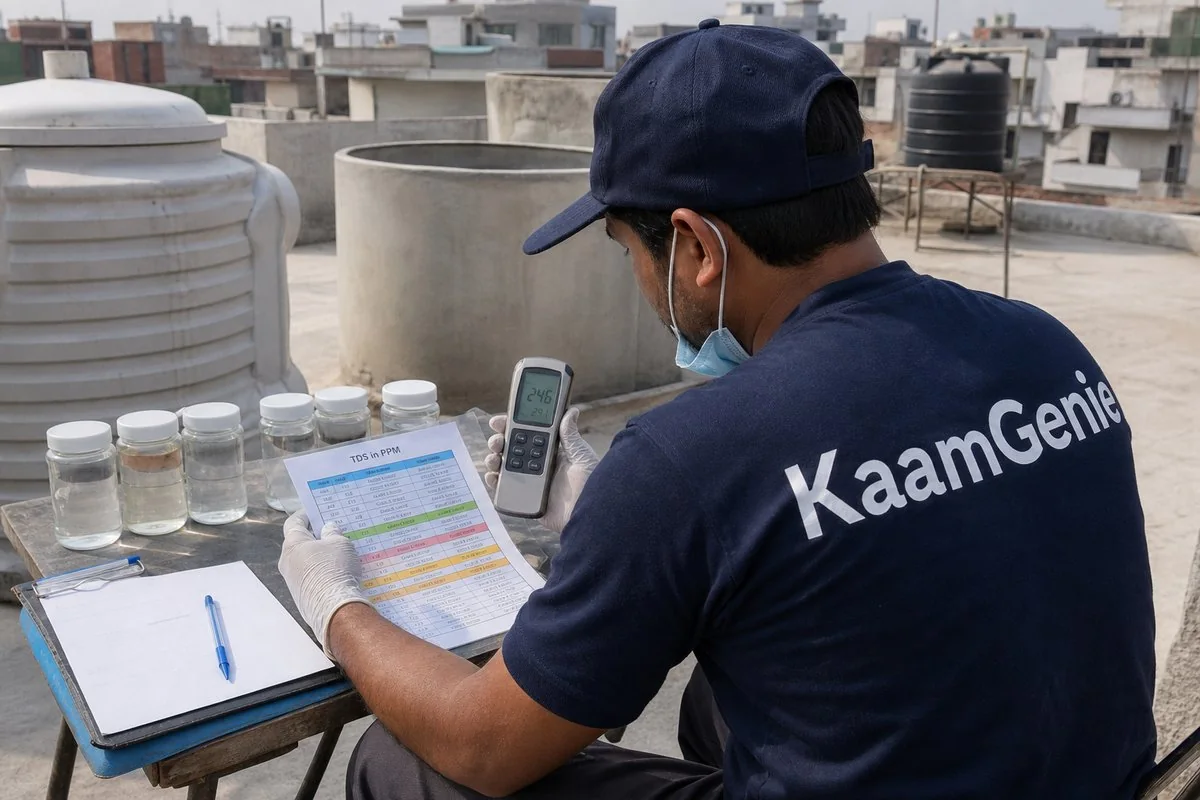
Every parameter in IS 10500 has an acceptable limit, the level below which water is considered fully satisfactory, and many also have a permissible limit, a relaxed ceiling that applies only when no alternative water source is available. The standard is explicit about that condition: permissible is a concession to scarcity, not a second grade of “fine”. When a parameter says “no relaxation”, the acceptable limit is the only limit, whatever the circumstances.
This two-column logic is why a borewell reading of 1,400 mg/L TDS can be simultaneously “within the standard” and a genuine quality problem: it clears the 2,000 permissible ceiling but sits nearly three times above the 500 acceptable line.
| Parameter | Acceptable | Permissible | Why it matters |
|---|---|---|---|
| Total dissolved solids (TDS) | 500 mg/L | 2,000 mg/L | The headline number on every TDS meter; taste turns brackish well before 2,000 |
| Total hardness (as CaCO₃) | 200 mg/L | 600 mg/L | Drives scale in tanks, geysers and pipes; the “hard water” number |
| Chloride | 250 mg/L | 1,000 mg/L | Salty taste; high in Delhi’s saline groundwater belts |
| Sulphate | 200 mg/L | 400 mg/L | Bitter taste at high levels, laxative effect for new residents |
| Calcium | 75 mg/L | 200 mg/L | Main hardness contributor along with magnesium |
| Magnesium | 30 mg/L | 100 mg/L | Second hardness contributor |
| Fluoride | 1.0 mg/L | 1.5 mg/L | Essential in traces, harmful above the limit; a known issue in some NCR groundwater |
| Nitrate | 45 mg/L | No relaxation | Sewage and fertiliser signature; serious for infants |
| Iron | 0.3 mg/L | No relaxation* | Orange staining in tanks and on fixtures; common in borewell belts |
| Turbidity | 1 NTU | 5 NTU | Cloudiness; rises after monsoon and in poorly maintained storage |
| pH | 6.5 to 8.5 | No relaxation | Outside this range water corrodes pipes or tastes off |
*Iron: the 2012 edition sets 0.3 mg/L with no relaxation; earlier editions permitted up to 1.0 mg/L, and some older reports still print the higher figure. Bacteriological requirements (E. coli and total coliforms must be absent in any 100 mL sample) have no numeric relaxation at all. Always defer to the current published standard for regulatory use.
Compare each result against the acceptable column first, not the permissible one. Anything between the two columns is a flag worth acting on: filtration for TDS and hardness, source investigation for nitrate or iron. And remember the standard describes water at the point of testing. Water that leaves a treatment plant compliant can still degrade inside a dirty storage tank, which is why stored-water hygiene is part of meeting the spirit of the standard, not separate from it. Our area lookup shows the indicative TDS band for any Delhi locality, and The Delhi Water Index tracks what we actually find in the city’s tanks.
Source: BIS IS 10500 Explained, KaamGenie, KaamGenie — https://kaamgenie.com/bis-10500-drinking-water-standardOverhead tanks from ₹699, underground sumps ₹1,499, same-day across Delhi if you call before 10 AM.
Call +91 95603 66362