
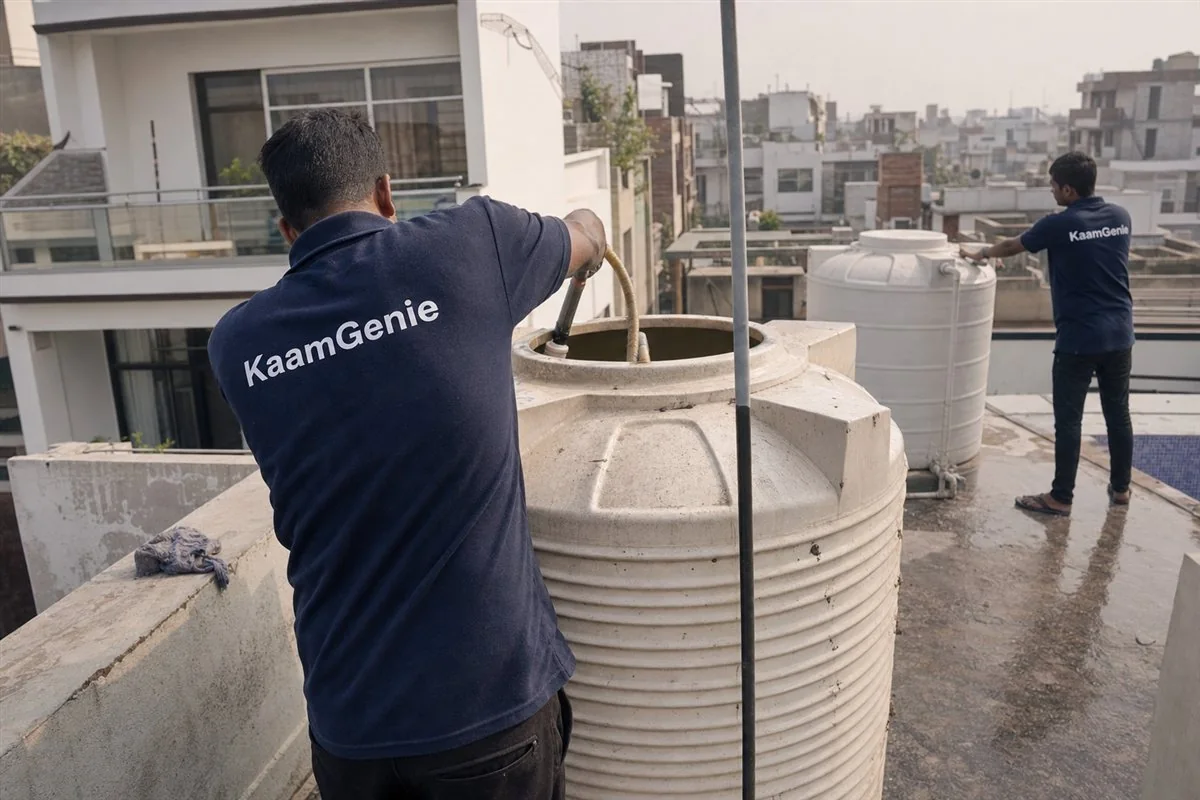
The short version
- Borewell water is raw, untreated groundwater — it carries iron, manganese, sand, silt and high hardness straight from the aquifer.
- These tanks sludge up 2-3x faster than tanks on treated municipal supply, so they need cleaning every 3-4 months, not every six.
- Iron stains the walls reddish-brown, sand and silt settle on the floor, and a rotten-egg smell means the sludge has gone bad.
- Hard-water scale needs descaling, not just scrubbing — a food-grade descaling treatment dissolves the mineral crust.
- Cleaning manages the symptom; source treatment (sediment filter, iron-removal, softener) slows how fast it comes back.
Gurgaon — Gurugram, the Millennium City — grew faster than its piped-water network ever could. The treated canal supply from the Basai and Chandu Budhera water works reaches the older, central colonies reasonably well, but huge swathes of the city run wholly or partly on groundwater. New Gurgaon, the Sohna Road and Southern Peripheral Road (SPR) belt, Dwarka Expressway towers, and dozens of peripheral sectors lean heavily on private borewells and on water tankers that are themselves filled from borewells. If that describes your home, the water sitting in your tank is fundamentally different from what a flat in an older sector receives.
We have cleaned thousands of tanks across the city through our water tank cleaning in Gurgaon service, and the difference between a treated-supply tank and a borewell-fed one is obvious the moment we open the lid. This guide is specifically about the groundwater problem: iron, sand, silt, hardness and smell — why they happen, and what a real cleaning does about them.
Why borewell-fed tanks in Gurgaon sludge up faster
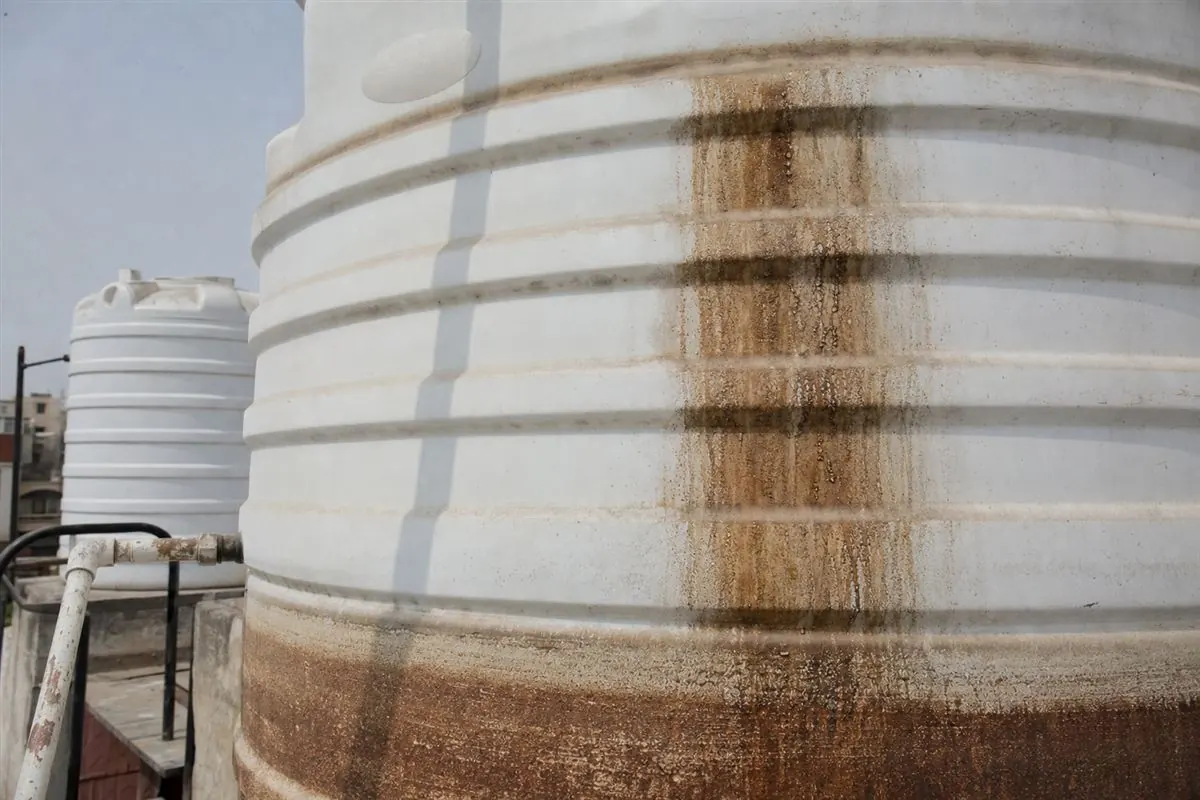
Municipal water is treated — screened, settled, filtered and chlorinated — before it ever reaches your inlet. Borewell water skips all of that. It is pumped straight from the aquifer into your underground reservoir or rooftop tank, carrying whatever the ground gives it. In Gurgaon’s geology, that typically means four things:
- Dissolved iron and manganese. Underground, iron is colourless and dissolved. The moment it meets air inside your tank, it oxidises into reddish-brown ferric oxide — rust, essentially — which coats the walls and settles as sludge. Manganese adds a blackish tinge.
- Sand and fine silt. Even a well-developed borewell throws fine sand and silt, especially during the summer when the water table drops and pumps draw harder. It settles as a gritty layer on the tank floor.
- Hardness (calcium and magnesium). Gurgaon groundwater is notoriously hard. Those dissolved minerals deposit as a chalky white-grey scale on walls, fittings and the float valve.
- Organics and bacteria. Sediment plus the warm, dark inside of a tank is an ideal home for bio-film and sulphur-reducing bacteria — the source of that rotten-egg smell.
Put together, a borewell tank can build the same volume of muck in three to four months that a treated-water tank takes a full year to accumulate. That is not an exaggeration; it is what we scoop out of these tanks week after week across New Gurgaon and the Sohna Road belt.
| What you find | Borewell / tanker-fed tank | Treated municipal-fed tank |
|---|---|---|
| Wall staining | Reddish-brown iron, blackish manganese | Mostly light bio-film |
| Floor sediment | Gritty sand & silt, often thick | Fine dust, thinner layer |
| Scale | Heavy chalky calcium / magnesium crust | Light to moderate |
| Smell | Rotten-egg (hydrogen sulphide) common | Rare unless badly neglected |
| Recommended cleaning | Every 3–4 months | Every 6 months |
| Job type needed | Clean + descaling | Standard clean |
Book a borewell tank clean + descale
Iron, sand, silt and scale removed properly — before/after photos, food-grade disinfection, fixed price. ₹699 onwards for residential tanks.
The four signatures of a borewell tank — and what to do about each
When we open a groundwater-fed tank, we are reading four separate problems. Each one needs a different part of the job.
1. Iron and manganese staining
This is the most visible problem: walls washed in reddish-brown, a rust-coloured film on the float valve, and rust-tinted water at the tap first thing in the morning after the tank has stood overnight. If your white clothes are picking up a yellow-orange cast in the wash, or your washbasins and WC have stubborn brown rings, iron is the culprit. Scrubbing and a food-grade descaling pass lift it off the surfaces, but because the iron is dissolved in the source water, it returns with every fill unless you add an iron-removal stage on the inlet.
2. Sand and silt on the floor
Run your hand along the bottom of a borewell tank and you will feel grit. That gritty layer is sand and fine silt that the pump pulls up from the aquifer. It is more than an eyesore: the sediment gets drawn into your pressure pump, clogs tap aerators, and wears the inlet valves of geysers, washing machines and RO units. Removing it is a drain-and-scoop job — you cannot rinse it away from the top, which is exactly the shortcut cheap operators take.
3. Hard-water scale
Gurgaon’s hardness leaves a chalky calcium and magnesium crust that no brush will shift on its own. This is where descaling comes in: a food-grade descaling treatment is applied to dissolve the mineral crust, after which it scrubs and rinses away cleanly. If your tank specifically suffers more from white scale than from iron, our dedicated guide on hard water tank cleaning in Gurgaon goes deeper into the descaling side.
4. The rotten-egg smell
That hydrogen-sulphide, rotten-egg odour comes from sulphur-reducing bacteria thriving in the sludge at the bottom of a long-neglected tank. It is the clearest sign that the sediment layer has gone anaerobic and needs a full strip-out, not a top-up rinse. A complete drain, sludge removal, scrub and food-grade disinfection clears it reliably. If you are seeing several of these signs together, our checklist on the signs your tank needs cleaning is a quick way to gauge how overdue you are.
How a proper borewell tank cleaning is done
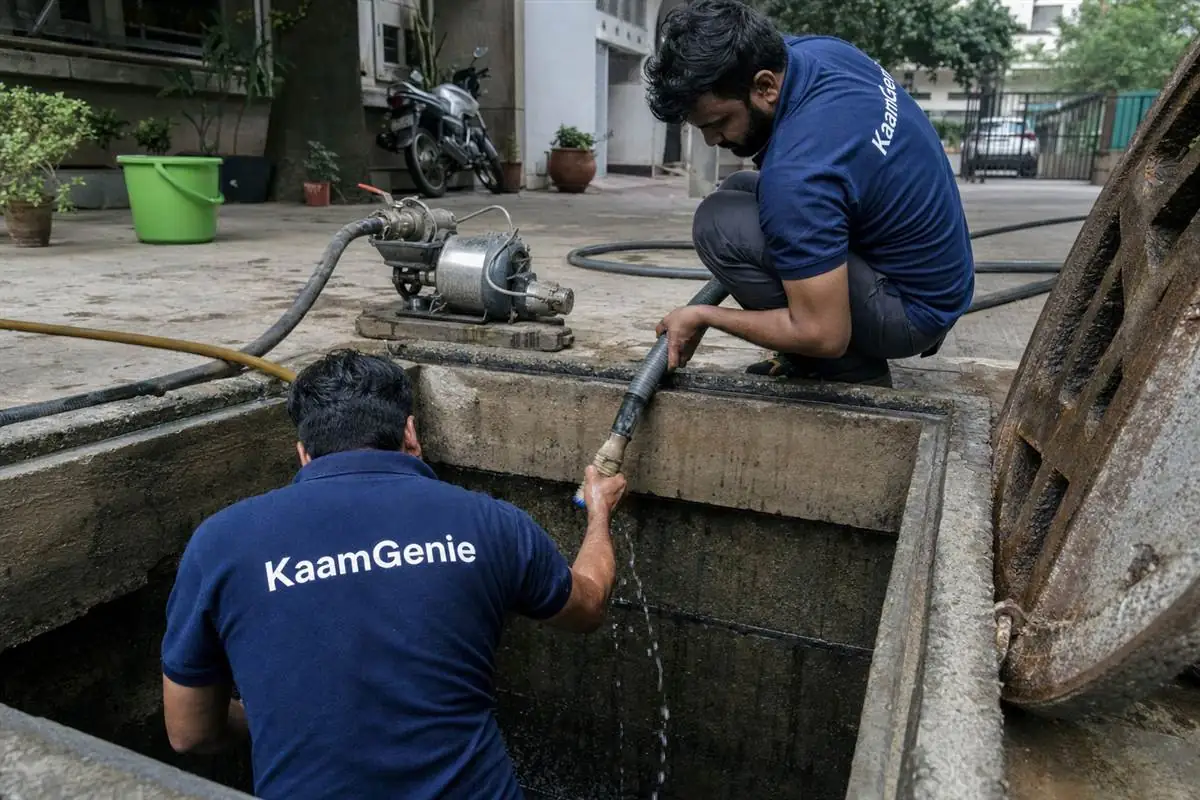
A borewell tank follows the same core sequence as any professional clean, with two important additions: heavier sludge removal and a dedicated descaling pass. Here is the order of work:
- Inspect and photograph. We open the lid, assess how heavy the iron, scale and sediment are, and take “before” photos. This decides whether the tank needs a standard clean or a clean-plus-descale.
- Drain fully. The tank is drained completely — you cannot reach the sediment with water sitting on top. Usable water is preserved in a drum for non-drinking use where possible.
- Scoop the sand and sludge. The gritty sand, silt and iron sludge is hand-scooped off the floor into sealed buckets and carried away, not flushed into your plumbing.
- Descale. A food-grade descaling treatment is applied to dissolve the hard-water crust on walls and fittings — the step that separates a borewell job from an ordinary one.
- Scrub. Every wall, the floor, corners and the area around inlet/outlet are scrubbed with food-grade nylon brushes — never metal, which scratches plastic and gives bacteria new places to hide.
- Jet wash. A high-pressure jet blasts loosened scale and iron film out of corners, behind fittings and out of the textured surface of RCC sumps.
- Vacuum and disinfect. The dirty rinse water is wet-vacuumed out, then food-grade sodium hypochlorite is applied at the correct concentration and given proper contact time before a final rinse.
- Refill, inspect, certify. The tank refills, we check the fittings, take “after” photos and hand you a cleaning record.
For the full step-by-step on the core method, our water tank cleaning process guide breaks down each stage. The borewell-specific difference is simply that steps 3 and 4 — sludge removal and descaling — carry far more weight here than on a treated-supply tank.
Where the time goes — borewell tank vs treated-supply tank (1,000L overhead)
Sludge removal and descaling are the steps that stretch on a groundwater-fed tank
A borewell clean-plus-descale runs roughly 105–120 minutes for a 1,000L tank — longer than the 75–90 minutes a treated-supply tank needs, almost entirely because of the extra sludge and descaling work.
Don’t forget the underground sump
Most Gurgaon homes and societies on borewell or tanker supply do not fill rooftop tanks directly. The water goes into a large underground reservoir (UGR) first, and a pump lifts it to the rooftop tower tanks. The sump is the bottom of the system, which means it is where the heaviest sand and silt settle out. If you clean the overhead tanks but leave the sump, you are pumping dirty water back up within days.
A borewell-fed sump should be cleaned at least as often as the rooftop tanks — we treat it as a confined-space job with proper safety gear and pump-out equipment. If your home runs a UGR, our dedicated guide on underground sump cleaning in Gurgaon covers the safety and scheduling side in detail.
How often, and where this matters most in Gurgaon
The headline number: clean a borewell or tanker-fed tank every 3 to 4 months, against the every-six-months rule for treated supply. The reason is simply the rate of build-up — sediment and iron return far faster from raw groundwater. For a fuller breakdown by household type and supply, see our guide on how often to clean your water tank in Gurgaon.
The areas where this matters most are the ones built out fastest and furthest from the treated network: New Gurgaon and the new sectors of the 80s and 90s, the Sohna Road and SPR corridor, and the peripheral builder-floor pockets. Independent builder floors and older bungalows on private borewells are the heaviest cases we see; condominium AOAs running borewell-backed UGRs are close behind. Wherever you are — from Sector 65 to the SPR towers — the principle is the same: groundwater means more frequent, more thorough cleaning.
Cleaning manages the symptom — source treatment slows the cause
We will always give you the honest version: cleaning resets your tank to a clean baseline, but it does not change what is coming out of the ground. If your borewell water carries iron, sand and hardness, the deposits will gradually return. To slow that down, the real fix sits upstream of the tank — a sediment pre-filter on the inlet to catch sand, an iron-removal unit for the staining, or a softener for the scale. We will tell you what your particular tank actually needs rather than pushing equipment you do not. And for drinking, always run borewell water through your RO/UV purifier regardless of how clean the tank is.
For one-off jobs, recurring schedules, or society contracts across the city, you can see the full scope and pricing on our NCR water tank cleaning services page. If you want the city-wide overview first, the complete Gurgaon water tank cleaning guide ties all of this together.
Book a borewell tank clean across Gurgaon
Whether you are on a private borewell, on tanker supply, or on a borewell-backed underground reservoir, the same trained crew and fixed pricing apply right across the city through our water tank cleaning in Gurgaon hub. We will assess the iron, sand and scale on arrival, tell you honestly whether you need a standard clean or a clean-plus-descale, and document the whole job with before/after photos and a cleaning record.
To book, call +91 95603 66362 or use the booking form on this site — we’ll confirm shortly.
Tank smelling of rotten eggs or staining your basins?
That is your groundwater talking. Book a full borewell clean + descale — standard residential ₹699 onwards, sump and society jobs quoted on site.
Frequently asked questions
Why do borewell-fed tanks in Gurgaon get dirty faster than municipal-fed ones?
Borewell water carries dissolved iron and manganese, suspended sand and fine silt, and high mineral hardness straight from the aquifer. Municipal canal water is treated and filtered before it reaches you; raw groundwater is not. So every fill deposits a fresh layer of sediment and the iron oxidises into reddish-brown sludge on the floor and walls. A borewell tank can build the same muck in 3-4 months that a treated-water tank takes a year to accumulate.
What are the brown and orange stains inside my borewell tank?
That is iron. Gurgaon groundwater often carries dissolved ferrous iron that is colourless underground but oxidises to reddish-brown ferric oxide once exposed to air inside the tank. It coats the walls, settles as rust-coloured sludge on the floor, and stains your taps, washbasins and white clothes. Manganese adds a blackish tint. It is harmless to scrub off but comes back with every refill unless you treat the source.
Why does my tank water smell like rotten eggs?
That rotten-egg smell is hydrogen sulphide gas, usually produced by sulphur-reducing bacteria living in the sediment and bio-film at the bottom of a borewell-fed tank. The smell almost always means the tank has not been cleaned in a long time and the sludge layer has gone anaerobic. A full drain, sludge removal, scrub and food-grade disinfection clears it; a surface rinse does not.
How often should a borewell or groundwater-fed tank be cleaned in Gurgaon?
We recommend every 3 to 4 months for tanks on raw borewell or tanker-supplied groundwater, versus the standard every 6 months for treated supply. New Gurgaon, Sohna Road and the peripheral sectors that rely heavily on borewells and tankers fall in the more-frequent bracket. If you can already see sand at the bottom or staining on the walls, you are overdue.
Can you remove the hard-water scale, not just the dirt?
Yes. Hard borewell water leaves a chalky white-to-grey calcium and magnesium scale that ordinary scrubbing will not shift. We use a food-grade descaling treatment that dissolves the mineral crust, then scrub, jet wash and rinse it away. This is separate from the disinfection step and is the reason a borewell tank needs a slightly longer, more thorough job than a treated-water tank.
Will cleaning the tank stop the iron and sand coming back?
Cleaning resets the tank to a clean baseline, but if your source water still carries iron, sand and hardness, the deposits will gradually return. The honest answer is that cleaning manages the symptom. To reduce the rate of build-up you also need source treatment — a sediment pre-filter on the inlet, an iron-removal unit, or a softener. We will tell you what your tank actually needs rather than overselling equipment.
Does sand and silt damage my pump and plumbing?
Over time, yes. The fine sand and silt that settles in a borewell tank gets drawn into your pressure pump, taps and the inlet valves of geysers, washing machines and RO units, wearing seals and clogging aerators. Clearing the sediment from the tank floor regularly protects everything downstream, which is one reason borewell tanks reward a tighter cleaning schedule.
Do you clean underground sumps fed by borewell as well as rooftop tanks?
Yes. Most Gurgaon homes and societies on borewell or tanker supply fill a large underground reservoir (UGR) first, then pump up to rooftop tower tanks. The sump is where the heaviest sand and silt settle, so it needs cleaning at least as often as the overhead tanks. We clean both as confined-space jobs with proper safety gear and pump-out equipment.
Is borewell water safe to drink after the tank is cleaned?
Cleaning and disinfecting the tank removes sludge, bacteria and bio-film, which makes the stored water far safer. But cleaning does not change the dissolved chemistry of the source — iron, hardness or other parameters may still exceed the BIS IS 10500 limits for the water coming out of the ground. For drinking, always run borewell water through your RO/UV purifier. We are happy to advise but we do not test or certify drinking-water chemistry.
Sources & references
- Bureau of Indian Standards (BIS) — IS 10500:2012 is the canonical Indian Standard for drinking water specification, defining acceptable limits for iron, hardness, total dissolved solids and other parameters relevant to groundwater.
- WHO Guidelines for Drinking-water Quality, 4th edition — the global reference for water quality standards, including guidance on storage, sediment and disinfection.
- Food Safety and Standards Authority of India (FSSAI) — defines water quality requirements for food businesses, including hygiene standards for stored water and acceptable disinfection chemicals.
- WHO Fact Sheet on Drinking Water — overview of safe drinking water requirements and contamination risks.
- CPHEEO — Manual on Water Supply and Treatment — the Government of India’s engineering manual covering tank design, iron and turbidity removal, cleaning protocols and disinfection practices.
Last verified: 30 June 2026. If you find any of these links broken, please let us know.