
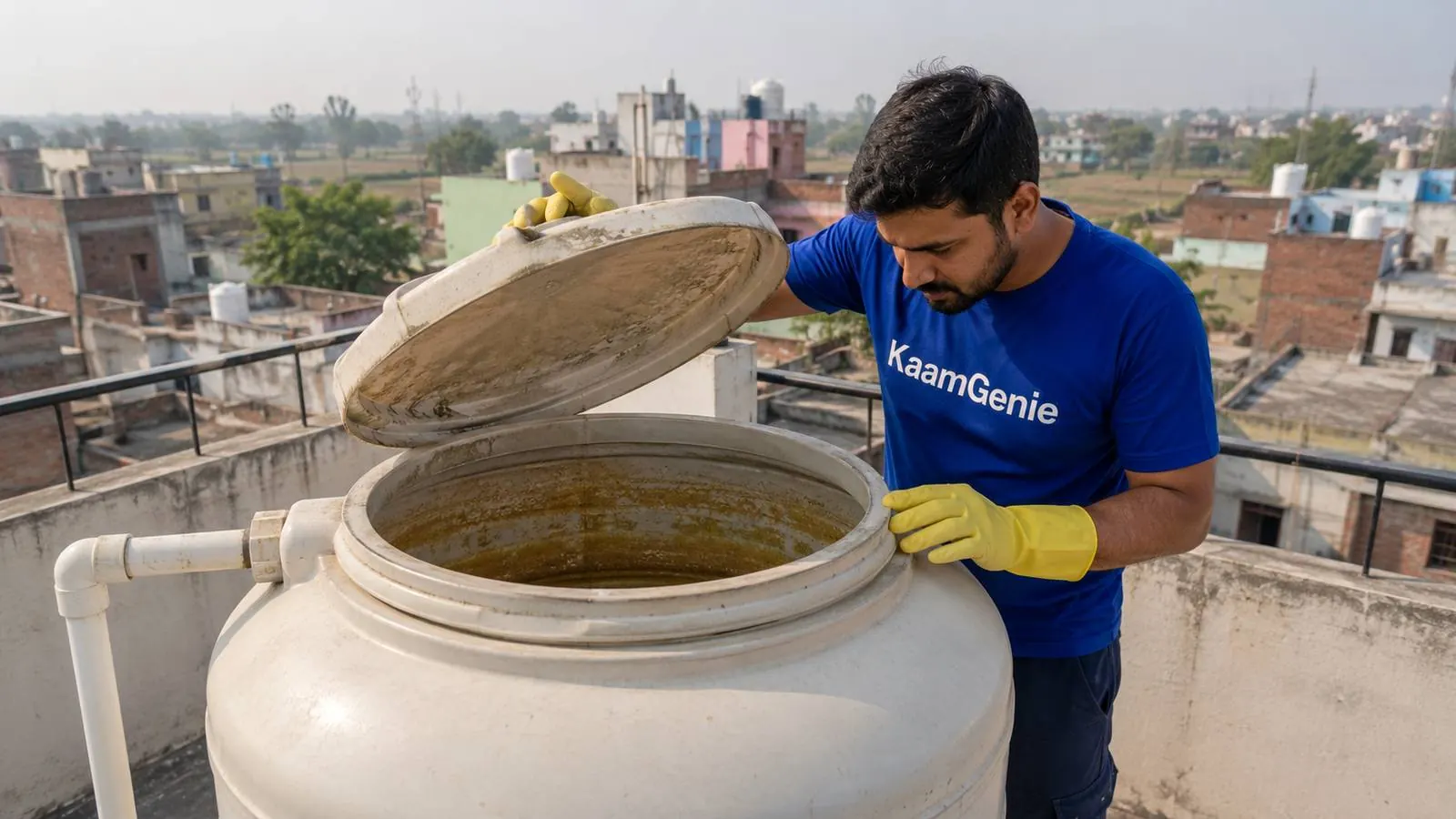
Quick answer for outer Delhi households
- Why it’s different: borewell water has 2-3× more dissolved minerals than DJB water — visible scale, faster sediment buildup, and a unique cleaning challenge.
- Recommended frequency: every 2 months (6 visits/year), not the standard quarterly.
- Cleaning approach: standard 8-step process + food-safe descaling step before disinfection.
- Areas served: Narela, Bawana, Kanjhawla, Bakkarwala, Mundka, Najafgarh, Bakkarwala, Pooth Kalan, Tikri.
- Typical TDS: 600-1,400 mg/L depending on pocket — well above the BIS 500 mg/L acceptable limit.
- Annual contract pricing: ₹7,200-9,600/year for a single-family home (6 visits, 20% off ad-hoc).
Why borewell-fed homes need a different approach
Most water tank cleaning advice you’ll find online is written for households on municipal piped water. That advice is reasonable for South Delhi, Central Delhi, and most of East and West where the Delhi Jal Board (DJB) supply dominates. It does not work as well for outer Delhi.
The reason is the water itself. DJB water in central Delhi typically arrives at your tank with 200-400 mg/L total dissolved solids (TDS) — mostly soft to moderately hard. Borewell water in the outer pockets — Narela, Bawana, Najafgarh, Kanjhawla — arrives with 600-1,400 mg/L TDS, sometimes higher. That’s 2-4× the mineral load.
Inside the tank, this difference is the difference between a tank that looks clean for 4-6 months and one that shows visible scale, yellowed walls, and sediment buildup in 6-8 weeks. The cleaning approach has to account for that, and the schedule has to be tighter.
Outer Delhi borewell water by area — what we actually measure
Over the last 18 months, we’ve cleaned tanks across most outer Delhi pockets and informally tracked the TDS readings we encounter. Below is the rough picture — not lab-grade data, but indicative of what your tank is dealing with. The Central Ground Water Board (CGWB) publishes official groundwater quality reports that broadly confirm these patterns.
| Area | Typical TDS range | Hardness level | Recommended frequency |
|---|---|---|---|
| Narela | 800-1,200 mg/L | Very hard | Every 2 months |
| Bawana | 800-1,300 mg/L | Very hard | Every 2 months |
| Kanjhawla | 900-1,400 mg/L | Very hard | Monthly to bi-monthly |
| Bakkarwala | 700-1,100 mg/L | Hard | Every 2 months |
| Najafgarh | 700-1,100 mg/L | Hard | Every 2 months |
| Mundka | 600-900 mg/L | Moderately hard | Every 2-3 months |
| Pooth Kalan | 700-1,000 mg/L | Hard | Every 2 months |
| Tikri | 600-900 mg/L | Moderately hard | Every 2-3 months |
| Badli | 500-800 mg/L | Moderately hard | Every 3 months |
| Alipur | 600-900 mg/L | Moderately hard | Every 2-3 months |
For comparison: BIS IS 10500:2012 considers TDS up to 500 mg/L acceptable for drinking water, up to 2,000 mg/L permissible in absence of alternative source. So most outer Delhi borewell water is above the "acceptable" threshold — not unsafe, but harder than what DJB-fed homes deal with, and requiring more tank-side attention.
TDS by area — visual comparison
Outer Delhi borewell water TDS — rough by area
Mid-range of observed values; BIS "acceptable" = 500 mg/L, "permissible" = 2,000 mg/L
Field observations indicative, not lab-grade. Values vary even within the same colony depending on borewell depth and aquifer used.
The visual is the point: outer Delhi homes are operating roughly 2-4× above the central-Delhi water hardness baseline. Cleaning frequency and approach need to match.
What hard borewell water does inside a tank
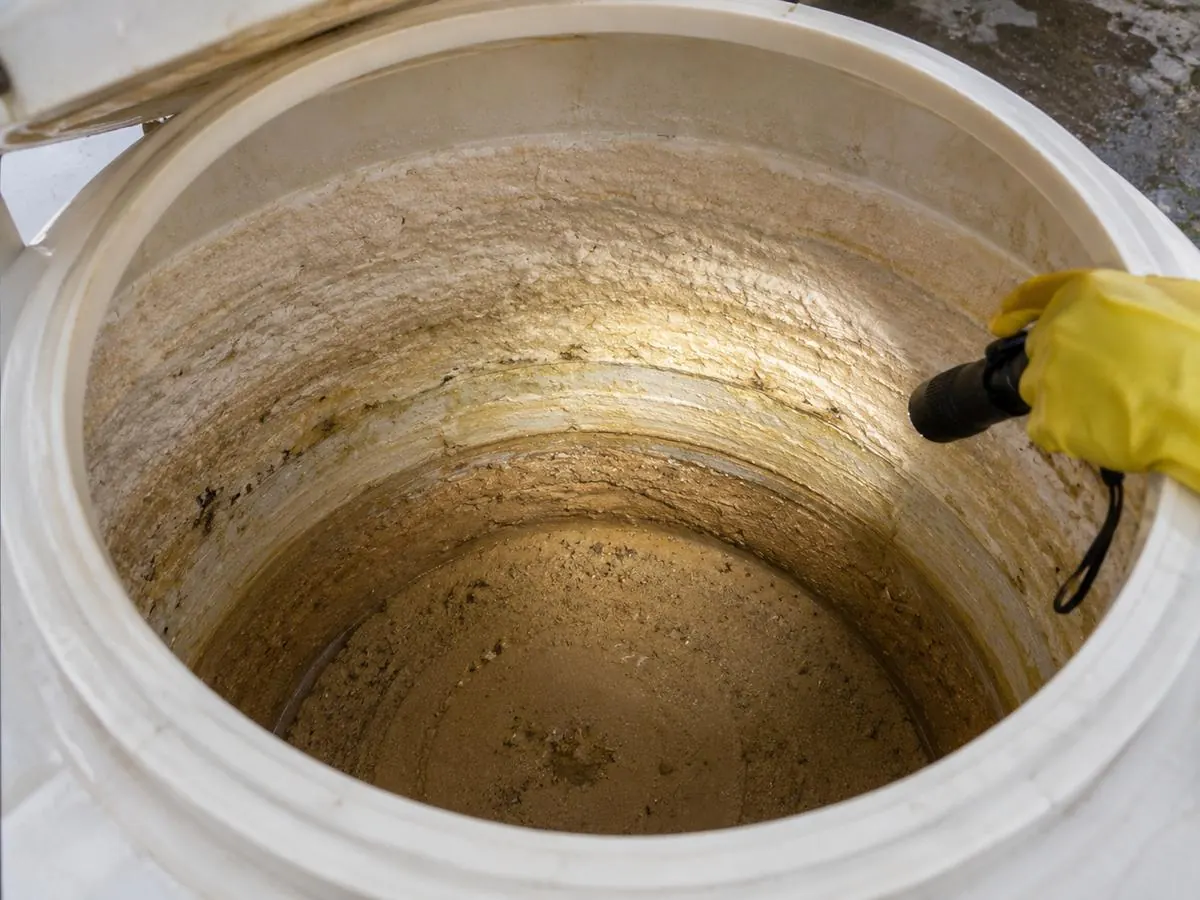
If you’ve never looked inside your tank, here’s what you’d see in a Narela or Bawana home that hasn’t been cleaned in 6+ months:
- White or yellowish crust on the tank walls at the typical water-line height — that’s calcium and magnesium carbonate scale.
- Hard sediment at the bottom — fine mineral particles that have settled out and compacted, sometimes 2-3 cm thick.
- Discoloured patches on plastic tank walls — iron and manganese staining if borewell water has those minerals.
- Reduced effective capacity — the scale and sediment together can reduce a 1,000L tank’s usable capacity by 5-10%.
- Tank lid corrosion — on metal-lid plastic tanks, the lid often shows rust around the seal where hard water has dried repeatedly.
None of this is your fault — it’s what hard water naturally does over months. But it does mean a routine "rinse and chlorinate" cleaning isn’t enough. You need scale removal as part of the cycle.
Borewell-specific cleaning — outer Delhi rates
Scale removal + standard 8-step clean. Single visit from ₹999. Annual contract (6 visits) from ₹7,200.
The 9-step borewell cleaning process (vs the 8-step standard)
A standard tank cleaning has 8 steps — inspection, drain, sludge, scrub, jet, disinfect, refill, certify. For borewell-fed tanks with visible scale, we add a 9th step (descaling) between scrubbing and jet wash. Here’s the full sequence:
| Step | Standard 8-step | Borewell 9-step |
|---|---|---|
| 1. Inspection | Walls + base photos | Same, plus scale-thickness assessment |
| 2. Drain | Full drain, vacuum residual | Same |
| 3. Sludge removal | Manual scoop + vacuum | Same, expect more mineral sediment |
| 4. Initial scrub | Food-grade brushes, all surfaces | Same |
| 5. Descaling step | (not in standard) | Food-safe dilute citric or phosphoric acid applied to scaled areas, 15-20 min contact |
| 6. Jet wash rinse | 80-120 bar high-pressure | Same — especially focused on descaled areas to remove dissolved mineral residue |
| 7. Disinfection | Food-grade sodium hypochlorite, 20 min contact | Same |
| 8. Final rinse + refill | Remove residue, refill | Same |
| 9. Certificate + photos | Signed certificate, before/after | Same, plus a note on scale thickness for next-visit comparison |
The descaling step adds 30-45 minutes to the total job and is the reason borewell cleanings are priced 15-25% above standard cleanings. Without it, you’d be cleaning the bio-film and bacterial colonies but leaving the mineral scale intact — which means the scale keeps growing visit on visit, and eventually requires far more aggressive removal.
What you’ll notice if your borewell tank hasn’t been cleaned
- White spots on dried utensils after washing in tank water
- Scale buildup on tap aerators and shower heads — needs unscrewing and descaling every 2-3 months
- Yellowish bathroom tile lines where water repeatedly dries
- Reduced water pressure from kitchen and bathroom taps over time
- Soap doesn’t lather well — one of the classic hard-water signs
- Skin and hair feeling dry after bathing
- Sometimes a faint metallic or earthy taste in the water if you drink directly from the tap
None of these are emergencies on their own, but together they tell you the tank hasn’t been properly cleaned in months. The fix is the descaling-included cleaning we described above.
Common borewell tank cleaning mistakes (we’ve seen them all)
- Treating it like a DJB tank. Skipping the descaling step means the white crust stays. Six months later it’s thicker.
- Using harsh acid without protection. Some local cleaners use undiluted muriatic acid — effective but unsafe for both crew and drinking water. Food-safe dilute citric or phosphoric acid is the correct chemistry.
- Cleaning only twice a year. By month 4, the scale is back. By month 6, you’re looking at a tank that needs an extended cleaning, not a standard one.
- Skipping the post-descaling rinse. Mineral residue from the descaling step has to be fully flushed before the disinfection step. Skipping the rinse leaves a chemical taste.
- Not testing TDS at the borewell vs the tank. A clean tank should not increase TDS. If your tank TDS reads much higher than your borewell TDS, the tank has scale shedding into the water.
Does a softener change the cleaning math?
A water softener installed at the home’s inlet (before the tank or after, depending on setup) does reduce the scale formation rate inside the tank, but it doesn’t eliminate the need for cleaning. Here’s what softener-equipped borewell homes can expect:
- Scale buildup slows by about 50-70% — meaning cleanings can stretch from every 2 months to every 3 months
- Bio-film and bacterial colonies still build up — softener doesn’t kill bacteria, only removes mineral hardness
- Softener regeneration cycles sometimes flush brine into the tank, which actually needs more attention to disinfection
- Sediment build-up is still present — sand particles and fine debris from groundwater still settle
The honest summary: softener helps but doesn’t replace cleaning. A softener-equipped Narela home should still clean quarterly; without a softener, bi-monthly is the right cadence.
Annual contract for borewell homes — outer Delhi
6 scheduled visits/year, descaling included, same crew every time, off-season pricing baked in. From ₹7,200/year for single-family homes.
Pricing for borewell tank cleaning in outer Delhi (2026)
Borewell-specific pricing reflects the additional descaling step and the typically longer cleaning time. Here’s our published pricing for outer Delhi pockets:
| Job type | Single visit | Annual contract (6 visits) |
|---|---|---|
| Residential overhead tank (up to 1,000L) | ₹999 | ₹7,200 |
| Larger residential (1,000-2,000L) | ₹1,499 | ₹9,600 |
| Underground sump (kothi) | ₹1,899-2,899 | ₹13,500-19,800 |
| Society shared tank (per visit) | ₹1,800-2,400 | ₹12,000-16,000 |
| Heavily scaled tank (12+ months neglected) | +30% surcharge | Reduces to standard after first visit |
For tanks that haven’t been cleaned in over a year, the first visit takes longer and uses more chemical — hence the surcharge. Once the baseline is reset, the regular bi-monthly cadence keeps each visit at standard pricing.
What we’ve learned from cleaning outer Delhi (the honest take)
Three observations from regular work across Narela, Bawana, Kanjhawla, Mundka, and Najafgarh:
- Most homes have never had a proper descaling. Even households that book cleanings yearly are getting standard cleanings — the scale isn’t being addressed. The first borewell-specific cleaning is often visibly transformative because nobody’s done it before.
- Annual contracts make outsized economic sense. Because the bi-monthly frequency adds up — 6 ad-hoc visits at ₹1,499 = ₹8,994 vs ₹7,200 annual = ₹1,800 saved. That’s 20% off plus the convenience of scheduled visits.
- RO/UV purifiers are not a substitute for tank cleaning. Many outer Delhi homes invest in expensive purifiers and skip tank maintenance because they figure "the water gets purified anyway". The purifier handles the kitchen tap. Your bathing water, washing water, utensil washing water, and tank-side bacterial issues are unaddressed.
If you’re in one of the outer Delhi pockets we serve and want a borewell-specific cleaning — or want a fixed-price annual contract — call +91 95603 66362 or use the booking form. We’ll quote on the call with full transparency about which step is included and how the descaling chemistry works.
Frequently asked questions
How is borewell water tank cleaning different from DJB water tank cleaning?
Borewell water carries higher mineral load — typically 600-1,400 mg/L TDS vs 200-400 mg/L for DJB. The cleaning needs more aggressive scale removal (acid-based descaling step in addition to standard food-grade disinfection), takes longer, and should be more frequent. Frequency rises from quarterly to bi-monthly.
How often should outer Delhi households clean their borewell-fed tanks?
Bi-monthly — every 2 months — is the recommended cadence for borewell-fed tanks in outer Delhi pockets like Narela, Bawana, Najafgarh, Kanjhawla, and Mundka. Some homes in particularly hard-water pockets clean monthly. Twice a year is the absolute minimum and not really sufficient for borewell.
What’s the TDS level of borewell water in outer Delhi?
It varies significantly by location. Narela and Bawana typically see 800-1,200 mg/L TDS, Najafgarh 700-1,100 mg/L, Kanjhawla 900-1,300 mg/L, Mundka 600-900 mg/L. BIS IS 10500 considers up to 500 mg/L as the acceptable limit and up to 2,000 mg/L as the maximum permissible — so most outer Delhi borewell water is above the acceptable threshold for drinking without further treatment.
What does borewell water do inside a water tank that DJB water doesn’t?
Three things: it deposits visible mineral scale on the tank walls (white/yellow crust), it leaves a heavier sediment layer at the tank base (settled mineral particles), and it shortens the time between cleanings being noticeable. DJB-fed tanks can go 6 months looking visually clean; borewell-fed tanks show buildup in 2-3 months.
Is borewell water safe for drinking after the tank is cleaned?
Cleaning the tank doesn’t change the water quality from the borewell — it only removes contamination that built up inside the tank. For drinking, you’ll still need a RO/UV purifier if TDS is above 500 mg/L. A clean tank ensures the water that reaches your purifier is at its starting quality, not degraded by tank conditions.
Why is borewell tank cleaning more expensive than DJB tank cleaning?
Borewell cleaning typically costs 15-25% more per visit because: scale removal takes longer than standard cleaning (additional 30-45 minutes), it sometimes requires food-safe descaling chemicals in addition to standard disinfectant, equipment wears faster on hard scale, and the cleaning needs to be more thorough to be useful.
Which outer Delhi areas have the hardest borewell water?
Generally, the pockets furthest from DJB supply lines and reliant entirely on groundwater show the highest mineral load. Kanjhawla, Bakkarwala, Bawana industrial pockets, and parts of Najafgarh extension consistently show TDS above 1,000 mg/L. Mundka and Tikri are somewhat better at 600-900 mg/L typically.
Should I install a water softener for my borewell-fed tank?
If you’re regularly seeing scale on bathroom fittings, white spots on dried utensils, and your tank shows visible buildup within 2 months — yes, a water softener at the inlet point is worth considering. But the softener is for taste/usage, not drinking — you still want the tank cleaned regularly because the softener doesn’t remove biological contamination.
Can RO/UV purifiers replace tank cleaning for borewell water?
No. RO/UV purifiers treat water at the point of use — the kitchen tap. They don’t address the tank water that gets used for bathing, washing utensils, washing clothes, and food prep at sinks. A purifier and a clean tank do different jobs; you need both.
What chemicals are used for borewell tank cleaning specifically?
Standard cleaning uses food-grade sodium hypochlorite 5-6% for disinfection. Borewell-specific cleaning adds a food-safe descaling step — usually a dilute citric acid or food-grade phosphoric acid application to dissolve mineral scale, followed by thorough rinse before the disinfectant step. Both chemicals must have MSDS available.
How long does borewell tank cleaning take vs DJB tank cleaning?
Standard DJB tank: 90 minutes for a 1,000L overhead tank. Borewell-fed tank with visible scale: 120-150 minutes for the same size, because the descaling step adds 30-45 minutes. Heavily scaled tanks (haven’t been cleaned in 1+ year) can take 3 hours and may need a follow-up visit.
Is there an annual contract for borewell tank cleaning in outer Delhi?
Yes — we offer 6-visit annual contracts for borewell-fed homes in Narela, Bawana, Kanjhawla, Mundka, and Najafgarh. Visits roughly every 2 months. Annual price typically ₹7,200-9,600 for a single-family home, which is 20% less than 6 ad-hoc bookings.
Sources & references
- Central Ground Water Board (CGWB) — official groundwater quality reports for Delhi NCR; the source of regional TDS, hardness, and aquifer data.
- Bureau of Indian Standards (BIS) — IS 10500:2012 drinking water quality specification including TDS limits (acceptable 500 mg/L, permissible 2,000 mg/L).
- Delhi Jal Board (DJB) — municipal water supply authority; useful for comparing DJB-fed vs borewell-fed water quality across zones.
- Food Safety and Standards Authority of India (FSSAI) — documented water hygiene requirements that apply equally to borewell-fed and DJB-fed food businesses.
- WHO Drinking Water Fact Sheet — global framework on safe drinking water that informs Indian standards.
Last verified: 1 June 2026. If you find any of these links broken, please let us know.