
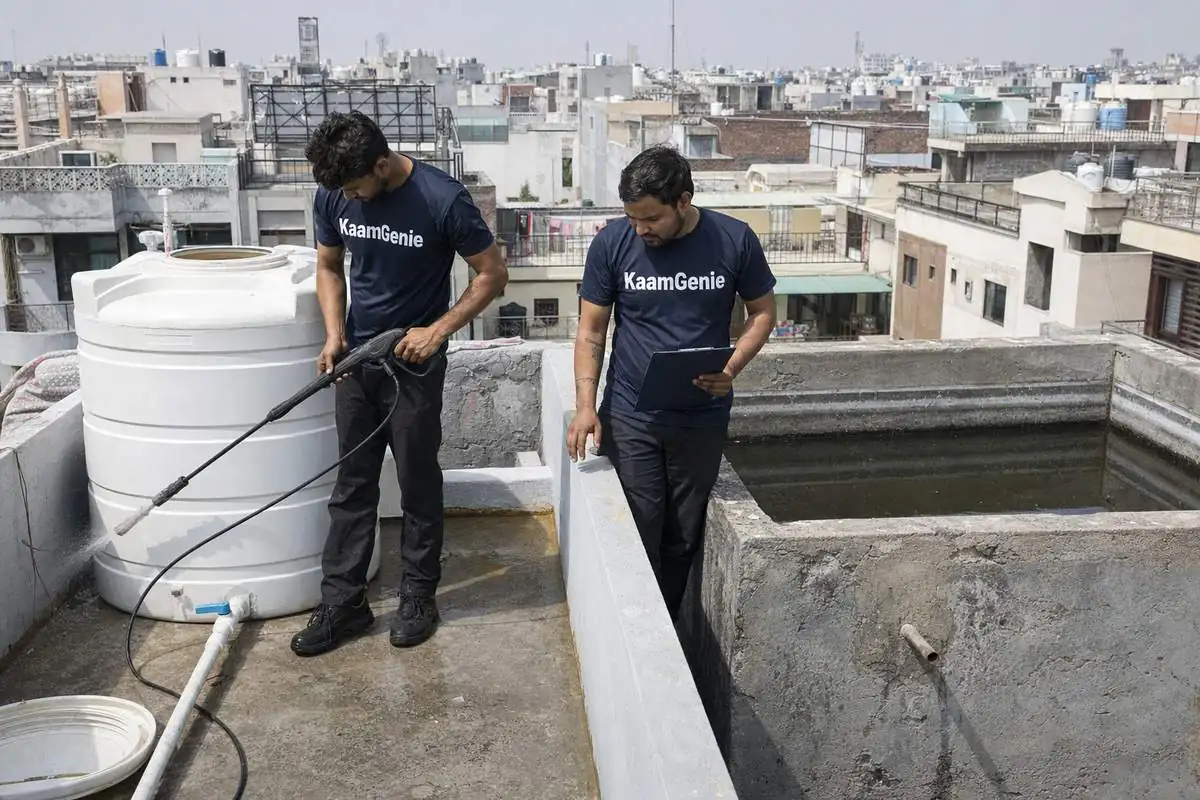
Quick answer — plastic vs concrete tanks in Delhi (2026)
- Plastic tank lifespan: 15-20 years (UV + summer heat degrades it over time).
- Concrete (RCC) tank lifespan: 30-50 years (much longer, but porous walls hold biofilm).
- Which needs cleaning more often: Concrete — porous surfaces hold bacteria and sediment that plastic does not.
- Which is cheaper to clean: Plastic — smooth surface scrubs out fast (15-25% lower price).
- Plastic price (500L): ₹399. Concrete equivalent (500L): ₹499.
- Plastic price (1000L): ₹499. Concrete (1000L): ₹599.
- Plastic price (2000L): ₹699. Concrete (2000L): ₹899.
- Plastic price (5000L): ₹1,199. Concrete (5000L): ₹1,499.
- We clean both — same-day across Delhi.
The two tank materials in Delhi homes — quick anatomy
Drive through any Delhi neighbourhood and look up at the rooftops. You’ll see two shapes repeating: the smooth molded curve of a plastic overhead tank (usually white, black, or dark blue, sitting on a small steel stand), and the square or rectangular silhouette of a concrete RCC tank (built into the parapet wall or sitting on a thick concrete platform). Underground you’ll find the same two materials — plastic sumps buried below the lawn or driveway, or concrete RCC sumps cast into the foundation when the house was first built.
Plastic tanks are made by rotational moulding of high-density polyethylene (HDPE), specified under BIS IS 12701. They are factory-produced in fixed sizes (500L, 1000L, 1500L, 2000L, 5000L are the common Delhi sizes), come with a fitted lid, and weigh light enough that two people can lift a 1000L empty tank onto a roof. You see plastic tanks on virtually every DDA building, every newer flat block, every recent kothi rebuild in South Delhi and West Delhi. They are the default material for anything built in the last 20-25 years.
Concrete (RCC) tanks are cast in place during construction — the contractor builds shuttering, lays reinforcing steel, pours concrete, and waterproofs the interior with a cement-based coating. They cannot be lifted, moved, or replaced without breaking them out. You see RCC tanks in old Civil Lines bungalows, Lajpat Nagar Block A-E houses, Defence Colony pre-1995 stock, Karol Bagh independent houses, the older parts of Punjabi Bagh, and any house built before the plastic-tank market matured in the late 1990s. Many new highrises in Delhi also use RCC for the large underground reservoir (because plastic doesn’t scale economically above 10,000L) and plastic for the rooftop overhead tank — a hybrid setup.
So when we say “Delhi homes have one of two materials,” the reality is that many homes actually have both — plastic overhead, concrete underground — and each needs a different cleaning approach. The rest of this guide explains exactly what changes between the two.
Plastic tanks — pros, cons, lifespan, the Delhi summer problem
Plastic (HDPE) tanks dominate the Delhi market for clear reasons. They’re cheap (a 1000L sells for ₹7,000-9,000 retail), light, factory-tested for water contact, and come with a smooth interior that doesn’t support biofilm growth as easily as concrete. For a single-family overhead tank under 5000L, plastic is almost always the right pick today.
Pros. Smooth non-porous interior — bacteria and algae have nothing to grip. Easy to inspect (just lift the lid). Easy to clean (one crew member can scrub the whole interior in 30-40 minutes). Factory-fitted lid seals out dust, lizards, birds, and the all-too-common Delhi sparrow nest. BIS-certified plastic grades for water contact mean no chemical leaching into the water under normal conditions. Replaceable in a day if damaged — lift the old one off the stand, drop a new one in, reconnect the inlet and outlet pipes, done.
Cons. The Delhi summer is brutal on plastic. Rooftop surface temperatures hit 60-65°C in May and June, and even though tanks are usually painted white or sit under a small awning, the polymer is being heat-stressed for 4-5 months every year. Over 15-20 years this leads to UV degradation (the outer surface gets chalky and brittle), microcrack formation on the sun-facing side, and in poorly-shaded installations a small amount of polymer breakdown that shows up as a faint plastic taste in the water by year 12-15. None of this is dangerous immediately, but it’s why we recommend evaluating plastic tanks over 15 years old — not necessarily replacing, but inspecting for cracks and brittleness.
The Delhi-specific issue. Plastic tanks that face direct south or west sun without any shade are the ones that degrade fastest. We’ve cleaned tanks in West Delhi and Dwarka where the south-facing wall of the tank had visibly faded and become chalky after just 8-10 years because the building had no parapet shading. If your plastic tank is in this situation, build a simple bamboo or GI-sheet shade structure over it — it adds 5-7 years to the tank life and reduces summer heat load on your stored water.
Lifespan. Realistic working life is 15-20 years for plastic tanks in Delhi conditions. Some last longer with good shading; some need replacement at 12-13 years if sun-exposed and poorly maintained. Beyond 20 years, even structurally-sound plastic tanks start to show interior surface degradation that makes cleaning less effective and biofilm easier to form. Plan for replacement around year 15-18 as a default.
Concrete (RCC) tanks — pros, cons, lifespan, the porosity problem
Concrete tanks were the standard in Delhi from independence through the late 1990s. If your house was built before 1995, the underground reservoir almost certainly is RCC, and there’s a good chance the overhead tank is too. They’re much longer-lived than plastic, but cleaning them is a different and harder job.
Pros. Lifespan of 30-50 years with no maintenance, longer with re-waterproofing every 8-10 years. Structurally part of the building — doesn’t need a separate stand or platform. Holds large volumes economically (a 15,000L concrete underground sump costs roughly the same to build as a 5,000L plastic tank). Better thermal mass — water stays cooler in summer because the concrete walls absorb and slow heat transfer. No UV degradation (concrete doesn’t care about sun). Can be repaired locally with cement slurry and waterproofing chemicals; doesn’t need wholesale replacement when small cracks appear.
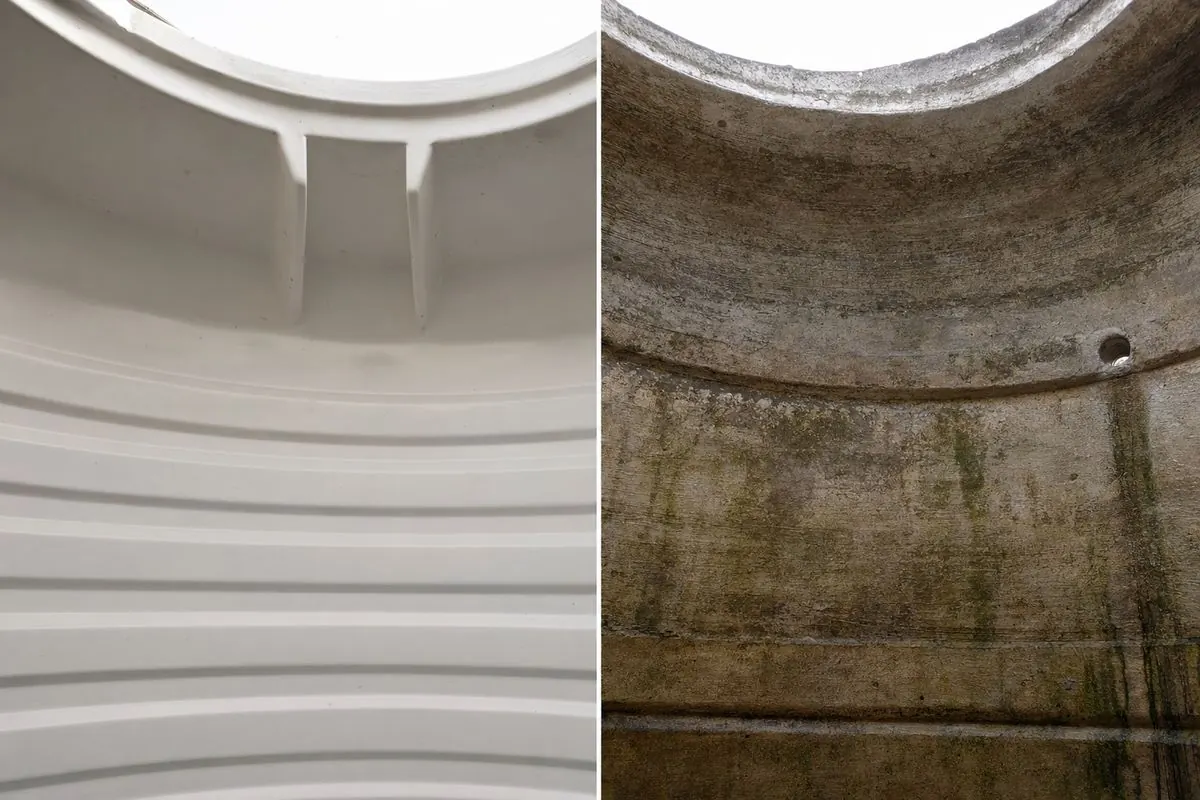
Cons. The big one is porosity. Even with cement-based waterproofing, the interior surface of an RCC tank is microscopically rough and slightly absorbent. Over time, biofilm (the sticky bacterial layer that forms wherever water sits) grips the concrete and is much harder to scrub off than from plastic. Old waterproofing layers crack and let dust, fine soil, and (in older parts of Delhi with high water tables) groundwater contamination seep in. Hairline cracks in the wall let in lizards, ants, and small insects through tiny gaps you can’t easily seal. The lid — usually a heavy precast slab — rarely seals as tightly as a plastic tank lid, so dust ingress is constant.
Cleaning is harder. The porous surface means a quick rinse doesn’t remove biofilm. Real cleaning of a concrete tank requires longer scrubbing time, more chemical contact time for disinfection (we use 25-30 minutes instead of the 20 minutes used for plastic), and a second-pass jet wash because the first pass leaves residue trapped in the surface micro-roughness. All of this means concrete tank cleaning takes 30-40% longer on site than the same-size plastic tank.
Lifespan. A well-built RCC tank with periodic re-waterproofing can last 40-50 years. After year 35-40, hairline cracks become problematic, the waterproofing layer fails permanently, and food contamination (rodent entry, dust storms) becomes a recurring issue. At that point, the honest answer is either a full re-waterproofing job (₹15,000-30,000 for a typical underground sump) or a switch to a plastic tank if the geometry allows. We see this decision come up often in Civil Lines and old Lajpat Nagar properties.
Cleaning frequency comparison — why concrete usually needs MORE frequent cleaning
This is the question that brings most people to this article. If plastic tanks last shorter but are easier to clean, and concrete tanks last longer but are harder to clean — which one needs cleaning more often?
Honest answer: concrete tanks need cleaning more often than plastic tanks of the same size and usage. Here’s why — and whichever material you have, you can book a water tank cleaning on the right schedule for it.
Biofilm grips concrete more tightly. Biofilm is the slimy bacterial layer that forms wherever stored water sits for more than a few weeks. It uses any surface roughness as anchor points. Plastic’s smooth molded interior gives biofilm very little to grip; the same biofilm growth on concrete digs into the surface micro-pores and forms a much more stubborn layer. By month 4-5 in a concrete tank, biofilm is already established at a level that takes 3-4 months in a plastic tank to reach.
Sediment settles harder in concrete. The bottom of an RCC tank is rough enough that fine silt and sediment from Delhi’s incoming tanker water and DJB supply settles into the surface texture and doesn’t flush out with a normal drain-down. You have to manually scrub and pressure-wash to remove it. In a plastic tank, the same sediment sits as a loose layer that lifts off with the drain-down water.
Crack-induced contamination. Older RCC tanks (15+ years) develop hairline cracks in the waterproofing layer. Dust storms (April-May in Delhi), monsoon water tracking through the structure, and groundwater pressure on underground sumps all push small amounts of external contamination into the tank between cleanings. Plastic tanks don’t have this problem — the molded shell either holds or it visibly fails; there’s no slow seepage.
Honest cleaning frequency by tank material:
- Plastic overhead tank, residential, well-shaded: every 6 months is fine. Annual at minimum.
- Plastic overhead tank, sun-exposed or borewell water: every 4-5 months.
- Concrete overhead tank, residential: every 4-5 months. Skipping past 6 months noticeably degrades water taste.
- Concrete underground sump: every 3-4 months. Underground concrete sumps get the worst of both worlds — porous walls plus higher contamination ingress.
- Hybrid setup (concrete underground + plastic overhead): sump every 3-4 months, overhead every 6 months. The sump is the bottleneck.
- Restaurant or commercial: quarterly minimum regardless of material, monthly for high-volume kitchens.
Cleaning method differences — what actually changes between the two
The 8-step cleaning process we use on every tank is the same on both materials, but the time and intensity of each step changes. Here’s what differs.
Inspection step. On plastic we’re looking for surface chalking, microcracks (especially on the sun-facing side), brittleness at the inlet/outlet flanges, and lid seal integrity. On concrete we’re looking for hairline wall cracks, waterproofing-layer flaking, rust stains from the embedded steel reinforcement, and lid-slab fit. Concrete inspection takes about 10-15 minutes longer because there’s more to check.
Drainage step. Same on both — we drain the tank to within an inch of the bottom and then bucket out the residual sediment-laden water.
Manual sludge removal. On plastic, the sludge lifts off the smooth bottom in a few minutes with a soft brush and bucket. On concrete, the sludge is partially embedded in the rough bottom surface and needs longer agitation with stiffer brushes. Add 15-20 minutes for a concrete tank.
Scrubbing step. Plastic walls scrub fast — food-grade nylon brush, mild detergent, 20-25 minutes for a typical 1000L tank. Concrete walls need stiffer brushes, sometimes a second pass with a fine wire brush in heavily-scaled tanks, and 30-40 minutes for the same size.
Jet wash step. Plastic responds well to a single high-pressure jet pass — the smooth surface gives the residue nowhere to hide. Concrete needs two passes — the first pass lifts the bulk; the second pass cleans the surface pores that the first pass missed.
Disinfection contact time. Plastic: 20 minutes is sufficient because the food-grade chlorine-based disinfectant only has to act on surface bacteria. Concrete: 25-30 minutes because the disinfectant has to penetrate slightly into the porous surface layer to reach the bacteria living in the pores.
Final rinse + refill. Same on both.
Net effect: a 1000L plastic tank takes about 75-90 minutes of on-site work. A 1000L concrete tank takes 100-120 minutes for the same quality of result. That extra 25-30 minutes is the labour cost difference that shows up in the pricing.
Plastic or concrete — we clean both
Same crew, same chemicals, different protocols. Tell us which material on the call and we’ll give you a fixed price.
Pricing comparison — what plastic vs concrete actually costs to clean
Concrete tank cleaning is honestly priced 15-25% higher than plastic for the same nominal capacity. The extra cost reflects the extra scrub time, the second-pass jet wash, the longer disinfection contact, and the stiffer brushes that wear out faster. Here are the real numbers from our booking sheet across Delhi.
| Tank size | Plastic price | Concrete price | Plastic time on site | Concrete time on site |
|---|---|---|---|---|
| 500L | ₹399 | ₹499 | 45-60 min | 60-75 min |
| 1000L | ₹499 | ₹599 | 75-90 min | 100-120 min |
| 2000L | ₹699 | ₹899 | 90-110 min | 120-150 min |
| 5000L | ₹1,199 | ₹1,499 | 2-2.5 hrs | 3-3.5 hrs |
| 10,000L (society/sump) | ₹1,899 | ₹2,499 | 3.5 hrs | 4.5 hrs |
GST 18% extra on all prices. AMC (4 visits/year) discount: 15-20% off per visit for both materials. The percentage gap between plastic and concrete prices is consistent across sizes — concrete is roughly 20-25% pricier per visit, which is what the extra labour and chemicals actually cost.
If you have a hybrid setup (concrete underground sump + plastic overhead tank, which is common in Defence Colony, GK-1, GK-2, parts of Vasant Kunj), the right way to budget is the sump price every 3-4 months plus the overhead price every 6 months. A typical bungalow in this category spends ₹3,000-4,500/year on tank cleaning total. AMC drops that to ₹2,500-3,800/year for more visits.
Tank-material-specific problems we see in Delhi homes
Beyond the obvious cleaning differences, plastic and concrete tanks each have their own recurring problems that show up in Delhi’s climate and water supply conditions. Knowing these helps you spot trouble early.
Plastic tank problems we see most often:
- Heat-induced sediment — in poorly-shaded plastic tanks during May-June, the polymer’s outer layer breaks down slightly under UV and gives off micro-particles that settle as a faint white-grey sediment over the summer months. Not dangerous but worth a mid-summer cleaning to flush it out.
- Lid hinge failure — the plastic lid hinge is the weakest part of the tank. It breaks after 8-10 years of opening/closing for cleaning, and once it’s broken, lids get propped open or sit askew, letting dust and lizards in. Easy fix: replace the lid (₹800-1,500 for the part).
- Inlet flange cracking — where the supply pipe enters the tank, the plastic flange flexes with water pressure variations and eventually develops a hairline crack. Catches you out as a slow leak from the side of the tank. Fix is either a flange replacement or a full tank swap depending on tank age.
- Sun-side wall brittleness — on south- and west-facing tank walls, the polymer becomes chalky and brittle after 12-15 years. Once you can scratch a flake off with a fingernail, the tank is past its useful life and needs replacement before it cracks under water pressure.
Concrete tank problems we see most often:
- Hairline wall cracks — show up as faint dark lines on the interior wall. Small cracks (under 0.5mm) are surface-level and patchable. Larger ones (over 1mm) need re-waterproofing the whole interior.
- Waterproofing layer flaking — the original cement-based interior coating starts coming off in patches after 10-12 years. You see grey-white flakes in the sediment when you drain the tank. The fix is re-coating the interior, which takes the tank offline for 3-5 days.
- Rebar corrosion stains — orange-brown streaks on the interior walls mean the embedded steel reinforcement is rusting because water has reached it. Serious. Means the waterproofing has failed and structural repair is needed.
- Groundwater contamination (underground sumps only) — in older South Delhi colonies with high water tables (Lajpat Nagar III, parts of Defence Colony, areas around the Yamuna in East Delhi), an old concrete sump can develop a slow ingress of groundwater between cleanings. You notice it as a slightly muddy taste or as the water level rising in the sump even when the inlet is closed. Needs immediate re-waterproofing — this is a health issue, not just a quality issue.
- Lid-slab gaps — the heavy precast lid slab on RCC tanks rarely sits flush. Dust ingress is continuous, and we’ve found dead lizards, sparrow droppings, and even small snakes inside concrete tanks where the lid had been off-position for months.
When to repair, when to replace, when to just clean — rule of thumb
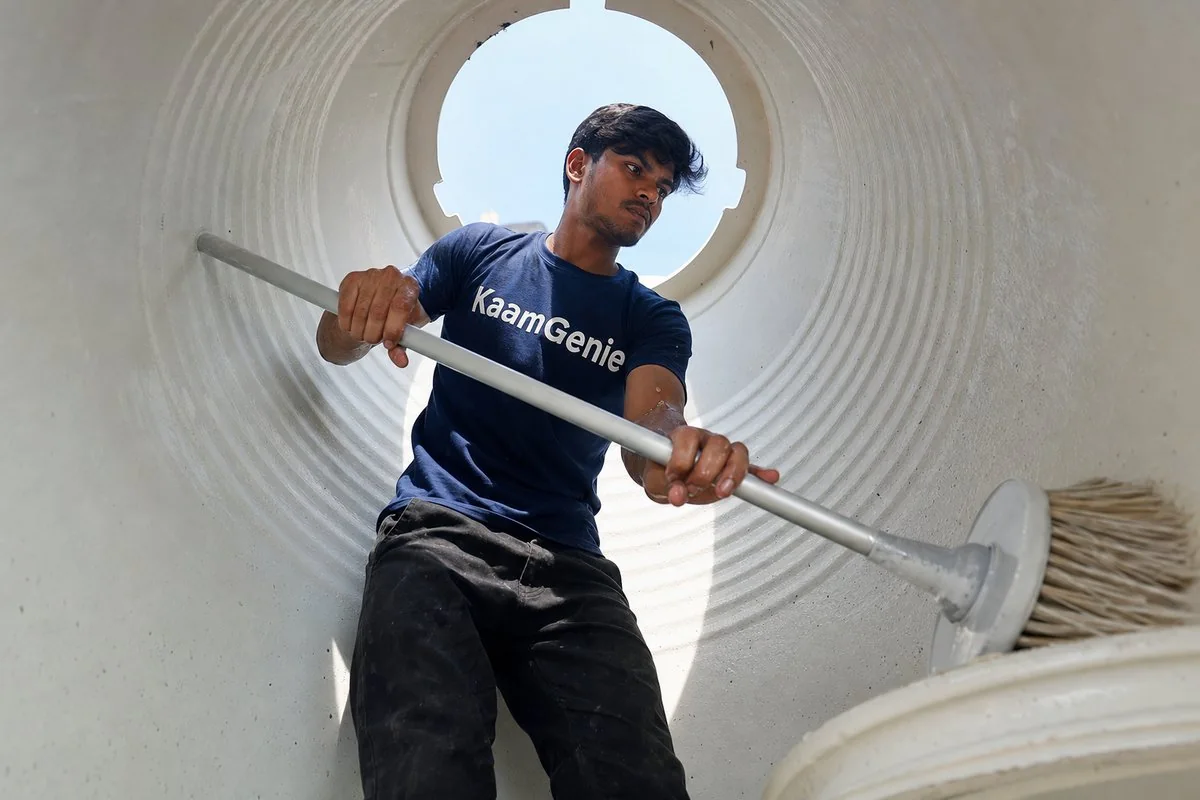
Cleaning fixes water quality. It doesn’t fix structural problems. Sometimes the right answer to “my water tastes off” isn’t another cleaning — it’s a repair or a replacement. Here’s how to tell.
Plastic tank under 12 years old: clean it. Whatever problem you’re seeing is almost certainly fixable with a proper cleaning. Replacement at this age is overkill unless there’s visible damage.
Plastic tank 12-15 years old, no visible problems: clean it, but inspect during the cleaning. Ask the crew to specifically check for sun-side brittleness, microcracks, and inlet flange condition. If those look fine, you’ve got 3-5 more years of safe use.
Plastic tank 15+ years old: evaluate seriously. Get the cleaning crew to assess all four walls and the bottom. If anything looks chalky, brittle, or cracked, plan replacement within 12-18 months. A new 1000L plastic tank fitted on the existing stand is a ₹9,000-12,000 job including labour.
Plastic tank 20+ years old: replace, even if it still looks OK. Polymer breakdown at this age is happening at a molecular level whether you can see it or not, and the water taste and trace contamination start adding up.
Concrete tank under 25 years old: clean it. RCC tanks at this age are usually in fine structural shape.
Concrete tank 25-40 years old: clean it AND check waterproofing condition. If the interior coating is flaking in patches, schedule a re-waterproofing job within the year. Re-waterproofing costs ₹15,000-30,000 for a typical underground sump or ₹10,000-20,000 for an overhead RCC tank, and extends the life by 10-15 years.
Concrete tank 40+ years old: evaluate seriously. At this age, cumulative crack damage, rebar corrosion risk, and waterproofing failure add up. Options are a full structural repair + re-waterproofing (₹30,000-60,000) or a switch to a plastic tank if the geometry allows. Many Civil Lines and Lajpat Nagar properties have made this switch in the last decade.
Concrete tank with visible rebar staining or active leakage: stop using it until you’ve had a structural assessment. This is a safety issue.
Which material to choose for a new build or replacement — honest comparison
If you’re building a new house, renovating an old one, or replacing a failed tank, which material should you pick? The honest answer depends on tank size, location, and how long you plan to own the property.
Pick plastic if: the tank capacity is under 5000L (anything residential overhead), the installation is on a rooftop, you want easy future replacement, you don’t want to deal with re-waterproofing every decade, and you’re willing to plan for a tank swap around year 15-18. This covers 95% of Delhi residential overhead tanks — plastic is the right pick.
Pick concrete (RCC) if: the tank capacity is over 10,000L (typical of society reservoirs, large bungalow sumps), the location is underground (where soil pressure makes plastic unsuitable above a certain volume), you’re building from scratch and can integrate the tank into the structure cost-effectively, or you want maximum lifespan and are willing to do re-waterproofing every 10-15 years. RCC is the right pick for big sumps and society reservoirs.
The hybrid setup — concrete underground + plastic overhead. This is the modern Delhi default for kothis and independent houses. The concrete sump holds the bulk water supply (typically 5,000-10,000L), pumps lift it to a plastic overhead tank (typically 1,000-2,000L), and the household draws from the overhead. The hybrid gets you the longevity of concrete where it matters (the large buried reservoir) plus the ease-of-cleaning of plastic where you interact with the water daily (the overhead). It’s a sensible setup, and it’s what we recommend for most new construction in Delhi.
What to avoid: oversized plastic tanks (over 5000L on a residential rooftop — the structural load on the building gets risky and the tank life suffers); undersized concrete sumps (under 3000L — the per-litre construction cost is bad and you’re better off with plastic); and cheap unbranded plastic tanks (the BIS IS 12701 specification matters — unbranded tanks often use lower-grade polymer that fails inside 8-10 years instead of 15-20).
Delhi neighbourhoods and what material is typical there
For context as you think about your own tank, here’s a rough guide to what you’ll find in different Delhi neighbourhoods based on housing stock age and rebuild patterns.
Mostly plastic overhead, some concrete underground: Dwarka, Rohini, Mayur Vihar, Vasant Kunj, Sangam Vihar, Khanpur, most DDA-built blocks anywhere in the city. The DDA standardised on plastic tanks for rooftop water storage from the mid-1990s, so anything built or rebuilt since then is overwhelmingly plastic on top.
Mixed but mostly plastic after rebuilds: Defence Colony, Greater Kailash (GK-1, GK-2), Hauz Khas, Safdarjung Enclave, Vasant Vihar, Panchsheel. The original 1960s-80s housing was concrete; the 2000s-onwards rebuilds switched to plastic overhead with concrete underground sumps. You’ll find both within the same colony.
Mostly legacy concrete (RCC) tanks: Civil Lines, Old Rajinder Nagar, Karol Bagh, parts of Lajpat Nagar I-III, parts of Punjabi Bagh, Daryaganj, Old Delhi. Older independent houses with original concrete tanks are still common here, and many haven’t been rebuilt. Cleaning these older RCC tanks is most of what we do in these neighbourhoods.
Mixed hybrid (highrises): Vasant Kunj highrise blocks, modern Dwarka sectors, new Greater Noida-Delhi border housing. Society reservoirs underground are RCC (size); rooftop tanks are plastic. Quarterly AMC on the reservoir, semi-annual on the rooftop is the typical pattern.
Knowing what your colony tends to have is useful when you’re thinking about replacement timing — if you’re in Civil Lines and your tank looks old, it’s probably RCC from the 1970s and due for a re-waterproofing assessment. If you’re in Dwarka and your tank looks original, it’s probably plastic from the early 2000s and you have another 5-7 years before replacement comes up.
Areas we serve for both plastic and concrete tank cleaning in Delhi
Same-day cleaning available across all of Delhi for both materials: South Delhi (Saket, Lajpat Nagar, Defence Colony, GK-1, GK-2, Vasant Kunj, Chattarpur, Mehrauli, Khanpur, Sangam Vihar, Hauz Khas, Safdarjung Enclave), Central Delhi (Karol Bagh, Patel Nagar, Civil Lines, Daryaganj, CP, Paharganj), East Delhi (Mayur Vihar, Preet Vihar, Laxmi Nagar, Patparganj, Yamuna Vihar), West Delhi (Janakpuri, Tilak Nagar, Rajouri Garden, Dwarka, Uttam Nagar, Punjabi Bagh), North Delhi (Model Town, Kamla Nagar, Mukherjee Nagar), North-West Delhi (Rohini, Pitampura, Shalimar Bagh, Ashok Vihar). Coming soon: Gurgaon, Noida, Faridabad, Ghaziabad — call us anyway if urgent.
Frequently asked questions
Which tank material lasts longer — plastic or concrete?
Concrete (RCC) tanks last much longer — 30-50 years with periodic re-waterproofing, compared to 15-20 years for plastic tanks in Delhi conditions. The trade-off is that concrete is harder to clean (porous walls hold biofilm) and harder to repair (requires specialist re-waterproofing every 10-15 years). For overhead residential tanks under 5000L, plastic is usually the right pick even though it lasts shorter, because replacement is straightforward.
Which tank material needs cleaning more often in Delhi?
Concrete tanks need cleaning more often than plastic of the same size. The porous interior surface holds biofilm and sediment that smooth plastic surfaces shed easily. Honest frequencies: plastic overhead every 6 months, concrete overhead every 4-5 months, concrete underground sump every 3-4 months. Skipping past these intervals noticeably degrades water taste in concrete tanks before it does in plastic.
Why is concrete tank cleaning harder than plastic?
Three reasons. First, the porous interior surface of concrete grips biofilm and sediment that smooth plastic shrugs off. Second, the rough bottom traps fine silt that won’t flush out with a drain-down; manual scrubbing is required. Third, disinfectant needs longer contact time (25-30 minutes vs 20 for plastic) because it has to penetrate the surface pores to reach bacteria living in them. Net effect: 30-40% more time on site for the same tank capacity.
Can I switch from a concrete tank to a plastic tank?
Yes, and many Delhi homeowners do this when their old RCC tank fails. The switch is straightforward for overhead tanks — break out or leave the old RCC structure, install a steel stand, drop a plastic tank on it, reconnect pipes. Takes one day, costs ₹15,000-25,000 including the tank and the stand. For underground sumps, the switch is more complicated — you need to excavate around the old sump or build a new plastic sump beside it. Usually only worth it if the old concrete sump is structurally failing.
Are old concrete water tanks safe to use?
Up to about 35-40 years, yes — if waterproofing is maintained. After 40 years, the cumulative risk from cracks, rebar corrosion, and waterproofing failure adds up. Warning signs that mean stop using until repaired: visible orange-brown rust streaks on the interior walls (rebar corrosion), water level rising in the sump on its own (groundwater ingress), muddy or earthy taste that doesn’t go away after cleaning. Any of these means an immediate structural assessment, not just another cleaning.
What about underground tanks vs overhead — do both materials exist in both positions?
Yes, both plastic and concrete tanks exist underground and overhead in Delhi. The typical patterns: overhead is mostly plastic (lighter, easier to replace); underground is mostly concrete (size, structural integration). But underground plastic sumps do exist, especially in smaller residential plots, and overhead concrete tanks still exist on older houses in Civil Lines and Old Delhi. We clean all four combinations — plastic overhead, concrete overhead, plastic underground sump, concrete underground sump — with appropriate protocols for each.
Do I need to clean my tank before monsoon arrives?
Yes, and this matters more for concrete tanks than plastic. Pre-monsoon cleaning (early June, before the heavy rains) flushes out the summer’s accumulated heat-induced sediment from plastic tanks and the dust-storm contamination from concrete tanks. For concrete, it’s especially important because hairline cracks let in more during the wet months — starting the monsoon with a clean tank means you have a known baseline if water quality issues come up in July-August.
How do I know if my concrete tank is leaking?
Three signs. First, water level dropping faster than your household usage explains — check the meter against the tank level over 24 hours. Second, damp patches on the wall below the tank or in the room next to it. Third, sudden mid-year increase in your water bill without changed usage. For underground sumps, leaks usually go outward into the soil and are hard to spot; the symptom is just ‘the sump empties faster than it should’. Once you suspect a leak, get it inspected — we offer a leak inspection as part of the cleaning visit at no extra cost.
How long does each cleaning take for plastic vs concrete?
For the same tank capacity: plastic is faster. A 1000L plastic overhead tank takes 75-90 minutes of on-site work; the same 1000L concrete tank takes 100-120 minutes. A 5000L plastic tank takes 2-2.5 hours; concrete equivalent takes 3-3.5 hours. The extra time on concrete covers longer scrubbing, second-pass jet wash, and longer disinfectant contact time. This is the labour cost difference that shows up in the 15-25% higher concrete pricing.
What about hybrid tanks — concrete underground sump + plastic overhead?
Common Delhi setup, especially in kothis and independent houses across Defence Colony, GK, Vasant Kunj, and similar neighbourhoods. We clean them as two separate jobs in one visit. Sump (concrete) first, because it needs more time and the crew can work on it while the overhead tank is still in use. Overhead (plastic) after the sump dries. Total visit time 3-4 hours for a typical bungalow setup. Pricing is the sump price plus the overhead price — we offer a combined discount of 10-15% when both are done in the same visit.
Is the food-grade disinfectant the same for both materials?
Yes, same chemical — food-grade calcium hypochlorite or sodium hypochlorite at the dilution permitted by BIS IS 10500:2012 for potable water systems. What changes is the contact time. Plastic gets 20 minutes; concrete gets 25-30 minutes because the porous surface needs more time for full bacterial kill. We use the same brand and grade across both, and the residual chlorine level after refill is well within the 0.2 mg/L limit that WHO drinking water guidelines specify.
Should I clean a plastic tank that’s about to be replaced?
If the replacement is within the next 60 days, no — save the cleaning fee for the new tank. If it’s 3+ months away, yes — you don’t want to drink from a tank with active biofilm growth while you’re waiting. Some homeowners ask us to do a final cleaning the day before the tank swap, which is helpful because it makes the disposal of the old tank easier (no sludge to deal with). We can also pick up and dispose of the old tank for an extra ₹500-800 if you don’t have a scrap dealer arranged.
Sources & references
- Bureau of Indian Standards — IS 10500:2012 — the Indian specification for drinking water quality. Defines acceptable bacterial count, residual chlorine, and turbidity that any cleaned tank’s water must meet.
- Bureau of Indian Standards — IS 12701 — the Indian specification for rotational moulded plastic water storage tanks. Sets the polymer grades, wall thickness, and quality controls that distinguish a real BIS-certified plastic tank from an unbranded knockoff.
- WHO Drinking Water Guidelines — international framework on safe drinking water that supports the residual chlorine targets and the proper-vs-rushed-cleaning protocols used here.
- CPHEEO Manual on Water Supply and Treatment — the Central Public Health and Environmental Engineering Organisation manual is the reference text for water storage infrastructure in Indian cities, including the comparative analysis of plastic vs concrete storage that informs much of this guide.
Last verified: 7 June 2026. If you find any of these links broken, please let us know.