
The short answer for renters
- Shared society tanks (underground reservoir + rooftop tower tanks) — the AOA/RWA’s job, paid from maintenance you may already be funding.
- A tank that serves only your flat or builder floor — settled by your rent agreement; in practice often the tenant’s routine upkeep unless it says otherwise.
- Before you move in — ask for the last cleaning date and the certificate. No record usually means it’s overdue.
- If it’s neglected — raise it in writing with the owner or the facility office. You can also just book an individual cleaning yourself from ₹699 onwards.
The water doesn’t care whose name is on the lease. If you’re drinking it, a dirty tank is your problem to solve — even when it isn’t your bill to pay.
| Your setup | Which tank | Usually responsible | Who pays |
|---|---|---|---|
| Condo flat (AOA / facility-managed) | Common UGR + rooftop tower tanks | Society / facility company | Maintenance (CAM) |
| Condo flat with an in-flat tank | Tank serving only your flat | Per rent agreement | Tenant, unless agreed |
| Independent builder floor | Shared overhead tank for the building | Owner / co-owners | Often split or owner |
| Builder floor (single tank for your unit) | Your overhead tank / sump | Per rent agreement | Tenant, unless agreed |
| Independent house / kothi on rent | Overhead tank + underground sump | Per rent agreement | Tenant for routine upkeep |
Just want clean water now?
Skip the back-and-forth. Book an individual cleaning for your flat’s tank — full process, before/after photos, certificate to keep. ₹699 onwards.
First, figure out which tank you’re actually talking about
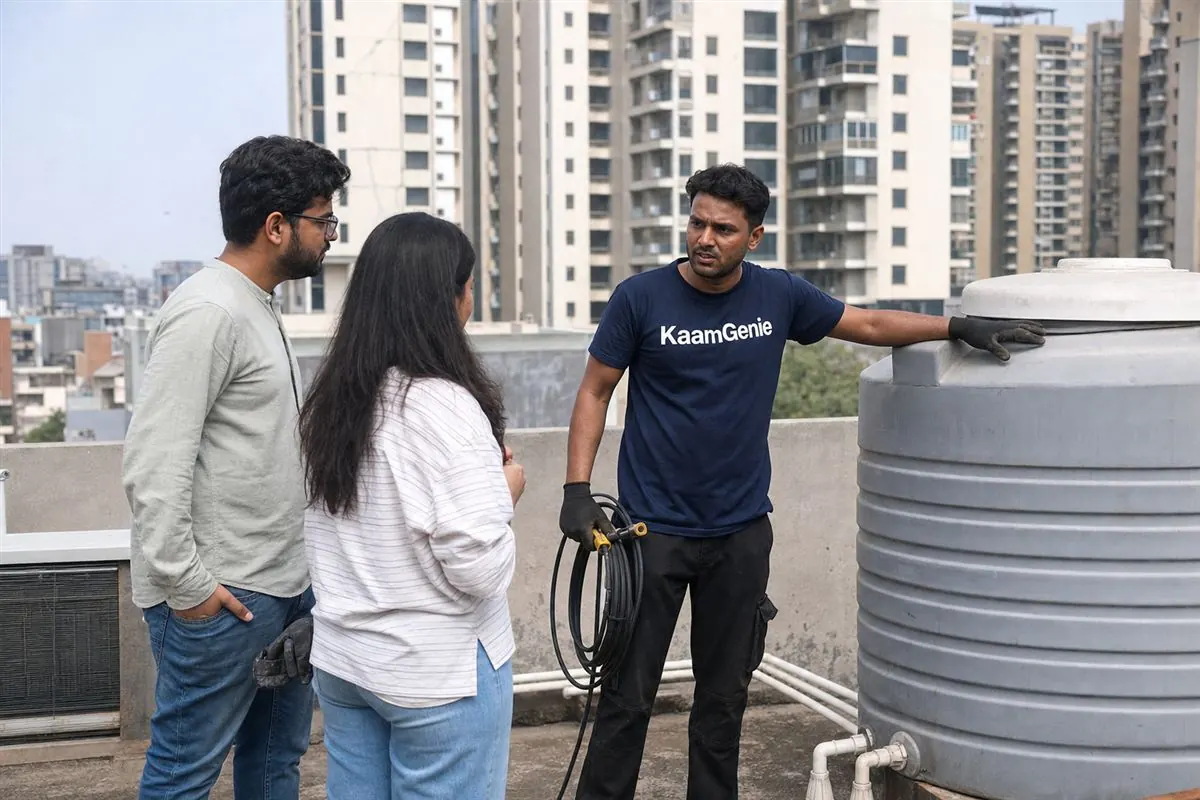
Before anyone argues about responsibility, you need to know which tank is in question — because in Gurgaon a single home can sit on top of three or four different tanks, owned and maintained by different people.
Most large condominiums — the DLF towers, the luxury developments along Golf Course Road and the Sohna Road belt — work the same way. A large underground reservoir (UGR) stores incoming municipal or tanker water at the base of the complex. Pumps lift that water to rooftop tower tanks on each block, and gravity feeds it down to your taps. Both of those are common infrastructure: they serve dozens or hundreds of flats, and they belong to the society, not to any single owner or tenant.
An independent builder floor is different. Typically there’s one overhead tank per floor, or one shared tank for the whole building split between three or four units, and sometimes a small sump at ground level. There’s no facility company — just the owner (or co-owners) and whatever the residents arrange between themselves.
And then there are the tanks that serve only your unit — a dedicated overhead tank for your flat, or your own sump in a rented kothi. Those are the ones where the rent agreement does the deciding.
The shared society tanks: the AOA’s job, your maintenance money
If you rent a flat in a managed condominium, the common UGR and rooftop tower tanks are not your direct responsibility — or the owner’s. They’re the Association of Apartment Owners (AOA) or RWA’s job, carried out by the facility company and funded from the monthly maintenance, the Common Area Maintenance or CAM charge.
Here’s the catch most renters miss: if you pay the maintenance directly, you’re already paying for that cleaning. It’s almost never itemised on the bill, so people assume it isn’t happening — and often it genuinely isn’t being done on schedule. Either way, the right move isn’t to quietly pay a second time for the common tanks. It’s to ask the facility office to confirm the schedule and show you the last certificate. A well-run society in Sushant Lok or a tower complex in DLF Phase 4 will usually have a fixed half-yearly or quarterly programme and a folder of certificates on file.
For a deeper look at how shared-tank cleaning is staged tower-by-tower with per-tank certificates, see our guide to society water tank cleaning in Gurgaon. The key point for you as a tenant: you can raise it, but you can’t book it yourself, because it isn’t your asset to schedule.
Tanks that serve only your flat: read the agreement
The moment we’re talking about a tank dedicated to your unit — an in-flat overhead tank, your builder-floor tank, or your own sump — the answer lives in your rent agreement, specifically the maintenance and repairs clause.
The common pattern in Gurgaon rentals: the landlord is responsible for structural and major repairs (a cracked tank, a failed pump, a burst pipe), and the tenant handles routine upkeep and consumables. Tank cleaning usually falls on the routine-upkeep side — like getting the chimney serviced or the RO filter changed — which is why, by default and absent any clause saying otherwise, it tends to land on the tenant.
But “by default” isn’t a rule. Plenty of agreements say nothing at all, and plenty of owners are happy to fund the first cleaning to hand over a clean flat. The honest reading is: if the agreement is silent, it’s a negotiation, not an obligation. Put it in writing, keep it friendly, and you’ll usually land on a fair split.
- Agreement says tenant handles upkeep: the cleaning is on you. Book it and keep the certificate.
- Agreement says owner handles maintenance/repairs: request it from the owner in writing, with the last-cleaned date.
- Agreement is silent: propose the owner funds the move-in cleaning; you cover routine cleanings during the tenancy.
Before you move in: the two things to demand
The cheapest cleaning is the argument you never have. Before you sign or hand over the deposit, ask the owner or broker two specific questions — and don’t accept “it’s fine” as an answer.
1. When was the tank last cleaned? You want a date, not a reassurance. For a society flat, ask the facility office for the UGR and overhead tank cleaning schedule. For a builder floor or independent house, ask the owner directly about the overhead tank and any sump.
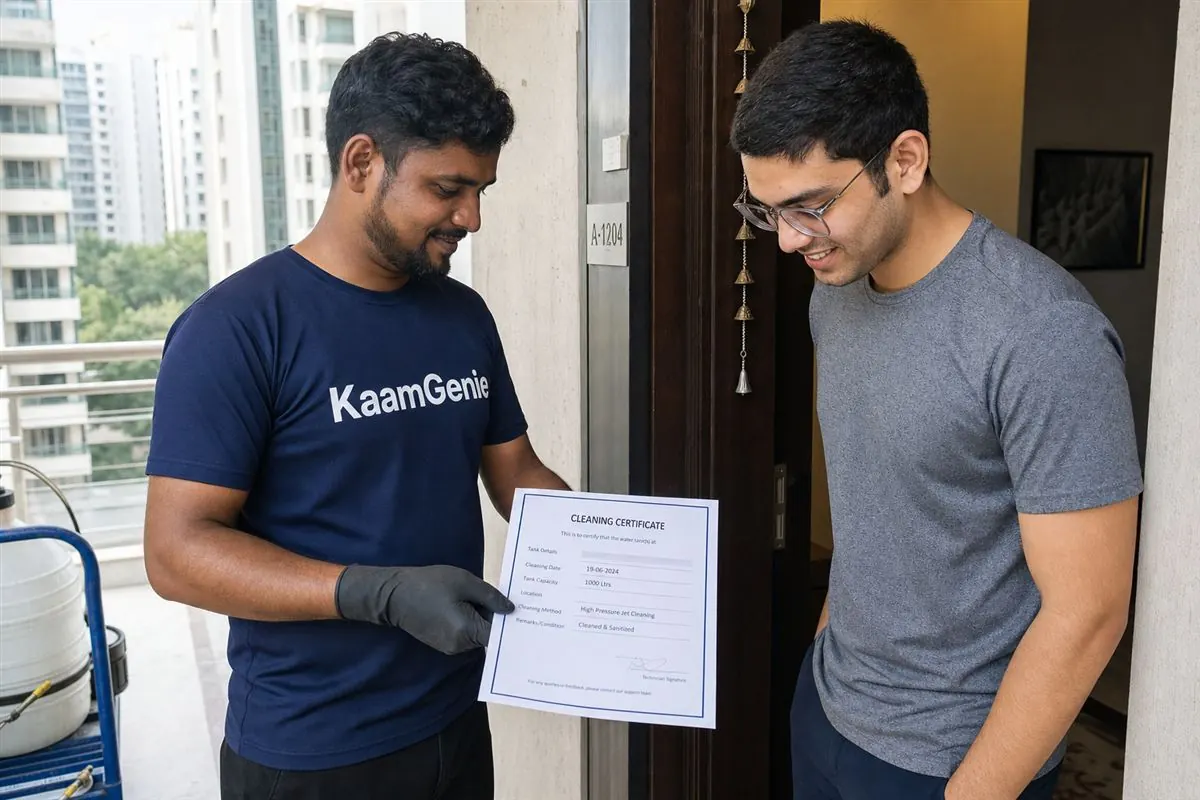
2. Can I see the cleaning certificate or service record? A real cleaning leaves a paper trail — date, tank type and capacity, chemicals used, before/after photos. If nobody can produce one, treat the tank as overdue and factor a fresh cleaning into your move-in checklist, the same way you’d get the flat painted and deep-cleaned.
This matters more in Gurgaon than in most cities. The groundwater here is genuinely hard, the city leans heavily on private water tankers of variable quality, and that combination drives sediment and scale into tanks faster than soft municipal supply does. A tank that was cleaned “a year or so ago” in a tanker-fed building on Sector 82 or the New Gurgaon belt is very likely due again. If you spot yellowish water, a musty smell or grit at the bottom of a glass, don’t wait — those are the classic signs a tank needs cleaning.
How to raise it — without starting a fight
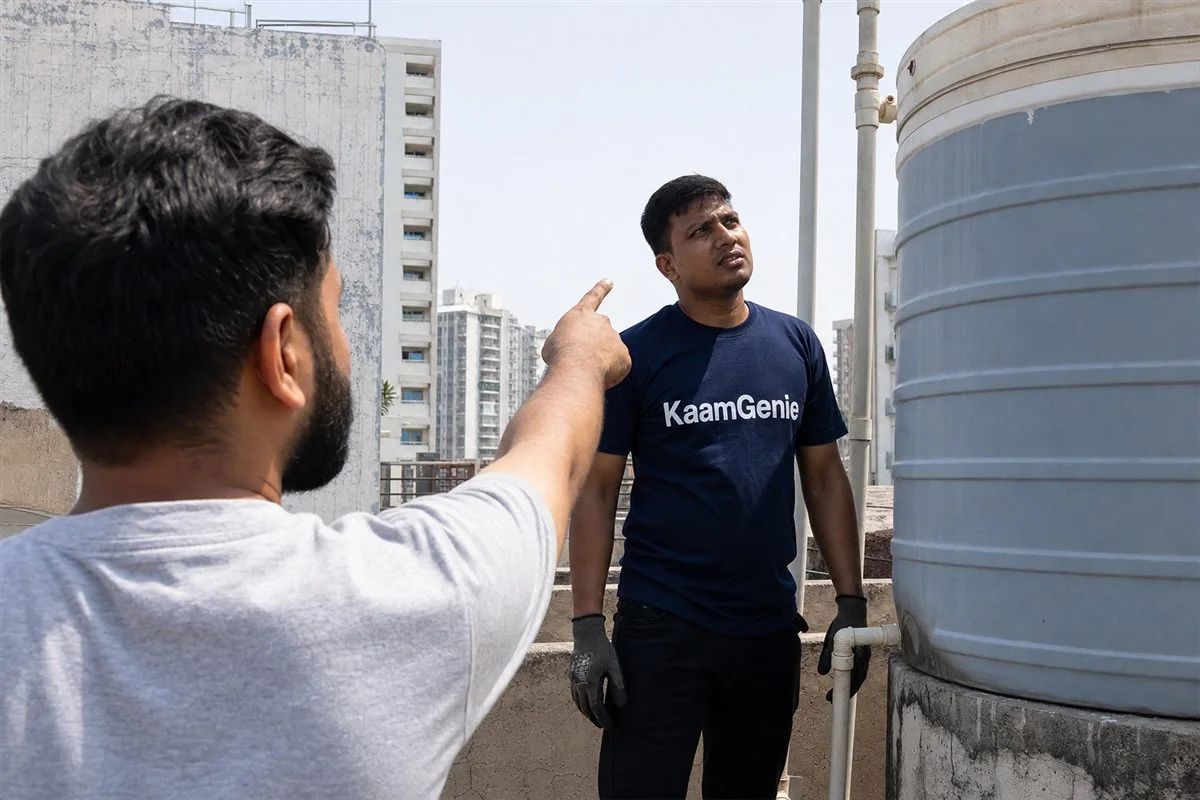
Whether you’re approaching an owner or a society, the same approach works: be specific, be factual, and put it in writing.
With your landlord — a short WhatsApp or email beats a phone call, because it creates a record. Something like: “Hi, the overhead tank for the flat hasn’t been cleaned in [X] months and the water has started looking off (photo attached). As per our agreement, could you arrange a cleaning, or shall I book it and adjust against rent?” Reference the clause if you have one. Offering to handle the booking yourself often unblocks a hesitant owner.
With the AOA / facility office — tenants can usually raise hygiene and civic issues directly, even where formal AOA voting rights sit with owners. Use the society app or email to ask for the last UGR and rooftop tank cleaning date, the next scheduled one, and a copy of the certificate. If a few neighbours feel the same, a group request carries far more weight than one resident chasing alone. Many residents on Sushant Lok have got stalled schedules restarted simply by asking, in writing, for the certificate.
Keep the tone collaborative. You’re not accusing anyone — you’re asking for water that’s safe to drink, which nobody can reasonably argue against.
Who pays, in practice — a realistic split
Setting the legalese aside, here’s how it actually tends to shake out in Gurgaon rentals, and the split most tenants and owners end up agreeing is fair.
Who typically foots the bill, by scenario
Indicative split based on common Gurgaon rent-agreement practice — your contract overrides this
Bars show how often each party tends to pay in practice — not a legal ruling. A written rent agreement or AOA bylaw always takes precedence.
A fair and common compromise when the agreement is silent: the owner funds the cleaning at move-in (clean flat, clean water, happy tenant), and the tenant covers any further cleanings during the tenancy as routine upkeep. For the typical numbers behind these conversations, our Gurgaon tank cleaning cost guide breaks it down by tank type so you can quote a real figure instead of guessing.
You can always just book it yourself
Here’s the liberating part: for any tank that serves only your home, you don’t need permission to get clean water. If the owner is dragging their feet, or the agreement makes it your job, or you simply don’t want to drink from a tank cleaned who-knows-when, you can book an individual residential cleaning directly — from ₹699 onwards for a standard overhead tank. All we need is rooftop or sump access.
This is exactly what most renters do when they move into a new place — the same logic as our guide to water tank cleaning for a new flat in Gurgaon. And if you’re in an independent builder floor, the access and tank-sharing quirks are covered in our piece on builder floor water tank cleaning in Gurgaon. You get the full process — drain, sludge removal, scrub, jet wash, food-grade disinfection — plus before/after photos and a certificate. That certificate is the single most useful thing you can keep: it settles any later dispute with an owner over deposits, and it proves the flat was handed back in good order.
For a shared society reservoir or common tower tank, you can’t book it solo — that has to go through the facility office — but our team handles those AOA contracts too, and we’re part of the broader network of water tank cleaning services across NCR.
Renting in Gurgaon? Get the tank sorted today
Individual flat or builder-floor cleaning — full process, photos, and a certificate you can keep for your deposit. ₹699 onwards.
The bottom line for Gurgaon renters
Responsibility splits cleanly once you know which tank you mean: the shared society reservoir and tower tanks are the AOA’s job, funded by the maintenance you may already be paying; anything serving only your flat is decided by your rent agreement, and in practice usually lands on the tenant for routine cleaning. Either way, the smartest move is the same — ask for the last-cleaned date and certificate before you move in, raise gaps in writing, and remember that for your own tank you can always just book a cleaning and keep the receipt.
Whichever bucket you fall into, you can sort it through our water tank cleaning in Gurgaon service — individual flat cleanings from ₹699 onwards, and proper AOA-coordinated jobs for society reservoirs and tower tanks. Clean water shouldn’t depend on whose name is on the lease.
Frequently asked questions
As a tenant in Gurgaon, am I legally required to clean the water tank?
There is no specific Gurgaon law that names the tenant. It comes down to your rent agreement and which tank you mean. The shared underground reservoir and rooftop tower tanks in a condominium are the society’s job, funded by maintenance (CAM) that you may already be paying. A private overhead tank that serves only your rented flat or builder floor is usually treated as routine upkeep — often the tenant’s responsibility unless the agreement says otherwise. Read the maintenance clause before assuming.
Who pays for water tank cleaning in a rented Gurgaon condo flat?
In a managed condominium with an AOA or facility company, cleaning of the common underground reservoir (UGR) and rooftop tower tanks is paid for out of the maintenance/CAM charges — so effectively whoever pays maintenance funds it. If you, the tenant, pay maintenance directly, you are already paying for it and should expect it done on schedule. If the owner pays maintenance, it is on their bill. Any tank dedicated to your individual flat is a separate question settled by your rent agreement.
What should I check about the water tank before moving into a rented Gurgaon flat?
Ask for the date of the last tank cleaning and a copy of the cleaning certificate or service record. In a society, ask the facility office for the UGR and overhead tank cleaning schedule. For an independent builder floor, ask the owner when the overhead tank and any sump were last cleaned. Also note the water source — Gurgaon’s hard borewell water and heavy tanker reliance mean sediment builds up faster, so a tank cleaned over a year ago likely needs doing.
The landlord refuses to clean the tank — what are my options?
First check the rent agreement’s maintenance clause. If cleaning is the owner’s responsibility, put the request in writing (WhatsApp or email) with the last-cleaned date and a photo if the water looks off. If it is a society tank, escalate to the AOA/RWA or facility manager rather than the owner. If the agreement makes it your responsibility, or you simply want clean water now, you can book an individual cleaning yourself from ₹699 onwards and keep the receipt.
How do I raise tank cleaning with the AOA or RWA in my Gurgaon society?
Tenants can usually raise civic and hygiene issues directly with the facility office even if AOA voting rights sit with owners. Email or use the society app to ask for the last UGR and overhead tank cleaning date and the next scheduled one, and request the certificate. If several residents share the concern, a group request to the AOA carries more weight. Most managed Gurgaon societies on Golf Course Road, Sohna Road and the SPR belt run a fixed half-yearly or quarterly schedule.
How often should a tank be cleaned in Gurgaon, and does renting change that?
Public health guidance points to cleaning stored water tanks roughly every six months. Gurgaon’s hard groundwater and heavy dependence on water tankers push more sediment and scale into tanks, so twice a year is a sensible minimum and busy buildings often do it quarterly. Renting does not change the tank — it only changes who arranges and pays for the cleaning. The water you and your family drink is the same either way.
Can I book a tank cleaning myself without the owner or society?
Yes, for any tank dedicated to your own flat or builder floor — an individual overhead tank or your own sump — you can book a residential cleaning directly from ₹699 onwards. You only need rooftop or sump access. For a shared society UGR or common tower tank you cannot unilaterally book it, because it serves many homes and is the AOA’s asset; that has to go through the facility office.
I’m moving out soon — is it worth getting the tank cleaned?
If the tank serves only your flat and it has not been cleaned in over a year, a one-time cleaning before you hand back the flat is cheap insurance against deposit disputes, and it leaves clean water for the next tenant. Keep the certificate as proof of upkeep. If it is a society-managed tank, you do not need to do anything — it stays on the AOA’s schedule regardless of who lives there.
Does the maintenance I pay in my Gurgaon society already cover tank cleaning?
In most managed condominiums, yes — cleaning of the common underground reservoir and rooftop tower tanks is part of the building’s upkeep funded by monthly maintenance (CAM). It is rarely itemised separately, so people assume it is not happening. Ask the facility office to confirm the schedule and show the last certificate. If it is not being done despite maintenance being collected, that is a service-level issue to raise with the AOA, not a reason for you to pay twice.
What does an individual tenant cleaning include and cost in Gurgaon?
A residential cleaning of a single overhead tank starts at ₹699 onwards and covers draining, sludge removal, manual scrubbing, high-pressure jet wash, food-grade disinfection and a before/after photo record plus certificate. Underground sumps, multiple tanks, and society reservoirs are quoted separately because of size and access. Ask for the certificate by name — it is the document that settles any later dispute with an owner or society.
Sources & references
- Bureau of Indian Standards (BIS) — IS 10500:2012 is the canonical Indian Standard for drinking water specification, defining acceptable limits for physical, chemical, and biological parameters.
- WHO Guidelines for Drinking-water Quality, 4th edition — the global reference for water quality standards, including guidance on storage and disinfection.
- Food Safety and Standards Authority of India (FSSAI) — defines water quality requirements for food businesses, including hygiene standards for stored water and acceptable disinfection chemicals.
- WHO Fact Sheet on Drinking Water — overview of safe drinking water requirements and contamination risks.
- CPHEEO — Manual on Water Supply and Treatment — the Government of India’s engineering manual covering tank design, cleaning protocols, and disinfection practices.
Last verified: 29 June 2026. If you find any of these links broken, please let us know.