
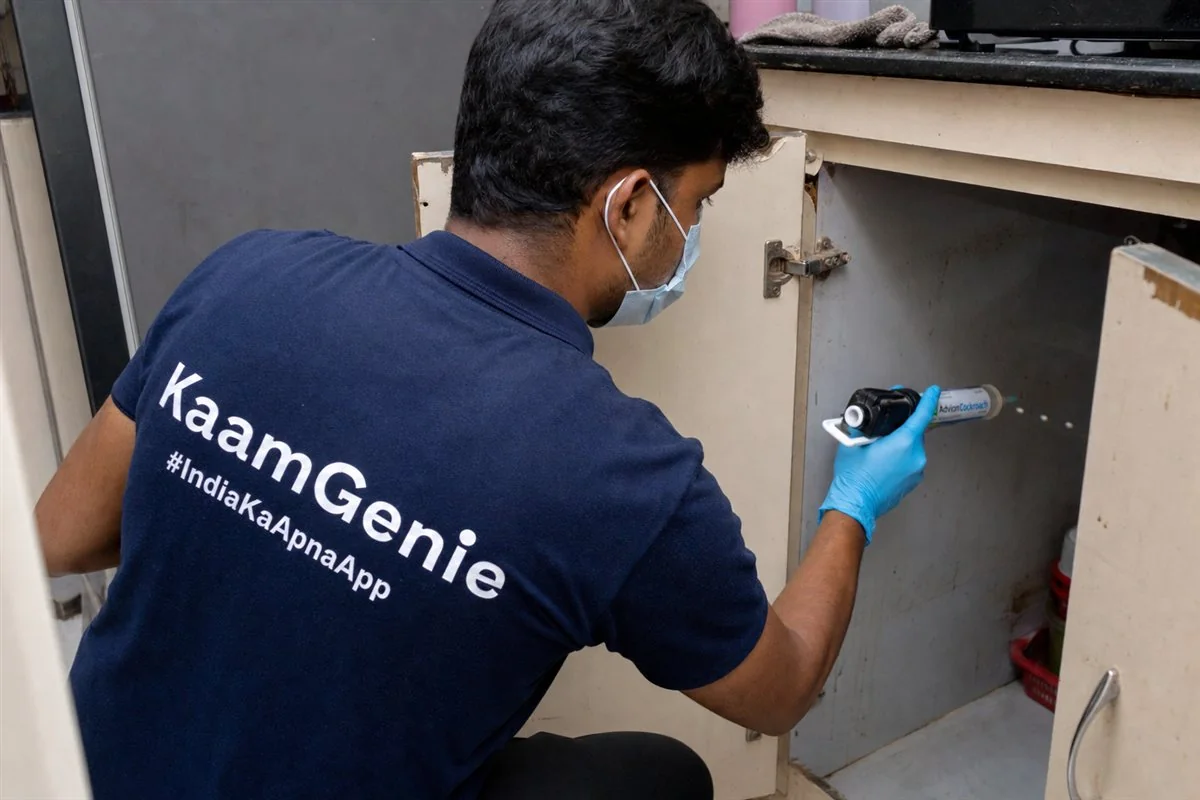
Quick answer — cockroach gel treatment in Delhi (2026)
- How it works: a roach eats a pinhead of gel bait, walks back to its hiding spot, and dies there — then the roaches that feed on its droppings and body die too. One bait, a chain reaction through the whole nest.
- Odourless & kitchen-safe: gel is placed as tiny dots inside cracks and hinges, not sprayed in the air. No smell, no fumes, no emptying cabinets or covering food — ideal for Delhi kitchens.
- Beats spray: spray scatters roaches and misses the nest; gel pulls them to it. For German cockroaches in a flat kitchen, gel is the professional standard.
- How long it lasts: you’ll see a drop in 3–7 days and most gone in 2–3 weeks. A good gel point stays active for weeks; re-application or a top-up visit handles stubborn nests.
- Real cost (2026): cockroach gel treatment starts from ₹599; larger homes and AMC plans cost more. GST 18% extra.
- Same-day where slots allow, across Delhi. No spray smell means you use your kitchen the same evening.
How cockroach gel baiting actually works
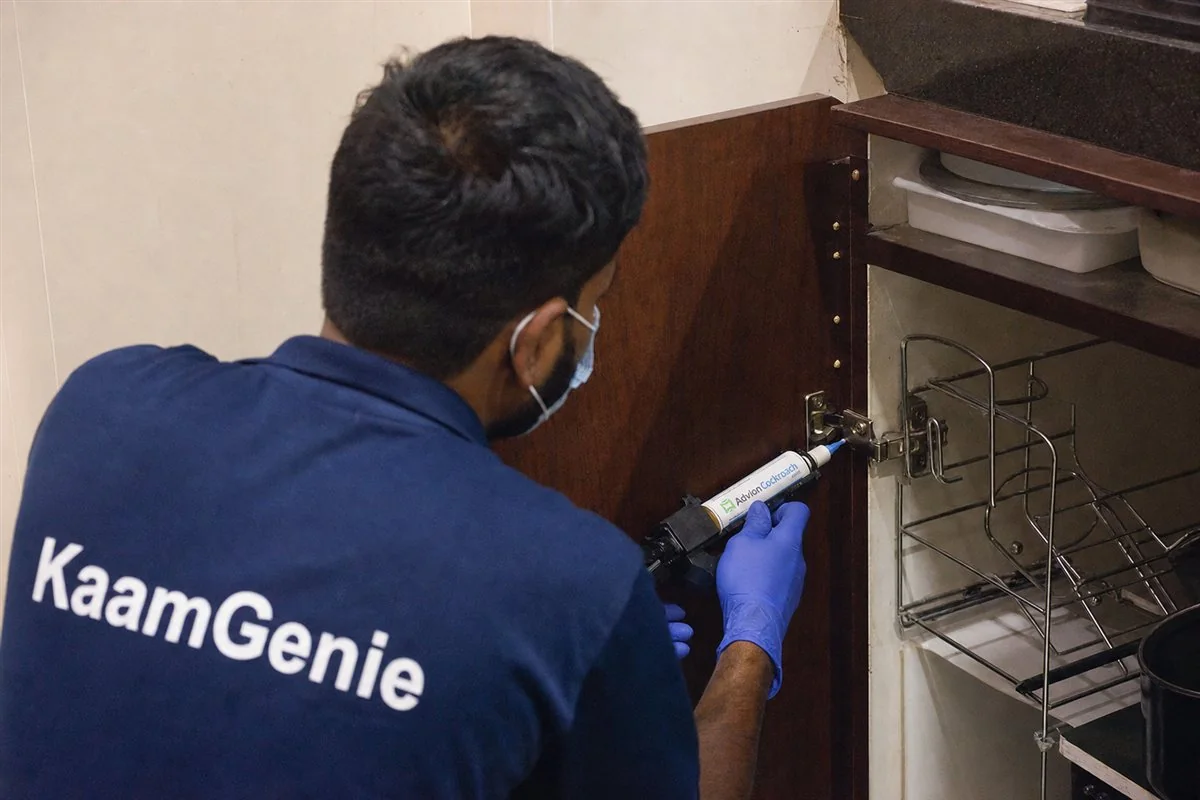
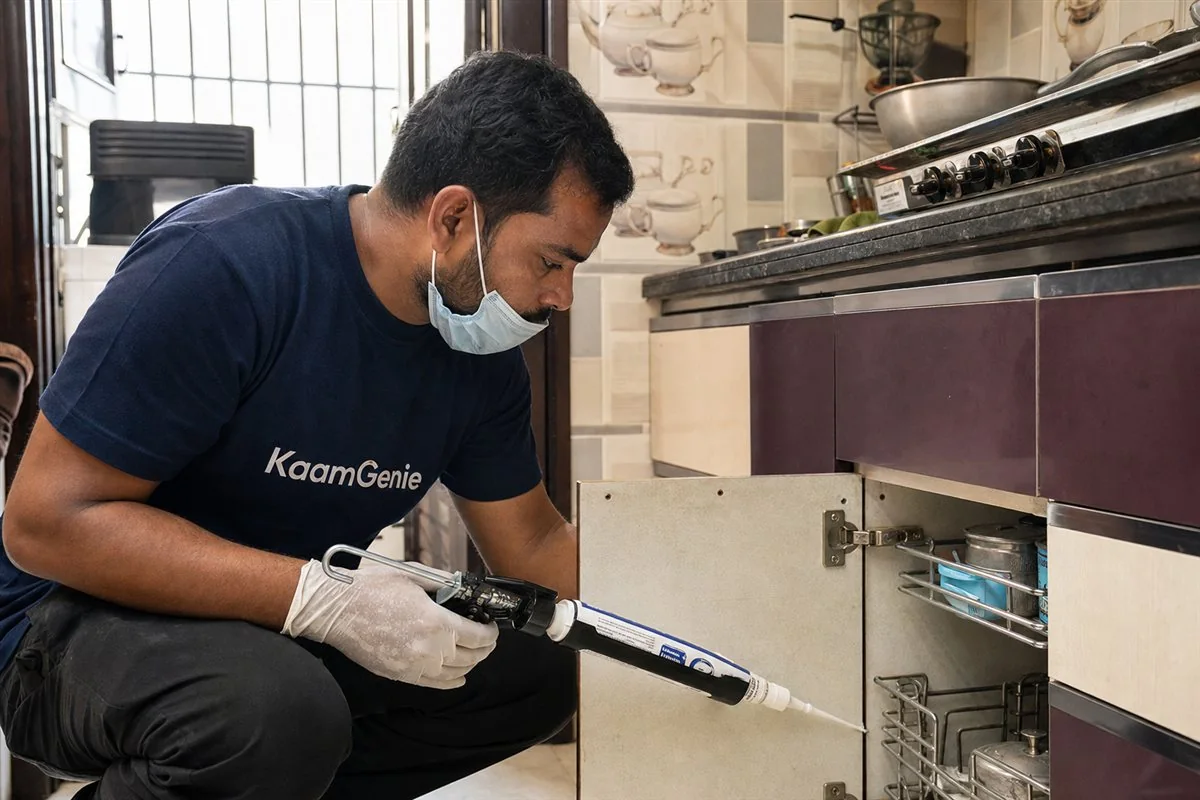
Here is the bit that makes gel different from everything else you’ve tried. A cockroach gel bait is a sweet, food-like paste laced with a slow-acting insecticide — fipronil, imidacloprid or indoxacarb in the products licensed for Indian use. The technician lays it as tiny dots, each the size of a pinhead, exactly where roaches travel and hide: inside cabinet hinges, behind the gas stove, along the lip of the sink, in the gap behind the fridge motor. The roach finds the gel, eats it, and walks away — and that “walks away” part is the whole point.
The insecticide is deliberately slow. A roach that ate the gel doesn’t drop on the spot; it returns to its harbourage — the dark, warm crack where the rest of the colony lives — and dies there a few hours later. Now the chain reaction starts. Cockroaches feed on each other’s droppings, on the gel residue smeared around, and on the bodies of the dead. This is called the secondary, or cascade, kill: the roach that never touched your bait dot still dies because it fed on one that did. Researchers describe this as a domino effect through the nest, and it’s why one well-placed gel point can wipe out roaches you never even saw. A spray can’t do that — it only kills what the droplet lands on.
That’s also why patience matters. People are used to spray, where roaches drop in front of you within seconds (and the nest survives). Gel is the opposite: quiet for the first day or two, then you start finding dead roaches in the open as the colony collapses. In a typical Delhi flat you’ll notice the difference in 3–7 days and see the bulk gone in two to three weeks. Slow on the surface, lethal underneath — that’s the trade you’re making, and it’s the right one.
Why gel is odourless, no-spray and food-safe — and better for kitchens
The single biggest reason I push gel for Delhi kitchens is that it doesn’t put chemical into the air you breathe or onto the surfaces you cook on. Spray is a mist — it drifts, it settles on the counter, the tawa, the open dabba of atta, and it leaves that sharp pesticide smell that lingers for days and means you’re cleaning every shelf afterwards. Gel is the opposite: a contained dot tucked inside a crack or hinge, where roaches go and your hands and food never do. No fumes, no smell, nothing to ventilate.
The practical difference for a household is huge. With spray, the technician asks you to empty the kitchen cabinets, cover the utensils, take the kids and pets out, and stay away for a few hours. With gel, none of that. The crew works around your routine, places the dots, and leaves — you can cook dinner the same evening. For homes with babies, elderly parents, asthmatics or anyone sensitive to fumes, that is not a small thing. It’s also why gel is the method of choice for restaurant and tiffin kitchens that can’t shut down or risk food contamination; placed properly, the bait never contacts food-contact surfaces. If you want the full kitchen-hygiene picture, our kitchen pest control guide for Delhi walks through where roaches breed around the stove and sink and how to keep them out.
One honest caveat so you trust the rest of this page: gel is brilliant for cockroaches in a kitchen, but it is a targeted tool, not a magic wand for every pest. A heavy, long-neglected infestation, or American cockroaches pouring up from a building drain, often needs gel plus a crack-and-crevice treatment of the drains and basement. A good technician tells you that up front rather than promising gel alone will fix a sewer problem.
| What matters | Gel bait | Aerosol / liquid spray |
|---|---|---|
| Smell & fumes | None — odourless dots | Strong pesticide smell for days |
| Kitchen prep | No emptying, no covering food | Empty cabinets, cover utensils, vacate |
| Reaches the nest | Yes — roaches carry it back | No — only kills what it touches |
| Scatters survivors | No — draws them in | Yes — pushes roaches into new cracks |
| Use kitchen after | Same evening | After hours of airing out |
| Best for | German roaches in kitchens | Quick visible knockdown only |
Roaches behind the kitchen stove again?
Skip the spray that scatters them. Our technician places odourless gel bait at the cracks they actually nest in — cockroach gel from ₹599 (GST 18% extra).
German vs American cockroaches in Delhi flats — and why it changes the gel plan
Not all roaches are the same problem, and getting this wrong is why so many DIY attempts fail. In Delhi flats you’re almost always dealing with one of two species, and gel works on both — but the placement is different.
The German cockroach is the small, light-brown one, about 12–15mm, that you find inside the kitchen — in cabinet corners, behind the toaster, in the gap around the chimney, inside the motor housing of the fridge. This is the species gel was practically invented for. They breed fast (one female and her offspring can become thousands in a year), they stay close to food and warmth, and they hide in tight cracks — which is exactly where gel dots go. For a German cockroach problem in a flat kitchen, gel baiting is the gold standard, full stop. Spray just makes them disperse to the next flat and come back.
The American cockroach is the big reddish-brown one, 35–40mm, that you meet in the bathroom at night or see climbing out of a floor drain. These don’t usually breed inside your flat — they come up from the building’s sewer lines, manholes, the basement and shared drainage, common in older DDA blocks and dense colonies. Gel still kills them, but if you only bait inside your flat you’re fighting an unlimited supply marching in from below. The fix is gel at their entry points plus sealing and treating drains, and ideally a society-level approach for the shared lines. A technician who identifies the big roach and still only sells you a kitchen gel job hasn’t solved your problem.
This is also where realistic expectations come in. A German-roach kitchen usually clears beautifully with gel and a top-up. An American-roach issue driven by the building’s drains will keep sending you visitors no matter how good your gel is — that’s a structural fight, not a bait failure. For the deeper playbook on clearing a colony for good, see our guide on getting rid of cockroaches permanently at home in Delhi.
How long cockroach gel lasts, and when to re-apply
Two timelines matter here, and people mix them up. The first is how long the treatment takes to work; the second is how long the gel stays active.
On working: expect activity to drop noticeably within 3–7 days and the bulk of the colony gone in two to three weeks. A bad infestation that’s been building for months takes the full three weeks and usually a follow-up. On staying active: a fresh gel dot remains attractive and lethal for several weeks as long as it stays moist and clean. It loses its punch when it dries out and crusts over, gets covered in kitchen grease or dust, or is wiped away during cleaning — which is why placement inside protected cracks matters, and why kitchens that get scrubbed hard need re-dotting sooner.
Re-application is normal and not a sign the gel failed. For a moderate problem, one thorough treatment plus one follow-up at two to three weeks clears it — the follow-up mops up the nymphs that hatched from eggs after the first round (gel doesn’t kill eggs inside the case, so timing a second hit for when they’ve hatched is the whole trick). For ongoing protection, especially in ground-floor flats, restaurants or homes that border a chronic source, a quarterly top-up or an annual maintenance plan keeps fresh bait in place year-round. Don’t let anyone tell you a single gel visit guarantees a roach-free home forever; honest cockroach control is a first treatment, a planned follow-up, and maintenance where the risk is high.
What happens after a cockroach gel treatment (2026)
Rough share of the colony gone over time in a typical Delhi kitchen — from what we see on the ground.
What a real cockroach gel treatment includes
A proper gel job is not someone squeezing a tube around the kitchen in five minutes. Done right, it’s four steps, and the inspection is the part cheap operators skip.
- Inspection and species ID first. The technician finds the harbourages — behind the fridge motor, inside cabinet hinges, around the chimney, under the sink, along skirting — and works out whether you’ve got German roaches, American roaches, or both. The plan follows from this.
- Targeted gel placement. Many small dots in the right cracks beat a few big blobs in the open. Gel goes inside hinges, corners, voids and crevices — never on open surfaces where it dries out, gets cleaned off, or sits near food.
- Sanitation advice and source control. Gel competes with your crumbs. The technician should tell you to fix the leaking tap under the sink, store atta and sugar sealed, clear the grease behind the stove — roaches that have no other food hit the bait harder and faster.
- A planned follow-up. A revisit at two to three weeks to catch newly hatched nymphs and top up any gel that’s been eaten or cleaned away. You should get a GST invoice and clear, written before/after notes — not vague promises.
Be wary of the ₹200 “cockroach spray” that’s one person, one can, no inspection, gone by next week — that’s the scatter-and-vanish job that makes the problem worse. Real gel work costs a bit more because the inspection, the right licensed gel at the right dose, and the follow-up are what make it actually work.
Want it sorted without emptying your kitchen?
Gel needs no evacuation, no covering utensils, no smell. Book a slot and use your kitchen the same evening. Same-day where slots allow.
Cockroach gel treatment cost in Delhi (2026)
Here’s an honest 2026 price range so you can spot both the lowball and the overcharge. Cockroach gel treatment starts from ₹599 for a compact kitchen and bathroom, with larger homes and add-on services costing more. GST 18% is extra on all of it. For the full home-by-home breakdown and why ₹100 spray is false economy, see our detailed cockroach treatment cost in Delhi guide.
| Home / job | What’s covered | Starting price (2026) |
|---|---|---|
| Kitchen + bathroom (1–2 BHK) | Inspection + gel baiting of harbourages | From ₹599 |
| Whole flat (2–3 BHK) | Gel across kitchen, bathrooms, utility, store | From ₹999 |
| Independent house / bungalow | Gel + crack-and-crevice, multiple floors | From ₹1,799 |
| With drain treatment (American roaches) | Gel + drain & entry-point treatment | From ₹1,499 |
| Annual maintenance (AMC) | Quarterly top-ups, fresh bait year-round | From ₹2,999/year |
My honest steer for a Delhi family flat with a German-roach kitchen: take the one-time gel treatment from ₹599 with the included follow-up, and only step up to an AMC from ₹2,999/year if you’re on the ground floor, run a food business, or live somewhere the building’s drains keep sending American roaches up. Pay for the inspection and the follow-up — that’s where gel earns its keep — not for a big-name brand sticker on a spray can.
The honest bottom line on cockroach gel
If you take one thing from this page: for cockroaches in a Delhi kitchen, gel beats spray nearly every time. It’s odourless, it needs no emptying or covering of your kitchen, it’s safe to live around the same evening, and crucially it kills the nest you can’t see instead of scattering it. The two things that make or break it are correct placement by someone who found the harbourage, and a follow-up to catch the next generation. Get those right and a German-roach kitchen clears in two to three weeks; ignore them and even good gel underperforms. We do exactly this work — inspection, licensed gel, planned follow-up, GST invoice — across Delhi, from Dwarka and Rohini to Saket, Lajpat Nagar and Greater Kailash, with Gurgaon, Noida, Faridabad and Ghaziabad coming soon. Call 95603 66362 and get the roaches gone the quiet way.
Frequently asked questions
How does cockroach gel treatment work?
A roach eats a pinhead dot of sweet gel bait laced with a slow-acting insecticide, then walks back to its hiding spot and dies there. Other roaches feed on its droppings and body and die too — a chain reaction, or domino effect, that wipes out the whole nest including roaches that never touched the bait directly. That secondary kill is why gel clears infestations a spray can never reach.
Is cockroach gel safe to use in the kitchen?
Yes — that’s its biggest advantage. Gel is placed as tiny dots inside cracks, hinges and voids where roaches travel, not sprayed in the air or onto surfaces you cook on. There’s no smell, no fumes, and nothing to ventilate. You don’t need to empty cabinets, cover utensils or vacate the house, and you can use the kitchen the same evening. Keep the dots away from food-contact surfaces and out of reach of small children and pets.
Is cockroach gel better than spray?
For cockroaches in a kitchen, almost always yes. Spray only kills the roaches the droplet lands on and tends to scatter the survivors into new cracks, so the nest rebuilds. Gel does the opposite — roaches carry it back to the harbourage and the colony collapses from the inside. Spray gives a quick visible knockdown; gel gives a real fix. Gel is also odourless and needs no kitchen prep, while spray means smell, fumes and clearing out cabinets.
How long does cockroach gel take to work?
You’ll usually notice fewer roaches within 3 to 7 days and the bulk of the colony gone in two to three weeks. It’s deliberately slower than spray because the roach has to carry the bait back to the nest before it dies — that delay is what lets it kill roaches you never see. A heavy, long-standing infestation takes the full three weeks plus a follow-up.
How long does cockroach gel last after it’s applied?
A fresh gel dot stays attractive and lethal for several weeks as long as it stays moist and clean. It loses effect when it dries out and crusts over, gets coated in kitchen grease or dust, or is wiped away during cleaning. That’s why it’s placed inside protected cracks, and why kitchens that are scrubbed hard need re-dotting sooner.
Do I need to re-apply cockroach gel?
Usually one thorough treatment plus a follow-up at two to three weeks clears a moderate problem. The follow-up kills the nymphs that hatch from eggs after the first round, since gel doesn’t kill eggs inside the case. For high-risk homes — ground floor, restaurants, or near a chronic drain source — a quarterly top-up or annual maintenance plan keeps fresh bait in place. Re-application is routine, not a sign the gel failed.
What’s the difference between German and American cockroaches in Delhi flats?
German cockroaches are the small light-brown ones (12–15mm) that live inside the kitchen — cabinet corners, behind the fridge, around the chimney. They breed fast and are exactly what gel is designed for. American cockroaches are the big reddish-brown ones (35–40mm) that come up from sewers, drains and basements, common in older blocks. Gel kills both, but American roaches also need drain treatment and sealing of entry points, often at building level, or they keep marching back in.
Will cockroach gel kill the whole nest?
It can, because of the secondary kill — roaches that feed on the droppings and bodies of baited roaches die too, so the bait spreads through the colony without you reaching every hiding spot. For German cockroaches in a kitchen this clears the nest reliably with a follow-up. For American cockroaches breeding in a building’s drains, gel kills the ones inside your flat but can’t stop new ones coming up from the shared sewer without drain treatment.
Does cockroach gel have a smell?
No. Gel bait is odourless to humans — that’s a key reason it’s preferred for kitchens, homes with babies or asthmatics, and food businesses. Unlike aerosol or liquid spray, there are no fumes drifting onto counters or lingering for days, and nothing to air out afterwards.
How much does cockroach gel treatment cost in Delhi in 2026?
Cockroach gel treatment starts from ₹599 for a compact kitchen and bathroom in a 1–2 BHK, from around ₹999 for a whole 2–3 BHK flat, and from ₹1,799 for an independent house. Adding drain treatment for American roaches starts around ₹1,499, and an annual maintenance plan from ₹2,999 a year. GST 18% is extra. Avoid ₹200 spray jobs with no inspection — they scatter roaches and come back.
Can I do cockroach gel baiting myself?
You can buy retail gel, but DIY commonly fails on placement and species ID. People put a few big blobs in the open where the gel dries out and roaches ignore it, or they treat American roaches coming from a drain as if they were a kitchen problem. A technician finds the harbourages, uses the right licensed gel at the right dose in the right cracks, and plans the follow-up that catches the next generation — which is what actually clears the colony.
Do I need to leave home or cover food during gel treatment?
No. That’s the whole point of gel versus spray. There are no airborne chemicals, so you don’t need to empty cabinets, cover utensils, take pets and children out, or vacate the house. The technician places the dots and leaves, and you can cook the same evening. Just avoid wiping the treated cracks for a few weeks so the bait stays active.
Get the roaches gone the quiet way
Let a trained technician inspect, place odourless gel where roaches actually nest, and come back to finish the job. Cockroach gel from ₹599, across Delhi.
Sources & references
- Central Insecticides Board & Registration Committee (CIB&RC) — the Indian regulator that approves the gel-bait insecticides (fipronil, imidacloprid, indoxacarb) referenced in this guide.
- National Centre for Disease Control (NCDC) — tracks urban pests including cockroaches and the diseases they help spread in Indian cities.
- Food Safety and Standards Authority of India (FSSAI) — sets the pest-control and hygiene requirements for kitchens and food businesses referenced here.
- Indian Council of Medical Research (ICMR) — publishes research on cockroach biology and integrated pest management protocols.
Last verified: 30 June 2026. If you find any of these links broken, please let us know.