
Key takeaways
- Industrial tanks carry both worker-welfare and operational risk
- Quarterly is a baseline; potable and process-critical tanks need tighter intervals
- Prioritise drinking-water and canteen tanks with the strictest hygiene and testing
- Keep per-tank cleaning logs with photos and water-quality tests for audits
- Watch tanker and borewell sources — mixed supply fouls tanks faster
- Rotate cleaning across tanks to avoid stopping production; AMC 15–25% off
We cover why industrial tanks carry both worker-welfare and operational risk, how often to clean given heavy usage, the records that satisfy safety and hygiene audits, how to separate potable and process water hygiene, and how to schedule cleaning around production. It is practical guidance for plant and admin managers who want defensible water hygiene without stopping the line — framed honestly around real obligations and reasonable practice rather than invented clause numbers or fake certifications.
Why industrial tanks carry double risk
Factory tanks sit at the intersection of two distinct responsibilities. First, worker welfare: employees rely on stored water for drinking and washrooms, and contaminated water directly threatens their health and your obligations as an employer to provide safe working conditions. Second, operational integrity: where water touches processing, cleaning or cooling, dirty water can spoil output, damage equipment, and trigger customer or hygiene-audit failures that cost far more than any clean. Industrial storage also tends to be large and heavily used, so sediment and biofilm accumulate quickly, and tanks are often tucked away on rooftops or underground where nobody checks them. Treating tank hygiene as a core maintenance task — not an afterthought — protects both your workforce and your production at once, which is exactly why serious units schedule it deliberately instead of cleaning only after something has already gone wrong.
How often to clean industrial tanks
Heavy, continuous usage means industrial tanks generally need cleaning more often than homes or ordinary offices. A quarterly cycle suits most units, moving to every one to two months where water contacts food, beverages, or sensitive processes, or where borewell water leaves heavy mineral sediment. Potable-water tanks serving canteens and drinking points should be prioritised on the tighter schedule because they affect worker health most directly. Any supply change, sediment complaint, or hygiene-audit finding should prompt an off-cycle clean rather than waiting for the next scheduled date. Because a plant may run several tanks for different purposes, track each one separately with its own date. The right frequency reflects how the water is used and how fast your specific tanks foul in Delhi conditions — not a single number applied blindly across the whole site regardless of function.
Records that satisfy hygiene and safety audits
Auditors — whether internal safety officers, customers, or third-party hygiene assessors — want to see evidence of a managed process, not a one-off effort. Keep a per-tank cleaning log recording date, method, personnel, tank purpose and capacity, and before-and-after photos, ideally paired with periodic water-quality tests for potable tanks. A standard written cleaning procedure that every visit follows turns ad-hoc cleaning into an auditable system that any assessor can trace. Our crews follow a consistent method on each tank-cleaning visit and hand over a service record for your files. When an auditor asks how you assure worker water safety, a tidy folder of dated records and test results is a far stronger answer than a verbal assurance, and it protects the responsible manager if a question is ever raised after the fact.
Book your water tank cleaning
Trained crew, food-grade process, before/after photos and a service record every job. ₹699 onwards, same-day where possible across Delhi NCR.
Separating potable and process water hygiene
Not all factory water is equal, and treating it as if it were wastes effort in some places and creates risk in others. Drinking-water and canteen tanks demand the strictest hygiene because they affect worker health directly, so they get the highest cleaning priority and, ideally, periodic potability testing. Process, washroom and cooling tanks still need regular cleaning to prevent sediment and biofilm from harming equipment and output, but their risk profile is different. Mapping which tank serves which purpose lets you allocate frequency and rigour sensibly instead of treating every tank identically. Clear physical labelling of tanks by use also helps your cleaning vendor and your auditors follow the logic at a glance. This separation is basic good practice that keeps potable water genuinely safe without either over-servicing or, worse, under-servicing the tanks that matter most.
Scheduling around production
Factories cannot casually cut water mid-shift, so cleaning becomes a scheduling exercise as much as a technical one. Where a unit has multiple tanks, isolate and clean them in rotation so supply continues uninterrupted from the others. Otherwise, plan draining for a shift break, a weekend, or a planned maintenance window, and confirm that any process areas depending on that tank can pause safely first. Give the plant and canteen teams advance notice so drinking water can be arranged for workers during the clean. Good coordination means tanks get properly serviced without a production hit — the mark of a mature maintenance programme rather than a rushed clean squeezed in reactively after a complaint or a failed audit forces the issue. A little planning turns an apparent disruption into a routine, invisible part of plant upkeep.
Tankers, borewell and mixed supply in industrial areas
Many Delhi industrial units rely on more than DJB alone, drawing on borewell water and bought-in tanker supply during shortages, and each source brings its own contamination profile into your tanks. Tanker water quality can vary widely depending on the supplier and how their own tanker is maintained, so it can introduce sediment or contamination you did not create. Borewell water is often hard and high in TDS, leaving scale and heavier sludge. When several sources mix in one sump, the combined load fouls the tank faster than any single source would. If your unit runs on mixed supply, treat that as a higher-frequency case, keep an eye on tanker sources, and lean toward the shorter cleaning interval. Knowing exactly where your water comes from is the first step to setting a schedule that actually keeps workers safe.
Booking industrial tank cleaning with KaamGenie
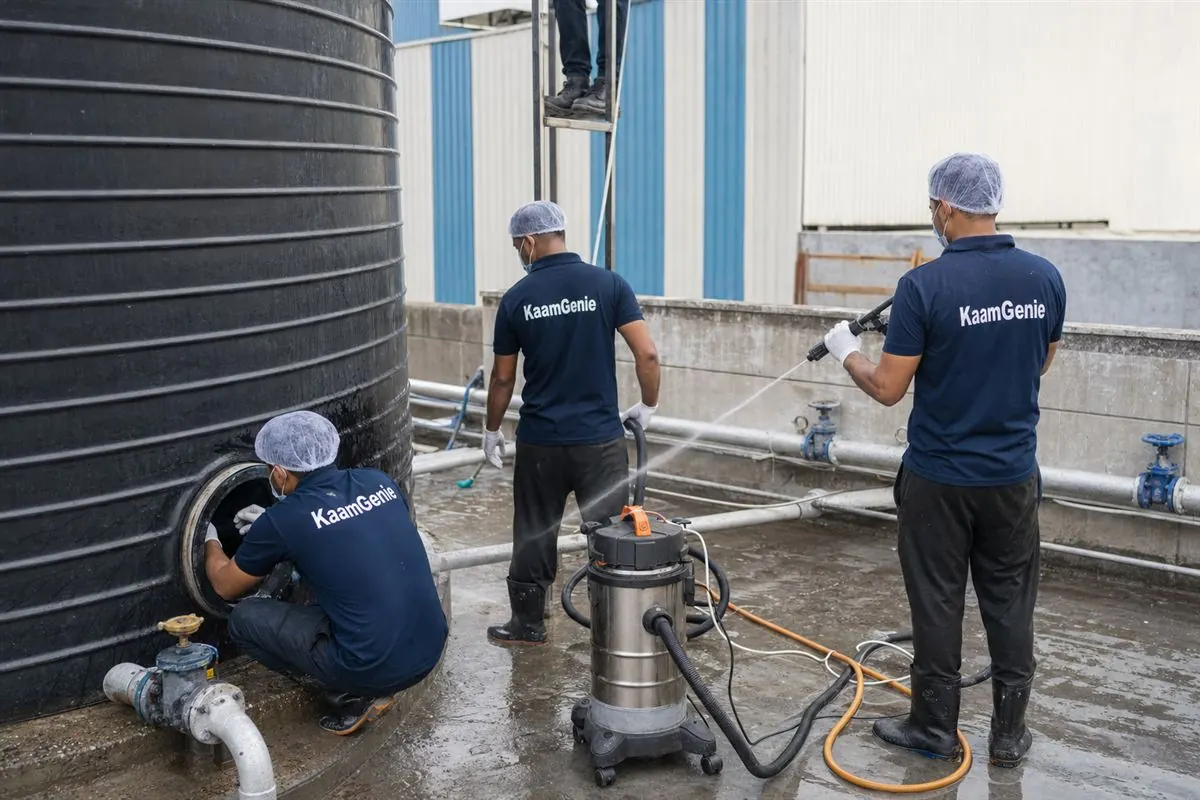
KaamGenie cleans factory and industrial tanks across Delhi’s industrial areas, handling large-capacity sumps and rooftop tanks with a documented method and audit-ready service records. We survey your site, map tanks by use, and propose a schedule that keeps production running — available under an annual maintenance contract at 15–25% below per-visit pricing so cleaning never quietly lapses. Industrial jobs are quoted after a site visit based on tank number, size and access, so you get a realistic figure rather than a guess. Call or WhatsApp 95603 66362, or see our Delhi water-tank cleaning coverage for more. We can align our cleaning records and format with your internal safety and hygiene audit requirements, so the evidence slots straight into the systems your auditors already expect to see.
Frequently asked questions
How often should a factory clean its water tanks?
Quarterly suits most industrial units, tightening to every one to two months where water contacts food, beverages, or sensitive processes, or where borewell water leaves heavy sediment. Drinking-water and canteen tanks should be on the tighter schedule. Any supply change, sediment complaint, or audit finding warrants an off-cycle clean, tracked per tank with its own date.
Is water tank cleaning part of factory compliance in Delhi?
Worker-welfare obligations and hygiene-audit expectations both point to keeping stored water safe, so tank cleaning is a practical compliance task even without one simple universal clause. The defensible approach is a planned, recorded cleaning programme with testing for potable tanks — confirm the exact requirements that apply to you with your safety officer or auditor.
What records do factory hygiene audits expect for tanks?
Auditors look for a managed process: a per-tank log with cleaning date, method, personnel, tank purpose and capacity, before-and-after photos, and periodic water-quality tests for potable tanks. A standard written cleaning procedure that every visit follows turns occasional cleaning into an auditable system that stands up to internal, customer or third-party hygiene assessments.
Should potable and process tanks be treated differently?
Yes. Drinking-water and canteen tanks affect worker health directly, so they get the highest cleaning priority and periodic potability testing. Process, washroom and cooling tanks still need cleaning to protect equipment and output, but their risk differs. Mapping and clearly labelling each tank by use lets you apply the right frequency and rigour to each one.
Can tanks be cleaned without stopping production?
Usually. Units with multiple tanks can clean them in rotation while supply continues from the others. Where that is not possible, plan draining for a shift break, weekend, or maintenance window and confirm dependent process areas can pause safely first. Advance notice to plant and canteen teams keeps workers’ drinking water arranged during the clean.
Can you clean very large industrial tanks and underground reservoirs?
Yes. We size the crew and equipment to the tank, whether it is a big overhead unit or a large underground reservoir, and follow safe entry practice for confined spaces. Share your capacity and tank type when you call 95603 66362 so we bring the right pumps, ladders and safety gear for the job.
Do you provide a service record our EHS and hygiene audits can file?
Yes. Every clean comes with a dated service record and before and after photos, tied to the specific tank. That gives your EHS or hygiene auditor clear evidence of the work, the date and the condition, which is exactly the diligence trail factory inspections expect to see.
We run rotating shifts — can you work around continuous production?
Yes. We plan around your shift pattern and use tank-by-tank sequencing so process water is never fully cut. For canteen or potable tanks we often pick a shift change or low-demand slot. Tell us your production schedule at booking and we build the visit around it.
Our factory is in an industrial area on tanker and borewell supply — does that need special attention?
It does. Tanker and borewell supply in Delhi industrial belts often carries more silt and higher TDS, so tanks scale and settle faster. We scrub deposits thoroughly and can suggest a tighter cleaning interval for potable tanks. A regular schedule keeps canteen and drinking water genuinely safe.
Can we sign an AMC for scheduled factory tank cleaning?
Yes. An annual contract locks in the frequency your potable and process tanks need and keeps continuous records for audits. We remind you before each due date and hold all your tank details on file. Ask for industrial AMC pricing when you call 95603 66362.
Sources & references
- Bureau of Indian Standards (BIS) — IS 10500:2012 is the canonical Indian Standard for drinking water specification, defining acceptable limits for physical, chemical and biological parameters.
- WHO Guidelines for Drinking-water Quality, 4th edition — the global reference for water quality standards, including guidance on safe storage and disinfection.
- Food Safety and Standards Authority of India (FSSAI) — defines water quality requirements for food businesses, including hygiene standards for stored water and acceptable disinfection chemicals.
- WHO Fact Sheet on Drinking Water — overview of safe drinking water requirements and contamination risks.
- CPHEEO — Manual on Water Supply and Treatment — the Government of India’s engineering manual covering tank design, cleaning protocols and disinfection practices.
Last verified: 6 July 2026. If you find any of these links broken, please let us know.