
Key takeaways
- Society tanks fill and empty constantly from mixed sources, so clean every six months — quarterly for busy sumps.
- Schedule around Delhi water timings, clean one tank at a time, and give residents 48–72 hours’ notice.
- Use a society AMC (15–25% off) to turn cleaning into a small, budgeted per-flat cost approved once at the AGM.
- Insist on a full mechanised clean — drain, de-sludge, jet-scrub, vacuum, anti-bacterial treatment — for both tank and sump.
- Keep dated invoices and before-and-after photos on file to prove the committee is doing its job.
This guide is written for RWA members, secretaries and facility managers running residential societies across Delhi. It covers how often society tanks should be cleaned, how to schedule around water timings, what to budget from the maintenance fund, how to vet a contractor, and how to keep records that protect the committee if residents ever question the supply. The goal: clean water for every flat, with zero drama at the AGM.
Why society tanks need more frequent cleaning
A society tank works far harder than a single home’s. It fills and empties many times a day, is fed from multiple sources — DJB supply, tankers and borewell — and serves people with very different water habits. That constant churn and mixing accelerates sediment, biofilm and algae growth. Underground sumps are worse: they’re large, dark, often poorly sealed, and collect silt through the monsoon. For a Delhi society, a six-monthly clean is the minimum; many well-run RWAs move to quarterly for the sump. The consequence of skipping it isn’t just complaints — contaminated common water can trigger stomach illness across multiple families at once, which becomes the committee’s problem overnight.
Scheduling around Delhi water timings
The practical challenge in a society is doing the job without leaving flats dry. Plan the clean for a day the tank can be drained with least disruption — usually mid-morning after the early supply, when consumption dips. Coordinate so the tank refills before evening peak. For a two-tank setup, clean one at a time so supply never fully stops. Steps that keep residents calm:
- Give 48–72 hours’ notice on the society board and WhatsApp group.
- Ask residents to store a bucket or two for the cleaning window.
- Schedule underground sump and overhead tank on the same visit to save a mobilisation.
Budgeting it from the maintenance fund
Tank cleaning should be a planned line item, not a surprise expense the treasurer scrambles for. Because society tanks are large, they’re quoted on inspection rather than a flat rate — but the AMC route is where RWAs save real money. KaamGenie water-tank cleaning in Delhi offers society and commercial AMCs at 15–25% off standard rates, covering two or more scheduled cleans a year on a fixed calendar. That converts an unpredictable cost into a budgeted per-flat amount of a few rupees a month — easy to justify at the AGM. Get a written quote covering both the overhead tank and the underground sump, confirm what’s included, and put the annual figure into the maintenance budget so it’s approved once and never debated again.
Book your water tank cleaning
Trained crew, food-grade process, before/after photos and a service record every job. ₹699 onwards, same-day where possible across Delhi NCR.
What a proper society clean must include
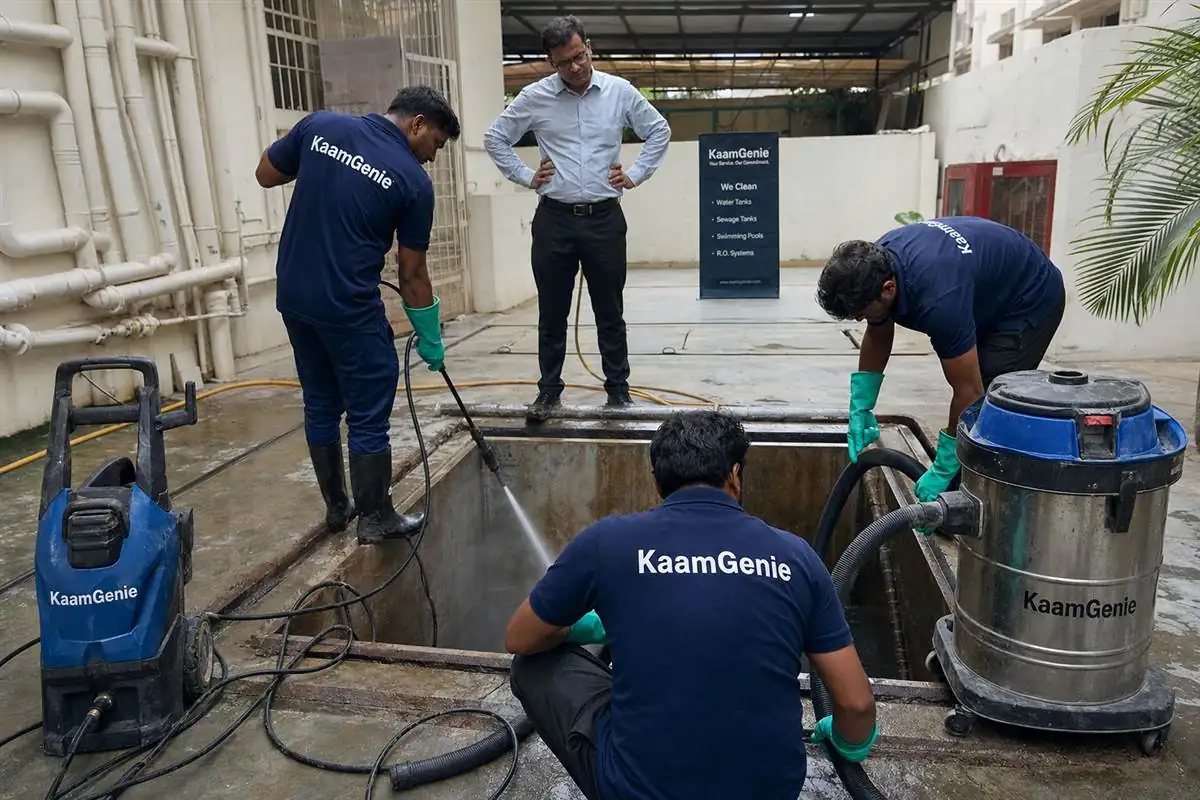
Vet the scope before signing — a broom-and-bucket job is not cleaning. A proper mechanised clean for a society tank should cover complete draining, mechanical removal of sludge and sediment, high-pressure jet scrubbing of walls and floor, vacuuming of residue, an anti-bacterial and anti-fungal treatment, and a final rinse before refilling. For large tanks, confined-space safety matters — the crew should follow proper entry precautions for a deep sump. Ask whether the team documents before-and-after photos; for an RWA, that photographic record is gold when a resident later claims the water is dirty. Insist the same standard applies to the sump as the overhead tank, since the sump is usually the dirtier of the two.
Keeping records that protect the committee
The best defence against “the committee doesn’t do anything” is a paper trail. After every clean, file the invoice, the date, and before-and-after photos in the society records, and post a one-line update to residents: “Overhead tank and sump professionally cleaned on [date], next scheduled for [date].” This does three things — it reassures residents, it proves the committee is discharging its duty, and it creates a maintenance history the next committee inherits. Tie the schedule to the AMC calendar so cleans happen automatically rather than depending on someone remembering. When water quality is ever questioned, you produce dates and photos instead of arguments — and the issue dies quickly.
Handling resident complaints about water
When complaints come, respond with a process, not defensiveness. First, check whether the issue is society-wide or one flat — a single-flat problem usually means that flat’s own storage or plumbing, not the common tank. If several flats report muddy or smelly water and the last clean was months ago, book a clean promptly and communicate the date openly. Between cleans, small fixes help: keep tank lids sealed against dust and birds, check for algae after heavy rain, and flush the sump if a tanker delivered visibly silty water. Being seen to act fast on a fixed schedule is what keeps residents confident — and keeps the water committee off the AGM hot seat.
Frequently asked questions
How often should a Delhi society clean its water tanks?
Every six months is the minimum for a residential society. The overhead tank and underground sump both need it, but because sumps are larger and collect more silt — especially through the monsoon — many well-run Delhi RWAs move the sump to a quarterly schedule. Tie the dates to an annual AMC so cleans happen automatically.
How is society tank cleaning priced compared to a single home?
Society and commercial tanks are quoted on inspection rather than a flat rate because sizes vary widely. The cost-effective route for an RWA is an annual AMC at 15–25% off, covering two or more scheduled cleans. Spread across all flats, it works out to only a few rupees per flat per month — easy to budget.
How do we clean tanks without cutting off water to flats?
Clean one tank at a time in a two-tank setup so supply never fully stops, and schedule mid-morning after the early supply when demand dips, letting the tank refill before evening peak. Give residents 48–72 hours’ notice to store a bucket or two. A good crew finishes an overhead tank the same day.
What records should an RWA keep after each cleaning?
Keep the dated invoice, the cleaning date, and before-and-after photos in the society records, and post a short update to residents with the next scheduled date. This proves the committee is discharging its duty, reassures residents, and gives the next committee a maintenance history to inherit — invaluable if water quality is ever questioned.
Who arranges society tank cleaning — the RWA or individual owners?
Common overhead tanks and shared sumps are the RWA’s responsibility, funded from the maintenance corpus, not by individual owners or tenants. Only a tank exclusive to one flat is that owner’s concern. To book a society clean or set up an AMC, the committee can call KaamGenie on 95603 66362 for an on-site quote.
Can KaamGenie handle a large society with several blocks and sumps?
Yes. We size the crew to your number of overhead tanks and underground sumps and work block by block so no wing loses water for long. The committee gets one consolidated quote and a single set of records covering every tank, which keeps the accounts and follow-up simple.
Do you clean the underground sump as well as the overhead tanks?
Yes, and for a society it matters — the sump is where incoming supply and sediment first collect. We follow safe confined-space practice for underground tanks, scrub and disinfect them, and photograph each one. Cleaning both means the water reaching flats is genuinely fresh, not just the overhead tank.
What proof do residents get that the job was actually done?
Every tank gets before and after photos and a dated service record, which the RWA can circulate on the society group or notice board. That visible evidence usually ends the debate about whether the fund was well spent and reassures residents the shared water is safe.
Do you provide a GST invoice for the society accounts?
Yes. We issue a proper invoice the treasurer can file against the maintenance fund, matched to the tanks cleaned and the date. Combined with the photos and record, it gives the committee a clean audit trail for the annual accounts.
How far ahead should the RWA book to lock a preferred date?
A week’s notice is ideal for a multi-block society so we can send a right-sized crew and you can inform residents of the water-off window. For smaller societies we can often fit you in sooner, sometimes same week. Call 95603 66362 to hold a slot.
Sources & references
- Bureau of Indian Standards (BIS) — IS 10500:2012 is the canonical Indian Standard for drinking water specification, defining acceptable limits for physical, chemical and biological parameters.
- WHO Guidelines for Drinking-water Quality, 4th edition — the global reference for water quality standards, including guidance on safe storage and disinfection.
- Food Safety and Standards Authority of India (FSSAI) — defines water quality requirements for food businesses, including hygiene standards for stored water and acceptable disinfection chemicals.
- WHO Fact Sheet on Drinking Water — overview of safe drinking water requirements and contamination risks.
- CPHEEO — Manual on Water Supply and Treatment — the Government of India’s engineering manual covering tank design, cleaning protocols and disinfection practices.
Last verified: 6 July 2026. If you find any of these links broken, please let us know.