
Key takeaways
- Tank cleaning is usually the landlord’s job as it’s upkeep of a fixed structure — but the rent agreement overrides custom.
- Get one explicit line in your agreement making tank cleaning the owner’s responsibility, twice a year.
- Tenants fairly pay for extra mid-tenancy cleans or problems they caused; splitting the cost is a common compromise.
- Delhi’s intermittent DJB supply, hard borewell water and monsoon silt make six-monthly cleaning essential.
- A standard overhead clean starts from ₹699; forward the fixed quote to settle the who-pays question fast.
This guide breaks down exactly how water-tank cleaning responsibility works between Delhi tenants and landlords — what the rent agreement usually says, when the owner must pay, when the cost falls on you, how much the job costs, and how to settle a dispute without souring the relationship. We’ll also cover shared society tanks, DDA flats and what to do when nobody wants to take charge.
The general rule: structural is the owner’s job
In most Delhi rentals the underlying principle is simple — the landlord owns the fixed structure, so the water tank, pipes and overhead storage are the owner’s responsibility to maintain and clean. Cleaning removes sediment, biofilm and rust that build up inside a fixed asset, which is upkeep of property, not day-to-day consumption. Tenants are usually responsible only for what they consume and for minor wear. That said, “general rule” is not law here — the rent agreement overrides custom. If your contract stays silent, the fair default is that the owner arranges and pays for periodic tank cleaning, especially the first clean when you move into a flat that clearly hasn’t been serviced in a year or more.
What your Delhi rent agreement actually says
Before assuming anything, read the maintenance clause of your agreement. Most Delhi rent agreements split duties into two buckets:
- Owner’s account — structural repairs, waterproofing, tank and pipe maintenance, major plumbing.
- Tenant’s account — electricity, water charges, minor repairs, and “routine upkeep”.
When the cost fairly falls on the tenant
There are genuine situations where a Delhi tenant should foot the bill. If you’ve lived in the flat for a couple of years and the tank was clean when you moved in, an interim clean for your own comfort is reasonably yours. Same if you want extra cleans because your household is large, or you keep the terrace door locked and the owner can’t access the tank. Short-tenure sharing flats and PGs often build the cost into rent already. A fair compromise many Delhi landlords accept is splitting the ₹699–₹1,500 charge 50-50 for a mid-tenancy clean, while the owner fully funds the deep clean between tenants. Keep the receipt either way — it settles arguments at the time of the security-deposit refund.
Book your water tank cleaning
Trained crew, food-grade process, before/after photos and a service record every job. ₹699 onwards, same-day where possible across Delhi NCR.
Delhi water quality makes this non-negotiable
Delhi’s water supply makes tank cleaning more urgent than in many cities, so neither party should keep delaying it. DJB supply arrives intermittently, so tanks sit half-full and stagnant for hours, breeding biofilm. Borewell-fed buildings in outer Delhi push hard water heavy with dissolved salts that cake the tank base. And every monsoon, silt and dust wash in through loose lids. The result is sediment, a musty smell, and sometimes visible worms or algae — especially in low-lying areas like parts of East Delhi. A tank left uncleaned for a year is a real health risk for whoever drinks from it. Whichever way the bill is split, the tank genuinely needs professional cleaning every six months in Delhi conditions.
What a professional clean costs and includes
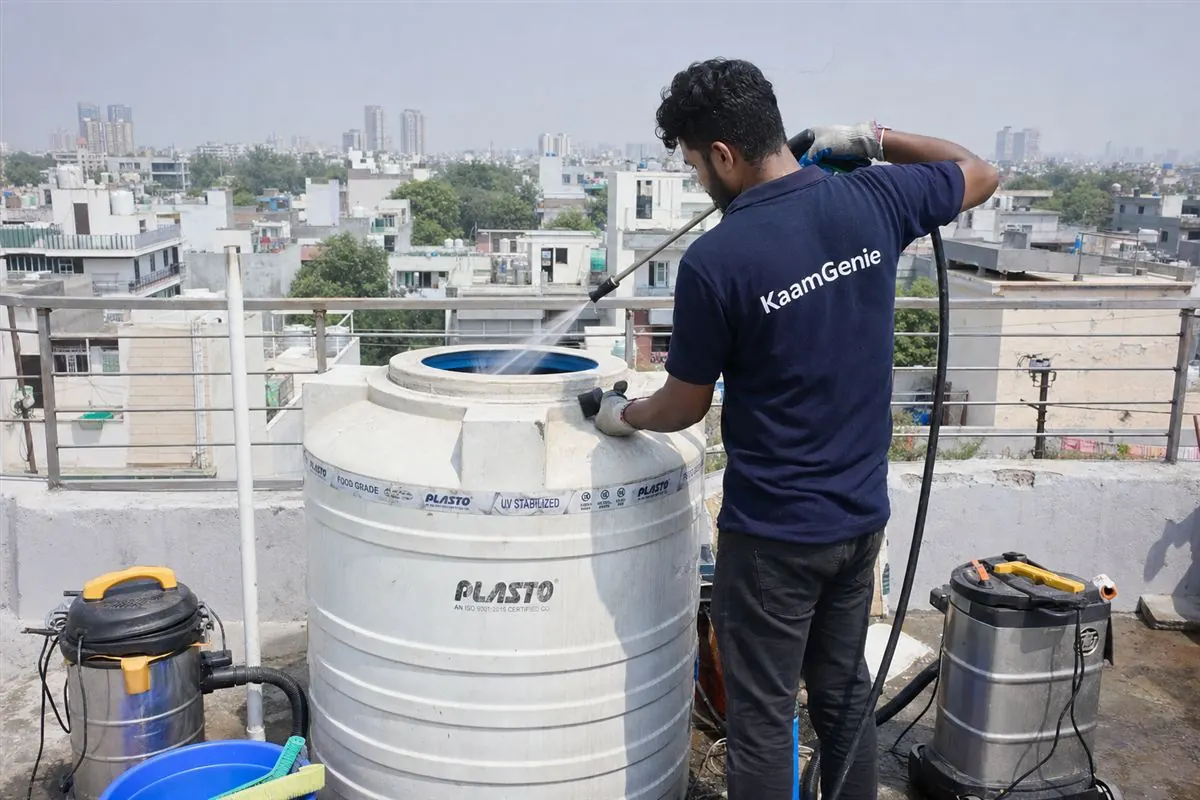
Knowing the real price stops the “it’s too expensive” excuse from either side. KaamGenie water-tank cleaning in Delhi starts from ₹699 for a standard overhead tank, with underground sumps typically ₹1,500–₹2,500 depending on size and access. The job is mechanised, not just a rinse — draining, sludge and sediment removal, high-pressure wall scrubbing, vacuuming, anti-bacterial treatment and a final rinse, so the tank is safe the same day. For shared buildings, ask about the AMC option — two scheduled cleans a year at 15–25% off, invoiced to the owner. Because it’s a fixed, transparent price, it’s easy to forward the exact quote to a landlord and get sign-off without haggling.
How to raise it with your landlord without a fight
Handle the conversation with evidence, not accusation. Send a short, polite message: mention the water smells or looks off, that it’s been months since the last clean, and attach a photo if the water is visibly dirty. Include a fixed quote so the owner sees the exact cost upfront — vagueness is what makes landlords stall. If the agreement puts it on them, reference the clause. If the owner refuses outright and the water is genuinely unsafe, you can get it cleaned, keep the receipt, and adjust it against rent by mutual agreement — but always inform them in writing first. Most Delhi landlords say yes quickly once they see a ₹699 fixed price rather than an open-ended “get someone to clean it.”
Frequently asked questions
Is the landlord legally required to clean the water tank in Delhi?
There’s no single Delhi law mandating tank cleaning, but as the tank is a fixed part of the property, maintaining it is customarily the owner’s duty. Your rent agreement is the deciding document — if it assigns tank maintenance to the owner, that’s binding. If it’s silent, the fair default is that the landlord funds periodic cleaning.
Can I deduct tank-cleaning cost from my rent?
Only by mutual agreement and after informing the landlord in writing. If the water is genuinely unsafe, the responsibility is clearly the owner’s, and they refuse to act, you may clean it, keep the receipt, and adjust it against rent. Deducting without prior notice risks a dispute, so always send a message and the quote first.
How often should a rented flat’s tank be cleaned in Delhi?
Every six months is the right cadence for Delhi. Intermittent DJB supply leaves tanks stagnant, hard borewell water leaves deposits, and monsoon brings silt. Twice-yearly professional cleaning keeps the water safe. In older buildings or areas with poor supply quality, consider it a little more often.
Who pays for tank cleaning in a shared or DDA flat building?
For a shared overhead tank serving multiple flats, the cost is normally split among owners or handled by the RWA from maintenance funds, not by individual tenants. In DDA flats with a common tank, it’s a building-level expense. Only a tank exclusive to your unit becomes a direct owner-versus-tenant question.
What does KaamGenie tank cleaning cost for a rental in Delhi?
A standard overhead tank starts from ₹699 and underground sumps run ₹1,500–₹2,500 depending on size and access. The fixed, transparent price makes it easy to forward the exact quote to a landlord for approval. To book or get a quote, call KaamGenie on 95603 66362.
The tank looks fine from outside — how do I know it actually needs cleaning?
You often can’t tell from the lid. Warning signs are a faint smell, particles or a yellow tinge in stored water, or filters clogging fast. The real test is opening it up; our crew photographs the inside before starting, so you and your landlord can see the actual state before deciding.
If my landlord refuses, can I just get it cleaned myself?
You can arrange a clean directly — it starts from ₹699 for a home tank — and keep the invoice and photos. Whether you can recover the cost depends on your rent agreement and prior notice to the owner, so it is best to inform them in writing first. Many tenants simply pay for the peace of mind.
How long does the water stay off if I book it in my rented flat?
Usually just the cleaning window — around 60–90 minutes for a typical overhead tank — after which it refills from your normal supply. We time the visit when the tank is naturally low so you barely notice the interruption. You don’t need to be an owner to book it.
I’m on a short lease — is it even worth cleaning the tank?
If the water shows any sign of sediment or smell, yes. You drink and cook with it every day, so even a few months of clean water is worth ₹699. A single clean plus a fresh filter can noticeably improve the water without you committing to anything long-term.
Can you deal with the landlord or caretaker directly for access?
We can coordinate with whoever holds the terrace or tank keys once you set it up. Just give us the caretaker’s contact at booking on 95603 66362 and tell them to expect us. We share the before and after photos with you, which you can forward to the owner as proof.
Sources & references
- Bureau of Indian Standards (BIS) — IS 10500:2012 is the canonical Indian Standard for drinking water specification, defining acceptable limits for physical, chemical and biological parameters.
- WHO Guidelines for Drinking-water Quality, 4th edition — the global reference for water quality standards, including guidance on safe storage and disinfection.
- Food Safety and Standards Authority of India (FSSAI) — defines water quality requirements for food businesses, including hygiene standards for stored water and acceptable disinfection chemicals.
- WHO Fact Sheet on Drinking Water — overview of safe drinking water requirements and contamination risks.
- CPHEEO — Manual on Water Supply and Treatment — the Government of India’s engineering manual covering tank design, cleaning protocols and disinfection practices.
Last verified: 6 July 2026. If you find any of these links broken, please let us know.