
Key takeaways
- In a kitchen, water safety is food safety — a dirty tank is a real FSSAI risk
- Clean quarterly as a baseline; every 1–2 months for high-volume or cloud kitchens
- Keep a dated cleaning log plus periodic water-quality tests for inspections
- Map every station where tank water touches food and protect them at source
- Avoid the classics: skipping the sump, cleaning only on symptoms, keeping no records
- Schedule draining for closed or off-peak windows; AMC 15–25% off
We cover why water sits at the heart of food-safety compliance, how often restaurant tanks should be cleaned, the records that support an FSSAI inspection, a station-by-station checklist for where tank water actually reaches food, common mistakes that trip kitchens up, and how to schedule cleaning without shutting the kitchen. It is framed around real hygiene obligations and sensible practice rather than invented clause numbers — confirm your exact FSSAI requirements with your food-safety supervisor.
Why water is central to food-safety compliance
FSSAI hygiene expectations for food businesses rest on a simple idea: everything that touches food must be safe — and water touches nearly everything in a working kitchen. It washes produce and utensils, goes directly into cooking and beverages, makes ice, and cleans surfaces and staff hands. If the storage tank feeding all of that is contaminated, no amount of surface cleaning downstream can fully compensate for it, because the problem is being reintroduced at the source with every tap that opens. That is why a dirty tank is a genuine food-safety risk, not a background utility issue to be dealt with someday. Treating tank hygiene as part of your food-safety management — with defined cleaning, records and periodic testing — is the honest way to meet the spirit of FSSAI requirements and, more importantly, to keep your guests genuinely safe from a preventable problem.
How often restaurant tanks should be cleaned
Because tank water reaches food directly and continuously, restaurants should clean far more often than ordinary buildings. A quarterly cycle is a sensible baseline, tightening to every one to two months for high-volume kitchens, cloud kitchens running almost around the clock, or premises where borewell water leaves heavy sediment behind. Any off note — cloudy water, an odour, a failed test, or a supply disruption — should trigger an immediate clean regardless of where you are in the schedule, because in a kitchen the water reaches a customer’s plate quickly. Do not overlook the underground sump, which collects the most silt and is the easiest tank to forget. Tracking each tank’s cleaning date keeps you honest and audit-ready. The right frequency reflects how heavily your kitchen runs and how fast your specific tanks foul, not a bare minimum done only in the week before an inspection is due.
Records that support an FSSAI inspection
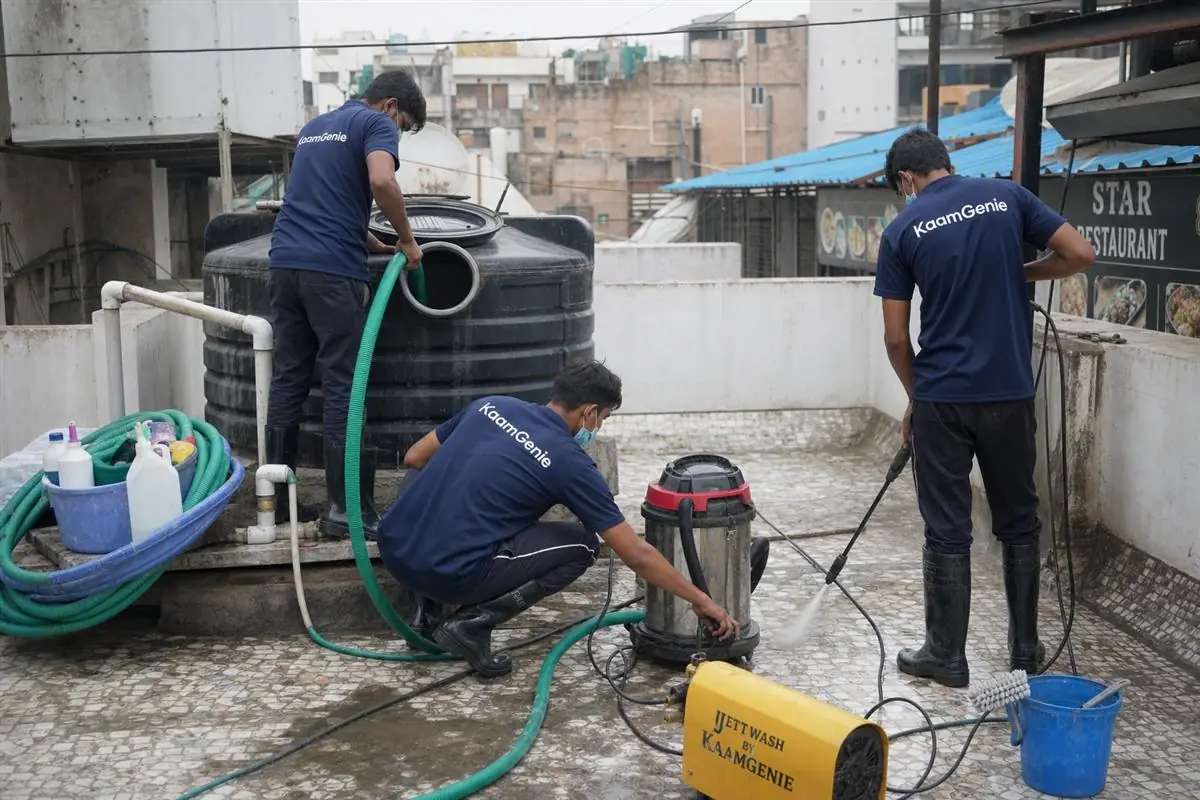
Inspectors look for a managed, documented hygiene system rather than a one-off effort the day before they arrive. Keep a tank-cleaning log with the date, method, personnel, tank capacity, and before-and-after photos, and pair it with periodic water-quality testing so you can show the water is actually safe, not merely that a tank was scrubbed at some point. A written cleaning procedure your team follows every single time turns occasional cleaning into a repeatable process an auditor can trust and trace. Our crews follow a consistent method on each tank-cleaning visit and provide a service record for your food-safety file. When an inspector asks how you assure water safety, dated records plus test results answer far more convincingly than a verbal assurance, and they demonstrate the diligence that keeps a food licence in good standing.
Book your water tank cleaning
Trained crew, food-grade process, before/after photos and a service record every job. ₹699 onwards, same-day where possible across Delhi NCR.
Station-by-station water checklist
It helps to map exactly where tank water reaches food and check each point, because a single clean tank protects all of them at once rather than needing separate fixes downstream:
- Prep sinks — washing produce, meat and utensils before cooking
- Cooking line — water added directly to dishes, stocks and sauces
- Beverage and ice — drinking water, dispensers and ice machines
- Dishwashing — final rinse hygiene depends entirely on clean supply
- Handwashing stations — staff hygiene, and therefore food safety, starts here
Common mistakes Delhi kitchens make
A few recurring errors trip up otherwise careful Delhi kitchens. The first is cleaning the rooftop overhead tank while ignoring the underground sump that feeds it, which just recycles silt straight back up into supposedly clean water. The second is treating tank cleaning as reactive — only booking it once water already looks or smells wrong, by which point the risk has already reached the kitchen. The third is keeping no records, so there is nothing to show an inspector and no way to prove a routine exists. The fourth is relying on tanker top-ups of uncertain quality during shortages without accounting for what they bring into the tank. Avoiding these four is most of the battle: clean both tanks, clean on a schedule rather than on symptoms, document every visit, and stay alert to what your supplementary water sources are adding to your storage.
Scheduling cleaning without shutting the kitchen
Restaurants can rarely afford a full water shutdown during service hours, so cleaning has to be planned around the operating rhythm. Schedule tank draining for a closed period, an off-peak morning before prep begins, or a weekly day off, and where you have multiple tanks, clean them in rotation so supply continues from the others. Store enough drinking and prep water to bridge the drain-and-refill window, and brief the kitchen team in advance so nobody is caught out mid-service. A well-timed clean fits neatly into the day rather than disrupting covers or delaying orders. This bit of planning is exactly what separates a kitchen that stays continuously audit-ready from one that keeps skipping cleaning because “there’s never a good time” — in reality there always is one, with a little coordination and a schedule agreed in advance with your team.
Booking restaurant tank cleaning with KaamGenie
KaamGenie cleans tanks for restaurants, cafes, cloud kitchens and hotels across Delhi, with a documented method and service records that slot neatly into your FSSAI file. We survey your setup, prioritise the tanks feeding your kitchen and beverage stations, and can run a fixed schedule under an annual maintenance contract at 15–25% below per-visit pricing so cleaning never slips in the run-up to an inspection. Food-business jobs are quoted after a quick site visit based on tank size and access, so the figure is realistic. Call or WhatsApp 95603 66362, or see our Delhi water-tank cleaning coverage for details. We are happy to align our records and cleaning timing with your food-safety supervisor’s needs, so the evidence fits how your kitchen already runs its compliance.
Frequently asked questions
How often should a Delhi restaurant clean its water tank?
Quarterly is a sensible baseline, tightening to every one to two months for high-volume or continuously running cloud kitchens, or where borewell water leaves heavy sediment. Clean immediately if water is cloudy or smells off, a test fails, or supply is disrupted. Track each tank’s date and do not overlook the underground sump, which foul the fastest.
Does FSSAI require water tank cleaning?
FSSAI hygiene expectations treat safe water as fundamental to a food business, so keeping storage tanks clean is part of meeting them, even without quoting a single specific clause. The practical approach is a documented cleaning routine with periodic water testing as part of your food-safety management. Confirm the exact requirements with your food-safety supervisor.
What tank records help during an FSSAI inspection?
Keep a cleaning log with the date, method, personnel, tank capacity and before-and-after photos, paired with periodic water-quality test results. A written cleaning procedure your team follows every time makes the process repeatable and auditable. Together these show an inspector that water safety is actively managed and documented, not just claimed on the day.
Which parts of my kitchen depend on a clean tank?
Nearly all of them: prep sinks for washing produce and utensils, the cooking line where water enters dishes and stocks, beverage and ice stations, the dishwasher’s final rinse, and handwashing points for staff hygiene. Because one tank feeds all these, cleaning it at source protects every station at once rather than fixing issues one by one downstream.
Can I clean the tank without closing the restaurant?
Usually yes. Schedule draining for a closed period, an off-peak morning, or your weekly day off, and if you have multiple tanks, clean them in rotation so supply continues. Store enough drinking and prep water to bridge the drain-and-refill window and brief the kitchen in advance so service carries on unaffected throughout.
Can you clean our restaurant tank overnight so we lose no covers?
Yes. Most Delhi kitchens prefer a late-night or early-morning slot so the tank is done before service. Our crew works tank by tank and finishes an overhead tank in about 60–90 minutes, so water is back well before prep starts. Book your window on 95603 66362.
Is your process safe for the water that touches food and ice?
Yes. We use a food-grade cleaning and disinfection process and rinse out all residue, so the refilled water is fit for cooking, washing produce and making ice. That directly supports the potable-water expectation an FSSAI inspection has for a licensed kitchen.
Do you give a GST invoice and record we can keep in the FSSAI file?
Yes. You get a proper invoice, a dated service record and before and after photos for each tank. Filed together in your hygiene folder, they give an inspector immediate proof of routine tank maintenance rather than a verbal claim.
Should the kitchen and the staff-washroom tanks be cleaned together?
Ideally on the same visit, yes, so nothing gets forgotten, but we keep a separate record for each so your paperwork is clear. Any tank feeding food prep is the priority; we make sure it is scrubbed, disinfected and documented as potable-ready.
Can we move to a fixed quarterly schedule instead of ad-hoc calls?
Yes, and most compliant kitchens do. A quarterly or as-needed AMC means cleaning never slips through a busy month, and you build a continuous dated trail auditors like to see. We hold your tank details and remind you before each visit is due — just ask when you call.
Sources & references
- Bureau of Indian Standards (BIS) — IS 10500:2012 is the canonical Indian Standard for drinking water specification, defining acceptable limits for physical, chemical and biological parameters.
- WHO Guidelines for Drinking-water Quality, 4th edition — the global reference for water quality standards, including guidance on safe storage and disinfection.
- Food Safety and Standards Authority of India (FSSAI) — defines water quality requirements for food businesses, including hygiene standards for stored water and acceptable disinfection chemicals.
- WHO Fact Sheet on Drinking Water — overview of safe drinking water requirements and contamination risks.
- CPHEEO — Manual on Water Supply and Treatment — the Government of India’s engineering manual covering tank design, cleaning protocols and disinfection practices.
Last verified: 6 July 2026. If you find any of these links broken, please let us know.