
The short version
- Disinfection is the final step of a real clean — it’s what kills bacteria after the physical cleaning removes the dirt.
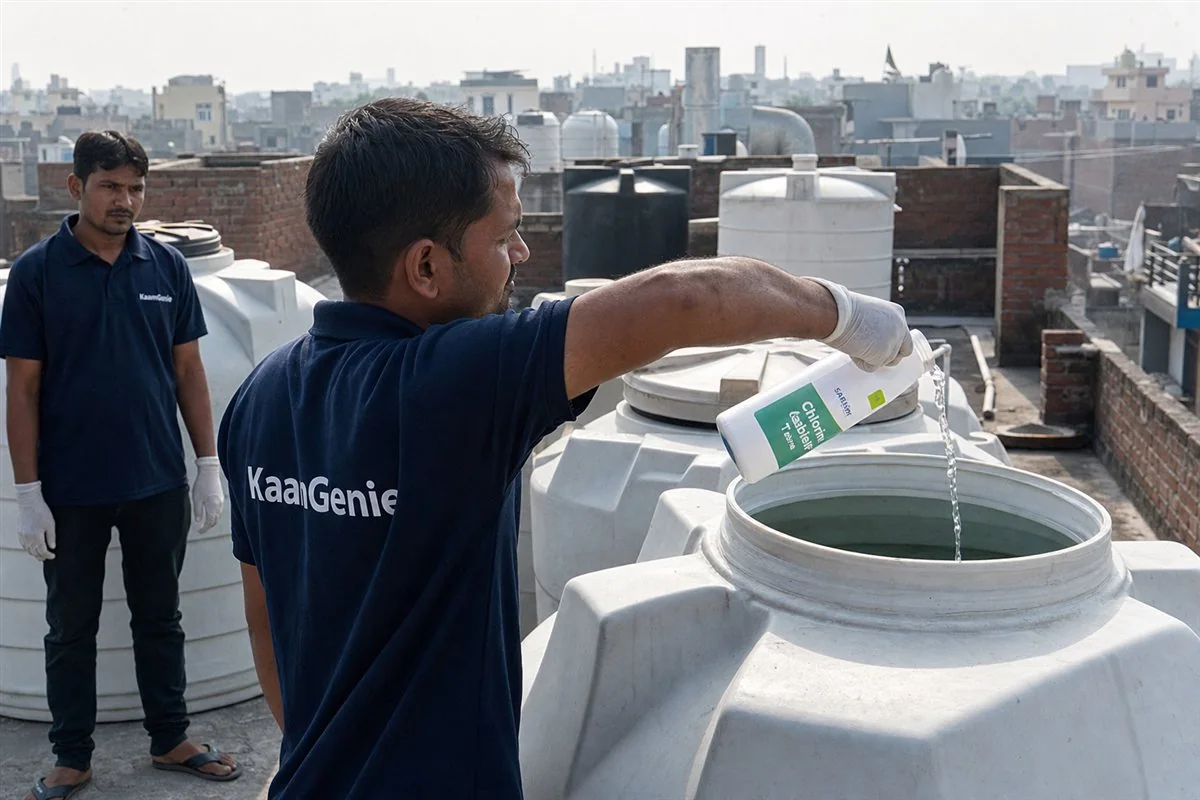
- Chlorination is the standard method: food-grade sodium hypochlorite at roughly 50–100 ppm available chlorine on the surfaces.
- Contact time is everything — the chlorine must stay wet on the walls for 15–30 minutes before rinsing. Skip the dwell and you’ve applied chemical without disinfecting.
- A trace residual is good: after rinsing and refill, around 0.2 mg/L free chlorine (per BIS guidance) keeps the water protected.
- UV and ozone are alternatives for large systems; for a home or society tank, food-grade chlorine or hydrogen peroxide is the proven choice.
Disinfection only works on an already-clean surface. Pouring chlorine into a dirty tank is close to useless — clean first, disinfect second.
| Method | How it works | Leaves a residual? | Best for |
|---|---|---|---|
| Food-grade chlorine (sodium hypochlorite) | Applied to clean surfaces at 50–100 ppm, 15–30 min contact, then rinsed | Yes — small protective trace | The standard for homes, societies and most tanks |
| Food-grade hydrogen peroxide | Chlorine-free oxidiser; breaks down to water and oxygen | No lingering residual | Premium jobs, customers sensitive to chlorine smell |
| UV (ultraviolet) | Light inactivates bacteria in flowing water | No | Point-of-use purifiers and supply lines, not the tank itself |
| Ozone | On-site generated oxidising gas dosed into water | Very short-lived | Large commercial / industrial systems only |
| Scented bleach / hardware chlorine | Unmeasured pour of non-food-grade product | Unpredictable | Nothing — never use on a drinking-water tank |
Want it cleaned AND properly disinfected?
Food-grade chlorination, correct dose, full contact time, rinse never skipped — documented every job. ₹699 onwards.
Why disinfection is the step that actually matters
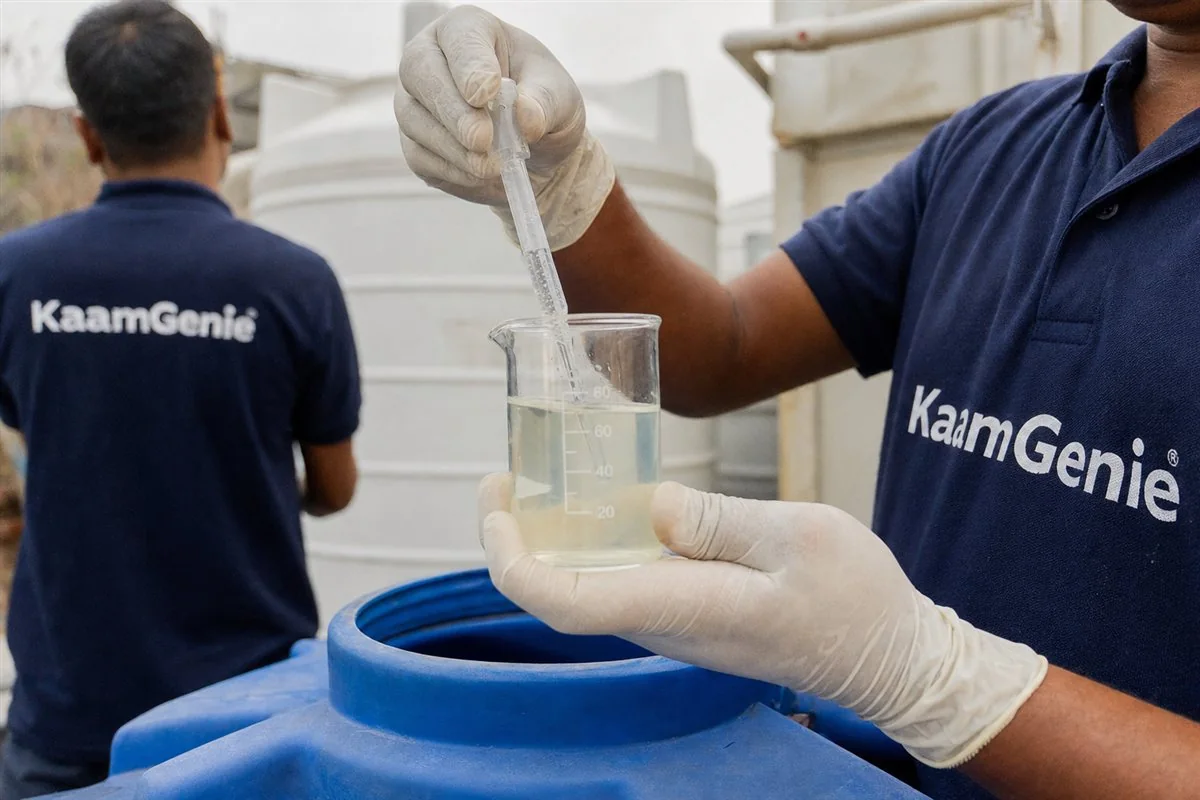
Here’s the uncomfortable truth most cleaners won’t tell you: a tank can look spotless and still grow bacteria. Scrubbing and jet washing get rid of the sludge, the scale and the visible biofilm — but the surfaces they leave behind still carry living organisms you can’t see. E. coli, salmonella, legionella and the other bugs behind Delhi’s stomach upsets and skin complaints don’t care how shiny the wall is.
That’s what disinfection is for. It’s the chemical step that kills what the physical clean exposed. Think of it as two different jobs: the cleaning makes the surface clean, and the disinfection makes the water safe. One without the other is half a job. A tank that’s scrubbed but not disinfected is cosmetic; a tank that’s “disinfected” while still dirty is close to pointless, because chlorine reacts with the leftover muck instead of killing bacteria.
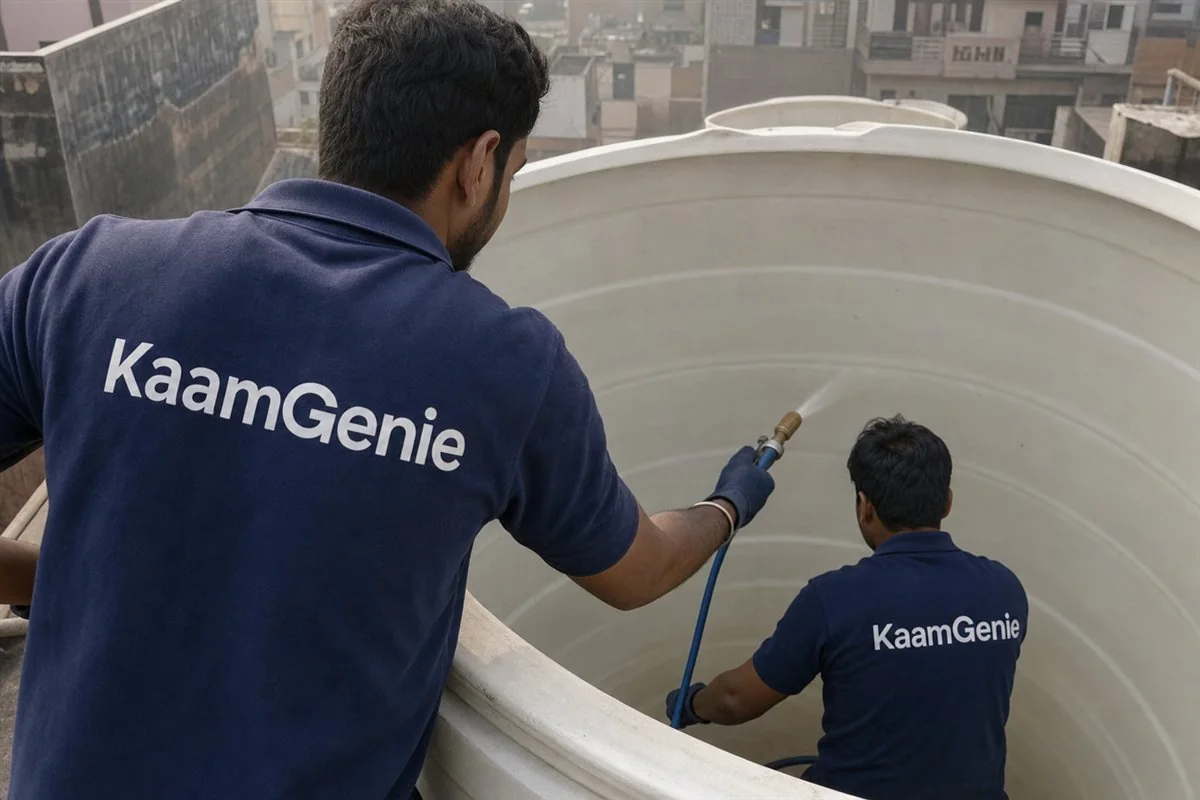
This is why the order is fixed and non-negotiable: clean first, disinfect second. The full sequence — drain, scrub, jet wash, vacuum, disinfect — is laid out in our 8-step cleaning process, and disinfection sits right at the end for a reason. It’s the last thing that happens before refill, and it’s the step that gives the whole clean its meaning.
How chlorination actually works
Chlorination is the most common and best-understood way to disinfect a tank. The chemical is food-grade sodium hypochlorite — liquid chlorine in its purest form, the same family of disinfectant Delhi Jal Board (DJB) uses to treat the municipal supply before it ever reaches your building. It’s cheap, effective, proven, and it leaves a small protective residual behind. For the vast majority of tanks, it’s the right answer.
Two numbers decide whether it works, and they work together:
- Concentration: for surface disinfection of an emptied, scrubbed tank, the target is roughly 50–100 ppm available chlorine on the walls and floor. This is a surface treatment on an empty tank — not a dose poured into water you’re about to drink.
- Contact time: the solution has to stay wet on the surfaces for 15–30 minutes. Chlorine kills organisms over time, not on contact. Rinse it off after five minutes and you’ve applied chemical without actually disinfecting anything.
- Rinse: after the dwell, the tank is rinsed with clean water and vacuumed so only a trace residual remains before refill.
If you want the deeper detail on the chemistry — food-grade versus industrial grade, hydrogen peroxide, and the things you must never pour in — we’ve covered it separately in our guide to safe water tank cleaning chemicals. The headline rule worth repeating here: only food-grade product certified for potable-water contact goes anywhere near a drinking-water tank.
Contact time: the step everyone fakes
If there’s one thing that separates a real disinfection from a fake one, it’s contact time. It’s invisible, it takes 15–30 minutes of doing apparently nothing, and that’s exactly why corner-cutters skip it. A cleaner in a hurry sprays a bit of chlorine and rinses straight away so they can move to the next job — and from the outside it looks identical to a proper disinfection.
The difference is in the water. Disinfection is a chemistry problem, and chemistry needs time. The chlorine has to sit in contact with the bacteria long enough to break them down. Cut that window short and you’ve got a tank that smells faintly of chlorine but still carries a live bacterial load — arguably worse than an honest no-disinfection job, because now you think it’s safe.
This is also why a genuine residential clean can’t be done in 20 minutes. When our crew applies the disinfectant and then waits, that pause isn’t idleness — it’s the part of the job that’s actually working. If you’re home during a clean and the “disinfection” takes thirty seconds, you didn’t get one.
What a safe chlorine residual looks like
A common worry is the opposite of under-dosing: “won’t all that chlorine make my water unsafe to drink?” It’s a fair question, and the answer is in how disinfection is finished.
Because the disinfectant is rinsed out before the tank is refilled, what you’re left with isn’t a tank full of chlorine — it’s fresh water carrying at most a trace. And that trace is actually desirable. BIS IS 10500:2012, the Indian drinking-water standard, treats a small free-chlorine residual — guideline around 0.2 mg/L at the point of use — as a good thing, because it keeps the water protected on its way to your tap. A correctly disinfected and rinsed tank lands right in that safe zone.
The problem is never careful chlorination done by measurement. The problem is the unmeasured bleach-dump — a hardware-shop bottle tipped into a full tank with no reference to concentration, contact time or rinsing. That either does nothing useful or over-chlorinates the water you’re about to drink. The whole point of doing it by the numbers is to land on that protective trace, not above it and not below it.
After disinfection: when is the water safe to use?
Practical timings after a tank is refilled following disinfection:
- Non-drinking use (bathing, washing, cleaning, plants): safe to use immediately.
- Drinking: give it about 2–3 hours, then run it through your RO/UV purifier as you normally would. Any faint chlorine smell dissipates in that window — that’s the trace residual doing its protective job, and it’s normal.
A point worth making clearly: disinfecting the tank and purifying at the tap are not the same thing, and one doesn’t replace the other. Tank disinfection keeps your stored water clean and protected. Your home RO/UV unit treats the water at the final point of use. They work as a team — a clean tank means your purifier isn’t fighting a losing battle against a contaminated source upstream.
Re-chlorination & the Delhi tanker problem
Disinfection isn’t only the closing step of a full clean — sometimes a tank needs a standalone re-chlorination between cleans, and in Delhi that comes up more than you’d think. The trigger is usually a contamination event: a water tanker fill of doubtful quality, water entering during plumbing work, a lid left open, or a tank that’s sat unused and then been refilled.
The tanker angle is a real Delhi issue. Through the summer water crisis, large parts of outer and unauthorised colonies — and plenty of South Delhi farmhouses and bungalows around Chattarpur and Sainik Farms with their own large reservoirs — lean heavily on private water tankers and borewell groundwater. The quality of that water varies enormously. It can arrive with sediment and a higher bacterial load than DJB’s treated piped supply, and it goes straight into your storage. A freshly cleaned, disinfected tank gives that water a clean, protected place to sit — and a quick re-chlorination after a questionable fill is a sensible precaution.
Disinfection doesn’t magically fix bad source water on its own — if the water arriving is heavily contaminated, that’s a source problem. But it keeps your stored water from getting steadily worse, which is exactly what an un-disinfected tank does over weeks of refills. For high-occupancy buildings — PGs, tenant-heavy builder floors, DDA flats and cooperative group-housing societies, and the high-rise towers across Dwarka and outer Delhi — that protection matters even more, because more people are drinking from the same store.
Chlorine, hydrogen peroxide, UV or ozone — which method?
Chlorine is the default, but it isn’t the only way to disinfect. Here’s how the options actually compare for a Delhi tank:
- Food-grade chlorine (sodium hypochlorite): cheap, proven, leaves a small protective residual. The workhorse for homes and societies.
- Food-grade hydrogen peroxide: chlorine-free, breaks down into nothing but water and oxygen, leaves no chlorine taste or smell. Popular for premium jobs and customers sensitive to chlorine odour, but it costs more and doesn’t leave a protective residual.
- UV (ultraviolet): inactivates bacteria in flowing water — your home purifier, or a large supply line. It doesn’t scrub a dirty tank and doesn’t leave a residual, so it complements tank disinfection rather than replacing it.
- Ozone: a powerful oxidiser generated on-site, used mainly on large commercial and industrial systems. Effective but capital-heavy and overkill for a rooftop Sintex tank.
For a typical Delhi home or society tank, a short, correctly-dosed application of food-grade chlorine or hydrogen peroxide remains the practical, proven choice. The fancy equipment-based methods are tools for big institutional systems, not your overhead tank. If you want to see how disinfection fits alongside the manual, jet-wash and vacuum stages, our breakdown of water tank cleaning methods used in Delhi walks through each one and when it’s used.
Why contact time decides the result
Disinfection effectiveness against common waterborne bacteria, by how the chlorine is applied
Illustrative comparison. The takeaway: disinfection only works at the right concentration AND for the full contact time, on an already-clean surface. Miss any one of those and you’ve applied chemical without disinfecting.
Not sure your last clean was really disinfected?
We dose food-grade chlorine by measurement, hold the full contact time, and never skip the rinse. Standard residential cleaning ₹699 onwards.
Get it cleaned and disinfected properly across Delhi
Disinfection is the quiet step that decides whether a tank clean was worth anything. It’s also the easiest to fake, because the part that matters — the contact time — is invisible. Our crews carry only food-grade disinfectant, dose it by measurement, hold the full dwell, and never skip the rinse, with before-and-after photos on every job so you can see the difference rather than take it on trust.
See pricing and book on our water tank cleaning in Delhi hub, or jump straight to your area — we cover South Delhi bungalows and farmhouses, the high-rise societies of Dwarka, and government and institutional housing around R.K. Puram. We’re part of KaamGenie’s wider water tank cleaning services across Delhi NCR. And if you’re not sure your tank is even due, here are the signs your tank needs cleaning urgently.
Frequently asked questions
What is the difference between cleaning and disinfecting a water tank?
Cleaning is physical — draining, scrubbing, jet washing and vacuuming to remove sludge, scale and biofilm from the surfaces. Disinfection is chemical — applying a measured dose of food-grade chlorine (or hydrogen peroxide) to the now-clean surfaces to kill the bacteria a scrub alone cannot. Cleaning makes the tank look clean; disinfection makes the water safe. You need both, and disinfection only works properly once the tank is already physically clean.
What does chlorination of a water tank actually mean?
Chlorination means applying food-grade sodium hypochlorite (liquid chlorine) to a cleaned, emptied tank at a controlled concentration, leaving it in contact with the walls and floor for a set time so it kills bacteria, then rinsing. It’s the same disinfecting chemistry Delhi Jal Board uses to treat municipal water, scaled down to your tank. It’s a surface and dwell treatment on an empty tank — not a matter of tipping bleach into water you’re about to drink.
How long does chlorine need to stay in the tank to disinfect it?
Contact time is what actually does the disinfecting. For surface disinfection at roughly 50–100 ppm available chlorine, professionals hold a contact time of about 15–30 minutes before rinsing. Chlorine kills organisms over time, not instantly — rinse it off after five minutes and you’ve applied chemical without disinfecting. Skipping or shortening contact time is the single most common shortcut behind a clean that looks done but isn’t.
What chlorine residual is considered safe in drinking water?
After a correctly disinfected tank is rinsed and refilled, only a trace residual should remain. BIS IS 10500:2012 treats a small free-chlorine residual — guideline around 0.2 mg/L at the point of use — as desirable, because it keeps the water protected on its way to your tap. That faint, protective trace is normal. A tank where bleach was dumped in without measuring sits well outside that safe zone, which is exactly why dosing and rinsing are done by measurement.
Is the water safe to use immediately after disinfection?
For non-drinking uses like bathing, washing and cleaning, the refilled water is fine to use straight away. For drinking, give it about 2–3 hours and run it through your RO/UV purifier as usual — any faint chlorine smell dissipates in that window. Because the disinfectant is rinsed out before the tank is refilled, what you’re left with is fresh water carrying at most a protective trace residual.
How often should a water tank be disinfected in Delhi?
Disinfection happens as the final step of every full clean, so the practical answer is the same as your cleaning frequency — for most Delhi homes that’s roughly every six months. Tanks fed by water tankers or borewell groundwater, high-occupancy buildings like PGs and societies, and tanks during the summer water crisis benefit from more frequent disinfection. A standalone re-chlorination is also worth doing after any contamination event, such as a tanker fill of doubtful quality or water entering during plumbing work.
Can I disinfect my tank myself with household bleach?
We strongly advise against it. Scented household bleach isn’t food-grade — it carries fragrances and stabilisers you can’t fully rinse out — and hardware-shop bleach varies wildly in strength, so an unmeasured pour either does nothing useful or over-chlorinates the water. Disinfection also only works on an already-clean surface and needs the correct contact time and rinse. For a drinking-water tank, food-grade chlorine dosed and timed correctly is the only safe approach.
Is UV or ozone better than chlorine for tank disinfection?
They’re different tools. UV and ozone disinfect water as it flows or for large institutional systems, but neither scrubs a dirty tank or leaves a protective residual the way chlorine does. UV at the point of use — your home purifier — complements tank disinfection rather than replacing it. For a typical Delhi home or society tank, a short, correctly dosed application of food-grade chlorine or hydrogen peroxide remains the practical, proven method; UV and ozone are for big systems.
Does tanker-supplied water need extra disinfection?
Often, yes. During Delhi’s summer water crisis many homes and colonies in outer and unauthorised areas rely on private water tankers, and the quality of that water varies a lot. Tanker water can arrive with sediment and a higher bacterial load, so a freshly cleaned and disinfected tank gives it a clean, protected place to sit — and a standalone re-chlorination after a doubtful fill is a sensible precaution. Disinfection doesn’t fix bad source water by itself, but it keeps your stored water from getting worse.
Sources & references
- Bureau of Indian Standards (BIS) — IS 10500:2012 is the canonical Indian Standard for drinking water specification, defining acceptable limits for physical, chemical, and biological parameters, including residual free chlorine.
- WHO Guidelines for Drinking-water Quality, 4th edition — the global reference for water quality standards, including guidance on storage, disinfection and chlorine dosing.
- Food Safety and Standards Authority of India (FSSAI) — defines water quality requirements for food businesses, including hygiene standards for stored water and acceptable disinfection chemicals.
- WHO Fact Sheet on Drinking Water — overview of safe drinking water requirements and contamination risks.
- CPHEEO — Manual on Water Supply and Treatment — the Government of India’s engineering manual covering tank design, cleaning protocols, and disinfection practices.
Last verified: 30 June 2026. If you find any of these links broken, please let us know.