

Quick answer — FSSAI pest control compliance for Delhi restaurants
- What FSSAI checks: Treatment frequency (quarterly minimum), CIB&RC-approved chemicals only, written treatment certificate, sealed disposal of pest material, food-safe chemicals only.
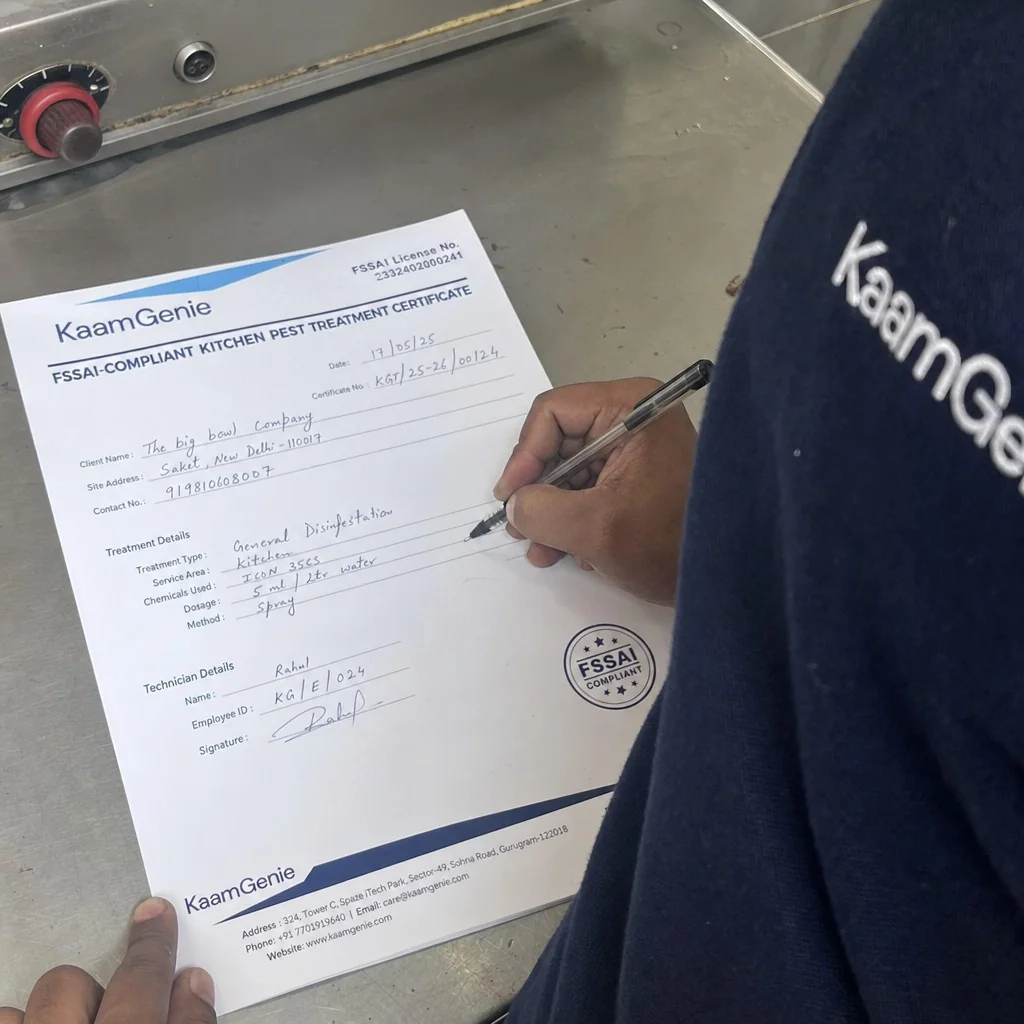
- Treatment certificate format: Chemical name + concentration + CIB&RC registration number, treatment date, technician name, kitchen footprint in sqft, signed by the licensed operator.
- After-hours scheduling: Standard for restaurants. Treatment happens between 11 PM and 5 AM so your kitchen reopens clean by morning service.
- Real cost in Delhi (2026): Small kitchen ₹2,499, medium kitchen ₹3,999, large kitchen ₹5,999+. 1-year commercial re-treatment cover.
- Quarterly AMC mandatory for FSSAI Category C+ kitchens (high-risk — raw meat, seafood, dairy on premises).
- Same-day not available — restaurant treatments need 24-48 hour scheduling because we need licensed technicians, after-hours crew rotation, and certificate paperwork ready.
What FSSAI actually requires from a restaurant kitchen
The FSSAI Schedule 4 hygiene requirements don’t use the words “quarterly pest control” in plain English, but in practice that’s what every inspector in Delhi expects to see documented. Here’s what they actually check, in the order they usually check it.
Treatment frequency. Minimum quarterly for any kitchen serving food to the public. For Category C+ kitchens — anywhere handling raw meat, seafood, dairy as ingredients, or running a banquet operation — quarterly is the floor and monthly is increasingly common. We have Karol Bagh non-veg restaurants on monthly schedules because the inspector flagged a quarterly contract as “not adequate for the risk category.”
Chemical type and proof of registration. The treatment certificate must name the chemical used and quote its CIB&RC registration number. Generic terms like “multi-pest spray” will not pass. Acceptable food-safe actives for restaurant kitchens are fipronil 0.05% (cockroach gel bait), imidacloprid 2.15% (cockroach alternative), boric acid powder for cracks, deltamethrin 2.5% SC for residual perimeter spray, and bromadiolone 0.005% for rodent baiting in sealed stations. If your current pest control is spraying cypermethrin or chlorpyrifos inside a food-prep area, that’s a fail.
Documentation kept on premises. The restaurant must keep the most recent treatment certificate visible or in an accessible binder. We see this fail more often than the treatment itself — the chef has the certificate at home, the manager doesn’t know where it’s filed, the cashier has lost the photocopy. Train your floor staff: the certificate lives in a specific folder behind the cashier counter, full stop.
Sealed disposal of pest material. Dead cockroaches and rodents must be collected in a sealed bag and disposed of as biomedical waste, not in the regular bin. Our crew handles this as part of the visit and adds a line to the certificate confirming sealed disposal.
Pest activity log. A simple table kept at the kitchen showing date of sighting, pest type, location inside the kitchen, action taken. The inspector reads this for trends. If the log shows three rodent sightings in a row in the dry-storage area, they will check what corrective action you took. Empty log book is also a red flag — means you’re not actually monitoring.
Treatment certificate format — exactly what to ask for
Most pest control providers in Delhi will give you a generic invoice and call it a “certificate.” That’s not what FSSAI wants. An FSSAI-acceptable treatment certificate must include nine fields. If any of them are missing, the inspector can ask you to redo the treatment.
The nine required fields, exactly as they should appear:
- Restaurant name and FSSAI licence number printed at the top.
- Treatment date in DD-MM-YYYY format, and the time window (e.g. 11:30 PM – 3:30 AM).
- Kitchen footprint in sqft, broken into food-prep area, dry storage, wet storage, dishwashing, and external garbage zone.
- Chemical(s) used with the exact brand name, generic name, concentration (e.g. fipronil 0.05%, imidacloprid 2.15%), and CIB&RC registration number.
- Method of application — gel bait placement points, residual spray zones, larvicidal locations, bait station locations.
- Technician name and licence number issued by the Delhi state pest control authority.
- Re-treatment cover window — for KaamGenie commercial work this is 1 year, with quarterly visits included for AMC customers.
- Next scheduled visit date.
- Signature of the licensed operator and the restaurant manager who received the treatment.
Ask any pest control vendor for a sample certificate before you book. If they can’t produce one with all nine fields, walk away. A real one looks like a structured form, not a hand-written invoice.
Need FSSAI-compliant pest control before your audit?
Treatment certificate in the format inspectors accept. CIB&RC chemicals. After-hours scheduling. Starts at ₹2,499 for a small kitchen.
Real cost for FSSAI-compliant pest control in Delhi
Honest 2026 pricing. From our commercial booking sheet. GST 18% extra. No hidden charges within standard Delhi zones.
| Kitchen size | Single FSSAI-certified visit | Quarterly AMC (4 visits/yr) | Documentation included |
|---|---|---|---|
| Small (under 300 sqft — tiny cafe, dhaba) | ₹2,499 | ₹8,999/year | 9-field certificate + log book |
| Medium (300-800 sqft — mid-range restaurant) | ₹3,999 | ₹14,999/year | 9-field certificate + log book + monthly audit summary |
| Large (800-1,500 sqft — full-service restaurant + bakery) | ₹5,999 | ₹22,999/year | Full audit binder + photo documentation |
| Banquet / hotel kitchen (1,500+ sqft) | From ₹9,999 | From ₹39,999/year | Custom audit pack + monthly visits |
| Cloud kitchen / dark kitchen | ₹2,999 | ₹10,999/year | 9-field certificate + aggregator-platform-ready PDF |
If you’ve been quoted ₹800-1,200 for a restaurant treatment somewhere on Justdial, that’s residential pricing applied to a commercial kitchen — the documentation will not pass FSSAI. If you’ve been quoted ₹15,000 for a one-off treatment of a 400 sqft kitchen, you’re paying for a brand-name aggregator margin, not better work. The honest Delhi range for a real FSSAI-compliant treatment is ₹2,499-5,999 for a single visit depending on size.
Why standard residential pest control doesn’t pass FSSAI audit
Restaurant owners ask this constantly: “I already have a guy doing my home pest control. Can he do the restaurant?” The honest answer is almost always no — and it’s not about skill. It’s about three structural differences that residential pest control providers simply don’t address.
Chemical choice. Residential treatments often lean on cypermethrin or chlorpyrifos for cost reasons. Both are CIB&RC-registered but both are flagged for food-contact-area use. FSSAI inspectors are trained to ask which active was used. The right answer for a kitchen is fipronil gel bait + imidacloprid + boric acid + bromadiolone in sealed stations — not the standard residential spray. The wrong chemical on the certificate is an instant fail.
Documentation depth. A residential pest control invoice has 3 fields — service, price, date. The FSSAI-acceptable certificate has 9. Your home pest guy hasn’t set up the forms because his residential customers don’t need them.
Sealed disposal protocol. Residential pest control disposes of dead pests in the regular dustbin. Commercial kitchens are required to seal-bag and dispose as biomedical waste. Your residential provider has no protocol for this and the inspector will catch it.
None of this is hard — we’re explaining it here so you can ask the right questions. The fix is to either use a commercial-specialist provider or to ask your residential guy explicitly: “do you have FSSAI-compliant certificate templates, food-grade chemicals on the truck, and a sealed disposal protocol?” If any answer is no, switch.
After-hours scheduling — why it’s mandatory and how it works
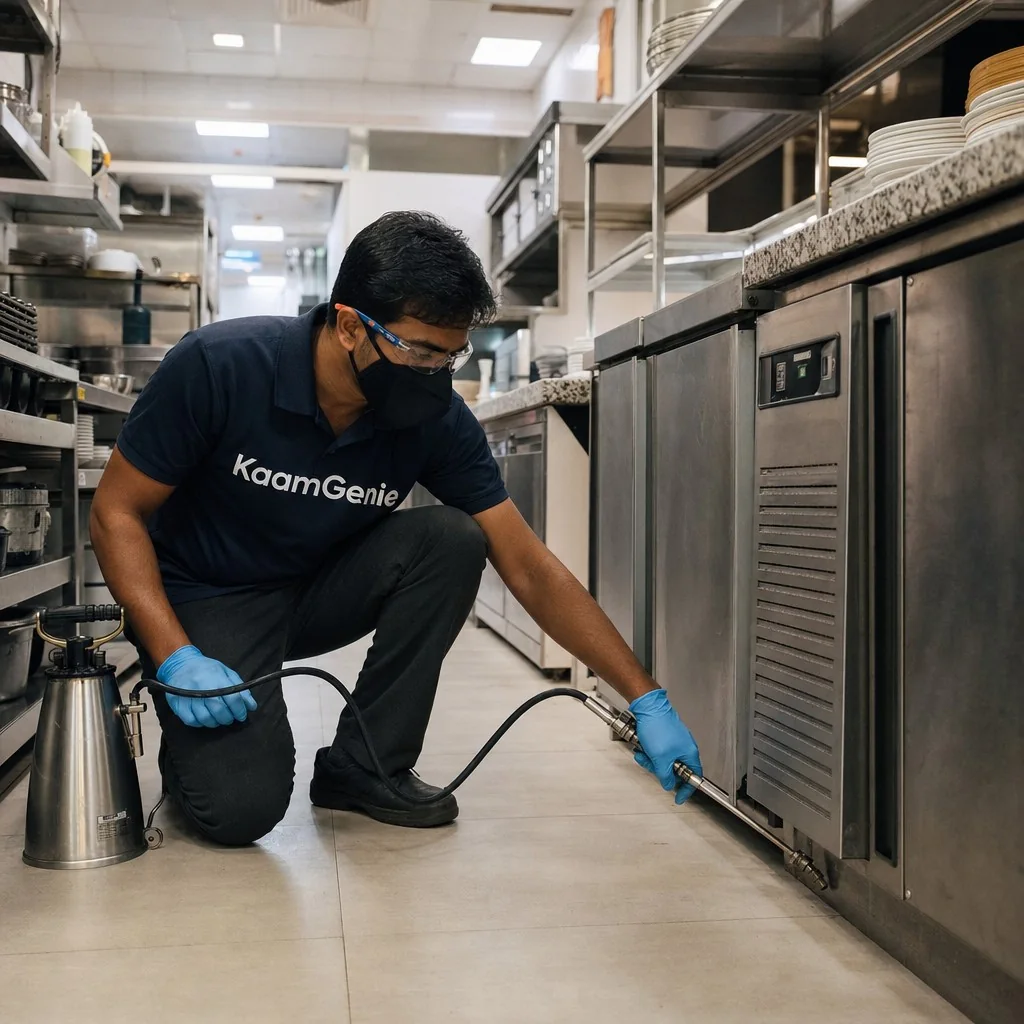
Restaurant pest control happens between 11 PM and 5 AM. Not because we charge more for it. Because it’s the only window that lets the kitchen reopen clean for breakfast or lunch service. Day-time treatment means closing the kitchen for 6-8 hours, losing a service window, and exposing prep staff to chemical residue. After-hours is the standard professional protocol, and FSSAI inspectors expect to see it on the certificate.
The actual after-hours protocol for a typical Delhi restaurant kitchen:
- 11:00 PM — arrival, walkthrough. Crew arrives after last service. Manager walks them through the kitchen, dry-storage, walk-in fridge, dishwashing, and external garbage zone. Hotspots flagged.
- 11:30 PM — food and equipment isolation. Loose ingredients moved to sealed containers. Cooking equipment covered with food-grade sheeting. Cutting boards washed and stored vertically. This step is where most residential providers cut corners.
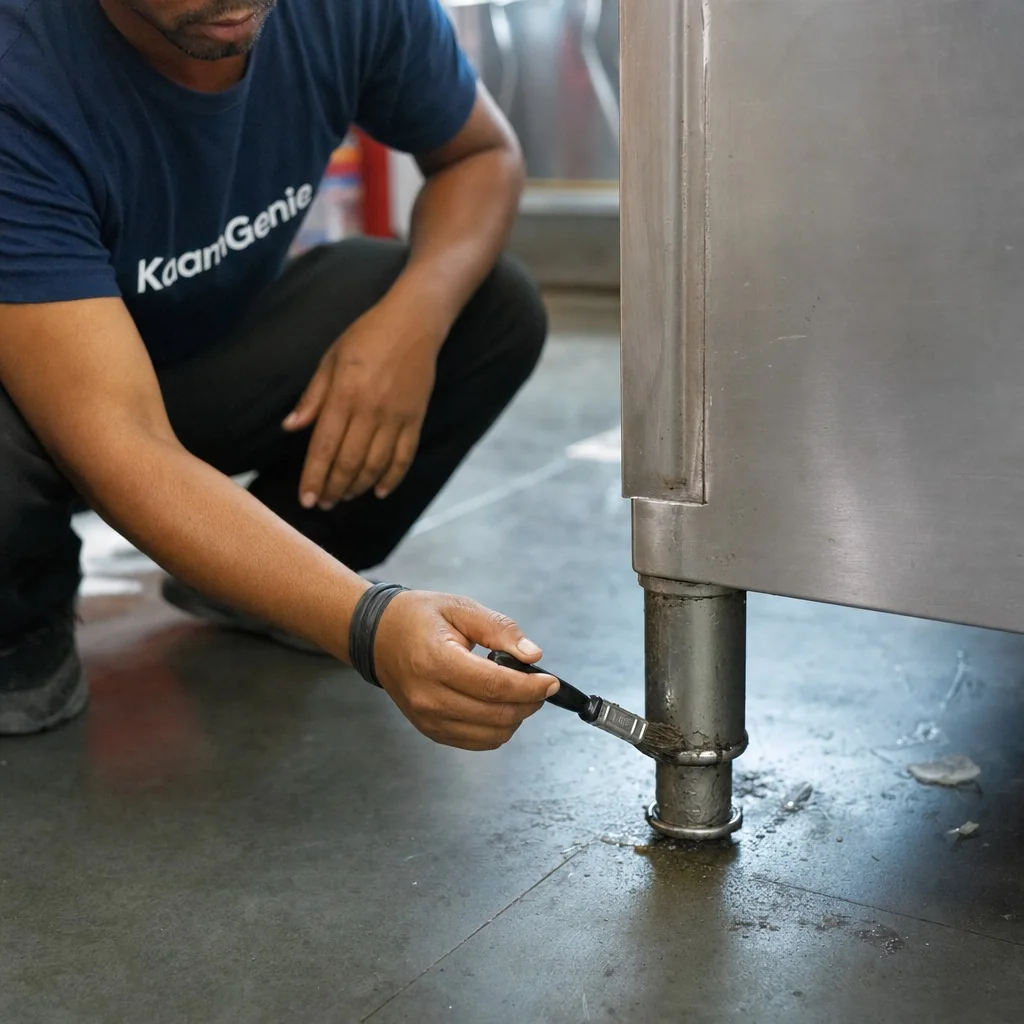
- 12:00 AM — gel bait placement. 30-50 placement points inside cabinet hinges, behind fryers, under prep tables, inside chimney shafts, behind the gas connection wall. Pinhead dots, never blobs.
- 1:30 AM — residual perimeter spray. Deltamethrin 2.5% SC sprayed on baseboards and wall-floor junctions only. Never on counters, never on stove surfaces, never inside fridge.
- 2:30 AM — rodent bait station placement. Sealed tamper-proof stations placed at external garbage zone and behind dry storage. Bromadiolone 0.005% inside.
- 3:30 AM — wipe-down of treated surfaces. Any surface that food touches gets a final wipe with food-safe surface cleaner.
- 4:00 AM — certificate paperwork. Technician fills the 9-field certificate, manager signs, copy goes into the FSSAI binder.
- 5:00 AM — kitchen handover. Breakfast prep staff can enter at 5 AM. No residual smell, no chemical contact for food prep.
The window assumes a 300-800 sqft kitchen. Larger banquet kitchens or hotel kitchens need a multi-crew operation across the same window or a two-night protocol.
Quarterly AMC vs single visit — what FSSAI actually expects
A single FSSAI-compliant treatment will pass an audit happening within 30 days. After 30 days the inspector can rightfully argue your kitchen is not under continuous pest management. For most restaurants the question isn’t whether to book quarterly AMC, but whether quarterly is enough or you need monthly.
The honest decision tree:
- Quarterly AMC (4 visits/year) is enough for: vegetarian restaurants, sweet shops, dessert cafes, ice-cream parlours, bakeries with limited cream usage, cloud kitchens with single-cuisine output.
- Monthly AMC (12 visits/year) is the right answer for: non-veg restaurants with raw chicken/mutton on premises, seafood restaurants, banquet halls running multiple events per week, hotel kitchens running multiple meal services, any kitchen flagged in the previous audit, any kitchen with a confirmed rodent incident in the past 6 months.
Cost difference is real but smaller than restaurant owners expect: quarterly AMC for a 400-sqft kitchen is ₹14,999/year. Monthly AMC for the same kitchen is ₹28,999/year. The extra ₹14,000 is roughly the cost of one bad audit fine + 1 day of closure, so the math favours monthly for high-risk categories.
Want quarterly AMC for sustained compliance?
Quarterly visits + free re-treatment between visits + audit-ready documentation. Restaurant AMC from ₹14,999/year for a medium kitchen.
The day-of-audit checklist
The morning of your FSSAI audit, what to have ready, in what order:
- Most recent treatment certificate on top of the binder, page 1, all 9 fields filled and signed. Inspector reads this first.
- Previous 12 months of treatment certificates in date order. If you’ve been on AMC for a year, this is 4 certificates for quarterly or 12 for monthly.
- Pest activity log — the kitchen-side daily monitoring book showing sightings, dates, locations, corrective action.
- Chemical safety data sheets (MSDS) for every active ingredient your pest control provider has used in the past year. Should be in the binder.
- CIB&RC registration numbers for those chemicals, photocopied or printed from the public registry.
- Photo evidence of bait station placement — especially if you have external rodent stations. Inspector will physically check.
- Sealed disposal records — a 3-column log showing date, weight (or count), where biomedical waste was handed over.
- Next scheduled visit date — demonstrates ongoing compliance, not a one-time treatment.
Lead with the certificate. The inspector wants to see structure. Most audit failures are administrative, not biological — the kitchen is clean but the paperwork is missing.
Pre-audit pest control — what to do 30, 14, 7 days before
If your audit is 30+ days away, you have time to do this properly. The pre-audit timeline that works for Delhi restaurants:
30 days before audit. Book a full FSSAI-certified treatment. Get the 9-field certificate. Start the pest activity log if you don’t already have one. Train the kitchen captain on where the FSSAI binder lives. Walk the inspector’s likely path: entrance, hand-wash, dry-storage, prep area, wet storage, dish-wash, garbage. Flag anything that looks like a harbourage point and tell the pest control crew.
14 days before audit. Cosmetic check. Walk through the kitchen as if you were the inspector. Look for gaps under doors, mesh damage on kitchen windows, U-bend drains that have lost their water trap, exposed wiring conduits, gaps behind the chimney. Get these fixed by the maintenance team. Pest control treatment without structural fixes is half the story.
7 days before audit. Book the pre-audit verification visit. Our crew comes back, inspects the placement points from the 30-day treatment, tops up any gel bait that’s been disturbed, verifies bait stations are still tamper-sealed, and produces a 7-day verification note that goes on top of the FSSAI binder. Some inspectors specifically read the most recent dated note — having one 7 days out is strong.
Day of audit. Kitchen captain on standby with the binder. FSSAI inspectors are usually first thing in the morning. Lead with the certificate, not the floor walk. Most audits are passed at the binder, not the kitchen.
Areas we serve for FSSAI restaurant pest control in Delhi
FSSAI-certified after-hours treatment available across all of Delhi: South Delhi (Saket, Lajpat Nagar Central Market, Defence Colony, GK-1, GK-2, Khan Market, Vasant Kunj, Hauz Khas Village, Khanpur), Central Delhi (Karol Bagh, Paharganj, CP, Pandara Road), East Delhi (Mayur Vihar, Preet Vihar, Laxmi Nagar), West Delhi (Janakpuri, Tilak Nagar, Rajouri Garden, Dwarka), North Delhi (Civil Lines, Model Town, Kamla Nagar), North-West Delhi (Rohini, Pitampura, Shalimar Bagh). Hotel and banquet kitchens across NCR — call us for site visit and quote.
Frequently asked questions
What pest control does FSSAI actually require?
Quarterly minimum visits, CIB&RC-approved food-safe chemicals only, written 9-field treatment certificate, sealed disposal of pest material, and a pest activity log kept at the kitchen. For Category C+ kitchens (raw meat, seafood, banquet) monthly is increasingly expected.
How much does FSSAI-compliant pest control cost in Delhi?
Small kitchen (under 300 sqft) ₹2,499 per visit or ₹8,999/year on quarterly AMC. Medium kitchen (300-800 sqft) ₹3,999 per visit or ₹14,999/year. Large kitchen (800-1,500 sqft) ₹5,999 per visit or ₹22,999/year. GST 18% extra.
Can residential pest control treatment pass FSSAI?
Almost never. Residential providers typically use cypermethrin or chlorpyrifos sprays not suitable for food-contact areas, give a 3-field invoice instead of a 9-field certificate, and have no sealed-disposal protocol. Either use a commercial specialist or insist your residential guy switch to FSSAI-grade chemicals and certificates.
What format does the treatment certificate need to be in?
Nine fields: restaurant name + FSSAI licence number, treatment date and time window, kitchen footprint in sqft by zone, chemical name + concentration + CIB&RC reg number, method of application, technician name and licence number, re-treatment cover window, next scheduled visit date, signature of licensed operator and restaurant manager.
Do all restaurant kitchens need quarterly pest control?
Yes. Quarterly is the floor for FSSAI compliance. For non-veg restaurants, seafood restaurants, banquet halls, hotel kitchens, and any kitchen with a confirmed rodent incident in the past 6 months, monthly AMC is the right answer.
Can you do after-hours treatment so the kitchen doesn’t close?
Yes — this is the standard protocol. Treatment between 11 PM and 5 AM means breakfast or lunch service is not affected. No day-time treatment means no service window lost. Our crew rotates a dedicated after-hours commercial team.
What if my existing pest control doesn’t give me a certificate?
You have an audit risk. Ask them today for a 9-field certificate template and a sample of recent work. If they can’t produce one, switch providers before your next audit. We can do an emergency FSSAI-compliant treatment with 24-48 hour notice anywhere in Delhi.
How quickly can you do FSSAI-compliant treatment before my audit?
Same-day not available for restaurants — we need 24-48 hours to assign a licensed operator and prepare paperwork. If your audit is within 7 days, call us immediately and we’ll prioritise the slot. Treatment takes one after-hours window; certificate is in your hand the morning after.
What chemicals are FSSAI-approved for restaurant kitchens?
Fipronil 0.05% gel bait for cockroaches, imidacloprid 2.15% as cockroach alternative, boric acid powder for crack-and-crevice treatment, deltamethrin 2.5% SC for residual perimeter spray on baseboards only, and bromadiolone 0.005% inside sealed tamper-proof rodent stations. All CIB&RC-registered with reg numbers quoted on the certificate.
Do you do treatment for hotels and banquet kitchens too?
Yes. Banquet kitchens (1,500+ sqft) start at ₹9,999 for a single visit or ₹39,999/year for monthly AMC. Hotel kitchens get a custom audit pack with photo documentation. We do site visit + scope discussion + written quote before booking the first treatment.
FSSAI-ready pest control across Delhi
Audit-compliant documentation. CIB&RC chemicals. After-hours scheduling. From ₹2,499 for a small kitchen.
Sources & references
- Food Safety and Standards Authority of India (FSSAI) — the national food safety regulator. Sets the Schedule 4 hygiene requirements that govern pest control documentation, chemical choice, and treatment frequency for licensed food businesses in India.
- Central Insecticides Board & Registration Committee (CIB&RC) — the Indian regulator that approves every pesticide formulation and assigns the registration numbers FSSAI inspectors check on treatment certificates.
- National Centre for Disease Control (NCDC) — technical guidance on commercial-kitchen vector control, rodent control protocols, and integrated pest management for food businesses in Indian metros.
Last verified: 7 June 2026. If you find any of these links broken, please let us know.