Home › Services › Pest Control › Commercial Pest Control
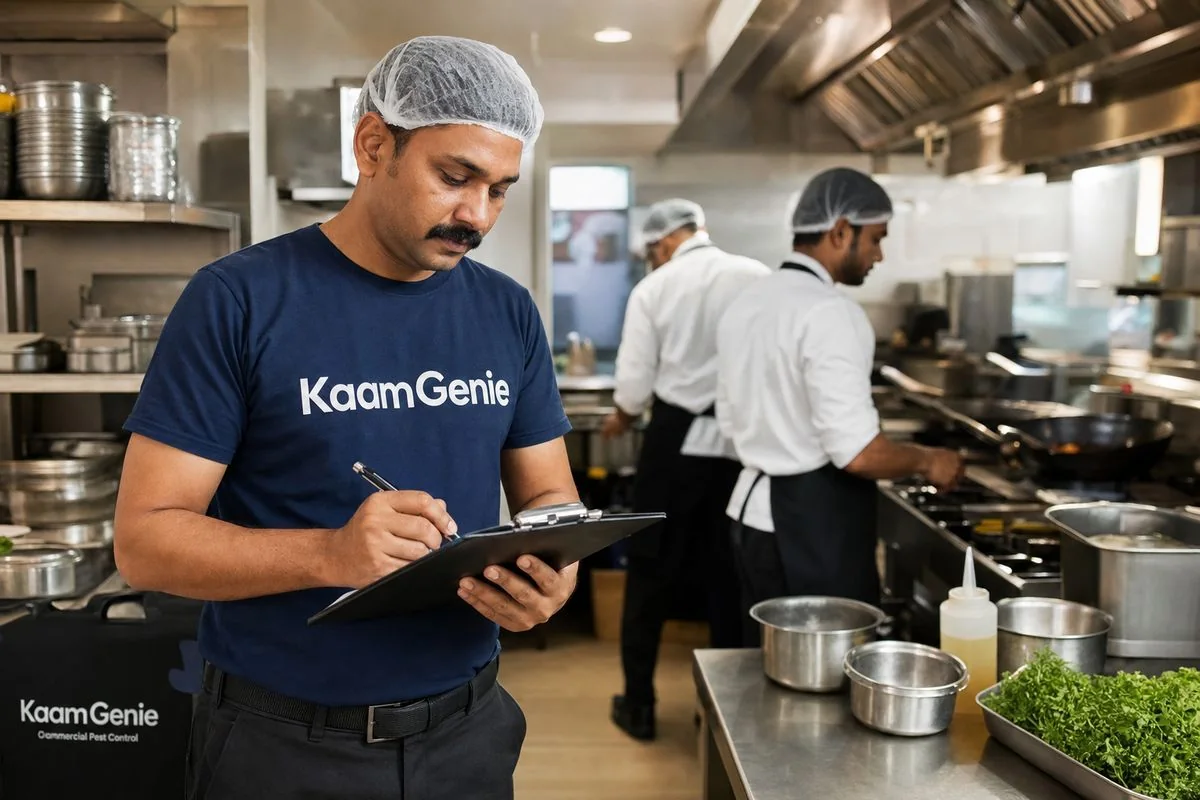
Service · B2B · FSSAI-CompliantRestaurants, hotels, offices, and food production units in Delhi don’t just need pest control — they need documented pest control. FSSAI mandates it. Inspectors check for it. License renewals depend on it. We run monthly visit schedules with written service reports, CIB&RC-approved chemicals logged by batch number, signed acknowledgments at every visit, and an audit-ready pest control log kept at your premise. Built for food businesses, scaled for hotels and production units. Custom quote after a free site visit — pricing depends on premise size, frequency, and complexity.
Pick the option that matches your home or premises. Fixed prices · GST 18% extra · Same-day available.
All prices: GST 18% extra · Cash / UPI / Card / Bank transfer · Same-day available · Free phone consultation before booking.
Every quote is confirmed on the phone after a 5-minute description of your premises. We never quote without understanding the job, and we never change the price on arrival.
Pest control isn’t a nice-to-have for food businesses in India — it’s a legal requirement. Schedule 4 of the Food Safety and Standards (Licensing and Registration of Food Businesses) Regulations 2011 is the section that lays it out. Every restaurant, hotel kitchen, cloud kitchen, packaged food unit, central commissary, and food retail outlet operating under an FSSAI licence must have an active pest control programme — not just occasional sprays when somebody spots a cockroach.
What Schedule 4 specifically requires. A documented pest management programme, a licensed pest control operator (with their CIB&RC registration on file), records of every treatment with chemicals used and quantities applied, a continuously maintained pest control log book available for inspection, and physical preventive measures — door sweeps, mesh on ventilators, sealed drains, fly traps in receiving areas. Each point has to be evidenced in writing at the premise.
What happens if you don’t have it. Three real consequences. First, inspection failures — pest control documentation is one of the top three things FSSAI inspectors check on a routine or complaint-driven inspection. Missing records means an Improvement Notice. Second, licence suspension risk — repeat non-compliance can lead to suspension of your FSSAI licence, which forces the outlet to close. Third, third-party audit failures — if you supply Zomato, Swiggy, or any large delivery / hotel chain, they conduct their own annual audits and a thin pest control file is an instant red flag.
What insurers and aggregators also expect. Beyond the regulator, Zomato Hygiene Ratings, Swiggy Pure Veg / Hygiene programmes, hotel chain compliance teams, and even commercial property insurance underwriters all ask to see a pest control contract with a licensed vendor before they certify or insure your premise. A handwritten note saying “sprayed last month” doesn’t qualify.
We’ve been part of dozens of FSSAI inspections across Delhi restaurants over the years. Inspectors don’t walk in with a single yes/no question on pest control — they work through a checklist. Here’s exactly what they look at.
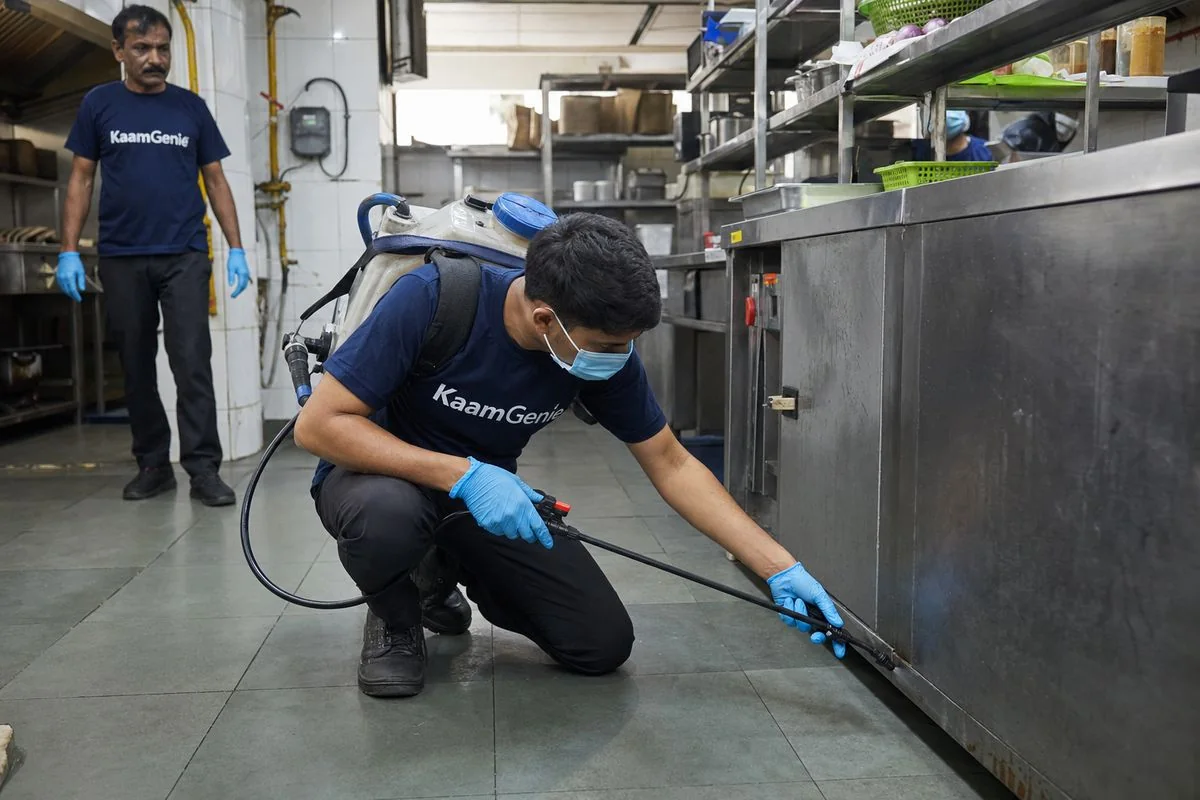
We don’t do one-off commercial treatments. The whole point of commercial pest control is that it’s a continuous, documented, repeatable programme. Here’s how a typical KaamGenie commercial contract runs.
Different commercial premises have different pest profiles. We don’t use a one-size-fits-all approach — the chemicals, devices, and visit cadence change with the pest risk on your premise.
Cockroaches (kitchens). The number-one pest in any restaurant kitchen. We rely heavily on fipronil and imidacloprid gel baits placed inside cracks, behind stoves, under prep tables, and around dishwash sinks. Gel baits are invisible to customers, inaccessible to food, and the cockroach “transfer effect” means treated insects carry the chemical back to the harbourage and wipe out the colony. We add monitoring glue boards in low-visibility corners so we can track activity month-to-month.
Rats and rodents (storage, dock). Tamper-proof bait stations placed along perimeter walls, near the dock, behind the dry storage racks, and outside the kitchen back door. The stations are locked, child-safe, and labelled with our contact number. Inside, second-generation anticoagulant baits (CIB&RC-approved for commercial premises) do the work. We log bait consumption per station each visit — rising consumption flags a new rodent pressure to act on.
Flies (outdoor zones and waste areas). Insect Light Traps (ILTs) installed in dishwash, dock, and dry storage areas — never directly over food prep, per FSSAI guidelines. Outdoor waste areas get residual sprays on garbage enclosure walls and around the trash compactor. We service ILT glue boards each visit and log the fly catch count.
Bed bugs (hotels and staff accommodations). Hotels with guest rooms and food businesses with on-site staff dorms occasionally get bed bug calls. Treatment is heat-based or contact-residual spray on mattress seams, bed frames, and skirting — with a 14-21 day re-visit to confirm the colony is dead. Quietly handled, no impact on guest experience.
Birds (rooftops and external ledges). Pigeon and crow droppings near rooftop water tanks, AC outdoor units, and external dining areas are both a hygiene risk and an FSSAI flag. We install bird spikes, bird netting, and physical deterrents on ledges — non-lethal, low-maintenance, and effective for years.
The documentation is half the value of a commercial pest control contract. Without it, you’re paying for a treatment that nobody can prove happened. Here’s what lands in your pest control file after every single visit.
Service report. A printed and signed report with the visit date and time-window, the outlet name and FSSAI licence number, the technician name and CIB&RC operator number, every area treated (kitchen / dishwash / storage / dining / dock / external / staff areas, ticked individually), every device serviced (bait stations refreshed, ILT glue boards changed, monitoring glue boards inspected), pest activity observed since the last visit, and corrective recommendations for the outlet team.
Chemical batch numbers. Every chemical applied is listed by trade name, CIB&RC registration number, manufacturing batch number, quantity used, and area of application. This is what FSSAI inspectors trace if there’s ever a chemical-contamination complaint. Generic “sprayed insecticide” entries are a violation; specific batch numbers are the standard.
Technician details. Name, CIB&RC operator licence number, and contact. Inspectors can call to verify the visit happened if they ever doubt the paperwork.
Photos. On request — and always on quarterly audit visits — we attach dated photos of treated areas, monitoring devices, and any structural issues that were flagged. Photos are filed alongside the service report.
Signed acknowledgment. The outlet manager signs the service report at the end of every visit, confirming the work was done and the recommendations were communicated. The signature is the legal proof the visit happened — without it, the report has no audit weight.
Monthly visits, written reports, audit-ready log book, CIB&RC-approved chemicals. Free site survey before any commitment. Custom annual contract sized to your premise.
Restaurant kitchens are the trickiest commercial pest control environment. You have open food, hot surfaces, stainless steel prep tables, drains, dishwash steam, and customers metres away. The wrong chemical — or the wrong application method — can taint food, trigger customer complaints, or fail FSSAI.
Our entire chemical strategy for restaurant kitchens is built around three principles: no fogging, no spraying over open food or prep surfaces, and no chemicals with detectable odour during service hours.
Gel baits as the kitchen mainstay. Cockroach gel baits (fipronil, imidacloprid, indoxacarb — all CIB&RC-approved for food-handling premises) are the kitchen mainstay. Tiny dots of gel placed inside cracks, behind appliances, under sinks, and around piping. Invisible to customers, inaccessible to food, and lethal to cockroaches that eat or contact them. No spraying, no odour, no residue on prep surfaces.
Low-residue, water-based sprays for non-food zones. Storage areas, dishwash, drains, and external perimeter get water-based residual sprays (low-odour, food-safe formulations) applied only to wall-floor junctions, drain edges, and crack-and-crevice zones. Never on prep surfaces, never in open air, never during service.
No fogging during open hours, ever. Fogging treatments (ULV cold fogging, thermal fogging) are only used in fully closed and de-staffed premises — typically once a year for a deep treatment during a planned closure, or for specific pest emergencies handled at 3 AM. The premise is ventilated for 4-6 hours before re-opening. We never fog while food prep, service, or staff dining is happening.
Targeted crack-and-crevice for visible issues. If we spot a cockroach during a daytime visit, we use a low-pressure crack-and-crevice injector to place treatment exactly where the pest came from — not a wide spray across the kitchen.
Almost every commercial visit we run for restaurants and hotels happens outside operational hours. It’s better for your customers, better for your food safety, better for our technicians (faster, fuller access to every corner), and the only way to do certain treatments compliantly.
Typical visit slots for Delhi restaurants. 11 PM to 2 AM is the most popular slot — kitchen is shut, last dishwash cycle is done, the team is winding down. Pre-opening 6 AM to 9 AM is the second most popular — works well for breakfast outlets and bakeries. We adjust to your hours: late-night QSRs that close at 4 AM get a 5 AM slot; cloud kitchens that run 24/7 get treatments on their planned weekly cleaning night.
For offices. Weekends or post-7 PM weekdays. Most corporate offices are empty by 8 PM and we have full access through the night. Saturdays are popular for the deeper monthly visit.
For hotels. Hotel kitchens go through cycles — breakfast prep, lunch, dinner, late-night. We slot treatments in the 2-5 AM window when only the overnight skeleton crew is on. Guest floors are handled room-by-room during low-occupancy daytimes coordinated with housekeeping.
The scheduling promise. Once your contract is signed, your visit slot is fixed for the year — same week of the month, same time window, same technician. You don’t have to coordinate or remind anyone. The technician knows your premise, your operations team knows them by name, and the programme runs on rails.
Commercial pest control pricing is not menu-priced. Every premise is different and a flat rate would either overcharge small outlets or undercharge large ones. Here’s how we work out a commercial quote.
Premise size. Square footage of built-up area is the biggest single driver. A 600 sq ft quick-service restaurant has a fraction of the surface area to treat compared with a 12,000 sq ft hotel kitchen. We measure or take your floor plan during the survey.
Visit frequency. Monthly is the standard for food premises. Quarterly works for low-risk offices. Bi-weekly is what we run for very high-risk premises (food production units, central commissaries, very high-volume restaurants). More frequent visits cost more per year but each visit is shorter.
Complexity of site. Single-floor outlets are simpler than multi-floor hotels. Closed kitchens are simpler than open kitchens (open kitchens need food-safer chemical choices and tighter discretion during operating hours). Premises with basement storage, dock, or external food prep areas add zones to cover.
Pest risk level. We grade premises low / medium / high risk during the survey based on existing pest activity, sanitation conditions, structural gaps, proximity to drains and waste, and the operational hours. Higher-risk premises need more device deployment (more bait stations, more ILTs, more monitoring boards) and slightly more frequent visits.
Indicative range. The lower end is around ₹2,499 per visit for a small single-outlet quick-service restaurant on a monthly contract; the upper end runs to ₹49,999 per visit for a large hotel or food production unit. Exact pricing is always on a written quote after the free site survey — we never give a flat number over the phone before seeing the premise.
To make the pricing and programme structure concrete, here are three real-shape scenarios that map to a large share of our commercial clients across Delhi. Names and exact locations are fictional but the structure of the engagement is exactly what we run.
Scenario 1: Connaught Place restaurant pre-FSSAI inspection. A mid-sized 80-cover North Indian restaurant in Connaught Place, around 2,200 sq ft including kitchen, dishwash and basement storage. FSSAI inspection due in three weeks; the owner realised their previous pest control vendor had stopped visiting six months ago and the pest log was empty. We ran an emergency deep treatment week one (11 PM to 4 AM), set up monitoring devices, started a monthly contract, and filled the pest log with three documented visits before the inspection. Outlet passed the inspection on first attempt.
Scenario 2: Gurgaon corporate office. A 9,000 sq ft single-floor IT services office in Cyber City Gurgaon with a 40-seat cafeteria and a pantry. Risk is mostly cockroaches around the pantry and dishwash, occasional rodents around the dry storage. We run a quarterly visit for the main office floor and a monthly visit for the cafeteria and pantry zone — combined into a single Saturday visit per month, with the broader office walk-through every third visit. Compliance documentation covers both their internal facility audit and their pantry vendor’s FSSAI requirements.
Scenario 3: Lajpat Nagar PG building hotel. A 28-room budget hotel in Lajpat Nagar with a small breakfast kitchen, common areas, and staff dorm. Bed bug complaints from two guest rooms had triggered a Zomato Hygiene Rating downgrade for the breakfast service. We ran a complete bed bug heat treatment in the affected rooms with a 21-day follow-up, started a monthly programme covering kitchen, common areas, and staff dorm, and rebuilt the pest control log from month one. Six months in, no bed bug complaints, Zomato rating recovered, FSSAI inspection passed.
| Program | Frequency | What’s included | Best for |
|---|---|---|---|
| Restaurant Standard | Monthly visits + 1 quarterly audit | Full treatment, gel bait refresh, ILTs and bait stations, signed service report, pest control log, FSSAI documentation pack | Single-outlet restaurants, cafes, bakeries under 3,000 sq ft |
| Hotel Programme | Monthly kitchen + rotating guest-floor coverage | Kitchen, banquet, dishwash, dock, basement, guest rooms (rotating), bed bug response cover, named account manager | Hotels with on-premise F&B, banquet halls, guest accommodations |
| Food Production / Commissary | Bi-weekly or weekly visits | Production floor, cold storage, raw material storage, packing area, dock, external perimeter, weekly monitoring reports | Cloud kitchens, central commissaries, packaged food units, cold storage facilities |
| Corporate Office | Quarterly office + monthly cafeteria | Office floor walk-through, pantry and cafeteria full treatment, bait stations on perimeter, weekend or evening visits | Standalone offices with on-site cafeteria or pantry |
| Multi-outlet Chain | Monthly per outlet, central reporting | All outlets on the same cadence, consolidated monthly report to head office, single contract across Delhi outlets, KPI dashboard | Restaurant chains, QSR brands, hotel groups with multiple Delhi properties |
Commercial pest control is currently live across all of Delhi:
Coming soon: Gurgaon (Cyber City, Golf Course Road, Sector 29 restaurant cluster), Noida (Sectors 18, 32, 62), Faridabad, Ghaziabad. We’re onboarding commercial-grade pest control crews in these zones currently. If you operate a chain or hotel group with outlets across NCR, call us — we can start the Delhi outlets immediately and bring the others on contract as crews come online, keeping your documentation consistent across all premises.
Senior technician visits your restaurant, hotel or office for 60-90 minutes, runs the full pest risk assessment, and sends a written annual contract proposal. No charge, no commitment.
Yes. Every commercial visit is documented to the exact format FSSAI inspectors expect under Schedule 4 of the Food Safety and Standards Regulations 2011. You receive a written service report with the date, technician name, chemicals used (with brand and CIB&RC registration numbers), areas treated, pest activity observed, and a signed acknowledgment from your manager. We maintain a running pest control log book at your premise that inspectors can review during any FSSAI audit. This is the single most important reason restaurants hire a proper pest control vendor.
We strongly prefer after-hours or pre-opening visits for restaurants and food businesses — typically between 11 PM and 7 AM, or during your off-day. This keeps food, customers, and staff away from any active treatment area. For offices, we work weekends or after 7 PM. We do not fog or spray in open dining areas during service hours. If something needs immediate attention during business hours, we use targeted gel baits and crack-and-crevice applications that are food-safe and odour-free.
All chemicals we use are CIB&RC-approved for food-handling premises. For kitchens, we rely heavily on gel baits (fipronil, imidacloprid, indoxacarb) which are placed inside cracks, behind equipment, and under stoves — invisible to customers and inaccessible to food. For perimeter and non-food zones we use low-residue, water-based sprays. We never use fogging or aerosol spraying anywhere near open food, prep surfaces, or storage. Every chemical batch number is logged on the service report so it traces back if any inspector questions it.
FSSAI and most international food-safety standards recommend monthly visits for restaurants, hotels, and food production units. Standalone offices can usually run on quarterly visits unless there is an active pest problem. High-risk premises — open kitchens, ground-floor restaurants, food courts, warehouses near drains or waste — should stay monthly. Our standard restaurant program is one full treatment visit per month plus one quarterly deep audit. That cadence is what FSSAI inspectors expect to see on your pest control log.
Yes. We cover full-service hotels (kitchens, banquet halls, guest floors, basements, laundry), cloud kitchens, central commissaries, packaged food production units, cold storage facilities, and corporate cafeterias. Larger premises get a dedicated account manager, a written pest management programme document, and a longer monthly visit window — typically 6-10 hours rather than the 2-3 hours a single-outlet restaurant needs. We have crews and chemicals scaled for premises up to 50,000 sq ft of built-up area.
A standard monthly visit includes: a walkthrough audit of every pest-sensitive zone, refresh of cockroach gel baits in the kitchen and dishwash area, refresh of rodent bait stations along storage and dock perimeters, fly-zapper and glue-board check, crack-and-crevice treatment of any new entry points, drainline and grease-trap inspection, and a fresh signed service report added to your pest control log. We also flag any structural issues that are causing pest entry — broken door sweeps, gaps around pipework, drainage problems — so your maintenance team can fix them.
Yes — a signed and dated cleaning record is handed over at the end of every single visit. The record lists the date and time, technician name and CIB&RC operator licence number, areas treated, chemicals used with batch numbers, pest activity observed (if any), corrective actions recommended, and a manager signature acknowledging the work. Restaurants and hotels keep these in a dedicated pest control file at the premise. During an FSSAI or third-party audit, this file is the first thing inspectors ask for.
Most commercial contracts run for 12 months with monthly visits, paid quarterly or half-yearly. This is the structure FSSAI and food-safety auditors look for — they want to see a continuous relationship with a licensed vendor, not one-off treatments. Shorter 3-month or 6-month contracts are available for new restaurants that want to evaluate the service first. Annual contracts include a fixed number of emergency visits at no extra charge — if pest activity flares up between scheduled visits, we come back.
Commercial pricing is always quoted custom, never flat-rate. The number we work out depends on premise size in square feet, visit frequency (monthly versus quarterly), complexity of the site (single floor versus multi-floor versus open kitchen versus cold storage), and the pest risk level we observe during the initial survey. After a free site visit we send a written annual contract proposal. Indicative range is ₹2,499 per visit for a small single-outlet quick-service restaurant up to ₹49,999 per visit for a large hotel or production facility — exact number always on a quote.
Right now we cover all of Delhi for commercial pest control. Gurgaon, Noida, Faridabad, and Ghaziabad are coming soon — we are onboarding commercial-grade pest control crews in those zones currently. If you operate a restaurant chain or hotel with outlets across NCR, call us — we can usually start the Delhi outlets immediately and roll the others in as crews come online, so your contract documentation stays consistent across all your premises.
FSSAI inspections don’t announce themselves. Auditors don’t wait for paperwork to catch up. Get the monthly schedule, log book, and documented vendor relationship in place before you need it. Call +91 95603 66362, WhatsApp here, or click the button below. Free site survey across Delhi.
Published by KaamGenie Private Limited — Delhi NCR’s trusted home services provider for water tank cleaning, pest control, and household maintenance. CIN: U74909DL2026PTC466750. Last updated 5 June 2026.
Every pest control service we offer across Delhi NCR — CIB&RC chemicals, photo documentation, GST invoice, transparent pricing.
Full overview of every pest control sub-service. Starting prices, process, CIB&RC chemicals, what each treatment covers.
Anti-termite chemical injection for Delhi wooden door frames, almirahs, plywood furniture and structural wood.
Combo cockroach, ant, spider, lizard, mosquito treatment for Delhi homes. Pet-safe and child-safe protocols.
Targeted gel-bait protocol for kitchen and bathroom infestations. CIB&RC chemicals, 15-day re-treatment warranty.
Two-visit protocol covering mattress seams, skirting, frame joints. Accounts for 10-14 day egg-hatching cycle.
Thermal fogging + larvae treatment + breeding-site elimination. Critical for dengue prevention pre/post monsoon.
Tamper-resistant bait stations + entry-point sealing + 30-day follow-up audit. Safe for kids and pets.
4 quarterly visits + free re-treatments + scheduled reminders. 20-25% off per-visit pricing.