
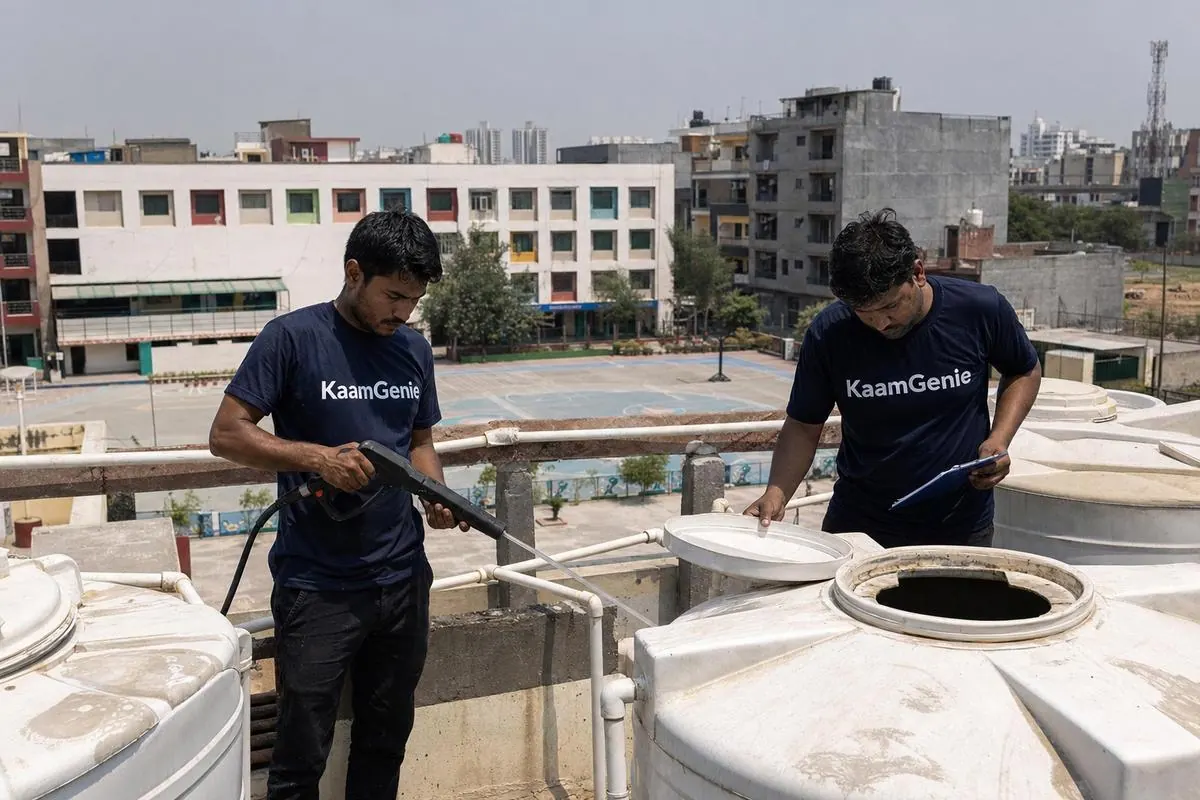
Quick answer — school + college tank cleaning in Delhi
- Why it’s different: children and young adults are drinking the water, volumes are high, and admin staff usually don’t have water-quality training.
- Frequency: quarterly is the baseline for educational institutions — not the residential 6-monthly standard.
- Scheduling: use winter break (Dec-Jan), summer break (May-June), or weekends. Avoid exam periods (March-April, Nov-Dec).
- Price range: ₹4,500 (small school under 500 students) to ₹35,000+ (large multi-building college campus) per service round.
- Documentation: GST invoice, water quality test (pre + post), MSDS for chemicals, crew police verification papers.
- AMC default: 4 visits/year, free re-cleaning if water test fails, priority response, fixed annual cost for the budget file.
Why educational institution water tanks need a different approach
A residential 6-monthly tank cleaning standard does not apply to a Delhi school or college. Four things change the moment you move from a home to an educational campus, and admins who don’t understand the difference end up either overpaying or, worse, running unsafe water to children for months at a time.
First, the consumer base. In a home of 4-5 people, the immune systems are mostly adult. In a school of 800 students, you have growing children aged 4-18 whose gut bacteria and immune responses are still developing. A waterborne issue that gives an adult mild diarrhoea can put a 6-year-old in hospital. Colleges aren’t much safer — hostel students are often away from home for the first time, eating mess food, with lower personal hygiene supervision than at home, and a single contamination event can put 50-100 students on the same ward in 24 hours. The reputational damage to the institution after one such incident is hard to recover from.
Second, the volume. A typical Delhi residential tank holds 500-1,000 litres and serves 4 people. A school rooftop tank cluster holds 8,000-15,000 litres and serves 800-2,000 people. A college hostel sump can hold 50,000-1,00,000 litres. The volume amplifies anything that goes wrong. A small bio-film at the bottom of a residential tank affects one family; the same bio-film at the bottom of a 50,000-litre college sump is feeding bacteria into the drinking supply of 500 hostellers for weeks.
Third, the throughput pattern. Schools and colleges have peak-burst usage — lunch break, recess, lab class — not the steady drip of a household. Tanks that drain to near-empty every afternoon and refill overnight cycle sediment differently than home tanks, and the standard residential 6-monthly cleaning misses the build-up that happens in that pattern.
Fourth, the accountability gap. In a home, the person who drinks the water is the person who books the cleaning. In an educational institution, the person drinking the water (a student) is three layers removed from the person booking the cleaning (an admin officer who reports to a director who reports to a trust board). The student has no way to escalate a tank smell or yellow water without going through a class teacher, a principal, and a maintenance request system. By the time the complaint reaches admin, it’s been weeks. By the time the cleaning is scheduled, the contamination has been brewing for months. This is why most school water issues are caught by parents in WhatsApp groups, not by the school itself — and by then it’s already a brand-damaging story.
The honest answer for any Delhi school or college admin reading this: assume your tanks need more frequent cleaning than a home, assume nobody on your maintenance staff has water-quality training unless you’ve specifically hired for it, and budget for proper quarterly service with documentation, not annual ad-hoc cleaning. When you’re ready to set it up, you can book an institutional tank cleaning with the full documentation pack included.
The Delhi school water tank setup — what’s usually on your campus
Most Delhi schools, whether CBSE or CISCE, government or private, follow a similar tank architecture. As an admin you may not have looked at it in detail — here’s the map of what you almost certainly have, and which tank serves which purpose.
Rooftop tanks (drinking + classroom use). Usually 2-4 plastic tanks of 1,000-2,000 litres each, sitting on the school roof. These feed every classroom water cooler, every staffroom kettle, every chemistry and biology lab tap, and the principal’s office. This is the highest-risk water on the campus because it’s the water children drink during recess from the cooler taps. If you have a school with 800 students, expect these rooftop tanks to drain 60-80% every day and refill overnight from the booster pump. The sediment from the daily refill cycle settles on the floor of the tank, and after 3-4 months of skipped cleaning, the bottom of the tank looks like the bottom of a pond.
Underground sump (toilets + watering + sports field). Usually a single large RCC sump of 8,000-20,000 litres, taking direct DJB supply and storing it before booster pumps lift it up to the rooftop tanks. This is the largest tank on a typical school campus. It feeds the toilets, the cleaning of the corridors, the watering of the lawn and tree pits, and the sports field grass. Quality is less critical than the rooftop tanks (this water is not drunk), but the sump is where most of the sediment and silt arrives from the DJB main, and if the sump isn’t cleaned, the dirty water gets pumped up to the rooftop tanks and from there into the drinking supply.
Kitchen / canteen tank (mid-day meal scheme schools). If your school runs a government mid-day meal scheme or has a paid canteen, there’s usually a separate smaller tank of 500-1,000 litres dedicated to the kitchen. This tank is FSSAI-adjacent because the water is used to cook food that’s then served to children. The cleaning standard for this tank should match restaurant cleaning standards — food-grade disinfection, documented water testing, dated cleaning documentation that an FSSAI inspector would accept.
Lab supply (chemistry, biology). Some senior secondary schools have a dedicated lab water line tapped before the drinking cooler distribution. The water here is used for experiments and for washing lab apparatus, so the quality requirement is different (chemical purity matters more than bacterial counts). This tank is often forgotten in cleaning schedules. If you have a science wing, ask the maintenance team where the lab water comes from and add that tank to the cleaning schedule.
Boundary wall / garden tank. Smaller schools sometimes have a separate non-potable tank for ground-floor garden watering. Low priority for hygiene but should still be cleaned annually to prevent mosquito breeding.
Typical Delhi college campus tank setup
College campuses scale up the complexity dramatically. Where a school has 3-5 tanks total, a Delhi college campus typically has 12-30 tanks across different building zones, and the admin department often doesn’t have a single map of where they all are. Step one of any campus cleaning programme should be a tank census.
Main academic block rooftop tanks. Each building (admin block, lecture theatres, library, faculty offices) usually has its own rooftop tank cluster of 2-4 tanks at 2,000-5,000 litres each. A college with 5 academic buildings might have 15-20 rooftop tanks just for the academic side.
Hostel tanks. Hostels are the highest-risk zone because students drink, brush, bathe, and sometimes cook in the hostel block, and they’re away from home and parental oversight. A 200-student hostel typically has a dedicated underground sump of 30,000-50,000 litres plus 4-6 rooftop tanks of 2,000-3,000 litres each. Boys’ and girls’ hostels are usually separate buildings with separate tank systems. PG hostels run by the institution use the same model.
Lab block. Science colleges (Delhi University, JNU, IIT, science colleges in the Greater Noida belt) have a dedicated lab block with its own water supply, often with separate distilled water systems for chemistry labs. The municipal water tank serving the lab block needs the same frequency as drinking tanks even if the water isn’t officially “potable” — lab staff and students wash hands here and sometimes drink from it.
Mess + canteen. The mess kitchen is FSSAI-regulated if the institution serves 50+ meals a day, which any hostel mess does. Mess water tanks need restaurant-grade cleaning protocols, documented testing, and the cleaning record must be filed alongside the FSSAI compliance documents for the next audit.
Sports complex. Sports complexes with showers, drinking water stations, and changing rooms have their own tank system. If your campus has a swimming pool, the pool itself is a separate cleaning category (chlorination, not standard tank cleaning), but the tank feeding shower water and drinking stations is standard cleaning scope.
Staff quarters. Many older Delhi colleges have on-campus faculty quarters with their own tank systems — these are technically residential but they’re inside the campus boundary and should be on the institutional cleaning schedule, not left to individual faculty to book.
The honest first step for a new college admin is to walk the campus with the maintenance head and physically count and photograph every tank. Most administrations are shocked to find 3-5 tanks they didn’t know existed.
Need a campus tank census before booking?
We’ll send a senior crew lead to walk your campus, map every tank, and quote a quarterly contract on the spot. No charges for the survey.
Cleaning frequency for educational institutions — why quarterly is the baseline
The single most common mistake Delhi school and college admins make is applying the residential 6-monthly cleaning standard to an educational campus. The residential standard exists because a home tank cycles slowly, serves few people, and any contamination is caught early by the household. None of those conditions apply on a campus.
The honest baseline for any Delhi educational institution is quarterly cleaning — four visits a year. Here’s the reasoning, broken down so you can defend the budget line to your director or trust board.
Reason 1: throughput multiplier. A residential tank refills 30-40% per day. A school rooftop tank refills 60-80% per day. The faster the refill cycle, the more sediment from the incoming DJB supply collects at the tank floor. Quarterly cleaning catches this before the layer thickens to a point where it starts seeding bacteria into the outgoing supply.
Reason 2: bio-film accumulation. The slimy layer on the inside walls of an unused tank section (above the daily water line) builds up faster in high-humidity, high-temperature conditions like a Delhi summer. By month 4 in a Delhi school tank, the bio-film is visible to the naked eye. By month 6, it’s sloughing off and seeding the water supply.
Reason 3: Delhi water quality variability. DJB supply quality varies week to week depending on Yamuna source quality, monsoon turbidity, and pipeline incidents. Educational institutions can’t afford to absorb a bad-supply month without intervention — quarterly cleaning gives you four reset points a year where the tank starts fresh.
Reason 4: outbreak risk math. A residential outbreak affects 4-5 people. A school outbreak affects 800. Risk multiplied by exposure equals consequence. The quarterly cleaning premium over annual cleaning (roughly 3x the cost) is dwarfed by the cost of one outbreak — medical bills, parent withdrawal, reputational damage, possible regulatory action. The math always favours quarterly.
Some institutions go to monthly cleaning for specific tanks — usually the kitchen tank or the hostel rooftop tanks. This is defensible if your campus has had a past water quality incident or if you’re in a particularly old building with corroded plumbing. But for most Delhi schools and colleges, quarterly is the right answer for all tanks except the kitchen, which should be bi-monthly (every 8 weeks).
Scheduling around the academic calendar — Delhi school + college rhythms
The academic calendar is the second-biggest constraint after budget. A tank cleaning that disrupts a CBSE board exam morning or a hostel orientation week is a tank cleaning that will never be re-booked from the same admin. Here’s the honest Delhi school + college calendar with cleaning windows marked.
Winter break (mid-December to early January) — PRIME WINDOW. Schools shut for 2-3 weeks. Most students gone. Maintenance staff present. This is the single best window for the Q3 cleaning visit. Most Delhi schools shut for winter break around 22 December and reopen around 4 January — that’s 13-14 days, more than enough for a full campus tank cleaning round including water quality testing turnaround.
Summer break (mid-May to end-June) — PRIME WINDOW. Schools shut for 4-6 weeks. Colleges shut for 6-8 weeks. This is the best window for the Q2 cleaning visit, and also the right time for any major repair work (tank patching, internal lining replacement) that takes the tank out of service for 24-48 hours. Summer break also coincides with peak Delhi heat, when biological growth in tanks is at maximum, so this cleaning has the highest impact on water quality going into the new academic session.
Weekends — SECONDARY WINDOW. Saturdays and Sundays in regular term are acceptable for individual tank cleaning visits. A single rooftop tank can be cleaned in 90 minutes, an underground sump in 3-4 hours — both fit comfortably into a weekend window. The constraint is that the school must arrange weekend access (security guard, maintenance head present to receive crew, water shut-off authority). This window is most useful for the Q1 (April) and Q4 (October-November) visits when there’s no break in the calendar.
Diwali break (varies by year) — OK WINDOW. 4-7 days off around Diwali, sometimes useful for catching up on missed cleanings.
EXAM PERIODS — DO NOT SCHEDULE. CBSE board exams run February to April. Internal exams in October-November. Pre-board exams in December-January. Any tank cleaning during these windows risks water shut-off during a critical morning — absolute no. Block these dates with your cleaning vendor before signing the AMC, in writing, as exclusion windows.
ORIENTATION + ADMISSION PERIODS — AVOID IF POSSIBLE. First two weeks of every term (April for schools, July-August for colleges) bring new parents and new students to the campus. Bad optics to have crew with vacuum hoses on the lawn while parents are touring. Schedule around it.
A good cleaning vendor will hand you a year-long schedule with these windows already marked. If your vendor wants to come on the morning of the Class 10 chemistry practical because that’s when their crew is “available”, that’s a signal to switch vendors.
Pricing for educational institutions — honest Delhi 2026 numbers
Prices here are from real Delhi school and college bookings on our sheet. GST 18% extra. Quarterly AMC pricing assumes 4 visits a year and includes water quality testing on visit 1 + visit 3 (every 6 months).
| Institution type | Typical tanks | Per-visit cost | Quarterly AMC (annual) | Time on site |
|---|---|---|---|---|
| Small school (under 500 students) | 2-3 rooftop + 1 sump | ₹4,500-6,500 | ₹14,500/yr | 4-5 hrs |
| Mid-size school (500-1,500 students) | 4-6 rooftop + 1-2 sump + kitchen | ₹8,500-12,500 | ₹28,500/yr | 6-8 hrs (full day) |
| Large school (1,500+ students) | 6-10 rooftop + 2-3 sump + kitchen + lab | ₹14,500-19,500 | ₹46,500/yr | 1.5 days (2 crews) |
| Small college (single building, 1,000-3,000 students) | 6-8 rooftop + 2 sump + canteen | ₹15,500-22,500 | ₹55,000/yr | 1.5 days |
| Large college multi-building campus | 15-30 tanks across academic blocks + hostels + mess + sports | ₹28,500-45,500 | ₹1,05,000-1,55,000/yr | 3-5 days (multiple crews) |
| Hostel-only tank cleaning (200-student block) | 1 sump + 4 rooftop | ₹6,500-8,500 | ₹22,500/yr | 5-6 hrs |
| Mess / canteen tank only (FSSAI-compliant) | 1 tank, 500-1,500L | ₹1,500-2,500 | ₹7,500/yr (6 visits) | 2 hrs (after-hours) |
A few notes on this pricing. One: we don’t charge a separate “survey fee” for any educational institution — the initial campus walk and tank census is free, included in the quote. Two: quarterly AMC pricing roughly equals 3.2x per-visit cost — you save the equivalent of one visit’s cost across the year for committing to the annual contract. Three: water quality testing (Total Coliform + E. coli + TDS + pH) is included twice a year in the AMC; ad-hoc testing is ₹1,500 per sample if you want to add it. Four: if you have a tank cluster nobody has cleaned in 18+ months, expect a one-time deep-clean surcharge of 30-40% on the first visit because the sediment load and bio-film thickness will need extra time and chemicals.
Child-safety and food-safety overlap — the FSSAI dimension
If your school runs a mid-day meal scheme or has a paid canteen, your water tank cleaning crosses from a hygiene service into a regulated food-safety activity. Most Delhi school admins don’t realise this until an FSSAI inspector asks for the water tank cleaning record during a food safety audit. By then it’s too late.
FSSAI license category for schools serving meals is usually State Licence (for institutions serving over 50-100 meals/day) or Registration (for smaller setups). Both categories require that the water used for cooking and drinking meets BIS IS 10500:2012 drinking water quality standards. The tank cleaning record is the document that proves the water-quality chain has been maintained — it lists chemical names used, contact time, crew details, and the post-cleaning water test result. Without this paperwork on file, the institution is technically non-compliant even if the water is actually safe.
For the canteen / mess tank specifically, the cleaning protocol changes. Cleaning has to happen after kitchen hours (typically after 8 PM for school canteens, after 10 PM for college messes) so the kitchen can resume cooking the next morning without disinfectant residue concerns. The disinfectant used must be food-grade (sodium hypochlorite or similar BIS-approved chemical, not industrial-grade chlorine). The contact time must be documented. A post-cleaning water sample must be drawn and sent to a NABL-accredited lab. The certificate must arrive on the institution’s letterhead within 7 days of the cleaning.
For hostel mess kitchens at colleges, the same protocol applies but the scale is larger and the documentation has to be more rigorous because hostel students are eating 3 meals a day from this water, not just one lunch. An FSSAI inspector visiting a hostel mess will ask for cleaning records going back 12 months. The AMC documentation file is what protects the institution in that conversation.
Documentation the admin department actually needs
Beyond the cleaning itself, the deliverables you should be receiving with every visit are the documentation that protects the institution in audits, FSSAI inspections, parent complaint conversations, and procurement audits. Here’s the full list every admin should be filing.
1. GST tax invoice. Standard 18% GST invoice on institution letterhead-receivable format. Required for the procurement file, claim against the annual maintenance budget, and accounting reconciliation. Cash payments without invoice are a budget red flag and create issues in any subsequent audit.
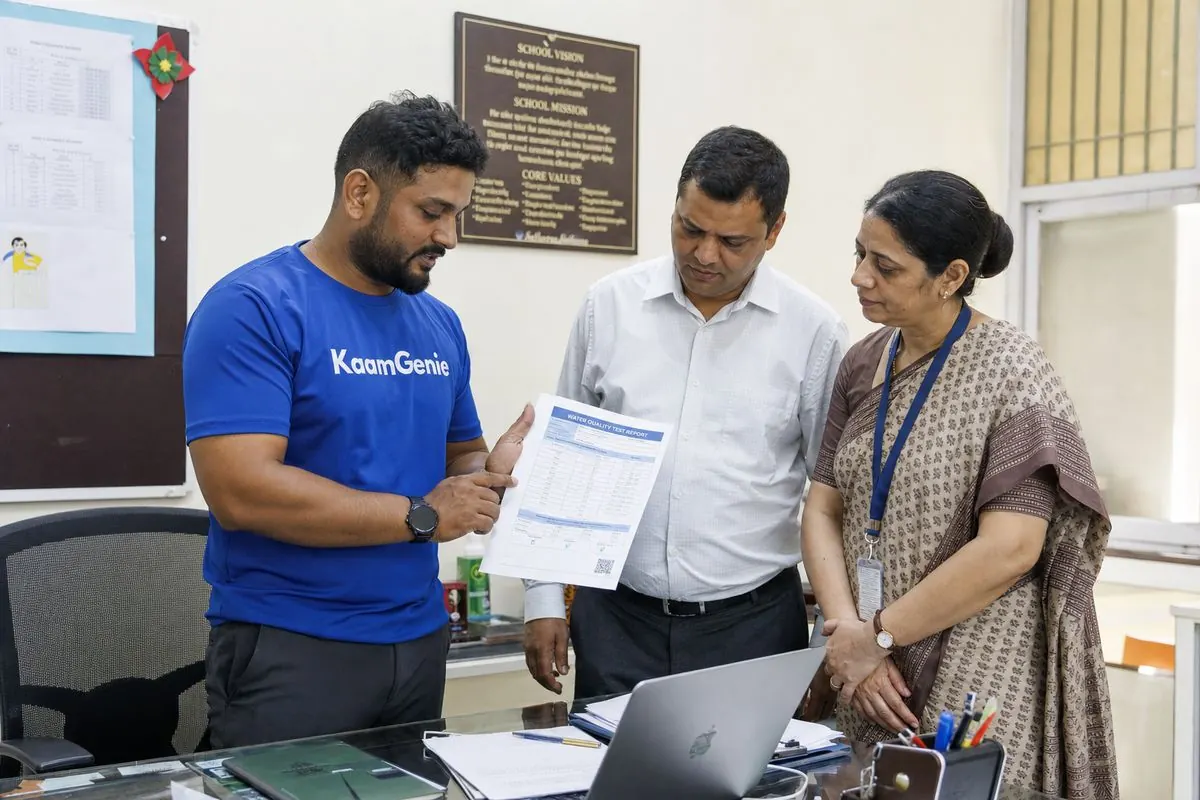
2. Pre-cleaning water sample test report. A water sample drawn before cleaning starts, tested for Total Coliform, E. coli, Total Dissolved Solids, pH, turbidity, and residual chlorine. This baseline report is what proves there was a problem to fix.
3. Post-cleaning water sample test report. Same parameters, sample drawn 24 hours after refill. This is what proves the cleaning worked. The two reports together are the audit chain — before vs after.
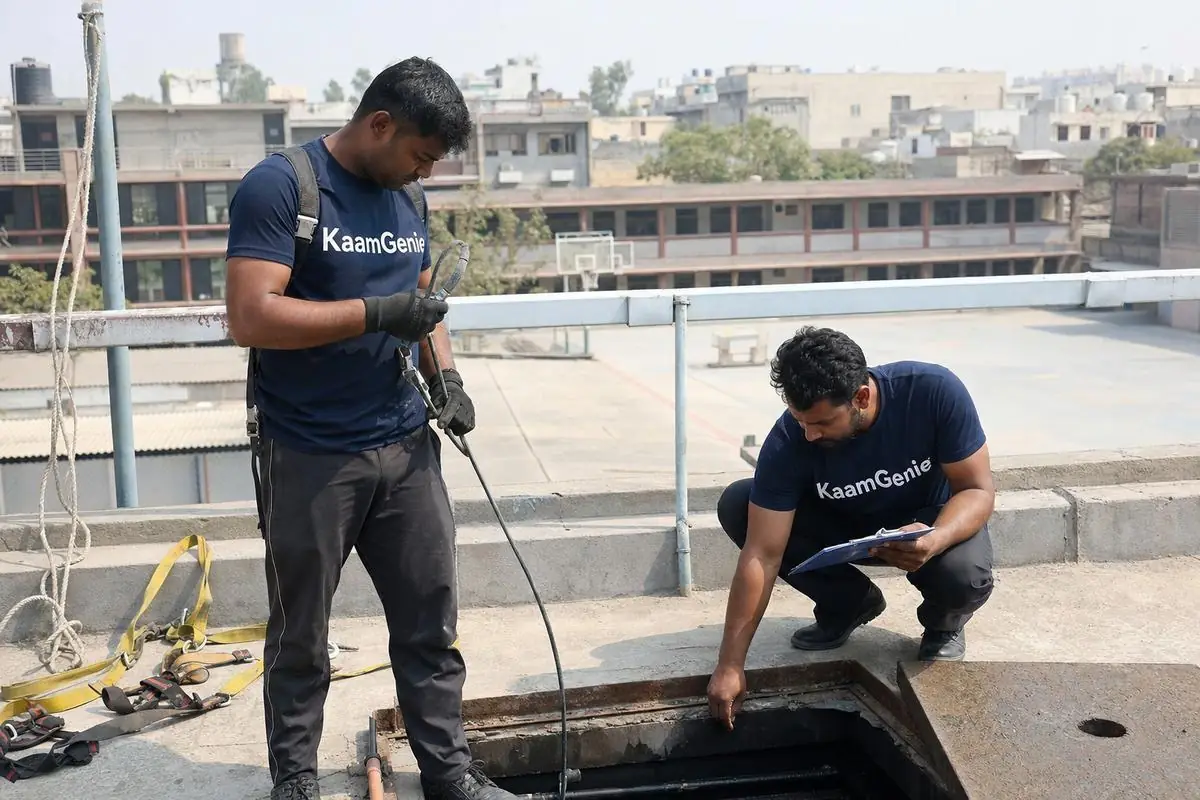
4. Photo log of the cleaning. Before photos (sediment, bio-film visible), during photos (crew in PPE, chemical containers labelled), after photos (clean tank floor, refilled tank). Some vendors share these via WhatsApp; we email a PDF summary.
5. Dated cleaning documentation. A single-page record on vendor letterhead listing: date of service, tank capacity and location, chemicals used (name + concentration + BIS or CIB&RC registration number), contact time, crew names, signature of crew lead, signature of school maintenance representative. This is the document an FSSAI inspector will ask for.
6. MSDS (Material Safety Data Sheet) for chemicals used. One-time delivery on first cleaning, updated annually. The MSDS lists what’s in the disinfectant, what to do if a child accidentally touches the wet tank surface, emergency contact details. Required for the school’s own first-aid records.
7. Crew police verification papers. Photocopies of the crew members’ police verification certificates and Aadhaar IDs. Required because the crew is entering a school campus with children present. Non-negotiable for any school admin who’s read the news in the last decade.
8. AMC schedule for the academic year. A single-page calendar showing exactly which date each cleaning visit will happen, marked against the school’s exam and event calendar. Signed by both sides.
If your current vendor doesn’t provide all eight items, you have a documentation gap. It doesn’t mean the cleaning is bad — it means the institution is exposed in the next audit.
Get the full documentation package on your next visit
GST invoice + pre/post water tests + dated cleaning documentation + MSDS + crew verification papers — the full set, every visit.
AMC vs one-time — why most Delhi schools should be on AMC
The honest decision tree for a Delhi school or college admin is this: if your institution will exist next year, you should be on AMC. The exceptions are vanishingly few. Here’s the math, broken down.
One-time cleaning cost (mid-size school example): ₹10,500 per visit, 4 visits a year = ₹42,000/year. No priority scheduling. Crew rotates each visit. No water quality testing included. No free re-cleaning if water test fails.
Quarterly AMC cost (same institution): ₹28,500/year for 4 visits. Same crew lead every visit (continuity matters). Free re-cleaning if any post-cleaning water test fails to meet BIS standards. Priority response in case of emergency (suspected contamination, parent complaint cascade). Water quality testing included on visits 1 and 3. Fixed annual line item for the institution’s budget file. Documentation pre-filed for FSSAI audit readiness.
The AMC saves roughly 30% in cash AND adds value the ad-hoc booking doesn’t carry. The only reason a school would choose ad-hoc is if cash flow is genuinely strained — in which case a 2-instalment payment structure on the AMC (50% in April, 50% in October) usually solves it.
Common AMC inclusions (the standard package): 4 visits a year on agreed dates, free re-cleaning if any post-cleaning water sample fails BIS testing, priority response for emergency call-outs, water quality testing twice a year (pre-monsoon + post-monsoon), full documentation package on every visit, single crew lead assigned to the account for the full year, dedicated escalation contact for the admin officer.
Common AMC exclusions (read the contract): tank repair work (cracks, fittings, plumbing) is quoted separately on discovery; emergency call-outs beyond 1 per quarter are charged additional; chemical surcharge if scaling is extreme (rare in Delhi). The honest vendors disclose all this upfront. The dishonest ones hide it in fine print and surprise the institution mid-year.
Real Delhi context — where the school + college clusters are
Delhi has dense school and college clusters in specific zones, and we’ve worked across most of them over the years. Knowing the cluster context helps you benchmark your institution’s tank profile against peers in the same area.
South Delhi school belt — Vasant Vihar, Saket, Greater Kailash, Defence Colony, Vasant Kunj. Dense cluster of CBSE and CISCE schools, both day and boarding. Most schools here have 2-4 acre campuses with separate rooftop tanks per building, central underground sumps, and dedicated kitchen tanks for the in-house canteens. Quarterly AMC is the norm in this belt. Annual cleaning budgets typically range ₹25,000-60,000.
Dwarka sector schools — Sectors 6, 7, 10, 12, 17, 19. Mostly large CBSE schools serving the planned residential sector. Campus sizes are larger (3-5 acres typical), tank infrastructure tends to be newer and well-mapped, but volumes are high because student counts are 1,500-3,000 per school. Quarterly AMC essential.
Rohini sector schools — Sectors 5, 6, 7, 11, 13, 17. Similar to Dwarka pattern, slightly older infrastructure in some sectors. Mid-day meal schemes more common, so kitchen tank cleaning becomes a priority.
Noida sector schools — Sectors 18, 25, 40, 41, 44, 50, 51, 62. Mix of well-established CBSE schools and newer International Baccalaureate schools. Tank infrastructure tends to be modern; admin departments are usually well-staffed and documentation-conscious. Good fit for AMC with strong reporting requirements.
Delhi University North Campus — Maurice Nagar, Patel Chest, Bungalow Road area. Dense cluster of colleges with extensive hostel infrastructure. Most colleges here have 8-15 hostels with their own tank systems on top of academic block tanks. Procurement procedures are formal (tender-based for AMC contracts above threshold), so the vendor selection process is longer but the contracts are larger.
Delhi University South Campus — Benito Juarez Road, Dhaula Kuan area. Smaller cluster, similar profile to North Campus but with fewer hostels and slightly different building stock.
JNU campus — Mehrauli-Munirka area. Single sprawling campus with extensive hostel network. Centralised maintenance department, AMC scope is typically very large and managed through formal procurement.
IIT Delhi area — Hauz Khas, Adchini. Single campus, technical institution with on-campus housing for both students and faculty. Lab water requirements add complexity.
Greater Noida college belt — Knowledge Park I, II, III, IV, V. Engineering, management, and pharmacy colleges. Campuses are large (5-15 acres), hostels are substantial, mess infrastructure is FSSAI-regulated. AMC with strong FSSAI documentation is standard.
Wherever your institution sits in this map, the cleaning architecture you need is similar — quarterly AMC, full documentation, scheduled around the academic calendar, and crew with proper verification papers. The size of the contract scales with the campus, the protocol doesn’t change.
Common admin mistakes that cost the institution later
Across years of working with Delhi schools and colleges, the same four mistakes show up at admin departments who haven’t set up tank cleaning properly. None are obvious in month 1. All of them surface within 18-24 months as either an audit issue, a parent complaint, or a budget overrun.
Mistake 1: hiring the cheapest local vendor without checking documentation capability. A vendor quoting ₹3,000 for a campus that needs ₹10,000 of work is almost always cutting documentation, water testing, or chemical quality — not labour. The institution pays less today and is exposed in the next FSSAI audit or the next parent complaint.
Mistake 2: treating tank cleaning as a maintenance task instead of a hygiene task. Maintenance teams know how to fix leaks, replace tank fittings, and clean exteriors. They generally don’t know food-grade disinfectant chemistry, NABL water testing, or FSSAI documentation requirements. Tank cleaning should sit under hygiene/health, not under general maintenance.
Mistake 3: forgetting the kitchen and lab tanks. The big visible rooftop tanks get cleaned; the small kitchen tank and the lab block tank get forgotten because they’re tucked away. These are the highest-risk tanks (kitchen feeds cooked food, lab feeds practical experiments) and they suffer the longest neglect.
Mistake 4: scheduling around the vendor’s convenience instead of the academic calendar. The vendor says “we can come Tuesday morning”, the school agrees, and the cleaning happens on a Class 10 mock exam day. Parents get water shut-off complaints. The vendor relationship turns adversarial. Lock the calendar exclusions in the AMC contract from day one.
The fix for all four is to set up the AMC properly at the start of the academic year, with clear documentation requirements, scheduled dates aligned to the calendar, and the right vendor relationship. The investment in the first month pays back over 3-4 years.
How to budget for an academic year — the line items
For admin officers writing the budget proposal for the next academic year, here’s the line-item breakdown that’s defensible to the director or trust board.
Line 1: Quarterly water tank cleaning AMC. Single annual figure based on campus size from the pricing table above. Pay in 2 instalments (April + October) for cash flow ease.
Line 2: Emergency call-out reserve. 10% of the AMC value, held as a reserve for any unplanned cleaning (suspected contamination, parent complaint cascade, post-construction work). Often unused, but the reserve allows immediate response without budget re-approval.
Line 3: Tank repair contingency. 15-20% of AMC value for repair work the vendor flags during cleaning (cracks, fittings, internal lining issues). Tank repairs done during cleaning are 30-40% cheaper than mobilising a separate plumbing team later.
Line 4: Water quality testing add-ons. If your AMC includes 2 tests/year and you want quarterly testing, the additional 2 tests cost roughly ₹3,000-4,000/year.
Line 5: FSSAI compliance overhead. If the institution serves food, the cleaning documentation needs to integrate into the FSSAI compliance file maintained by the canteen manager. Usually no additional vendor cost — just admin time.
Total budget for a mid-size Delhi school running a mid-day meal scheme: roughly ₹35,000-45,000/year all-in. For a large multi-building Delhi college with multiple hostels: roughly ₹1,40,000-2,00,000/year all-in. Both numbers are small fractions of the institution’s total maintenance budget but they protect the highest-stakes operational surface area.
Frequently asked questions
How often should a Delhi school clean its water tanks?
Quarterly — four visits a year — is the honest baseline for Delhi schools, not the 6-monthly residential standard. The reason: school tanks have higher throughput (60-80% daily refill vs 30-40% residential), serve a younger and more vulnerable population, and any outbreak affects hundreds at once. Kitchen tanks serving mid-day meal schemes should be cleaned every 8 weeks. Colleges with hostels follow the same quarterly baseline, with more visits per year for the mess kitchen tank.
Who at the school should book the cleaning — admin, principal, or maintenance?
The admin or estate officer should own the AMC contract, the principal should approve the annual budget line, and the maintenance head should be the day-of-cleaning point of contact for the crew. If maintenance owns it end-to-end, documentation usually slips because maintenance teams aren’t set up for water-quality paperwork. If admin owns it end-to-end without maintenance coordination, access and water shut-off authority becomes a problem on the cleaning day.
Can the tank cleaning be done on weekends or holidays instead of school days?
Yes — weekends and academic breaks are the preferred windows. Winter break (mid-December to early January) and summer break (mid-May to end-June) are ideal for full-campus cleaning rounds. Weekends work for individual tank visits during the term. The school just needs to arrange security clearance, maintenance head presence, and water shut-off authority for the visit. We routinely run weekend and break-period cleanings for Delhi schools.
What about hostel tanks — do they need separate handling from the academic block tanks?
Yes. Hostel tanks are the highest-risk water on a college campus because students drink, cook, brush, and bathe there with no parental oversight. The cleaning frequency should be the same (quarterly) but the documentation needs to be stricter, and the mess kitchen tank within the hostel needs FSSAI-grade cleaning every 8 weeks. Boys’ and girls’ hostels are usually separate buildings with separate tank systems, and both need to be on the AMC contract.
Do we need water quality testing on top of the cleaning?
Yes — the cleaning without testing is incomplete documentation. Pre-cleaning water testing proves there was a problem; post-cleaning testing proves the cleaning solved it. The two reports together are the audit chain that protects the institution in FSSAI inspections, parent complaints, or any regulatory query. Our AMC includes water quality testing twice a year (pre-monsoon + post-monsoon) on the standard contract; additional quarterly testing is ₹1,500 per sample if you want it.
What documentation do we need for procurement and audit files?
Eight items per visit: GST tax invoice, pre-cleaning water test report, post-cleaning water test report, photo log of the cleaning (before/during/after), single-page cleaning record listing chemicals used and contact times, MSDS for the disinfectants, crew police verification photocopies, and the year-long AMC schedule. All eight should arrive within 7 days of the cleaning. If your current vendor doesn’t supply all eight, the institution has a documentation gap that will surface in the next audit.
What about CBSE or CISCE compliance — do those boards have specific tank cleaning requirements?
CBSE and CISCE both reference the Department of School Education guidelines on safe drinking water in schools, which require clean drinking water access for all students but don’t prescribe a specific cleaning frequency. The de facto standard followed by most well-run Delhi schools is quarterly tank cleaning with documented water quality testing. If your school is preparing for affiliation renewal or an inspection, the cleaning documentation is part of the campus safety file.
How should we budget for tank cleaning across the academic year?
Five line items in the proposal: quarterly AMC (the main figure, based on campus size), emergency call-out reserve (10% of AMC), tank repair contingency (15-20% of AMC), water quality testing add-ons (₹3,000-4,000 if you want quarterly testing instead of twice-yearly), and FSSAI compliance overhead (usually admin time, not additional vendor cost). For a mid-size Delhi school running a mid-day meal scheme, the total is roughly ₹35,000-45,000/year all-in.
What’s the cost difference between AMC and one-time booking?
For a mid-size school: AMC is roughly ₹28,500/year for 4 visits, vs ad-hoc at ₹10,500 per visit which would total ₹42,000/year for the same 4 visits. The AMC saves about 30% in cash AND includes water quality testing, priority emergency response, same crew lead continuity, free re-cleaning if post-cleaning water test fails, and pre-filed documentation for FSSAI readiness. Ad-hoc booking is only defensible if cash flow is genuinely strained, and even then a 2-instalment AMC structure usually solves that.
Can KaamGenie handle a campus with 10+ tanks in a single visit window?
Yes — for large school and college campuses we deploy multiple crews simultaneously to complete all tanks within the booked window (usually 1.5-3 days for a 15-30 tank campus). The first step on any large campus is a free survey where a senior crew lead walks the site, photographs every tank, and quotes a custom AMC. Documentation is delivered per-tank, then consolidated into a campus-wide report at the end of each visit cycle.
What if a tank cleaning is needed urgently because of a suspected contamination?
Emergency response under AMC is usually within 24 hours for Delhi schools and colleges. For institutions not on AMC, we can usually mobilise within 24-48 hours depending on crew availability. If contamination is suspected, the first call should be to your vendor for an emergency cleaning AND to a NABL-accredited lab for an independent water quality test — the two confirmations together protect the institution if the issue escalates to parent complaints or regulatory attention.
Schedule a campus-wide quote for your school or college
Free campus survey. Quarterly AMC with full documentation package. GST invoice on institution letterhead. Crew police verification on file.
Sources & references
- Bureau of Indian Standards (BIS) — IS 10500:2012 defines the drinking water quality parameters (Total Coliform, E. coli, TDS, pH, turbidity) that the post-cleaning water test must satisfy for any educational institution.
- WHO Drinking Water Guidelines — global framework on safe drinking water that informs the case for quarterly cleaning frequency in high-throughput institutional settings.
- Department of School Education & Literacy, Ministry of Education — central guidelines on safe drinking water and hygiene facilities in schools, referenced by both CBSE and CISCE for affiliation requirements.
- Indian Council of Medical Research (ICMR) — publishes research on waterborne disease patterns in Indian institutional settings, including the elevated risk in residential schools and college hostels.
- CPHEEO Manual on Water Supply and Treatment — the Central Public Health and Environmental Engineering Organisation manual referenced for institutional water storage and cleaning protocols.
- Food Safety and Standards Authority of India (FSSAI) — sets water hygiene and documentation standards for school canteens and college mess kitchens serving 50+ meals a day.
Last verified: 7 June 2026. If you find any of these links broken, please let us know.