
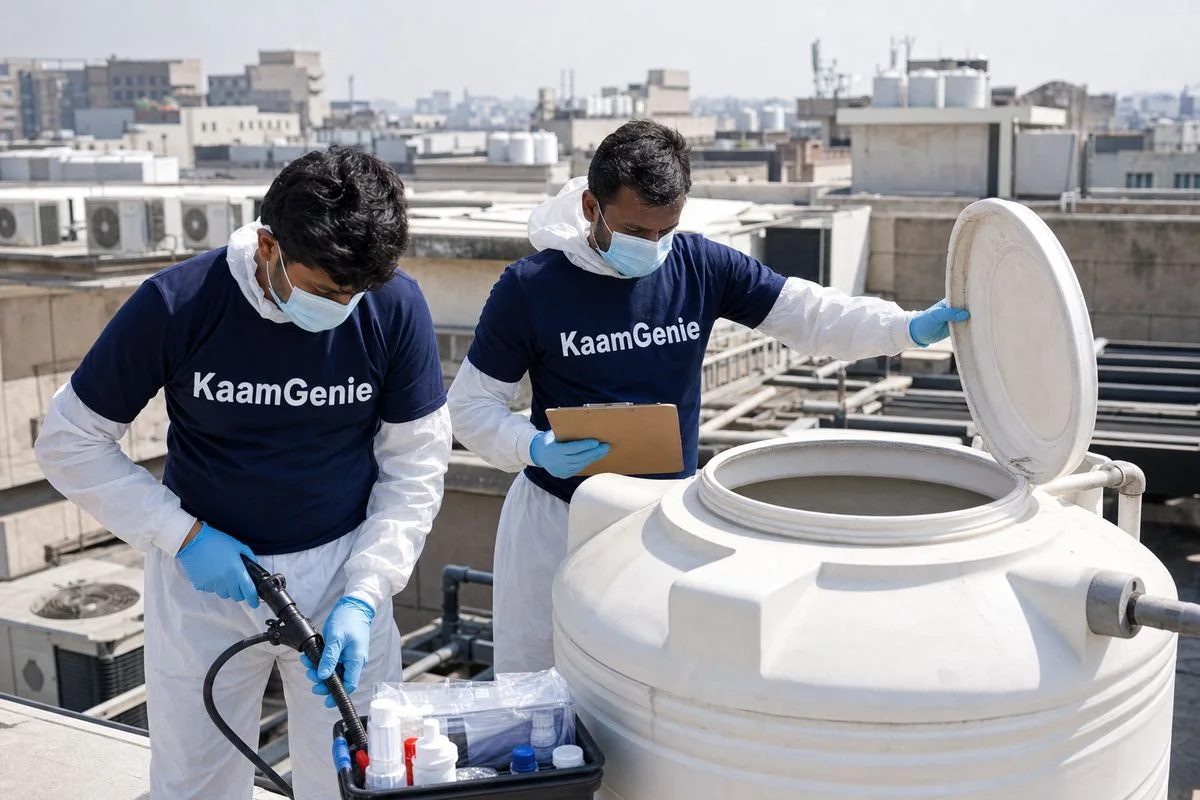
Quick answer — hospital water tank cleaning Delhi (2026)
- Who needs it: Hospitals, nursing homes, clinics, dialysis centres, day-care surgical units, IVF clinics, diagnostic labs — anyone whose water touches patients or instruments.
- Frequency: Quarterly minimum (NABH-aligned). Monthly for dialysis-zone tanks. Annual is not enough for any healthcare facility.
- Protocol: PPE crew, food-grade disinfection, microbiological swab testing (HPC, E. coli, Legionella), full documentation for the infection-control file.
- Pricing (2026): Single-tank clinic from ₹1,499. Nursing home ₹3,499-5,499. Mid-size hospital ₹8,999-14,999. Large multi-specialty: custom AMC quote.
- Documentation: Pre/post photos, chemical batch number, contact-time log, swab test report (3-5 day lab turnaround), signed sterility certificate.
- Timing: After-hours (10pm-6am) or low-occupancy windows to avoid patient disruption.
- Coordination: Direct line to your infection-control committee + biomedical waste officer.
Why hospital water tanks are a different category — the patient-safety stakes
A residential tank cleaning protects a family of four from stomach bugs, skin irritation, and yellow water. A hospital tank cleaning protects the same kinds of risks, but multiplied across hundreds of vulnerable patients every day — people whose immune systems are already compromised by illness, surgery, chemotherapy, or organ transplant medication. The same waterborne organism that gives a healthy adult a mild stomach upset can cause a post-op wound infection, a urinary catheter infection, or a fatal bloodstream infection in someone in the ICU. The patient-safety arithmetic is brutal: one contaminated tank in a 200-bed Delhi hospital can become a hospital-acquired infection (HAI) outbreak within a week.
The waterborne organisms that healthcare facilities worry about are not the ones a home worries about. In a Delhi residential tank, the realistic concern is total coliform and the occasional E. coli from a roof-bird or municipal supply break. In a hospital tank, the real risks include Legionella pneumophila (the cause of Legionnaires’ disease, transmitted via aerosols from showers and cooling towers), Pseudomonas aeruginosa (a major cause of post-op and burn-unit infections that colonises tank biofilm and tap fittings), non-tuberculous mycobacteria (NTM, increasingly recognised in central-line and dialysis infections), and Acinetobacter baumannii. None of these are killed by a casual residential-grade tank rinse. They live in the biofilm that lines the tank wall and the pipework downstream, and they require a documented disinfection protocol with measured contact time and post-clean microbiological proof that the colony has been knocked down.
The legal and accreditation stakes are also different. A residential tank cleaning has no external auditor. A hospital tank cleaning is reviewed by the NABH assessor on accreditation renewal, by the hospital’s own infection-control committee at every monthly meeting, by the state pollution control board on biomedical waste audits, and (if anything goes wrong) by the consumer court and the medical insurance carrier. A missing cleaning record, a non-NABL-accredited lab report, or a gap in the cleaning log can cost the hospital its accreditation tier or expose it to a negligence claim. The paperwork is not bureaucracy — it is the proof of due diligence that protects the facility when something downstream goes wrong.
This is why the same Delhi crew that cleans a flat in Lajpat Nagar for ₹699 cannot show up at a Saket nursing home with the same kit and the same protocol. Different chemistry, different contact times, different documentation, different testing, different PPE — the same reasons our water tank cleaning services are priced by scope rather than by tank size alone. The price difference reflects real differences in scope — not a brand markup.
NABH, NABL, JCI — the standards your hospital is being measured against
Most Delhi hospitals and clinics are working toward, holding, or renewing one of three accreditations. Each one has explicit water-quality and infection-control clauses that touch how tanks must be cleaned and documented.
NABH (National Accreditation Board for Hospitals & Healthcare Providers). The Indian standard, run by the Quality Council of India. The NABH Hospital Accreditation Standards include a dedicated Hospital Infection Control (HIC) chapter and a Patient Safety and Quality Improvement (PSQ) chapter. Within HIC, there are explicit requirements for documented water-quality surveillance, periodic microbiological testing, and a written environmental cleaning programme that covers water storage. The NABH assessor will ask to see your cleaning log, your microbiology reports, and your corrective-action records from the last 12 months. A missing quarter of records can drop the accreditation score. For nursing homes specifically, the NABH Small Healthcare Organisations (SHCO) standard applies and has lighter-but-still-mandatory water hygiene clauses.
NABL (National Accreditation Board for Testing and Calibration Laboratories). This applies to the testing lab, not the hospital. Critical because microbiological reports from a non-NABL-accredited lab are not accepted in an NABH audit. If the swab samples we take from your tank get tested at a non-accredited lab, the paperwork is worthless to your assessor. Our standard hospital protocol routes swabs to NABL-accredited microbiology labs in Delhi — the report carries the NABL logo and accreditation number, which is what the assessor wants to see.
JCI (Joint Commission International). The international accreditation held by Delhi’s largest private hospitals that handle medical tourism. JCI standards on water hygiene are stricter than NABH, with explicit Legionella surveillance requirements, hot-water temperature monitoring, and quarterly culture sampling protocols. If your facility holds or is pursuing JCI, the tank cleaning protocol needs to include the Legionella swab as a routine item, not an optional add-on. We coordinate directly with JCI-accredited hospital infection-control teams in South Delhi and Gurgaon on this.
Beyond these three, there are also ICMR (Indian Council of Medical Research) guidelines on hospital-acquired infection surveillance, the CPHEEO (Central Public Health and Environmental Engineering Organisation) Manual on Water Supply and Treatment, and the BIS IS 10500:2012 drinking water standard. None of these is optional for a serious healthcare facility. The tank cleaning protocol references all of them in the documentation pack we hand over.
Typical hospital water tank setup — what we’re actually cleaning
A residential building has one or two tanks. A hospital has anywhere from five to twenty separate water systems, each with its own risk profile and cleaning frequency. Knowing the setup before the crew arrives is half the protocol. Here’s the typical layout in a Delhi multi-specialty hospital or nursing home.
Rooftop primary potable tanks. The largest tanks on site, usually 10,000-50,000 litres in stainless steel or food-grade HDPE, feeding the entire facility’s drinking water, hand-wash, patient-bath, and general utility lines. These are the highest-volume, lowest-residence-time tanks. Quarterly cleaning is the floor; some facilities do six-weekly. Cleaning these requires confined-space entry, a two-person crew minimum, and a full disinfection cycle.
Underground sump (raw inlet). The municipal water from Delhi Jal Board or borewell arrives here first, before being pumped up to the rooftop. Sediment and silt collect at the bottom. Cleaning frequency: quarterly, paired with the rooftop visit. Confined-space gear is non-negotiable.
Dialysis-zone tanks (separate water loop). Dialysis water is treated through reverse osmosis (RO) systems with strict AAMI / ISO 23500 microbial limits — far stricter than drinking water. The feed tanks upstream of the RO plant need monthly cleaning, monthly endotoxin testing, and a coordinated maintenance window with the dialysis unit’s biomedical engineer. We do not touch the post-RO storage — that is the RO vendor’s scope — but the pre-RO feed tank is ours.
Kitchen and dietary tanks. Some hospitals run a separate tank for the dietary department because FSSAI rules apply to the patient-meal kitchen. These tanks need the food-grade cleaning protocol (the same protocol we use for restaurant kitchens) plus the hospital infection-control documentation. Quarterly cleaning, FSSAI certificate, infection-control file copy — same visit.
Laundry tanks. The hospital laundry uses high-volume hot water for thermal disinfection of patient linen. Tank cleaning frequency is quarterly, with thermal-disinfection records of the laundry process logged separately. The tank does not need the same swab testing as drinking water, but the cleaning record is still part of the infection-control file.
Fire-hydrant and reserve tanks. Separate large tanks for fire suppression. Cleaning frequency: annually at minimum, paired with the hospital’s fire-NOC renewal. These tanks sit stagnant for long periods and accumulate heavy biofilm — the cleaning takes longer than a potable-water tank of the same size.
OT (operating theatre) zone tanks. Some larger hospitals run a separate tank dedicated to the OT block, the CSSD (sterile supply department), and scrub stations. Monthly cleaning, monthly swab testing, and the tightest documentation in the facility. The crew assigned to this tank wears the same gowning as the OT staff during the cleaning window.
Walking into a hospital cold without this map means you miss tanks, double-book others, and create cross-contamination risk. Our first visit to a new healthcare client is always a free site walk with the infection-control nurse and the maintenance manager — we map every tank, every feed line, every cleaning window, before we quote.
The hospital cleaning protocol — what’s different from residential
The eight-step process for a residential tank cleaning — inspection, drain, sludge removal, scrub, jet wash, disinfect, refill, certify — is the skeleton of the hospital protocol too. But every step has a stricter version, and there are five additional steps that residential cleaning skips.
1. Pre-clean coordination meeting. 48 hours before the visit, we meet with the infection-control nurse, the maintenance manager, and the floor in-charge for the affected wards. We confirm which tank, which feed lines, which downstream wards lose water, and for how long. We schedule the cleaning to overlap with low-occupancy windows (typically 11pm-5am for inpatient wards, weekends for OPD-only zones). The maintenance team isolates the tank from the distribution loop and arranges bypass supply where needed.
2. PPE and entry control. Crew arrives in full PPE: N95 mask, eye protection, gowns, gloves, dedicated boots that have not been worn outside the hospital. For confined-space entry into the tank, we add a harness, lifeline, and a gas-detection meter (oxygen, hydrogen sulphide, methane) because hospital sumps can accumulate gas pockets. Entry is logged with the facility’s security desk.
3. Pre-clean swab sample. Before any chemical or scrubbing, we take a swab from the tank inner wall and the outlet pipe. This baseline sample goes to the NABL lab and tells us (and the infection-control file) the starting microbial load. Without the pre-clean sample, the post-clean improvement is unprovable.
4. Full drainage to the biomedical waste line. Residential tank cleaning drains to the rooftop scupper. Hospital tank cleaning drains to a dedicated waste line designated by the biomedical waste officer — the wastewater carries biofilm and disinfectant residue and cannot go to the regular storm drain. This step requires a hose route mapped in advance.
5. Manual sludge removal + scrubbing. Inside the tank with food-grade brushes. No abrasive pads on stainless steel (causes micro-scratches that biofilm loves to colonise). Two crew rotating in 15-minute shifts because PPE in a closed tank gets uncomfortable fast.
6. High-pressure jet wash, then food-grade disinfectant with measured contact time. The disinfectant is sodium hypochlorite (NaOCl) at the concentration specified for hospital tanks — significantly stronger than residential, with 30-60 minute contact time depending on the post-test target. Concentration and contact time are logged. The chemical batch number, manufacturer, and certificate of analysis are recorded in the documentation pack.
7. Neutralisation and rinse. Chlorine residual is neutralised down to drinking-water acceptable levels before refilling. We test with a portable residual chlorine meter and log the reading.
8. Refill and post-clean swab. Tank is refilled, the system is flushed through the distribution lines, and a second swab is taken from the same inner-wall location plus the outlet tap. This goes to the lab alongside the pre-clean sample. 3-5 days later, the comparative report comes back — the document the infection-control committee actually wants.
9. Documentation handover. Pre/post photos, chemical batch certificate, contact-time log, residual chlorine reading, pre-clean and post-clean swab reports (NABL-accredited), crew names and police-verification IDs, and a signed sterility certificate. All of this goes into the hospital’s infection-control file and is what the NABH assessor will look at on the next audit.
Need an NABH-ready protocol for your facility?
Free site walk + AMC quote for hospitals, nursing homes, and clinics across Delhi NCR. After-hours scheduling, infection-control file ready, NABL-routed lab reports.
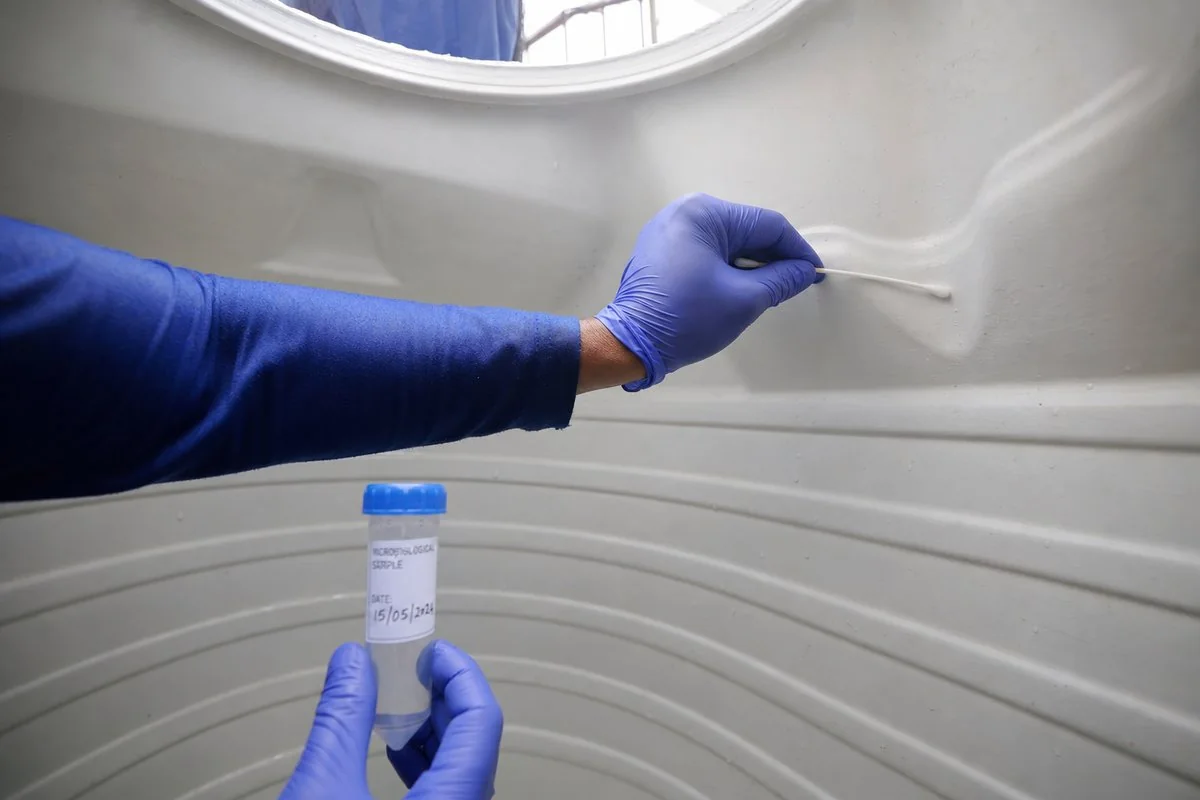
Microbiological testing before and after cleaning — the proof that justifies the protocol
The single most important difference between residential and hospital tank cleaning is the swab testing. Without it, you have a cleaning event but no proof of outcome. With it, you have a documented microbiological improvement that the NABH assessor and the infection-control committee can verify. Here is what we run for every hospital and clinic client in Delhi.
Heterotrophic Plate Count (HPC). The general microbial-load indicator. BIS IS 10500:2012 sets the drinking water limit at 100 CFU/mL or less. Healthy hospital potable water should be well below this. Pre-clean readings of 500-5,000 CFU/mL are common in tanks that haven’t been cleaned in 4+ months; post-clean readings should drop to single digits or undetectable. The CFU/mL number before and after, on the same NABL lab report, is the headline metric for the infection-control file.
Total Coliform and E. coli. BIS limit: not detectable in 100 mL. A positive coliform reading post-clean means the protocol failed somewhere — usually inadequate contact time or a downstream pipe biofilm that the tank cleaning alone cannot reach. We treat any positive coliform reading as a non-conformance and re-clean at no charge.
Pseudomonas aeruginosa swab. Standard add-on for hospital tanks, especially OT-zone and burn-unit-feeding tanks. The organism colonises biofilm and persists through routine chlorination. Detection requires specific selective media at the lab. Pre/post sampling is the only way to know if the cleaning actually broke the biofilm colony.
Legionella pneumophila culture or PCR. Required for hospitals with JCI accreditation and for any facility with patient cohorts at risk (transplant, ICU, neonatal). Legionella culture takes 7-10 days at the lab; PCR is faster (24-48 hours) but more expensive. We coordinate the sampling protocol with the hospital’s preferred lab and turnaround target.
Endotoxin (for dialysis-zone feed tanks). Different test entirely — measures bacterial cell-wall fragments that can pass through the RO membrane and cause pyrogenic reactions in dialysis patients. AAMI / ISO 23500 limit. Monthly testing for any pre-RO feed tank.
The three-to-five day turnaround on lab reports is why hospital cleaning has to be planned in advance — the post-clean swab is taken on the day, the result lands a few days later, and the certified report closes the cleaning event. We deliver the full report pack (signed sterility certificate + NABL lab report) within 7 days of the cleaning visit. If a result is non-conforming, we re-treat within 48 hours at no charge until the post-test passes.
Pricing for hospital and clinic tank cleaning in Delhi (2026)
Hospital pricing carries more variables than residential because the work scope depends on the facility’s tank count, accreditation tier, after-hours timing, and microbiological testing depth. Below is the honest 2026 range. Most facilities settle on a quarterly AMC quote after the first site walk — the per-visit number drops 15-25% under contract.
| Facility type | Typical tank setup | One-time price | Quarterly AMC (per visit) | Documentation |
|---|---|---|---|---|
| Small clinic / day-care / IVF / diagnostic lab | 1 rooftop tank, up to 2,000L | ₹1,499-2,499 | ₹1,199-1,999 | HPC + Coliform swab |
| Multi-specialty clinic / polyclinic | 1-2 tanks, up to 5,000L total | ₹2,999-4,499 | ₹2,499-3,599 | HPC + Coliform + Pseudomonas |
| Nursing home (20-50 beds) | 2-3 tanks + sump, up to 10,000L | ₹3,499-5,499 | ₹2,999-4,499 | Full HPC + Coliform + Pseudomonas + sterility cert |
| Mid-size hospital (50-150 beds) | 4-6 tanks incl. dialysis feed + kitchen | ₹8,999-14,999 | ₹7,499-12,499 | Full panel + endotoxin (dialysis) + Legionella (optional) |
| Large multi-specialty (150+ beds, NABH/JCI) | 10-20 tanks, multiple zones | Custom AMC quote | Custom AMC quote | Full panel + Legionella + monthly OT-zone test |
| Add-on: After-hours premium | 10pm-6am scheduling | +15-20% | Included in AMC | — |
| Add-on: Legionella culture / PCR | Per tank, per test | ₹1,800-2,500 | Included in JCI-tier AMC | NABL-accredited report |
GST 18% extra. All prices include the documentation pack, NABL lab routing, and infection-control file copy. Same-day callback for emergency contamination events on existing AMC clients.
Quarterly AMC vs one-time — why hospitals should always be on AMC
For residential clients, the AMC vs one-time decision depends on the home’s reinfestation risk. For healthcare facilities, the decision is settled: AMC, always. Five reasons.
1. Frequency is non-negotiable. NABH expects quarterly tank cleaning records at minimum, and dialysis-feed tanks need monthly. Booking these one cleaning at a time creates gaps in the log — one missed quarter and the audit trail breaks. AMC schedules the visits in advance, on the same calendar dates each quarter, so the log is continuous.
2. Same crew, every visit. The crew that did the September clean knows where the dialysis-feed tank is, knows the OT-zone gowning rules, knows the security desk routine, knows the infection-control nurse’s preferred sampling location. The next quarter’s crew picks up where the last one stopped. One-time bookings rotate crew and lose this institutional memory.
3. Predictable downtime windows. AMC scheduling means the wards know in advance which night they lose water and can pre-fill the bedside jugs and IV solutions. One-time bookings disrupt the wards because the cleaning slot is whenever the booking can fit.
4. AMC includes free non-conformance re-cleaning. If a post-clean swab comes back positive for coliform or Pseudomonas, the AMC contract obliges us to re-clean within 48 hours at no charge. One-time bookings carry no such commitment — you’d pay again for the second attempt.
5. The math is cheaper. Quarterly AMC visits run 15-25% below the per-visit rate. For a nursing home doing four cleanings a year, the AMC saves ₹5,000-12,000/year versus four separate bookings.
The honest position: if your facility holds NABH or is pursuing it, the AMC is not optional — it is part of the accreditation file. If your facility is small and unaccredited but still treats patients (a clinic, a day-care surgical unit, an IVF practice), the AMC is still the cheaper and safer choice. The only healthcare facility for which a one-time booking makes sense is a brand-new clinic that has not yet decided which side of accreditation it sits on.
Coordination with the infection-control committee and biomedical waste protocols
A hospital tank cleaning that happens in isolation, without coordination with the facility’s own clinical governance machinery, is almost as risky as no cleaning at all. The crew can do everything technically right and still create cross-contamination, miss a key tank, or leave waste in the wrong drain. Here is how we coordinate with the three internal stakeholders on every Delhi hospital and clinic job.
The infection-control committee (HICC). Every NABH-accredited facility has one. It meets monthly, reviews HAI surveillance data, signs off on environmental cleaning protocols, and reviews water-quality reports. Before our first cleaning visit, we share our protocol document with the committee chair (usually a clinical microbiologist or the medical superintendent) and ask for written acknowledgment that the protocol matches their internal SOP. After every cleaning visit, the swab test report and signed sterility certificate go straight to the committee secretary for the next monthly meeting. We attend the committee meeting as a vendor presentation once a year on request.
The biomedical waste officer. Hospital wastewater carrying disinfectant residue and tank biofilm is technically biomedical waste category-relevant — it cannot go down a roof scupper or storm drain. The biomedical waste officer (every facility above a certain bed count has one, per CPCB rules) tells us where to route the drain hose. Usually the answer is a designated effluent treatment plant (ETP) inlet on site, sometimes a tanker collection point. We confirm this on the pre-clean coordination meeting and never assume.
The maintenance / engineering manager. Tank isolation valves, bypass arrangements, pump shutdown timing, distribution-line flushing — all of this lives with the engineering team. Our crew works under their direction for the mechanical side of the job. The engineering team also keeps the master list of tank locations, capacities, and the last cleaning dates — the first thing we ask for is a copy of this register, updated by us after every visit.
Beyond these three, larger Delhi hospitals also involve the quality department (which owns the NABH file) and the nursing superintendent (whose staff lose water during the cleaning window and need notice). The pre-clean coordination meeting walks through the timing, the affected wards, the bypass arrangements, the lab pickup window, and the documentation handover. 30-45 minutes, scheduled 48 hours before the cleaning. This is the meeting that converts a residential-style cleaning into a hospital-grade cleaning.
Quarterly AMC for healthcare facilities — honest pricing, no surprises
Free site walk with your infection-control nurse and maintenance manager. AMC quote within 24 hours. Coverage across Delhi NCR.
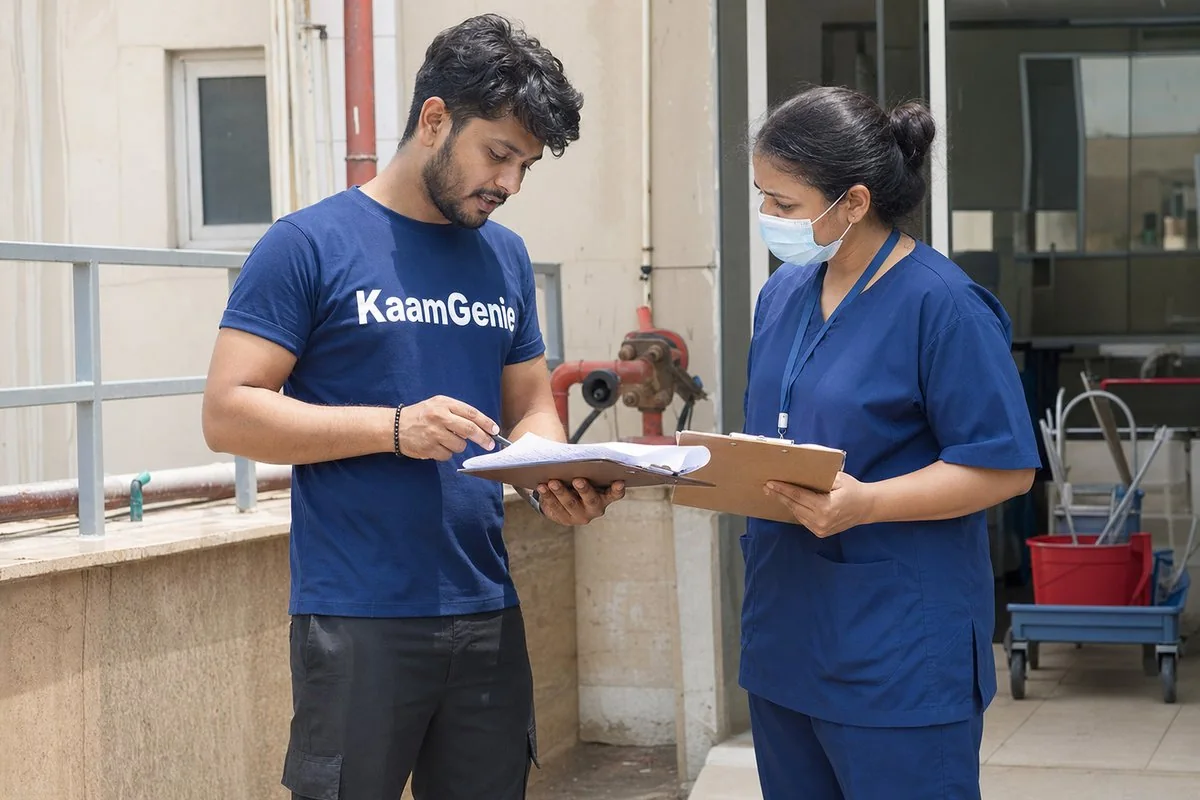
Real Delhi hospital context — where the work happens
Delhi has the densest concentration of healthcare facilities in north India. Different zones have different facility mixes and slightly different operational rhythms. Here is the realistic picture of where hospital and clinic tank cleaning happens, without naming specific facilities.
South Delhi (AIIMS-Safdarjung corridor, Saket, Vasant Kunj). The highest concentration of large multi-specialty hospitals in Delhi, including several JCI-accredited facilities targeting medical tourism. Tanks here are large rooftop stainless steel + multiple zoned distribution loops + dedicated dialysis feed tanks + OT-zone tanks. Cleaning windows are tight because patient throughput is high; we typically schedule between 11pm and 5am on weekdays. The clientele mix also includes a heavy concentration of high-end nursing homes and IVF clinics through GK, Defence Colony, and Hauz Khas.
East Delhi (Mayur Vihar, Patparganj, Dilshad Garden, Vivek Vihar). A mix of mid-size hospitals, nursing homes, and a strong concentration of diagnostic labs serving the trans-Yamuna population. Many facilities here have NABH-SHCO accreditation rather than full NABH — the protocol is similar, the documentation slightly lighter. Cleaning windows are more flexible because OPD-led practices have predictable downtime.
Dwarka. A planned-city healthcare cluster with several large multi-specialty hospitals and a strong concentration of polyclinics. Tank infrastructure tends to be newer and better-documented than older Delhi neighbourhoods, which makes the first site-walk faster.
Gurgaon (Medicity corridor and beyond). The biggest concentration of JCI-accredited multi-specialty hospitals in the NCR, with strict Legionella surveillance requirements and the highest documentation bar. Cleaning protocols here include monthly OT-zone swab testing as standard. The maintenance teams are typically the most sophisticated on the engineering side, which makes coordination smoother.
Noida sector hospitals (Sector 29, 30, 110 areas). A mix of large super-specialty hospitals, mid-size facilities, and a fast-growing nursing-home segment. Many facilities are NABH-accredited; some pursuing JCI. Operational rhythm is similar to South Delhi but with more after-7am OPD activity, which sometimes pushes cleaning windows to weekends.
Faridabad and Ghaziabad. Mid-size hospitals, nursing homes, and a heavy clinic concentration. Most facilities are NABH-SHCO accredited or working toward NABH. Cleaning frequency expectations are similar but the lab turnaround coordination is slightly different because most NABL labs the facilities use are in Delhi proper.
We serve all of the above zones under the same protocol and the same documentation standard. The difference between zones is scheduling logistics, not protocol depth. A clinic in Dilshad Garden gets the same swab testing, the same NABL routing, and the same infection-control file copy as a multi-specialty hospital in Saket.
Hospital + clinic water tank cleaning — built for your procurement file
Quarterly AMC. NABH-ready documentation. NABL-accredited swab testing. After-hours scheduling. GST invoice for accounting. Coverage across Delhi NCR. Free site walk with your infection-control nurse before we quote.
Frequently asked questions
Are you NABH-compliant?
We don’t hold a NABH accreditation ourselves (that’s for healthcare facilities, not vendors). What we provide is an NABH-ready cleaning protocol — documented procedures, NABL-accredited swab testing, chemical batch certificates, pre/post photo logs, signed sterility certificates — the exact paperwork your NABH assessor will look at when reviewing your environmental cleaning programme and your HIC (Hospital Infection Control) file. Several of our hospital clients have passed NABH renewal audits using our documentation pack as their water hygiene evidence.
What’s included in the hospital cleaning protocol?
Pre-clean coordination meeting with infection-control nurse and maintenance manager. Full PPE crew (N95, gowns, dedicated boots) plus gas-detection meter for confined-space entry. Pre-clean swab sample. Manual sludge removal + scrubbing with food-grade brushes. High-pressure jet wash. Food-grade sodium hypochlorite disinfection at hospital-grade concentration with measured 30-60 minute contact time. Neutralisation and residual chlorine testing. Refill, distribution flushing, post-clean swab sample. Documentation pack: pre/post photos, chemical batch certificate, contact-time log, NABL-accredited swab report, signed sterility certificate. Full handover to infection-control committee secretary.
How often should our hospital water tanks be cleaned?
Quarterly at minimum for general potable tanks. Monthly for dialysis-feed tanks, OT-zone tanks, and any tank with documented past contamination. Annually for fire-hydrant and reserve tanks. NABH expects the quarterly cadence at a minimum — an annual-only programme will not pass the HIC chapter review. We schedule AMC visits on fixed quarter-end dates so your cleaning log is continuous and audit-ready.
AMC vs one-time — which makes sense for our facility?
For any healthcare facility — hospital, nursing home, clinic, dialysis centre, IVF, diagnostic lab — AMC is almost always the right choice. Five reasons: quarterly frequency is non-negotiable for NABH, same crew every visit preserves institutional knowledge, downtime windows are predictable for the wards, the AMC contract includes free re-cleaning if a post-clean swab fails, and the per-visit math is 15-25% cheaper. One-time bookings make sense only for brand-new facilities still deciding on accreditation strategy.
Who at the hospital signs off on the cleaning?
Three internal stakeholders are involved on every visit. The infection-control nurse or HICC chair signs off on the protocol match and receives the post-clean swab report and sterility certificate. The biomedical waste officer approves the wastewater drain route. The engineering / maintenance manager coordinates tank isolation, bypass arrangements, and downstream flushing. For the documentation handover, the signature on the sterility certificate is typically the infection-control nurse’s, countersigned by the maintenance manager.
What microbiological swabs do you run?
Standard panel for every hospital tank: Heterotrophic Plate Count (HPC), Total Coliform, and E. coli — matched against BIS IS 10500:2012 drinking water limits, on a pre-clean and post-clean sample from the same NABL-accredited lab. Added for hospital tanks: Pseudomonas aeruginosa swab. Added for JCI-tier hospitals and ICU/transplant/neonatal-feeding tanks: Legionella pneumophila (culture or PCR). Added for dialysis-feed tanks: endotoxin test against AAMI / ISO 23500 limits. Results take 3-5 days for the standard panel, 7-10 days if Legionella culture is included.
What happens if the post-clean swab test fails?
Under our AMC contract, we re-clean within 48 hours at no additional charge. A non-conforming result usually points to one of three causes: inadequate contact time on the disinfectant, downstream pipe biofilm beyond the tank itself, or a recontamination event during refill. We re-test after the second cleaning to confirm the result lands within drinking-water limits. If a downstream pipe-biofilm issue is suspected, we coordinate with the facility’s engineering team on a flushing protocol or a pipe-replacement recommendation — outside our scope but flagged in the report. We don’t close out the cleaning event until the report passes.
How long is the water supply disrupted during cleaning?
For a single rooftop tank, the affected distribution lines are offline for 4-6 hours typically — from initial drainage to post-clean refill and flush. Larger multi-tank facilities can stretch to 8-10 hours per zone but we work zone-by-zone with bypass arrangements so the whole facility never loses water at once. We schedule the disruption between 11pm and 5am on weekdays for inpatient zones, and weekends or off-OPD-hours for clinic-only zones. Pre-clean meeting includes a written downtime estimate per ward so the nursing team can pre-stock bedside water and IV solutions.
What equipment and chemicals do you use?
Equipment: confined-space entry harness + lifeline, gas-detection meter (oxygen, hydrogen sulphide, methane), industrial wet/dry vacuum, high-pressure jet wash, food-grade non-abrasive scrub brushes, calibrated residual chlorine meter, sterile swab kits routed to NABL labs. Chemical: sodium hypochlorite (NaOCl) sourced from a CIB&RC-listed manufacturer with batch-level certificate of analysis. Concentration is hospital-grade (significantly above residential dosing), contact time 30-60 minutes depending on the post-test target. Chemical batch certificate is part of the documentation handover.
Can you work after-hours so we don’t disrupt patients?
Yes — this is the default for inpatient hospitals and nursing homes. Standard hospital cleaning windows: 10pm-6am weekdays for general wards, 11pm-4am for ICU-feeding zones, weekends for OPD-only clinics and diagnostic labs. After-hours scheduling carries a 15-20% premium on one-time bookings but is included at no extra charge under quarterly AMC. We coordinate the timing with the nursing superintendent and the engineering manager 48 hours before the visit.
What certifications does the cleaning crew hold?
All hospital-assigned crew are police-verified and Aadhaar-onboarded, with confined-space entry training and PPE certification. Our senior crew leads have BIS / CPHEEO familiarity and have completed in-house training on NABH HIC requirements and biomedical waste handling. Police-verification IDs are part of the documentation pack handed to the infection-control committee. For dialysis-zone work, the assigned crew has additional training on RO-feed-tank handling and the AAMI / ISO 23500 standard.
Do you serve clinics and small nursing homes too, or only large hospitals?
Both. Our smallest healthcare clients are single-doctor day-care surgical units and IVF clinics with one rooftop tank — AMC starts from ₹1,199/visit for these. Mid-size nursing homes (20-50 beds) and polyclinics are our most common segment. Large multi-specialty hospitals are a custom-quote category. The protocol depth scales with the facility’s accreditation tier and tank count, but the swab testing, PPE, and documentation handover are the same standard regardless of facility size. A small clinic gets the same NABL lab routing as a 200-bed hospital.
Sources & references
- Bureau of Indian Standards — IS 10500:2012 Drinking Water Specification — the Indian standard for drinking-water quality, including HPC, coliform, and chemical parameter limits referenced throughout the hospital swab-testing protocol.
- World Health Organization — Drinking-water Guidelines — global framework on safe drinking water, including the Legionella, Pseudomonas, and biofilm-management guidance that underpins hospital-grade tank cleaning.
- NABH — National Accreditation Board for Hospitals & Healthcare Providers — the Indian hospital accreditation body. The Hospital Infection Control (HIC) chapter and the SHCO standard set the water-quality surveillance and documentation requirements referenced in this guide.
- Indian Council of Medical Research (ICMR) — publishes guidelines on hospital-acquired infection surveillance and waterborne pathogen risk in Indian healthcare settings.
- CPHEEO — Central Public Health and Environmental Engineering Organisation — the Government of India manual on water supply and treatment that informs municipal-supply-fed hospital tank protocols.
- NABL — National Accreditation Board for Testing and Calibration Laboratories — the accreditation body for the microbiology labs that test our swab samples. NABH assessors require swab reports from NABL-accredited labs.
Last verified: 7 June 2026. If you find any of these links broken, please let us know.