
Quick answer — getting rid of houseflies in Delhi (2026)
- Flies have a source (2026): they breed in your kitchen bin, a blocked drain, rotting fruit, pet waste or the building garbage point — find it and the problem ends.
- Spraying never lasts: aerosol kills the adults in the room but does nothing to the eggs and maggots breeding elsewhere, so new flies keep coming.
- What actually works: a lidded bin emptied daily, fly screens on kitchen windows, sticky traps, and keeping all food covered.
- Health matters: flies move straight from filth to your food and carry typhoid, cholera and diarrhoeal bugs — a real concern in homes with kids or elderly.
- Cost of fly pest control (2026): general pest control starts at ₹999, GST 18% extra; a one-time treatment plus an AMC for food businesses.
- We cover Delhi: homes, shops and restaurants — book online or call 95603 66362.
Why flies suddenly take over a Delhi home
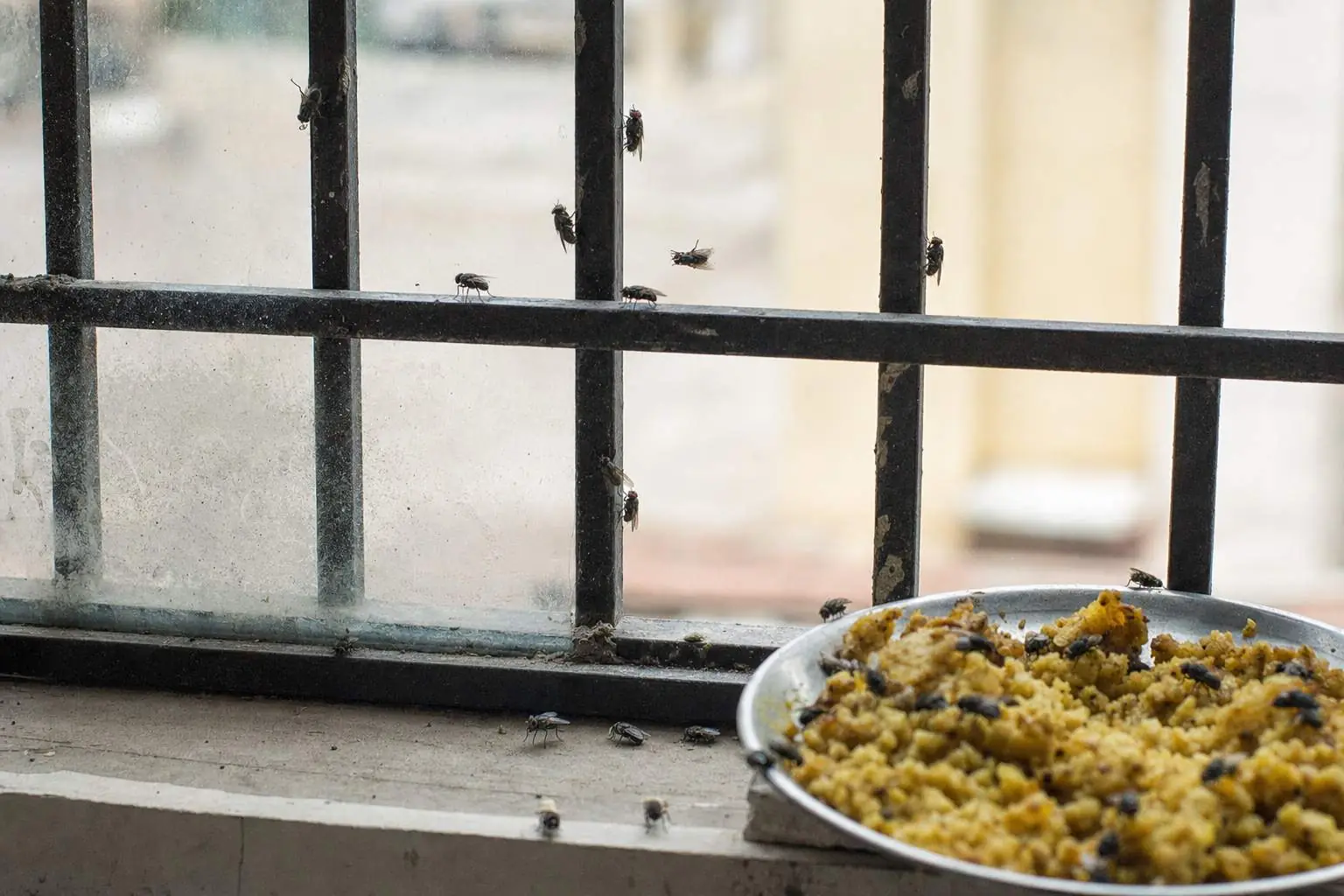
One day there’s a fly or two. A week later you can’t eat a meal without three of them circling the dal. People treat this like bad luck or bad weather — it isn’t. A housefly doesn’t wander in from the sky for no reason. It’s breeding somewhere close, and a single female lays hundreds of eggs in her short life. When you see a sudden swarm, you’re not looking at flies that flew in. You’re looking at a generation that hatched nearby and grew up on something rotting within a few metres of your kitchen.
Houseflies breed in moist, decaying organic matter. In a Delhi home and the lane outside it, that means a very predictable short list: the kitchen waste bin, especially the wet portion with fruit peels and leftover food; a blocked or smelly drain where gunk has built up in the trap; rotting fruit in the bowl on the counter or a forgotten potato at the back of the rack; pet waste on the balcony or in the building; and the big one nobody wants to think about — the open garbage point downstairs where the whole block dumps its kachra. In summer the whole cycle speeds up. Egg to adult fly can take barely a week in May and June heat, and the pre-monsoon and monsoon stretch — when wet waste sits and ferments in the humidity — is peak fly season across colonies from Laxmi Nagar to Uttam Nagar to Malviya Nagar.
So the first thing I tell anyone who calls in 2026 is: stop thinking of flies as a random nuisance and start thinking of them as a signal. They are telling you there is decaying matter somewhere with easy access. Find that, and you’ve found the off switch.
Why spraying is an endless loop
Here’s where most households waste their time and money. The reflex is to grab the aerosol can — you spray, the flies in the room drop, the air smells of chemical, and for an hour the kitchen is clear. By evening they’re back. So you spray again. And again the next day. You’ve now made spraying a daily ritual and the flies haven’t reduced at all.
The reason is simple once you see it. That can of spray only kills the adult flies it actually touches, in that room, right then. It does absolutely nothing to the eggs and the maggots quietly developing in the bin, the drain or the garbage outside. While you’re killing today’s adults, tomorrow’s batch is already maturing, and the day after that another batch hatches. You are pouring effort into the very end of the life cycle while the beginning runs completely untouched. It is, genuinely, like bailing water out of a boat without plugging the hole.
I’m not saying never use a swatter or a spray — for a couple of flies that got in through an open door, sure, knock them down. But if you’re reaching for the can every single day, the can is not your answer. The answer is upstream, at the source. Everything else is temporary.
Find and kill the breeding source — the real fix
This is the part that actually ends a fly problem, and it’s mostly free. You have to play detective for ten minutes and find where the maggots are growing. Once you clean out that one spot — or seal it so flies can’t reach it — the swarm collapses within days because no new flies are being produced. Here’s exactly where to look, roughly in order of how often it’s the culprit in a Delhi home.
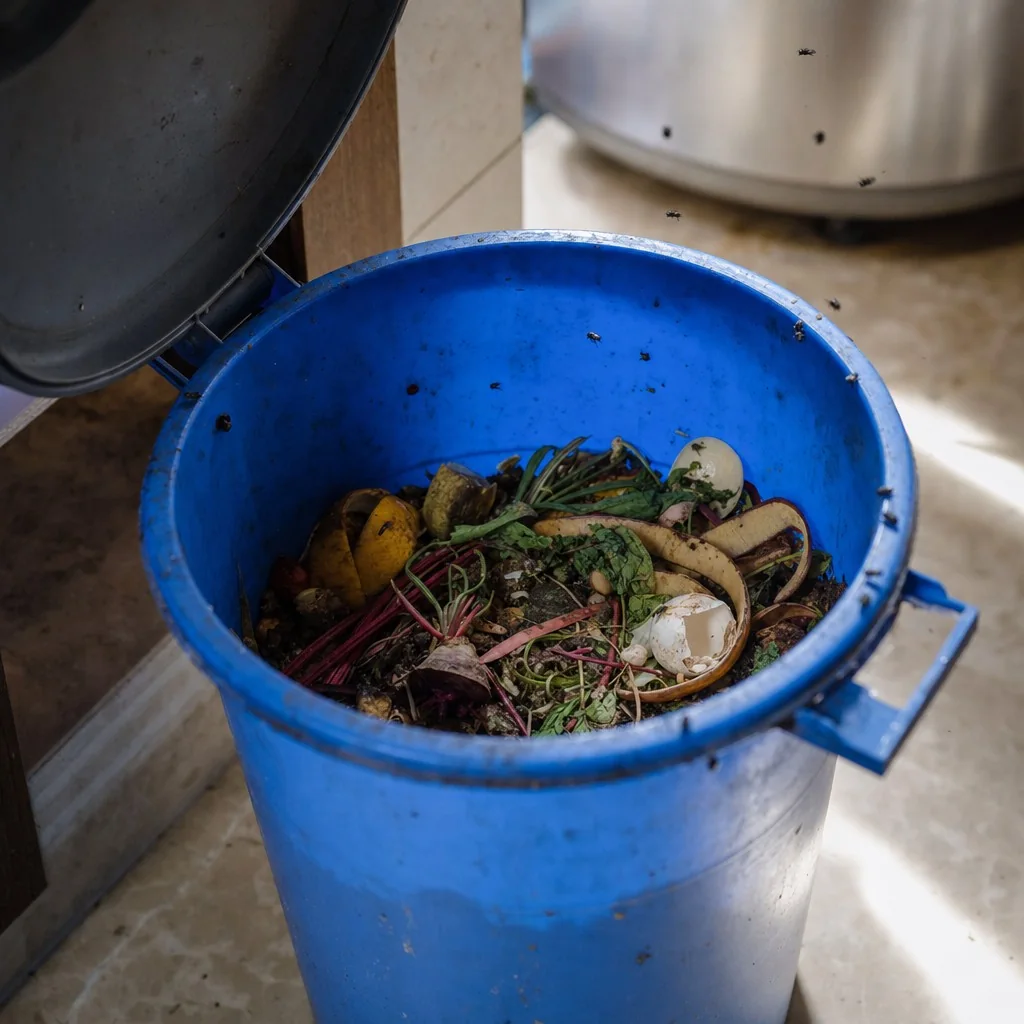
- The kitchen bin. Number one, every time. The wet waste at the bottom — peels, leftover rice, gravy — is a five-star nursery. If your bin has no lid, or the lid doesn’t seal, or you only empty it every couple of days, that’s very likely your source. Lift the liner and look at the base of the bin; if you see tiny pale wriggling maggots, you’ve found it.
- The drain traps. Kitchen sink, balcony floor drain, the gully outside the bathroom. Gunk and grease build a slimy layer in the trap that flies (especially the small drain flies people lump in with houseflies) breed in. Pour boiling water and a drain cleaner down it and scrub.
- Under and behind the fridge. A potato that rolled back there months ago, or spilt liquid that dried into a sticky film, feeds flies you never see the source of. Pull the fridge out and check.
- The balcony dustbin and pet waste. The little bin on the balcony, the cat litter, dog mess that didn’t get cleared the same day — all classic.
- Rotting fruit and veg. The banana going black in the bowl, onions and potatoes turning at the back of the rack. Throw them out, don’t leave them “for later.”
- The building garbage point. This is the one you can’t fix alone. If there’s an open kachra collection spot on your floor or downstairs, that’s a fly factory for the whole building, and your flat is downwind of it. This is an RWA conversation — covered bins and a fixed daily pickup time change everything.
Walk that list this evening with a torch. In most homes the source is the bin or a drain, and the fix costs nothing but ten minutes. If you genuinely can’t find it — or it’s the shared garbage point you can’t control — that’s the point where a professional earns their fee, because we trace and treat the spots a household can’t reach.
| Breeding spot | Tell-tale sign | What to do |
|---|---|---|
| Kitchen waste bin | Pale maggots under the liner; smell | Lidded bin, empty daily, rinse the bin out |
| Sink & floor drain traps | Slimy gunk; small flies hovering low | Boiling water + drain cleaner; scrub the trap |
| Under/behind the fridge | Flies with no visible source nearby | Pull out, clear spills and stray vegetables |
| Balcony bin & pet waste | Flies clustering on the balcony | Lidded bin; clear pet mess same day |
| Rotting fruit & veg | Flies on the fruit bowl / veg rack | Throw out anything turning; refrigerate ripe fruit |
| Building garbage point | Worst near the door / stairwell | RWA: covered bins + fixed daily pickup |
The disease angle — why flies on your food are not harmless
People shoo a fly off the roti and don’t think twice. I’d ask you to think twice. A housefly doesn’t just annoy you — it spends its day moving between filth and food. It lands on garbage, on drain gunk, on faeces, picks up bacteria on its legs and body and in its gut, then lands on your chapati and your child’s glass of milk. It also has a charming habit of regurgitating and defecating where it lands, because that’s how it feeds. So every fly that touches your food has very likely just come from somewhere you’d never let near your kitchen.
This is why the housefly is treated as a genuine public-health pest, not just a nuisance. It’s a mechanical carrier of the organisms behind typhoid, cholera and a whole range of diarrhoeal illness — exactly the food-and-water-borne diseases that spike in Delhi through the hot and monsoon months. The National Centre for Disease Control tracks this kind of disease risk in Indian cities for good reason. In a home with young children, elderly parents, or anyone with a weak stomach, this stops being a minor irritation and becomes something worth taking seriously. Controlling flies is, in plain terms, food-safety at home.
Can’t find where the flies are breeding?
Our technician traces the source — bin, drain, fridge gap or terrace — and treats it. General pest control starts at ₹999, GST 18% extra.
What actually works at home — and what’s a gimmick
Once the breeding source is dealt with, you still want to keep the stray flies out and mop up the ones that get in. Here’s my honest rating of the usual methods, because plenty of money gets spent on things that barely do anything.
- Lidded bin + daily disposal — the single best thing. Costs almost nothing and removes the main breeding ground. If you do only one thing, do this.
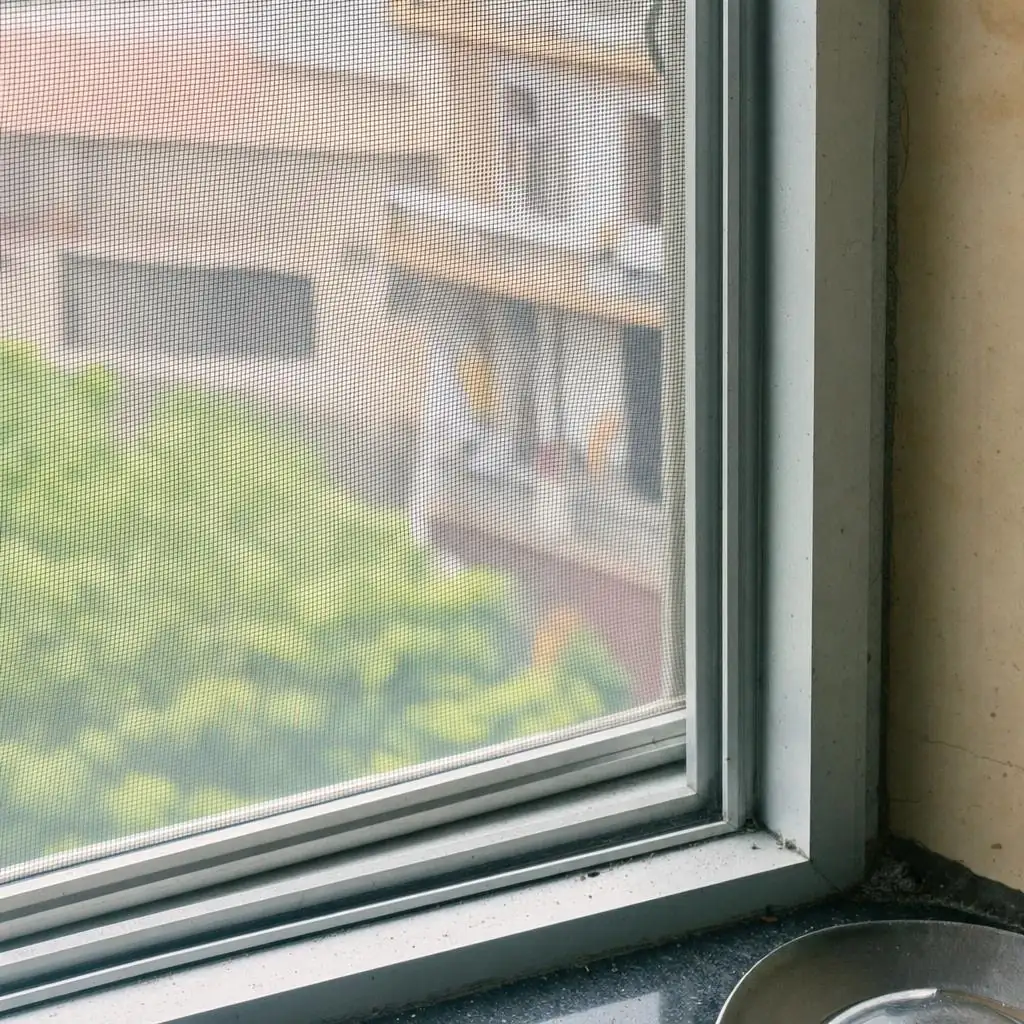
- Mesh screens on windows and doors. The quiet long-term winner. A fine net on the kitchen window and a screen door keeps flies out without a single chemical, and it works all day, every day. Worth every rupee in a Delhi flat.
- Keep food covered. A mesh food cover (the old-fashioned jali dome) over the dining table and on cooked food. Removes the reward, so flies have no reason to settle.
- Sticky fly ribbons / glue traps. Cheap, genuinely effective at catching adults, and they show you how bad it is. Hang them near the bin or window, not over the food. Ugly, but they work.
- Fly-light (UV) traps. Excellent for kitchens and shops — the light pulls flies onto a glue board. More of a commercial tool, but useful at home if flies are a constant battle.
And the things I’d not rely on: the electric “mosquito” bat is satisfying but it’s a swatter — it kills one fly at a time and changes nothing about the source. Ultrasonic plug-in repellers that claim to drive flies away with sound — save your money, the evidence for them is poor. The water-bag-over-the-door trick, lemon-and-clove bowls, scented gadgets — mild at best, useless at worst, and none of them touch the breeding ground. The pattern is always the same: gadgets fight adults, hygiene fights the source. The source always wins.
Restaurants, shops & kitchens — flies are an FSSAI problem
If you run a food business, flies aren’t just bad for the customer’s appetite — they’re a compliance issue. The Food Safety and Standards Authority of India is clear that food premises must keep pests, flies included, under control, and a fly settling on the buffet during an inspection is exactly the kind of thing that costs you a rating or a notice. I’ve seen good kitchens in places like Connaught Place and Lajpat Nagar get pulled up over it.
For a shop, dhaba or restaurant the playbook is a step up from a home. Air curtains over the entrance and the kitchen-to-dining doorway blow a sheet of air that flies can’t cross — the most effective single investment for a busy doorway. Fly-catcher UV light units on the walls (never directly above food prep) quietly take out whatever gets in. Tight discipline on waste — lidded bins, frequent clearing, a clean back area — removes the breeding ground that a kitchen otherwise creates daily. And critically, the documentation: a pest-control service that gives you dated treatment reports and a contract is what you put in front of an FSSAI inspector to show you’re managing it. That paper trail is half the reason food businesses keep us on a contract rather than calling only when there’s a problem.
Running a kitchen, shop or restaurant?
Fly control is an FSSAI hygiene point. We set up traps, treatment and an AMC, with paperwork for your audit.
When to call a pro and what it costs (2026)
Most home fly problems you can solve yourself with a lidded bin, a clean drain and a window screen. Call a professional when you’ve cleaned everything you can reach and the flies keep coming — that usually means the source is somewhere you can’t get to, like a wall cavity, a shared garbage area, or a drain line that needs proper treatment. And call one straight away if it’s a food business, where the stakes and the FSSAI angle make it worth doing right.
Here’s what fly control actually involves and what it costs in 2026. A proper job isn’t just someone spraying the air. It’s a survey to find the breeding spots, a residual spray on the surfaces where flies rest, treatment of the breeding source itself (drains, waste areas), and traps or units to catch what’s left. General pest control — which covers flies along with the usual household pests — starts at ₹999, with GST 18% extra. For a food business, an annual maintenance contract (AMC) with scheduled visits and documentation is the sensible route rather than one-off calls.
| Service | What you get | Starting price (2026) |
|---|---|---|
| General pest control (home) | Survey + residual spray + source treatment, covers flies and common pests | From ₹999 |
| Larger home / bungalow | Same, for a 3 BHK to independent house | From ₹1,799 |
| Shop / small kitchen | Treatment + fly-light unit advice + report | From ₹1,999 |
| Restaurant AMC (yearly) | Scheduled visits, traps, FSSAI-ready documentation | Custom quote |
One honest word on what to expect. No service can promise your home is fly-free forever — flies fly in, new waste appears, and a treatment isn’t permanent. What good fly control does is knock the population down hard and, more importantly, kill the breeding source so it doesn’t keep regenerating. The chart below is the difference I see on the ground between homes that only spray and homes that actually deal with the source.
Spray only vs kill the breeding source — flies back within a week (2026)
Rough share of Delhi homes where the flies were back within seven days, from what we see on the ground.
Get the flies out for good — we cover Delhi
Flies aren’t random and they’re not bad luck. They’re a sign of a breeding source within reach — usually your bin or a drain — and once you find it and seal it, the swarm dies off because nothing new is being made. Put a lid on the bin, screen the windows, keep food covered, and you’ll fix most of it yourself for almost nothing in 2026. When the source is somewhere you can’t reach, or you’re running a kitchen that has to pass an inspection, that’s when it’s worth bringing in a trained technician to trace and treat it properly. We serve homes, shops and restaurants across Delhi — from Dwarka, Janakpuri and Rohini in the west and north, to Saket, Lajpat Nagar and Greater Kailash in the south, to Mayur Vihar, Preet Vihar and Laxmi Nagar in the east, plus Central and North Delhi. Coming soon: Gurgaon, Noida, Faridabad and Ghaziabad. Call 95603 66362 and let’s find the source, not just chase the flies.
Frequently asked questions
How do I get rid of houseflies at home in Delhi in 2026?
Find the breeding source, don’t just spray. Houseflies breed in decaying matter, so check the kitchen bin (the usual culprit), the sink and floor drains, behind the fridge, the balcony bin, pet waste and rotting fruit. Clean or seal that one spot and the swarm dies off within days. Then keep them out with a lidded bin emptied daily, mesh screens on windows, food kept covered, and sticky traps for stragglers. Spraying alone never works because it only kills the adults, not the eggs and maggots.
Why does spraying never get rid of my flies?
Because a spray only kills the adult flies it touches in that room, right then. It does nothing to the eggs and maggots developing in your bin, drain or the garbage outside. While you kill today’s flies, tomorrow’s batch is already maturing, so they’re back by evening. It’s like bailing a boat without plugging the hole. You have to deal with the breeding source to actually stop them.
Where do houseflies breed in a Delhi home?
In moist, decaying organic matter. The most common spots are the kitchen waste bin (especially wet peels and leftovers at the bottom), slimy sink and floor-drain traps, spills or stray vegetables behind the fridge, the balcony bin and uncleared pet waste, rotting fruit on the counter, and the open garbage collection point in the building. In summer the egg-to-fly cycle can take barely a week, which is why swarms appear so fast.
Are houseflies actually dangerous or just annoying?
Genuinely dangerous, not just annoying. Houseflies move between filth — garbage, drains, faeces — and your food, carrying bacteria on their bodies and in their gut, and they regurgitate and defecate where they land. They’re mechanical carriers of the organisms behind typhoid, cholera and diarrhoeal illness, which spike in Delhi through the hot and monsoon months. In homes with young kids or elderly people, fly control is really food safety.
How much does fly pest control cost in Delhi in 2026?
General pest control, which covers flies along with common household pests, starts at ₹999 with GST 18% extra. For a larger home or bungalow it’s from around ₹1,799, and for a shop or small kitchen from about ₹1,999. Restaurants are usually better off on a yearly AMC with scheduled visits and documentation — that’s a custom quote. A proper job includes a survey, residual spray, breeding-source treatment and traps, not just spraying the air.
What’s the fastest way to reduce flies in my kitchen today?
Two things, right now: put a tight lid on the kitchen bin and empty it, then rinse the bin out — that removes the main nursery. Throw out any rotting fruit or vegetables. After that, hang a sticky fly trap near the window and keep all cooked food under a mesh cover. You’ll see a difference within a day or two as no new flies are produced. A window screen is the next step for keeping them out.
Do ultrasonic fly repellers and electric bats work?
Not really for solving the problem. The electric bat kills one fly at a time and changes nothing about the source — satisfying, but pointless against a swarm. Ultrasonic plug-in repellers that claim to drive flies off with sound have poor evidence behind them; save your money. The things that actually work are unglamorous: a lidded bin, clean drains, mesh screens, covered food and sticky traps.
How do I keep flies out of my restaurant or shop in Delhi?
Treat it as an FSSAI hygiene requirement, because it is. Fit an air curtain over the entrance and the kitchen doorway, put fly-light (UV) catcher units on the walls away from food prep, and keep tight discipline on waste with lidded bins and frequent clearing. Just as important, keep a pest-control contract that gives you dated treatment reports — that documentation is what you show an inspector to prove you’re managing flies.
Why are flies so much worse in summer and monsoon?
Heat and humidity speed up the housefly’s life cycle — egg to adult can take barely a week in Delhi’s May and June heat. Through the pre-monsoon and monsoon stretch, wet kitchen waste and garbage sit and ferment in the humidity, giving flies endless breeding ground. That’s why the same bin that was fine in winter turns into a fly factory by June. Stay on top of waste before the season builds.
Can pest control get rid of flies permanently?
No honest service should promise “permanent” or fly-free forever — flies fly in, new waste appears, and no treatment lasts indefinitely. What good fly control does is knock the population down hard and treat the breeding source so it doesn’t keep regenerating. Combined with your own habits — sealed bin, clean drains, screens — that keeps a home genuinely livable. For food businesses, a maintenance contract keeps it under control year-round.
The flies are coming from the building garbage point, not my flat. What do I do?
That’s a shared problem you can’t fully fix alone, so raise it with your RWA or building. Push for covered bins at the collection point and a fixed daily pickup time, because an open kachra spot on your floor breeds flies for the whole building and your flat is downwind of it. In the meantime, screen your own windows and keep your kitchen tight. A professional can also advise the RWA on treating the collection area properly.
Done chasing flies around the kitchen?
We’ll find the breeding source and treat it — homes, shops and restaurants across Delhi. General pest control starts at ₹999, GST 18% extra.
Sources & references
- National Centre for Disease Control (NCDC) — tracks fly-borne disease risk (typhoid, cholera, diarrhoeal disease) in Indian cities.
- Food Safety and Standards Authority of India (FSSAI) — sets fly-control and hygiene requirements for kitchens, shops and food premises.
- Indian Council of Medical Research (ICMR) — publishes research on housefly biology and disease transmission.
- Central Insecticides Board & Registration Committee (CIB&RC) — regulates the insecticides and baits used in licensed fly control.
Last verified: 9 June 2026. If you find any of these links broken, please let us know.