
The short version, by zone
- Old Gurgaon & DLF Phases 1–3: smaller overhead tanks, hard-water scale and rust — classic residential cleaning.
- Golf Course Road & premium condos: big underground reservoirs (UGRs) feeding tower tanks — scheduled, multi-tank, documented.
- Sohna Road & SPR sectors: tanker-dependent societies — heavier sediment, more frequent cleaning.
- New Gurgaon & Dwarka Expressway (82–92, 102–110): new towers with construction debris and tanker reliance.
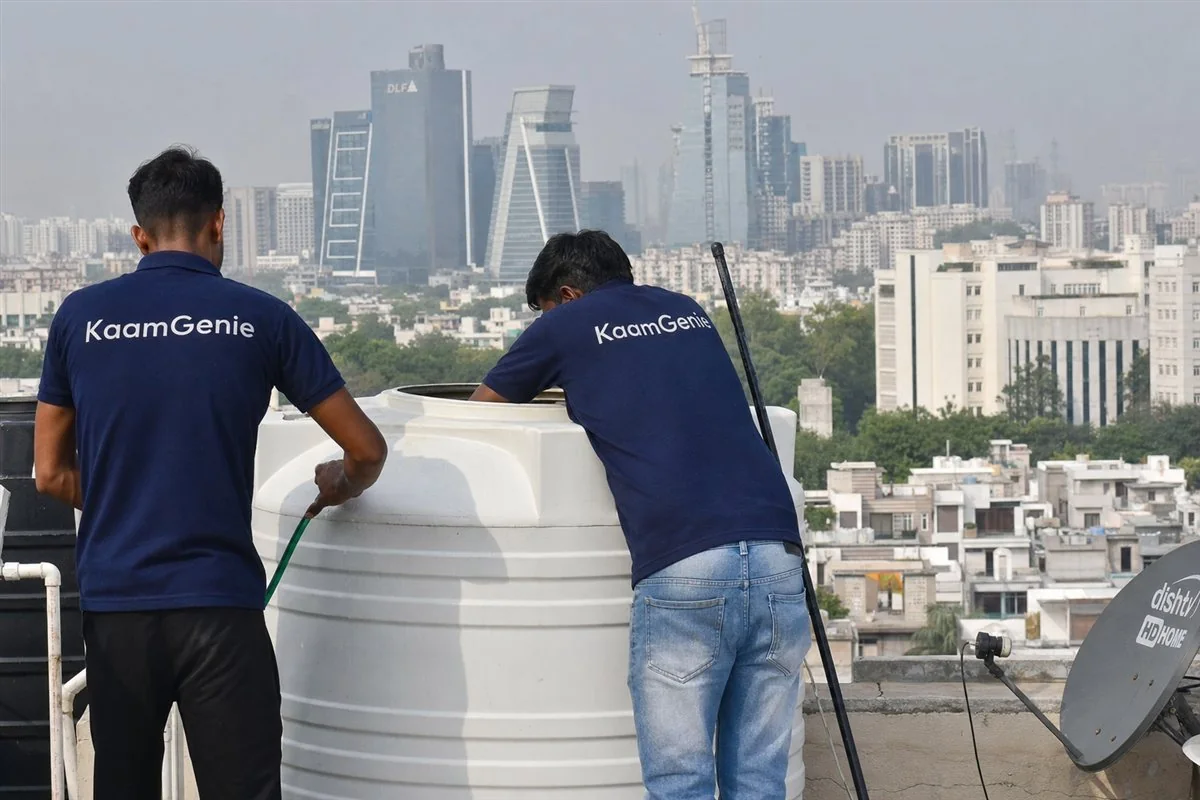
- MG Road, Cyber City & Udyog Vihar: commercial tanks, after-hours work, FSSAI-aligned for pantries.
Same proven 8-step method everywhere — the tank size, access and contamination pattern are what change. Residential cleaning is ₹699 onwards; reservoirs and commercial are quoted on site.
Gurugram — the Millennium City — grew so fast that its water infrastructure varies enormously from one colony to the next. A 1980s independent house in Old Gurgaon, a luxury condominium on Golf Course Road, and a brand-new high-rise off Dwarka Expressway all store and use water in completely different ways. After cleaning tanks across all of them, we’ve learned that the honest answer to “how should my tank be cleaned?” depends a lot on where you live. This guide walks through the city zone by zone. For the full service and pricing picture, our hub page on water tank cleaning in Gurgaon ties it all together.
| Zone | Typical water setup | What we usually find |
|---|---|---|
| Old Gurgaon & DLF 1–3 | Municipal + borewell, rooftop tanks | Hard-water scale, iron staining, rust |
| Golf Course Road condos | Large UGR feeding tower tanks | Bulk sediment, biofilm, multi-tank schedule |
| Sohna Road / SPR | Tanker-dependent societies | Fast-settling fine sediment |
| New Gurgaon / Dwarka Expwy | New towers, tankers + borewell | Cement slurry, grit, construction debris |
| MG Road / Cyber City / Udyog Vihar | Commercial tanks & reservoirs | High-traffic use, pantry hygiene needs |
Not sure which applies to you?
Tell us your area and tank setup — we’ll recommend the right cleaning and a fixed price. Residential ₹699 onwards.
Old Gurgaon & DLF Phases 1–3 — the hard-water belt
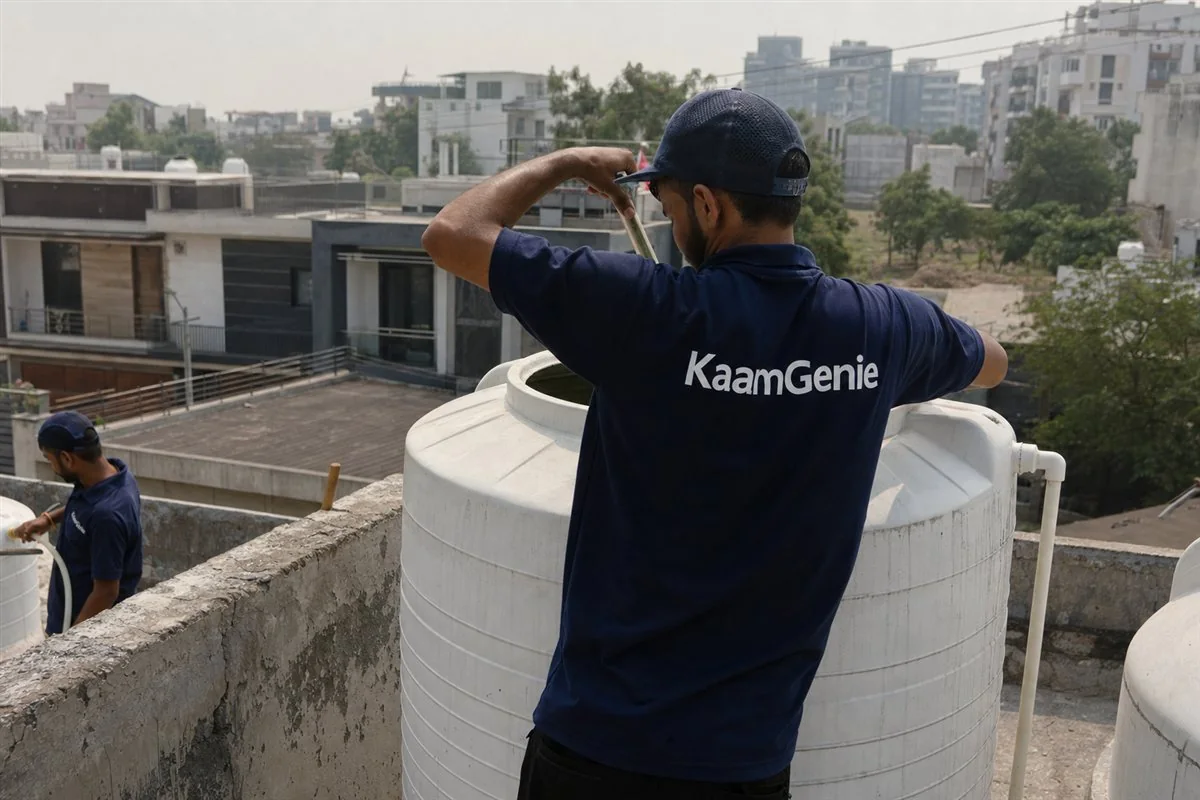
The older, established parts of the city — Old Gurgaon, the original sectors, and DLF Phase 1, DLF Phase 2 and DLF Phase 3 — are mostly independent houses, kothis and builder floors. Water here comes from a mix of municipal supply and private borewells, stored in rooftop Sintex-type tanks and the occasional underground sump.
The defining problem in this belt is hard groundwater. Gurgaon’s borewell water is high in dissolved calcium and iron, and over months it leaves a chalky white scale and reddish-brown staining on tank walls. Manual scrubbing alone doesn’t shift hardened scale — it needs the food-grade descaling step and a proper jet wash. We see the same pattern in nearby Palam Vihar and the older DLF colonies. If your tank water leaves white deposits on utensils or rust marks in the bathroom, that’s the scale we’re talking about — our note on hard-water tank cleaning in Gurgaon goes deeper on it.
Builder floors deserve a special mention: each floor often has its own tank, so a three-storey building can mean three or four separate tanks plus a shared sump. We price these as a set and clean them in one visit.
Golf Course Road & the premium condo belt
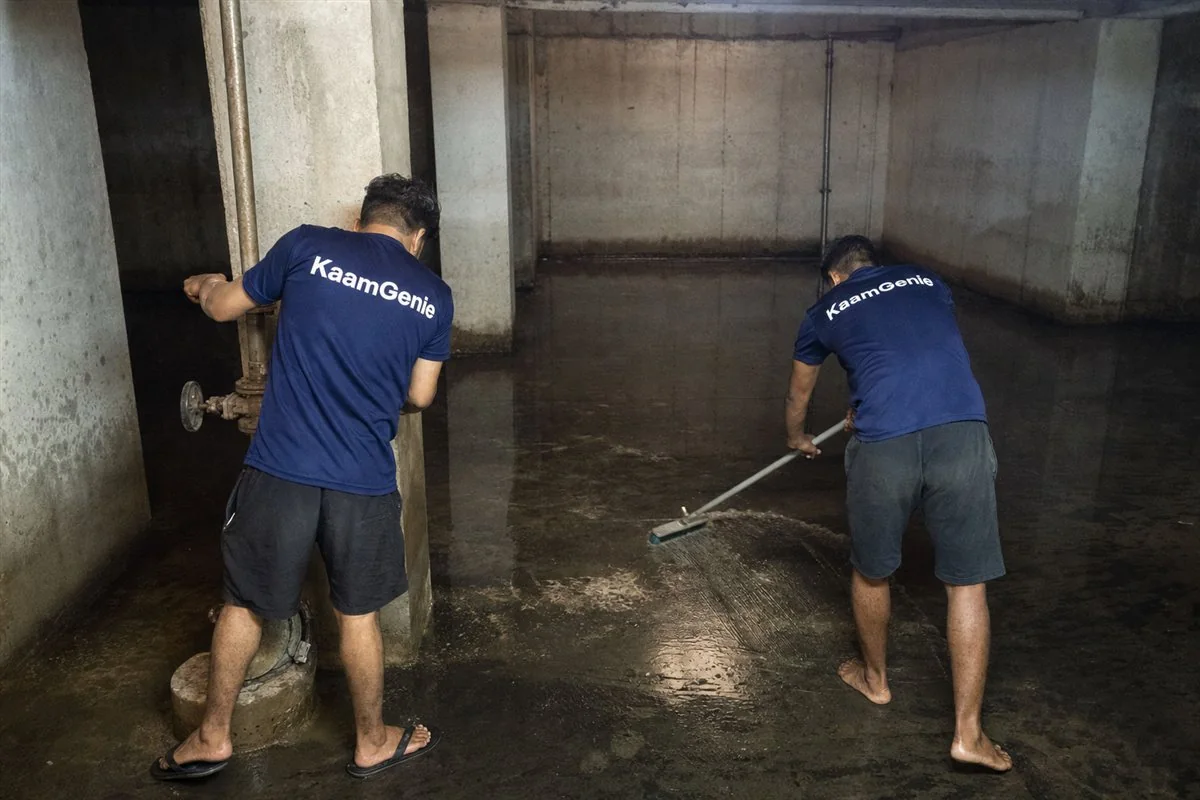
This is a different world of water storage. The luxury condominiums along Golf Course Road and Golf Course Extension Road — along with established townships like Sushant Lok and South City — typically run on a hydro-pneumatic system: a very large underground reservoir (UGR) takes in municipal and tanker water, and pumps feed rooftop tanks on each tower.
Cleaning these is a planned operation, not a doorstep job. A single UGR can hold tens of thousands of litres, so it’s a confined-space task needing dewatering pumps, safety harnesses, high-pressure jetting and food-grade disinfection — followed by a documented certificate for the Apartment Owners’ Association (AOA) or managing committee. We coordinate with the facility team, work around the building’s pumping schedule so residents aren’t left dry, and clean the tower tanks in sequence. Premium condos in DLF Phase 4 and DLF Phase 5 usually follow this same model. If you sit on a condo committee, our guide to society water tank cleaning in Gurgaon covers scheduling and compliance, and the DLF condominium cleaning guide is written specifically for this belt.
Sohna Road & the SPR corridor — tanker country
The fast-growing belt along Sohna Road and the Southern Peripheral Road (SPR) — including sectors around Sector 65 and the Sector 58, Sector 60 and Sector 61 cluster — is heavily dependent on water tankers, especially in the dry months. That dependence is the key thing for cleaning.
Tanker water is variable. Depending on the source and the tanker’s own hygiene, a load can carry fine silt and sediment that settles quickly at the bottom of your storage tank. Societies here often find a noticeably thicker sludge layer than a comparable building on piped municipal supply. The practical consequence: tanker-fed buildings should clean toward the more frequent end of the schedule. Our piece on tanker-fed water tank cleaning in Gurgaon explains why, and how to keep the sump from re-contaminating the tower tanks.
How tanker-dependent each Gurgaon zone tends to be
Higher tanker reliance generally means faster sediment build-up — and more frequent cleaning
Indicative pattern from our own Gurgaon jobs — not a formal survey. Your building’s exact mix of municipal, borewell and tanker supply is what really sets the cleaning frequency.
New Gurgaon & Dwarka Expressway — the new-tower sectors
The newest high-rise belt — New Gurgaon and the Dwarka Expressway sectors — is where we do a lot of first-ever cleanings. These towers in Sector 82, Sector 83, Sector 84, Sector 85, Sector 86, Sector 88, Sector 89, Sector 90 and Sector 92, and along the expressway in Sector 102, Sector 104, Sector 106, Sector 109 and Sector 110, are largely tanker- and borewell-fed because piped municipal supply is still catching up with the construction.
Two problems stack up here. First, the same tanker-sediment issue as the SPR belt. Second, and bigger for new possessions: construction debris. When a tower is handed over, its tanks and reservoirs frequently still hold cement slurry, grout, sand and grit left over from the build. We routinely scoop out genuinely shocking material on first cleanings of newly occupied flats. If you’ve just taken possession, a pre-move-in cleaning is one of the most worthwhile things you can book — we cover exactly why in our guide to water tank cleaning on Dwarka Expressway.
MG Road, Cyber City & Udyog Vihar — the commercial belt
Gurgaon’s commercial core — MG Road, Cyber City and Udyog Vihar — runs on large tanks and reservoirs serving offices, cafeterias and pantries with heavy daily footfall. The priorities here are different: minimal disruption to working hours, and proper hygiene for any tank that feeds a kitchen or pantry.
We schedule commercial cleanings after-hours or on weekends, and follow FSSAI-aligned practice for potable and pantry-feeding tanks. Facility and procurement teams get the documentation they need — cleaning record, chemicals used and a dated certificate. For offices that want to stay ahead of it rather than react, an annual maintenance contract keeps the whole estate on a fixed cleaning calendar. This belt is also where our water tank cleaning services for larger sites come into play.
Book the right cleaning for your area
From a single builder-floor drum to a high-rise reservoir — one trained crew, fixed pricing, photos and certificate. ₹699 onwards for residential.
The method is constant — book by area on the Gurgaon hub
Whatever zone you’re in, the cleaning itself follows the same 8-step process: inspect, drain, remove sludge, scrub with food-grade brushes, high-pressure jet wash, wet vacuum, disinfect with food-grade chlorine, then refill and certify. What changes by area is tank size, access, how dirty things are, and how often you should repeat it. The honest summary: hard-water belt needs descaling, condo belt needs scheduling, tanker belt needs frequency, new towers need that first debris-clearing clean, and the commercial belt needs after-hours discipline. Whichever describes you, pick your locality on our Gurgaon water tank cleaning hub and we’ll take it from there. New to all this? Start with the full Gurgaon water tank cleaning guide, and if budget is the question, the Gurgaon cost guide lays out pricing by tank type.
Frequently asked questions
Does water tank cleaning really differ from one part of Gurgaon to another?
Yes, more than people expect. Old Gurgaon and the early DLF phases run on a mix of municipal supply and borewell water through smaller overhead tanks, so we deal with hard-water scale and rust. Golf Course Road and condo belts have huge underground reservoirs feeding rooftop tower tanks — that is a scheduled, multi-tank job. New Gurgaon and Dwarka Expressway towers run almost entirely on tankers, which carry their own sediment. The 8-step method is the same everywhere; the tank sizes, access and contamination pattern change by area.
Why do Gurgaon water tanks get dirty so quickly?
Three reasons specific to Gurgaon. First, hard borewell groundwater leaves calcium and iron scale on tank walls. Second, heavy reliance on water tankers means whatever sediment is in the tanker load settles in your tank. Third, the dust and construction activity across New Gurgaon and the expressway sectors get into rooftop tanks through loose or cracked lids. Together they mean most Gurgaon tanks build up a visible bottom layer within months, not years.
How often should a Gurgaon society or condominium clean its tanks?
Every 6 months is the sensible baseline for residential overhead tanks and shared rooftop tanks, in line with the spirit of IS 10500 and standard storage hygiene practice. Large underground reservoirs (UGRs) in condos and high-rises are best done on a 4-6 month cycle because of their volume and the number of families relying on them. Tanker-fed towers on Dwarka Expressway and the SPR sectors often benefit from the shorter end of that range.
Do you clean the large underground reservoirs in DLF and Golf Course Road condos?
Yes. Condo and high-rise UGRs are a core part of what we do. These are confined-space jobs that need proper safety gear, dewatering pumps, high-pressure jetting and food-grade disinfection, plus a documented record for the AOA or RWA. We coordinate with the facility team or managing committee, work around the building’s water schedule, and provide before/after photos and a cleaning certificate for compliance files.
We just got possession of a new flat on Dwarka Expressway — does the tank need cleaning already?
Almost always yes. Newly handed-over towers in the Dwarka Expressway and New Gurgaon sectors usually have cement slurry, grout, sand and construction debris sitting in the tanks and reservoirs from the build phase. A pre-move-in cleaning removes that and disinfects the system before your family drinks from it. It is one of the most worthwhile cleanings you can book, even on a brand-new property.
How much does water tank cleaning cost in Gurgaon?
A standard residential overhead tank starts at ₹699 onwards. Underground sumps, multi-tank builder floors, condo reservoirs and commercial tanks are quoted on capacity, number of tanks and access. We give a clear figure before starting — no surprise charges on completion. For a full breakdown by tank type and area, see our Gurgaon cost guide.
Do you cover the new sectors of New Gurgaon — 82 to 92 and 102 to 110?
Yes, the New Gurgaon and Dwarka Expressway sectors are squarely in our service area, including sectors 82, 83, 84, 85, 86, 88, 89, 90, 92, 102, 104, 106, 109 and 110. These are mostly tanker-fed high-rise towers, so we are used to cleaning big rooftop tanks and underground reservoirs there and coordinating with society facility teams.
Can you clean office and commercial tanks in Cyber City and Udyog Vihar?
Yes. The Cyber City and Udyog Vihar corporate belt has large tanks and reservoirs serving offices, cafeterias and pantries. We schedule these after-hours or on weekends to avoid disrupting work, follow FSSAI-aligned hygiene practice for any tank feeding a kitchen or pantry, and hand over the documentation procurement and facility teams need.
We rely entirely on water tankers — does that change how the tank is cleaned?
The cleaning method is the same, but tanker-fed buildings usually need it more often. Tanker water varies in quality and frequently carries fine sediment that settles fast at the bottom of your storage. If your home or society depends on tankers — common across New Gurgaon, Sohna Road and the SPR sectors — expect a heavier sludge layer and plan cleanings toward the more frequent end of the schedule.
How long does the cleaning take and do I need to be home?
A residential overhead tank takes about 75-90 minutes; an underground sump 2-2.5 hours; large condo reservoirs 3-5 hours depending on size and access. You don’t have to be present the whole time — someone just needs to give the crew tank access. We share before/after photos and the cleaning record on WhatsApp, so you can verify the job even if you stepped out.
Sources & references
- Bureau of Indian Standards (BIS) — IS 10500:2012 is the canonical Indian Standard for drinking water specification, defining acceptable limits for physical, chemical, and biological parameters.
- WHO Guidelines for Drinking-water Quality, 4th edition — the global reference for water quality standards, including guidance on storage and disinfection.
- Food Safety and Standards Authority of India (FSSAI) — defines water quality requirements for food businesses, including hygiene standards for stored water and acceptable disinfection chemicals.
- WHO Fact Sheet on Drinking Water — overview of safe drinking water requirements and contamination risks.
- CPHEEO — Manual on Water Supply and Treatment — the Government of India’s engineering manual covering tank design, cleaning protocols, and disinfection practices.
Last verified: 30 June 2026. If you find any of these links broken, please let us know.