
The short version
- High-rise societies run a two-stage system — a big underground reservoir (UGR) that tankers and the GMDA line fill, plus a rooftop overhead tank (OHT) on every tower.
- Society cleaning is arranged by the AOA / facility company from the common fund, done tower-by-tower over a few days, with the UGR usually split into compartments so supply never fully stops.
- Plotted homes and builder floors run a single small system — one shared ground sump and a modest rooftop drum, sometimes one drum per flat.
- Plotted cleaning is a single short visit any one owner can book; standalone tanks start at ₹699, society and UGR work is custom-quoted.
- Both need cleaning at least twice a year because Gurgaon's hard, tanker-fed water leaves heavy sediment — but the UGR is the part that silts up fastest.
| Factor | High-rise society | Plotted home / builder floor |
|---|---|---|
| Water system | UGR + tower OHT on each block | Ground sump + 1 rooftop drum (or per-flat) |
| Who books | AOA / facility manager | Any single owner or tenant |
| Who pays | Common maintenance fund | The individual household |
| Schedule | Tower-by-tower over a few days | One visit, 1–3 hours |
| Supply interruption | Only the tower / compartment in progress | Just that home, briefly |
| Typical volume | UGR 10,000–1,00,000L+; OHT 1,000–5,000L | Sump 1,000–3,000L; drum 500–1,000L |
| Pricing | Custom contract, per-tank bundle | From ₹699 per standalone tank |
| Paperwork | Records kept for AOA audit / compliance | Record for owner's own reference |
Not sure which job yours is?
Tell us your building — tower society or builder floor — and we'll scope it right. Standalone tanks ₹699 onwards; society and UGR work custom-quoted.
Two kinds of Gurgaon home, two kinds of plumbing
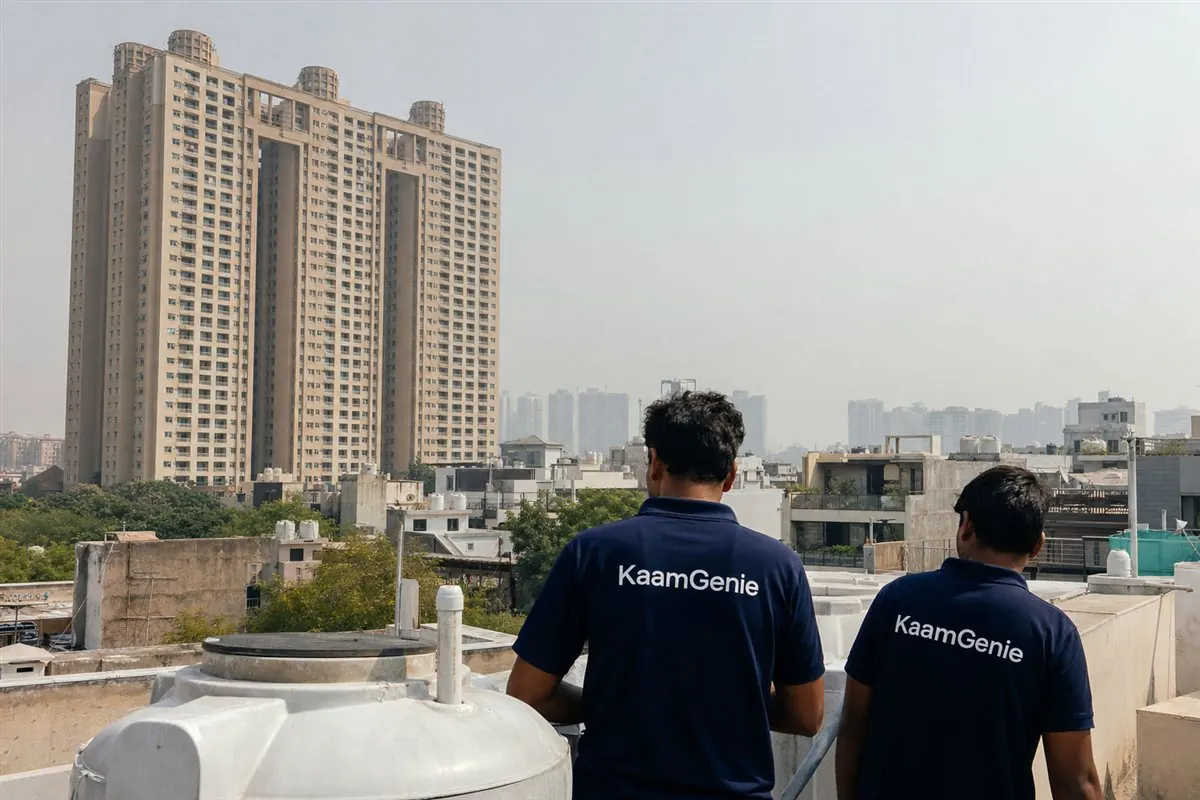
Gurgaon (Gurugram) grew in two layers that sit side by side across the city. On one side are the gated high-rise condominiums and group-housing societies — the glass towers of DLF’s colonies, the Golf Course Road and Golf Course Extension belt, the Sohna Road and Southern Peripheral Road (SPR) corridors, and the new-tower wall going up along Dwarka Expressway. On the other side are the plotted colonies and independent builder floors — the four-storey buildings in DLF Phase 4, the sectors of New Gurgaon, and the older licensed colonies where one plot holds a few flats.
Almost every building in the Millennium City, whatever its shape, leans heavily on stored water. Gurgaon’s groundwater is hard, the GMDA piped supply does not reach every pocket reliably, and a large rental and expat population means demand is constant — so private water tankers top up reservoirs all year round. That stored, tanker-fed water is exactly why tanks here silt up faster than in many other cities, and it is the common thread between the two systems. What changes is the plumbing those tankers fill.
The high-rise system: one big UGR, many tower tanks
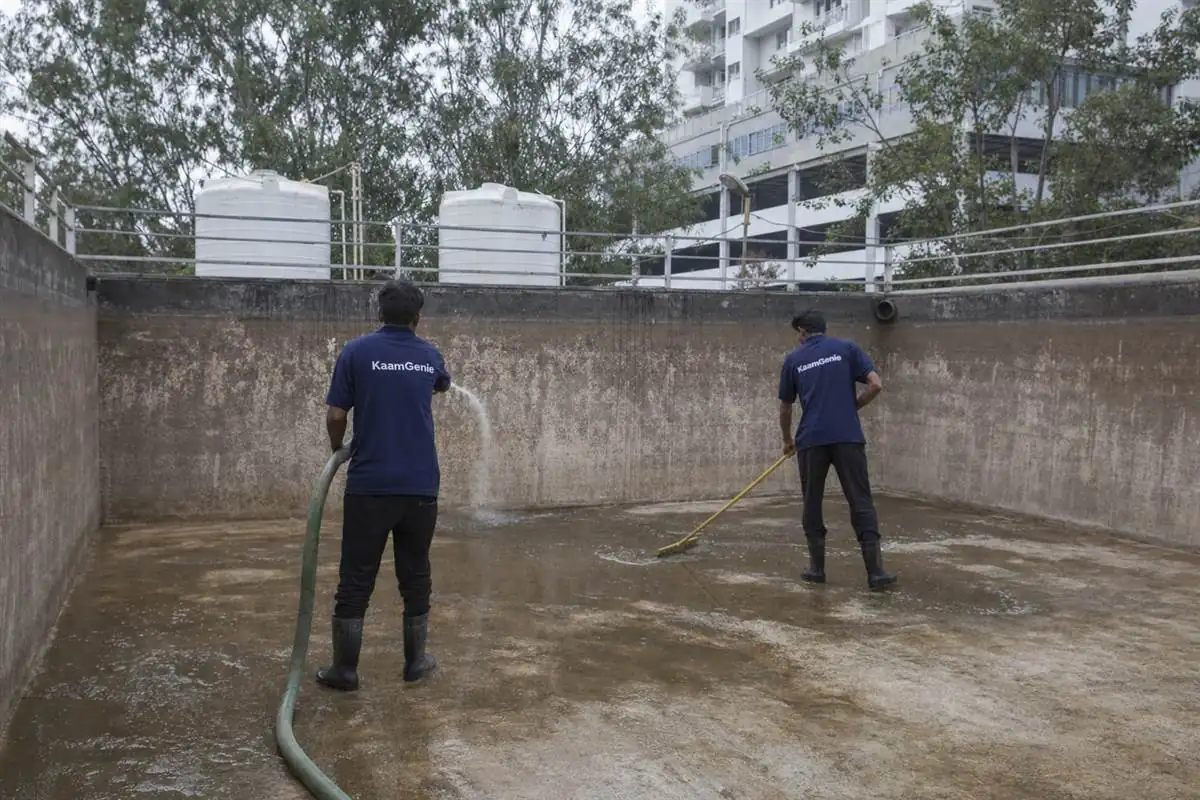
A Gurgaon high-rise is a two-stage water system. At the bottom, usually in the basement or under the podium, is the underground reservoir (UGR) — a large concrete tank, often split into two or more compartments, that the tankers and the municipal line discharge into. From there, pumps lift the water to an overhead tank (OHT) on the terrace of each tower, and gravity carries it down to the flats.
That architecture decides how the cleaning works:
- The UGR is the heavy job. It holds the most water, sits at the bottom of the chain where all the tanker silt settles first, and is a confined space that needs safe entry, manual sludge removal, full scrubbing, jet-washing and chlorination. A large reservoir can take half a day on its own.
- Each tower OHT is a separate task. A society with eight towers has at least eight rooftop tanks, each cleaned in turn — more if a tower has split domestic and flushing tanks.
- It is scheduled tower-by-tower. You cannot drain the whole complex at once, so we sequence it: the UGR first (often one compartment at a time so half stays in service), then block to block, with each tower’s residents notified the day before their turn.
This is why society work is almost always an AOA (Association of Apartment Owners) contract rather than a one-off booking. The reservoir and tower tanks are common property, the cost comes from the common maintenance fund, and the facility-management team wants a fixed schedule and proper records. If you manage a complex on Golf Course Road or in Sushant Lok, this is the model that fits — we cover it in detail in our guide to society water tank cleaning in Gurgaon, and the reservoir specifics in our underground sump and reservoir cleaning guide.
The plotted system: a shared sump and small drums
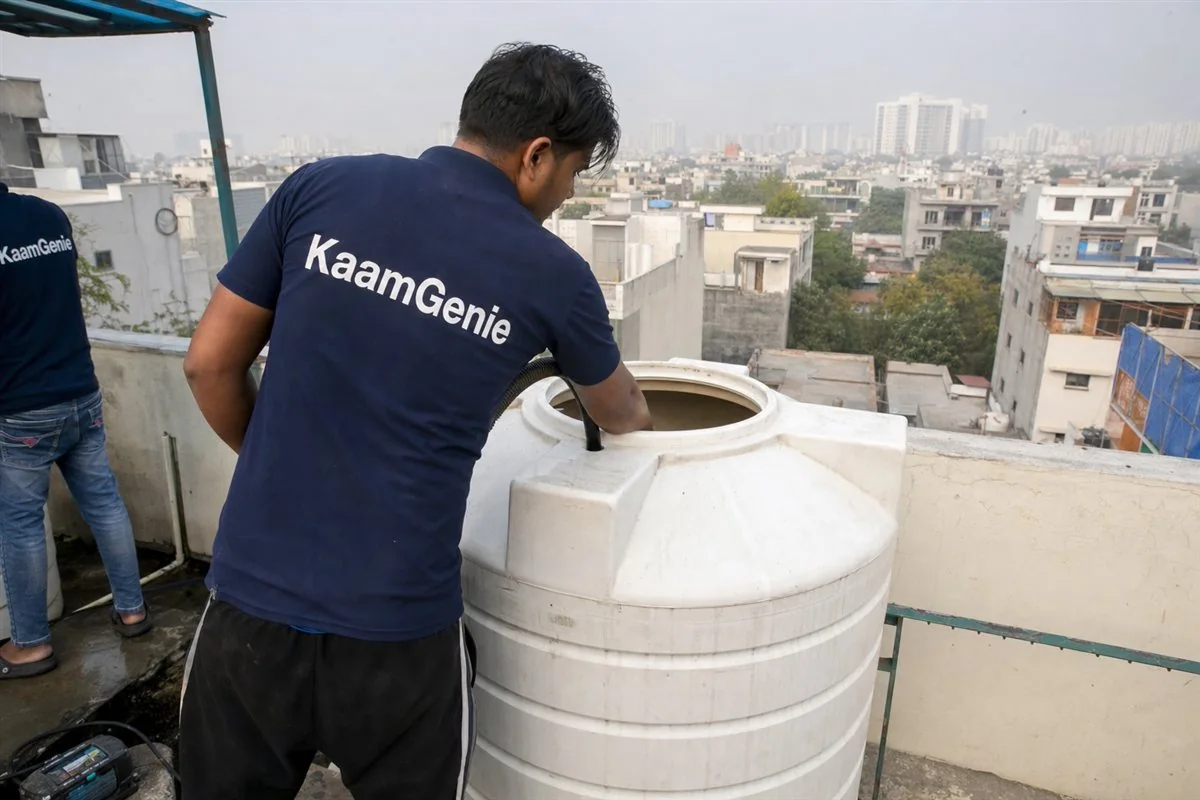
A plotted home or independent builder floor is a far simpler chain. Typically there is one ground-level sump where the tanker and supply water lands, and a pump that pushes it to a rooftop drum — a 500 to 1,000-litre Sintex or plastic tank. The wrinkle in Gurgaon builder floors is that a single plot often holds four flats stacked on four floors, and the builder may have given each flat its own rooftop drum while everyone shares the one sump below.
That changes the cleaning in three practical ways:
- Any one owner can book. Because each flat’s drum is effectively private, a single owner can have just their own tank cleaned without waiting for the building to agree. The only shared part is the sump.
- It is one short visit. A sump plus a drum, or even all four drums and the sump, is a single trip of one to three hours — no multi-day schedule.
- Clubbing is cheaper. Doing the sump and every drum it feeds in one visit means the per-tank rate drops, and the whole supply line is clean at the same time. We unpack this in our builder-floor water tank cleaning guide.
There is one trap worth naming. If a flat owner cleans only their rooftop drum but the shared sump below stays dirty, the sediment simply pumps back up within a few weeks. On a shared-sump building, cleaning the sump is not optional — it is the part that re-contaminates everything above it.
Where the two jobs really differ
Beyond the plumbing, four things separate a society job from a plotted one on the day:
1. Scale and time. A builder-floor drum is an hour’s work; a society’s UGR alone can be a half-day, and a full complex is a multi-day programme. The luxury condominiums off Golf Course Road and the large townships in New Gurgaon sit at the top end of this. Our DLF condominium tank cleaning guide goes deeper on those.
2. Confined-space safety. A large UGR is an enclosed tank that needs harnessed entry, ventilation and trained crew. A rooftop drum you can largely reach into from the top. The society job carries safety overhead that the plotted job does not.
3. Who decides and who pays. Society work runs through the AOA or facility company and the common fund; plotted work is decided and paid by one household. That is the single biggest practical difference for a resident — in a tower you raise it with management, on a builder floor you just book it.
4. Paperwork. Both get before-and-after photos and a dated cleaning record. But an AOA keeps those for its maintenance audit, resident queries and any hygiene compliance for shops, clinics or daycares inside the gate. A plotted owner usually just files it for the next service date.
What does not differ is the actual method inside any single tank — drain, de-sludge, scrub with food-grade brushes, jet-wash, vacuum, chlorinate, refill. Whether it is a UGR or a builder-floor drum, that core sequence is the same; if you want the step-by-step, see how the water tank cleaning process works. The same approach underpins our wider water tank cleaning services across NCR.
Rough cleaning time by tank, in a Gurgaon building
The UGR is the long pole — everything else is quick by comparison
Indicative only — actual time depends on tank size, sediment load, access and how many tanks are booked together. A full multi-tower society is sequenced across several days.
So which model is yours?
Quick test. If your home is a flat in a gated tower with a basement reservoir and a security gate, you are in the high-rise model — raise tank cleaning with your AOA or facility manager and it gets handled as a contract for the whole complex. If your home is a floor in a standalone building on a plot, with a sump in the stilt and a drum on the roof, you are in the plotted model — you can book your own tank, and clubbing the sump and drums with your neighbours saves money.
Either way, the trigger is the same: Gurgaon’s hard, tanker-fed water means both systems need cleaning at least twice a year, and the UGR or shared sump — the part at the bottom where silt collects — is the part you cannot afford to skip. If you are weighing it up for your building, the broader water tank cleaning in Gurgaon hub lays out coverage, pricing and booking across every sector and condominium we serve.
Book the right cleaning for your building
Single builder-floor tank or a full tower-by-tower society programme — we scope and schedule both. Standalone tanks ₹699 onwards; AOA and UGR work custom-quoted.
Book the right job for your Gurgaon building
Whether you run a tower society that needs a scheduled, tower-by-tower contract or you own a builder floor that needs a single quick visit, the starting point is the same conversation. Tell us the building type and we will scope it honestly — no padding a society quote, no over-selling a single drum. Browse coverage and pricing across the city on our water tank cleaning in Gurgaon hub, or get a fixed price for your own tank below.
To book, call +91 95603 66362 or use the booking form on this site — we’ll confirm shortly.
Frequently asked questions
What is the basic difference between cleaning a high-rise tank and a plotted-home tank in Gurgaon?
A high-rise society is a two-stage water system: a big underground reservoir (UGR) that the tankers and the GMDA line fill, plus a separate overhead tank (OHT) on every tower terrace that gets pumped up from the UGR. Cleaning means draining and scrubbing the large UGR and then doing each tower’s rooftop tank, usually under one Association of Apartment Owners (AOA) contract. A plotted builder floor is a single small system — one ground sump shared by the building and a modest rooftop drum, sometimes one drum per flat. The high-rise job is bigger, scheduled tower-by-tower, and contracted; the plotted job is a single short visit booked by one owner.
Who arranges and pays for tank cleaning in a Gurgaon high-rise society?
In a condominium or group-housing society it is the Association of Apartment Owners (AOA) or the appointed facility-management company that arranges it, and the cost comes out of the common maintenance fund — not from any single flat. The UGR and the tower OHTs are common property, so the whole building is billed as one job, usually on an annual or half-yearly contract. Individual flat owners do not book or pay separately; they raise it with their AOA or facility manager.
Do all the towers in a society get cleaned on the same day?
Rarely all at once. A multi-tower society is cleaned tower-by-tower over a few days so that water supply to the whole complex is never cut at the same time. We typically do the underground reservoir first (often split into compartments so half stays in service), then move tower to tower for the rooftop tanks. The AOA gets a schedule in advance and each tower’s residents are notified the day before their turn.
My builder floor has a separate tank for each flat — does every owner have to agree?
No. On a plotted builder floor where each flat has its own rooftop drum, any single owner can book the cleaning of just their own tank — you do not need the other floors to agree. The shared ground sump is the only common part. In practice neighbours often club the visit together because booking all the drums and the sump in one trip is cheaper per tank, but it is not required.
Why does a high-rise underground reservoir (UGR) take so much longer to clean?
A society UGR can hold tens of thousands of litres of Gurgaon’s hard, tanker-fed water, so it carries a thick layer of silt and mineral sediment at the bottom. It is a confined space that needs draining, safe entry with proper gear, manual sludge removal, full scrubbing, jet-washing, vacuuming and chlorination — on a surface many times larger than a home tank. A single tower OHT may take an hour or two; a large UGR routinely takes half a day or is split across compartments so the building keeps running.
Will the water supply be cut off to the whole building during cleaning?
In a high-rise, no — not the whole complex. We clean one tower’s tank or one UGR compartment at a time, so the rest of the society stays supplied and only the tower being worked on has a short interruption. On a plotted builder floor it is simpler: the flat or building whose tank is being cleaned has water paused for the duration of that one visit (typically an hour or two), and supply is restored as soon as the tank is refilled.
How often should each type of building clean its tanks in Gurgaon?
Both should be done at least twice a year because Gurgaon’s borewell and tanker water is hard and leaves heavy sediment, but the driver differs. High-rise UGRs collect tanker silt fast and many AOAs run a six-monthly or even quarterly contract on the reservoir, with tower OHTs on a six-monthly cycle. Plotted homes and builder floors are usually fine on a clean every six months, sooner if the supply is mostly tanker water or you notice cloudy water or odour.
We share one sump but have individual rooftop drums on a builder floor — what gets cleaned?
Everything in the chain that touches your water. The shared ground sump is where the tanker and supply water lands first, so it must be drained and scrubbed, and then each rooftop drum it feeds is cleaned and disinfected. If only the rooftop drum is cleaned but the dirty sump below is left, the sediment simply pumps back up within weeks. We recommend doing the sump and all the drums it serves in one visit so the whole line is clean at the same time.
Is the price per tank the same for a high-rise and a plotted home?
A standalone residential overhead tank on a plotted home or builder floor starts at ₹699. High-rise society work — large UGRs, multiple tower OHTs, AOA contracts — is quoted custom, because the volume, confined-space safety, and number of tanks vary hugely between complexes. The per-tank rate usually drops when several tanks are booked together, which is why society contracts and clubbed builder-floor visits work out cheaper per tank than a single ₹699 call.
Does a society need any paperwork or certificate after cleaning?
Yes, and it matters more for societies than for single homes. After each tower and the UGR, the AOA gets before-and-after photos and a dated cleaning record listing tank capacity, chemicals used and crew. AOAs keep these for their maintenance audit and resident queries, and any food business, clinic or daycare inside the complex may need them for hygiene compliance. A plotted home owner gets the same record, but typically just keeps it for their own reference and the next service date.
Sources & references
- Bureau of Indian Standards (BIS) — IS 10500:2012 is the canonical Indian Standard for drinking water specification, defining acceptable limits for physical, chemical, and biological parameters.
- WHO Guidelines for Drinking-water Quality, 4th edition — the global reference for water quality standards, including guidance on storage and disinfection.
- Food Safety and Standards Authority of India (FSSAI) — defines water quality requirements for food businesses, including hygiene standards for stored water and acceptable disinfection chemicals.
- WHO Fact Sheet on Drinking Water — overview of safe drinking water requirements and contamination risks.
- CPHEEO — Manual on Water Supply and Treatment — the Government of India’s engineering manual covering tank design, cleaning protocols, and disinfection practices.
Last verified: 29 June 2026. If you find any of these links broken, please let us know.