
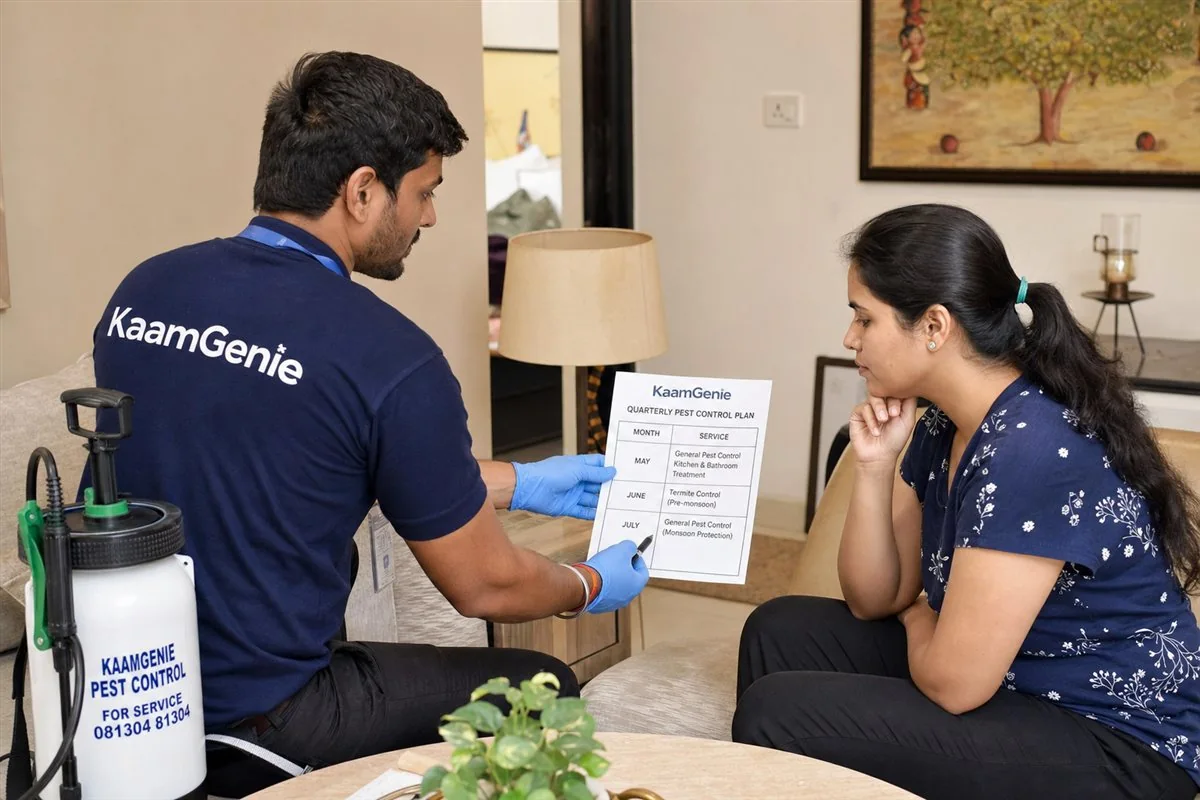
Quick answer — how often to do pest control in Delhi (2026)
- General home pest control: once every 3–4 months (quarterly) is the sensible baseline for a Delhi flat — from ₹999 a visit.
- Cockroaches (gel bait): re-do every 3–6 months; the gel keeps working for weeks but needs topping up — from ₹599.
- Termites: a quick yearly inspection; a full anti-termite treatment lasts about 5 years (carries a multi-year warranty) — from ₹2,499.
- Mosquitoes: seasonal — a pre-monsoon round in May–June plus top-ups through Aug–Nov — from ₹699.
- Rodents: ongoing — baiting needs monthly checks, not a one-shot — from ₹999.
- Cheaper overall: for most homes a yearly AMC at ₹2,999/year bundles the scheduled visits and works out cheaper than paying per panic. GST 18% extra. We cover all of Delhi.
The honest answer: it depends on the pest, not the calendar
There is no single number. Anyone who tells you “pest control every 6 months, fixed” is either selling a package or hasn’t thought about it. The truth is that each pest has its own biology and its own clock. A cockroach gel slowly loses its pull over a few months. A termite colony works silently for years and only needs catching once a year. A mosquito is a creature of one season. A rat never really stops. So the right question isn’t “how often is pest control?” — it’s “how often for which pest, in my kind of home, in Delhi’s weather?” Get that right and you’ll spend less and stay cleaner than the neighbour who panics and over-sprays.
Here is the schedule I actually give people when they call. Treat it as a baseline for a normal Delhi home in 2026 — a clean 2 BHK in Dwarka with no current outbreak. If you’re already seeing pests, or you run a kitchen, the frequency goes up, and I’ll get to that.
| Pest | How often | Why that gap | From (2026) |
|---|---|---|---|
| General home (ants, spiders, silverfish, mixed) | Every 3–4 months (quarterly) | Residual spray fades over a season; quarterly keeps a barrier up | ₹999 |
| Cockroaches (gel bait) | Every 3–6 months | Gel stays active for weeks then needs a fresh dose; re-bait before they return | ₹599 |
| Termites | Yearly inspection; full treatment every ~5 years | Anti-termite chemical barriers last around 5 years and carry a warranty | ₹2,499 |
| Mosquitoes | Seasonal — pre-monsoon + Aug–Nov top-ups | Breeding is monsoon-driven; out of season you barely need it | ₹699 |
| Rodents (rats, mice) | Ongoing — monthly bait checks | Baiting is a programme, not a one-shot; stations need refilling | ₹999 |
| Bed bugs | Two visits ~14 days apart, then as needed | Eggs survive the first spray; the follow-up kills the next hatch | ₹1,299/room |
Notice how different those gaps are. Lumping them all into one “6-monthly” visit is exactly why people either overpay or get let down. Let’s walk through the ones that trip people up.
Cockroach gel, termites and rodents — the three people get wrong
Cockroaches. Modern cockroach control in Delhi is gel bait, not the old wall-to-wall spray. A good gel keeps doing its job for a few weeks as roaches feed and pass it on, but it isn’t forever — the bait dries and they breed back. For a normal kitchen, re-baiting every 3 to 6 months holds the line; a heavy German-cockroach problem in an older Lajpat Nagar flat might need a tighter cycle at first, then settle to quarterly. If your service did one round and vanished, that’s the gap they exploited.
Termites. This is the one people skip and regret. You do not need a termite treatment every year — a proper anti-termite job sets a chemical barrier in the soil and structure that lasts roughly five years and comes with a multi-year warranty. What you do need yearly is a five-minute inspection: someone checking the usual suspects — wooden door frames touching the floor, the back of cupboards, that damp wall after the monsoon. Catch a mud trail early and you save a wardrobe; miss it and you’re replacing furniture. For older independent houses in places like Rajouri Garden or Krishna Nagar, that yearly look-over is cheap insurance.
Rodents. Rats are the opposite of a one-and-done. You cannot “treat” a rat the way you treat a wall. Control is a programme — bait stations and traps that get checked and refilled, usually monthly, because new rats come up the same drains and through the same gaps every few weeks, especially in ground-floor shops and kitchens. If you live above a market lane in Sarojini or Kamla Nagar, ongoing is the only honest answer.
Not sure how often your home actually needs it?
Tell us your flat size and what you’re seeing — we’ll suggest a real schedule, not a sales pitch. General home treatment from ₹999 (GST 18% extra).
Why Delhi’s weather pushes the frequency up
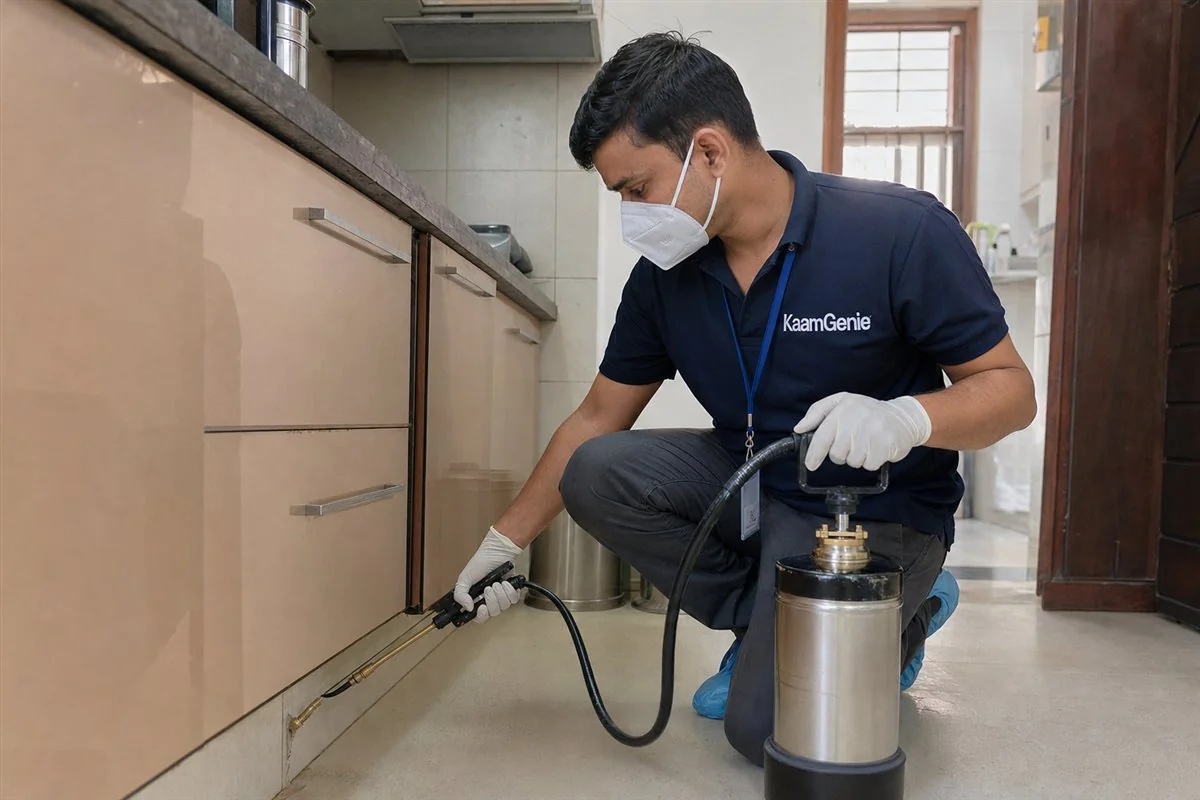
The frequency I’d quote in a dry hill town isn’t the frequency I’d quote in Delhi, and the reason is the climate. Delhi gives pests three gifts. First, a long, brutal summer — cockroaches and ants breed faster in the heat, and the dryness drives them indoors toward your kitchen water. Second, the monsoon from roughly July to September: standing water in coolers, terrace junk and clogged drains turns the city into one big mosquito nursery, and the damp wakes up termites and brings rodents up out of flooded burrows. Third, a short mild winter where bed bugs and rats move deeper indoors for warmth. There is no real off-season — the pest just changes.
That’s why a once-a-year spray doesn’t survive contact with reality here. The residual chemical on your skirting boards genuinely degrades over a Delhi summer — heat, mopping and dust wear it down in about three to four months. By month five there’s little left, which is precisely the biology behind the quarterly baseline. The monsoon is the sharpest spike: the smart move is a pre-monsoon round in May–June, before the breeding starts, rather than firefighting in September when every RWA WhatsApp group is in a panic. If you want the month-by-month version of this, we’ve mapped it out in our monsoon pest control calendar for Delhi.
| Season | Months | Pests on the rise | What to do |
|---|---|---|---|
| Summer | Apr–Jun | Cockroaches, ants, lizards | Quarterly general treatment; pre-monsoon mosquito round in May–Jun |
| Monsoon | Jul–Sep | Mosquitoes, termites, rodents, flies | Mosquito top-ups; check for termite mud trails after rain |
| Post-monsoon | Oct–Nov | Mosquitoes (dengue peak), cockroaches | Final mosquito visit; re-bait kitchens |
| Winter | Dec–Feb | Bed bugs, rodents (indoors for warmth) | Rodent station checks; bed-bug treatment if biting starts |
How often by property type — flat, builder floor, restaurant, society
Your home type matters as much as the pest, because it decides how exposed you are and how many neighbours share your problem.
- Apartment / flat in a society (DLF, Mahagun, a Dwarka co-op): a sealed upper-floor 2–3 BHK is the easy case. Quarterly general treatment is plenty, with a mosquito top-up in monsoon. You benefit when the society also treats common areas — push your RWA on that.
- Builder floor / independent house: more entry points — your own terrace, a boundary wall, a small garden, ground-floor doors. I’d do quarterly general plus a yearly termite inspection, because soil contact and damp walls make termites a real risk in standalone Delhi houses.
- Restaurant / cloud kitchen / cafe: a different world. Food, warmth and waste mean pests breed constantly, and FSSAI expects documented, regular control with audit-ready records. Most kitchens need a monthly visit, sometimes fortnightly for rodents and cockroaches. This is non-negotiable for a licence.
- Society / RWA common areas: basements, garbage rooms, water tanks, garden, drains — these breed the pests that then walk into individual flats. A society needs a monthly or quarterly schedule across common areas under a contract. We cover exactly this in our guide to society and RWA pest control AMCs in Delhi.
One pattern I see constantly: a diligent family treats their flat religiously while the building’s garbage room and basement go untouched for a year. The pests just keep walking back in. Frequency inside your four walls only works if the shared areas keep pace.
Want the whole year handled for one price?
An AMC bundles your quarterly visits plus call-backs between them. Plans from ₹2,999/year — usually cheaper than repeat one-offs.
The maths: why an AMC usually beats repeat one-offs
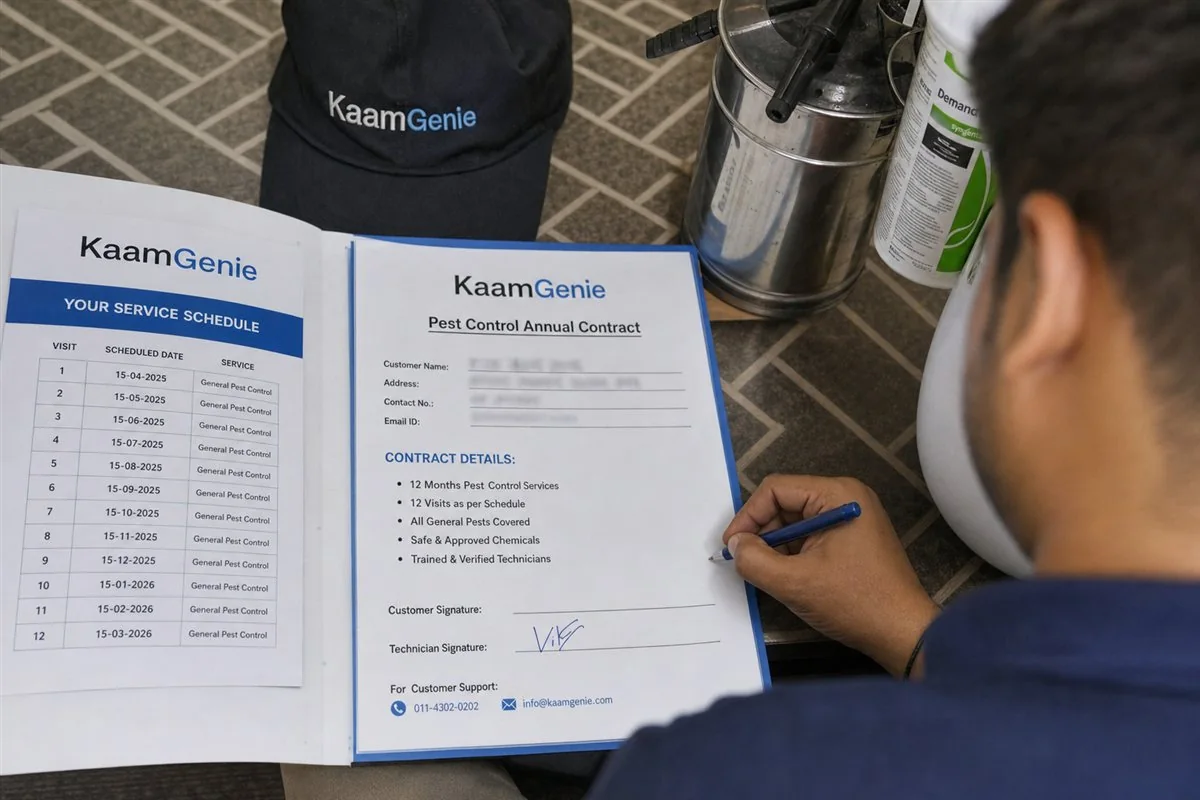
Here’s where the frequency question becomes a money question. Say you do the sensible thing and book general treatment four times a year at ₹999 a visit — that’s ₹3,996, and it doesn’t include the extra mosquito round in monsoon, the cockroach re-bait, or the call-back when ants show up in week six. Pay for each of those separately and a real year of pest control easily crosses ₹5,000–₹6,000 for an active home.
An annual maintenance contract (AMC) at ₹2,999 a year bundles the scheduled visits into one price and — this is the part people miss — usually includes free call-backs between visits. See a cockroach in week six? They come back at no charge. That single feature is what makes the AMC cheaper in practice: you stop paying ₹999 every time you spot something, and you stop putting off treatment to save money while the problem grows. For a full breakdown of what each plan covers, we’ve laid out the numbers in our pest control AMC cost guide for Delhi.
A year of pest control in a Delhi home — AMC vs paying per visit (2026)
Rough yearly spend for an active 2–3 BHK that needs quarterly treatment plus monsoon and call-back visits. GST extra.
The honest caveat: an AMC only wins if you’d actually use the visits. If you live in a sealed top-floor studio that has never seen a pest, a single general treatment once or twice a year may be all you need — don’t let anyone scare you into a plan you won’t use. But for a typical Delhi family home with a kitchen, a balcony and a monsoon, the AMC is the cheaper and calmer choice. It also means someone else remembers the schedule, which, let’s be honest, is half the battle.
Signs you need it sooner than the schedule says
The baseline assumes a calm home. Bump the frequency up the moment you see any of these, regardless of when your last visit was:
- Cockroaches in daylight. Roaches are night creatures — seeing them in the day means the population is large enough that they’re crowded out. Don’t wait for the quarter; re-bait now.
- Mud tubes or hollow-sounding wood. Thin lines of dried mud on a wall or skirting, or a door frame that sounds papery when tapped — classic termite signs. Get an inspection within days, not months.
- Droppings or gnaw marks. Rice-grain droppings near the kitchen platform, chewed packets or wire — rats are active and breeding. Start a baiting programme immediately.
- Daytime mosquito bites around the ankles. The dengue mosquito bites in daylight and breeds in clean standing water nearby. In monsoon, that means a breeding spot in or near your home — bring the mosquito round forward.
- You just moved in, or just renovated. A new flat carries the previous owner’s pests, and renovation disturbs nests. A fresh general treatment on day one saves months of grief.
Equally, don’t over-treat. If you’ve genuinely seen nothing for a year in a sealed flat, you can stretch the general treatment to twice a year and just keep an eye out. Pest control should match your actual risk, not a salesperson’s target.
So, what should you actually book in Delhi?
If you want it in one line: for a normal Delhi home in 2026, do general pest control quarterly, re-bait cockroaches every 3–6 months, get a yearly termite inspection, add mosquito rounds through the monsoon, and treat rodents as an ongoing programme if you’re on a ground floor or near a market. For most families, wrapping that into a ₹2,999/year AMC is cheaper and less stressful than paying per panic — and if you run a kitchen or manage a society, the frequency steps up to monthly with proper, audit-ready records. We serve homes, restaurants and societies across Delhi — from Dwarka, Janakpuri and Rohini to Saket, Lajpat Nagar and Greater Kailash, and east to Mayur Vihar and Laxmi Nagar. Coming soon: Gurgaon, Noida, Faridabad and Ghaziabad. Call 95603 66362 and we’ll work out the right schedule for your home — no upsell.
Frequently asked questions
How often should you get pest control done in Delhi in 2026?
There is no single number — it depends on the pest. For a normal Delhi home, do general pest control quarterly (every 3–4 months), re-bait cockroaches every 3–6 months, get a yearly termite inspection, add mosquito rounds through the monsoon, and treat rodents as an ongoing monthly programme if you’re exposed. For most families a ₹2,999/year AMC bundles these visits and works out cheaper.
Is once a year enough for pest control in a Delhi flat?
Usually not for an active home. Residual sprays fade over a Delhi summer in about 3–4 months because of heat, mopping and dust, so once a year leaves long unprotected gaps. Quarterly is the sensible baseline. A sealed top-floor flat that has never had pests can sometimes stretch to twice a year — but once a year is too thin for most homes.
How often should cockroach gel treatment be repeated?
Every 3 to 6 months. Cockroach gel bait keeps working for several weeks as roaches feed and pass it on, but it dries out and the population breeds back. A normal kitchen is fine on a 3–6 month re-bait; a heavy infestation in an older flat may need a tighter cycle at first before settling to quarterly. Cockroach treatment starts from ₹599.
How often do you need termite treatment in Delhi?
A full anti-termite treatment lasts around 5 years and carries a multi-year warranty, so you don’t redo it yearly. What you should do every year is a quick termite inspection — checking door frames, the back of cupboards and damp walls — to catch any new activity early. Anti-termite treatment starts from ₹2,499.
How often should mosquito control be done in Delhi?
Seasonally. Mosquito breeding is monsoon-driven, so the high-impact move is a pre-monsoon round in May–June before breeding starts, then top-ups through the August–November peak. Out of season you barely need it. Mosquito control starts from ₹699.
How often should rodent (rat) control be done?
Rodent control is an ongoing programme, not a one-time job. Bait stations and traps need checking and refilling roughly monthly, because new rats keep arriving through the same drains and gaps every few weeks — especially on ground floors and near markets. Rodent control starts from ₹999.
Does the monsoon change how often I need pest control?
Yes. Delhi’s monsoon (roughly July–September) spikes mosquitoes through standing water, wakes up termites with the damp, and drives rodents indoors from flooded burrows. The smart approach is a pre-monsoon treatment in May–June plus top-ups during the season, rather than firefighting in September.
How often does a restaurant or cloud kitchen need pest control in Delhi?
Much more often than a home — usually monthly, sometimes fortnightly for rodents and cockroaches. Food, warmth and waste mean pests breed constantly, and FSSAI expects documented, regular control with audit-ready records. A quarterly home schedule is nowhere near enough for a commercial kitchen.
Is a pest control AMC cheaper than paying for each visit?
For most active Delhi homes, yes. Four general visits at ₹999 already comes to nearly ₹4,000 before you add monsoon mosquito rounds, cockroach re-baits and call-backs — a real year often crosses ₹5,000–₹6,000. An AMC at ₹2,999/year bundles the scheduled visits and usually includes free call-backs in between, so it works out cheaper. GST 18% is extra.
How often should a society or RWA do pest control for common areas?
Monthly or quarterly under a contract, depending on the size and the pest pressure. Basements, garbage rooms, water tanks, gardens and drains breed the pests that then walk into individual flats, so common-area treatment has to keep pace with what residents do inside their homes. A society AMC schedules this across the complex.
How do I know if I need pest control sooner than scheduled?
Act immediately, regardless of the calendar, if you see cockroaches in daylight, mud tubes or hollow-sounding wood (termites), droppings or gnaw marks (rats), daytime mosquito bites in monsoon, or if you’ve just moved in or renovated. These are signs the population is active and growing — waiting for the next quarter lets it get worse.
Can I just do pest control twice a year to save money?
If you genuinely have a low-risk, sealed home that hasn’t seen a pest in a year, twice-yearly general treatment plus watching for signs can be enough — don’t let anyone push a plan you won’t use. But for a typical Delhi family home with a kitchen, balcony and a monsoon, twice a year leaves gaps; quarterly or an AMC is both cleaner and, with call-backs included, often cheaper in the end.
Let us set the right schedule for your home
Tell us your home type and what you’re seeing — we’ll recommend an honest frequency or an AMC from ₹2,999/year. We cover all of Delhi.
Sources & references
- Central Insecticides Board & Registration Committee (CIB&RC) — the Indian regulator that approves the pest-control chemicals and their renewal intervals referenced in this guide.
- Food Safety and Standards Authority of India (FSSAI) — sets the documented, scheduled pest-control expectations that drive the monthly frequency in restaurants and kitchens.
- National Center for Vector Borne Diseases Control (NCVBDC) — India’s nodal body for dengue and mosquito control, underpinning the monsoon mosquito schedule.
- National Centre for Disease Control (NCDC) — tracks seasonal urban pest and vector patterns across Indian cities including Delhi.
Last verified: 30 June 2026. If you find any of these links broken, please let us know.