

Quick answer — society RWA pest control AMC in Delhi
- What’s covered in society AMC common areas: Parking, lift wells, basement, drainage manholes, garbage room, perimeter walls, central garden, society gym + community hall if any.
- What’s NOT in common-area AMC: Inside individual flats (per-flat discount applies if booked separately by the flat owner).
- Pricing tiers (Delhi 2026): Up to 100 flats ₹15,000/year, 100-300 flats ₹25,000/year, 300+ flats ₹40,000/year+.
- Per-flat discount on individual jobs: 25% off published residential rates when the society is on AMC.
- Quarterly is standard (4 visits/year). Monthly available for high-pressure societies — ground-floor commercial blocks, restaurant-adjacent buildings — from ₹32,000/year.
- Annual report at end of contract year showing all visits, chemicals used, pest activity log per common area.
What a real society pest control AMC covers (and what it doesn’t)
The first thing every RWA committee gets wrong is treating “society AMC” as one contract. It’s actually two: a common-area contract paid by the society, and a per-flat option paid by individual flat owners. Getting this split clear in the contract avoids the most common dispute — an RWA secretary calling us because a flat owner is asking why their kitchen wasn’t treated during the quarterly visit.
Common areas a real society AMC covers, in the order our crew typically walks them on visit day:
- Basement and parking. Stilt parking, ramp, and the wet edges where water collects. Highest cockroach and rodent activity in any Delhi society.
- Lift wells. Lift shaft base, lift pit, behind the lift control panel. Cockroaches use lift shafts as travel routes between floors.
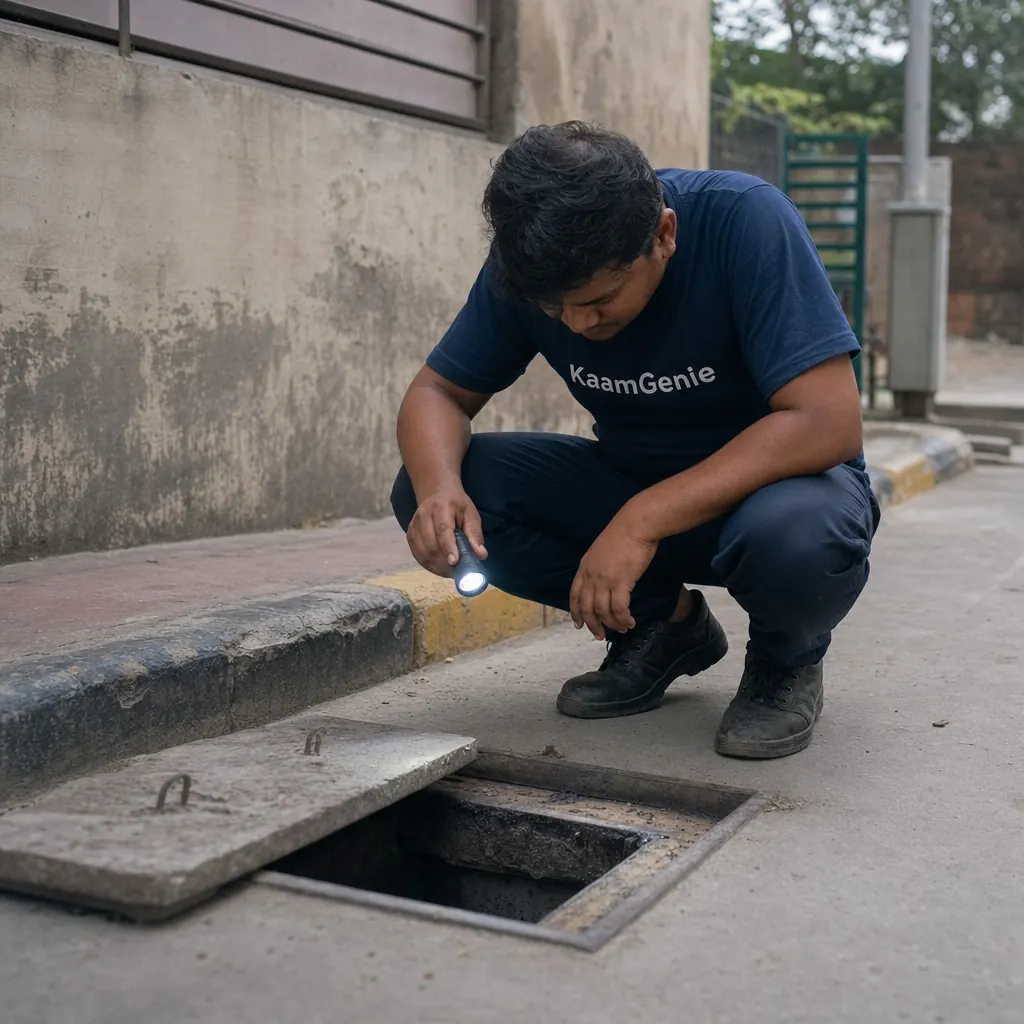
- Drainage manholes. All access manholes around the building perimeter. Larvicidal during monsoon, residual baiting year-round.
- Garbage room. The single highest-priority area in any society. Heavy gel-bait + sealed rodent stations. We re-check this every visit.
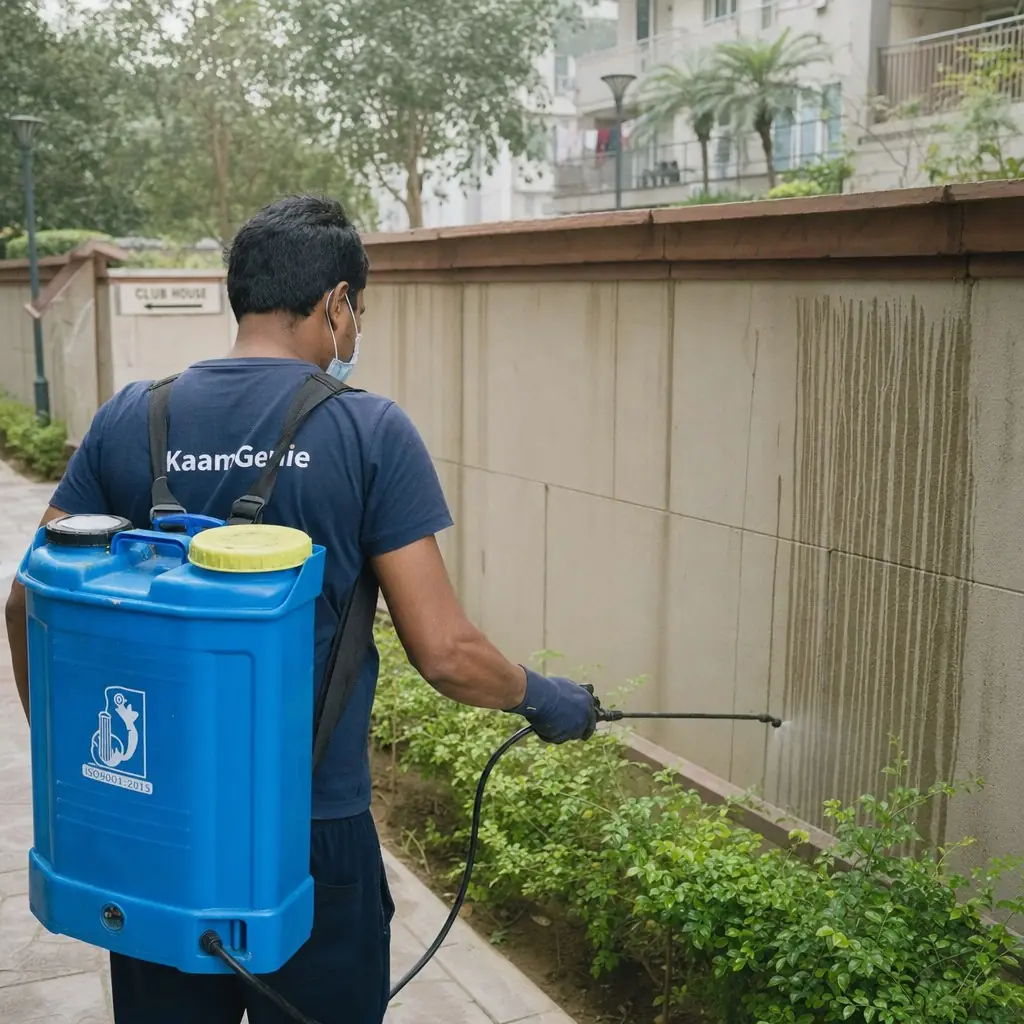
- Perimeter walls. Boundary wall plinth, perimeter gardens, gates, gate-keeper hut, mailroom.
- Central garden / podium. Mosquito control during monsoon, rodent stations along garden edges, larvicidal in any decorative water feature.
- Society gym, community hall, swimming pool deck. Treated under the same AMC at no extra charge for societies under 300 flats.
- Common terrace areas. Especially if there’s pigeon activity or rooftop garbage staging.
What is NOT covered in the common-area AMC: inside individual flats. This is the line that has to be crystal clear in the contract. When a flat owner has cockroaches in their kitchen, that’s a separate booking — but the per-flat discount under the AMC means they pay 25% less than the published residential rate. We’ll talk about how that math works in the dedicated section below.
Real Delhi pricing for society AMC (2026)
Honest 2026 pricing for society common-area AMC, from our actual contract sheet. GST 18% extra. No hidden visit charges within standard Delhi zones.
| Society size | Quarterly AMC (4 visits/yr) | Monthly AMC (12 visits/yr) | Per-flat discount |
|---|---|---|---|
| Up to 50 flats (small block) | ₹15,000/year | ₹32,000/year | 25% off residential |
| 50-100 flats | ₹18,000/year | ₹38,000/year | 25% off residential |
| 100-200 flats | ₹22,000/year | ₹48,000/year | 25% off residential |
| 200-300 flats | ₹28,000/year | ₹62,000/year | 25% off residential |
| 300-500 flats | ₹40,000/year | ₹85,000/year | 30% off residential |
| 500+ flats (mega-society) | Custom quote | Custom quote | 30% off residential |
Two things to know about the numbers above. First — quarterly is the floor. Anything less than 4 visits/year for a Delhi society means meaningful pest pressure builds between visits, especially in the monsoon. Second — the per-flat discount kicks in automatically once the society AMC is signed. Flat owners don’t need to re-negotiate; they just mention the society name when they book and the residential rate drops 25%.
What clauses you MUST include in the contract
Most society AMC contracts in Delhi are 2-page documents written by the vendor. That’s the problem — the vendor writes scope to favour themselves. The RWA should specify scope before signing. Here are the eight clauses every society AMC contract must include:
- Visit frequency in plain English. “Four visits per contract year, one in each calendar quarter, with at least 75 days between consecutive visits.” Not “quarterly” alone — that’s too vague.
- Specific common areas covered. List them by name — basement, lift wells, garbage room, perimeter, central garden, gym, community hall. Don’t accept “all common areas” as the scope — that’s where disputes happen later.
- Chemicals to be used. Names + concentrations. CIB&RC registration numbers in the appendix. Specifically: fipronil 0.05% gel bait for cockroaches, deltamethrin 2.5% SC for residual spray, bromadiolone 0.005% for rodent baiting in sealed stations, temephos 50% EC for larvicidal in standing water, propoxur 1% as alternative cockroach treatment.
- Photo documentation per visit. Before-and-after photos of high-pressure zones (garbage room, basement, lift well base) attached to the visit report. Most disputes are resolved by photos.
- Per-flat discount terms. “25% off published residential rates for any individual flat owner mentioning the society name at booking, valid for the full contract year.” Get this in writing.
- Callback window. “Within 72 hours of a written complaint from the RWA, the contractor will dispatch a crew at no additional cost for spot treatment of the reported area.”
- Annual report deliverable. Single PDF document at the end of the contract year showing all 4 visits dated, chemicals used, photo evidence, pest activity log per common area, recommended structural fixes if any.
- Liability clause. Standard professional liability for any property damage or chemical incident during treatment. Most vendors carry this; insist on the written clause.
None of these are aggressive asks. Any serious commercial pest control vendor in Delhi will include all eight when asked. The vendor who balks is the wrong vendor.
Want an honest society AMC quote?
Site visit + scope discussion + written quote. From ₹15,000/year for up to 50 flats. Per-flat discount included.
What’s optional but worth paying for
Beyond the base AMC, there are four add-ons that experienced RWA secretaries usually take. They cost extra but they pay for themselves in reduced flat-owner complaints.
Pest activity log book per common area. ₹1,500-2,500 add-on for the contract year. We supply a physical log book that the gatekeeper or housekeeping staff records pest sightings in. Quarterly review during the AMC visit. This is the single best early-warning system for societies because the gatekeeper sees everything.
Drainage inspection with camera scope. Once-a-year ₹3,000-5,000 add-on. We run a borescope camera through the society’s common drain stack to identify blockages, breakages, and rodent nesting points. Especially valuable for older DDA societies in Mayur Vihar, Yamuna Vihar, Rohini, and Patparganj where drain stacks have aged poorly.
Mosquito fogging for monsoon. ₹2,500-5,000 per fogging visit. Pre-monsoon (June), peak monsoon (August), post-monsoon (October). Three visits cover the dengue + malaria season effectively. Most societies bundle this into the AMC at a discount.
Rodent baiting station maintenance. ₹2,000-3,500 add-on for premium tamper-proof sealed stations with quarterly bait replenishment. Standard residential bait can be eaten by stray dogs and birds — sealed stations protect both the bait and the wildlife.
For a 100-flat society, the base AMC at ₹18,000 plus these four add-ons typically lands at ₹28,000-32,000/year — still cheaper than monthly AMC at ₹38,000, and arguably better targeted.
Quarterly vs monthly — what makes sense for your society
The single decision every RWA committee struggles with: quarterly or monthly? Honest framing — quarterly is the default. Monthly is for specific high-pressure situations.
Quarterly works fine for: mid-sized residential-only societies (50-200 flats), societies with no ground-floor commercial units, societies in low-density Delhi pockets (Vasant Kunj, Dwarka Phase 2 sectors, Rohini Phase 3 sectors), societies built post-2010 with proper drainage and waste handling, societies with covered garbage rooms and daily collection.
Monthly is the right answer for: societies with a ground-floor commercial block (restaurants, cafes, gyms), societies in older Delhi pockets (Mayur Vihar Phase 1, Yamuna Vihar, Patparganj DDA, Rohini Phase 1), societies with shared drain stacks running through every flat to the basement, societies where one or more flats have confirmed active infestation, societies during heavy monsoon seasons (you can downgrade to quarterly in winter), societies with basement parking that floods during monsoon, restaurant-adjacent residential buildings.
Mid-range option that most Delhi societies actually pick: bi-monthly (6 visits/year). Falls between quarterly and monthly in cost. Common for 100-300 flat societies where quarterly is genuinely too thin but monthly is over-spec.

Per-flat individual job discount — how the math works
Once the society signs an AMC, every flat owner gets 25% off the published KaamGenie residential rate when they book individually. Most RWAs don’t market this clearly, so flat owners don’t know about it. Here’s the math, taken from our actual residential price sheet:
| Treatment | Residential rate | Flat in AMC society (25% off) | Savings per booking |
|---|---|---|---|
| 1 BHK cockroach treatment | ₹599 | ₹449 | ₹150 |
| 2 BHK cockroach treatment | ₹799 | ₹599 | ₹200 |
| 3 BHK cockroach treatment | ₹1,099 | ₹824 | ₹275 |
| Bed bug single bedroom | ₹1,499 | ₹1,124 | ₹375 |
| Bed bug whole 2 BHK | ₹3,499 | ₹2,624 | ₹875 |
| Termite spot treatment | ₹2,499 | ₹1,874 | ₹625 |
| Mosquito whole-flat fogging | ₹1,299 | ₹974 | ₹325 |
| Rodent control 1-2 BHK | ₹1,499 | ₹1,124 | ₹375 |
For a 100-flat society where even 30% of flats book one individual treatment a year, the cumulative savings to flat owners is ₹6,000-9,000 — meaningful even before counting the AMC itself. RWAs that publicise the per-flat discount get more buy-in for the AMC at the next AGM.
Common AMC contract red flags
Things we’ve seen in competitor society AMC contracts that an RWA should flag and renegotiate:
- Vague scope. “Pest control for common areas” without listing which areas. Insist on the named list.
- No chemical name in the contract. The vendor reserves the right to switch chemicals based on “requirement.” This means cheaper chemicals will be used and you can’t audit. Insist on named chemicals with CIB&RC numbers.
- No callback window. Means you can complain but the vendor can ignore for weeks. Insist on a written 72-hour response clause.
- No annual report deliverable. Means you have no documentation when re-quoting next year. Insist on a single end-of-year PDF.
- One-year auto-renewal with 90-day notice. Vendor gets the contract on autopilot. Insist on annual renewal with explicit RWA committee approval.
- Generic insurance reference. “Vendor carries insurance.” Insist on certificate of insurance attached as appendix.
- Penalty clauses on the RWA side only. The vendor should bear penalty for missed visits or callback failures.
High-pressure society — need monthly AMC?
Monthly visits + free re-treatment + priority callbacks. From ₹32,000/year for up to 50 flats. Cheaper than weekly flat-owner complaints.
How to switch AMC providers without service gap
The most common reason RWAs delay switching providers is fear of a service gap during the handover. Honest answer: the handover takes 7-10 days if done correctly, and there is no gap if you time it right.
The handover protocol:
- Notify the outgoing vendor in writing. 30-day notice as per most contracts. Ask for the final visit to happen within the notice period and the final annual report to be delivered.
- Request handover documentation. Most recent treatment certificates for the past 12 months, photo log, pest activity log, list of identified harbourage points, any structural fix recommendations.
- Schedule the new vendor’s site visit. Ideally 2 weeks before the outgoing vendor’s final visit. The new vendor walks the society, reviews the handover documents, and proposes a starting protocol.
- Sign the new AMC with a start date the day after the outgoing vendor’s final visit. Zero gap.
- Schedule the new vendor’s first visit 30-45 days after start date. Allows time for trust-building with the RWA and gives the new vendor time to set up the photo log and pest activity log book.
- Ask the new vendor for a baseline assessment within the first 60 days. What they found, what was missed by the outgoing vendor, what structural recommendations they have.
The fear of a service gap usually doesn’t survive the actual switch. Most RWAs that switch end up wishing they’d done it 12-18 months earlier.
Areas we serve for society AMC in Delhi
Society AMC contracts available across all of Delhi NCR: South Delhi (Saket, Lajpat Nagar, Defence Colony, GK-1, GK-2, Vasant Kunj DLF + DDA, Hauz Khas, Khanpur), Central Delhi (Karol Bagh, Patel Nagar, CP, Paharganj), East Delhi (Mayur Vihar Phase 1/2/3, Preet Vihar, Laxmi Nagar, Patparganj DDA, Yamuna Vihar, Trilokpuri, IP Extension), West Delhi (Janakpuri all blocks, Dwarka all sectors, Punjabi Bagh, Rajouri Garden, Tilak Nagar, Vikaspuri), North Delhi (Civil Lines, Model Town, Kamla Nagar, Mukherjee Nagar), North-West Delhi (Rohini all sectors, Pitampura, Shalimar Bagh, Ashok Vihar). Coming soon: Gurgaon Sector 56-58 societies, Noida high-rises, Indirapuram, Vasundhara.
Frequently asked questions
How much does society pest control AMC cost in Delhi?
Up to 50 flats ₹15,000/year on quarterly AMC. 50-100 flats ₹18,000/year. 100-200 flats ₹22,000/year. 200-300 flats ₹28,000/year. 300-500 flats ₹40,000/year. Monthly AMC roughly doubles. GST 18% extra. No hidden visit charges.
What’s included in society AMC common areas?
Basement and parking, lift wells, drainage manholes, garbage room, perimeter walls, central garden, society gym + community hall, common terrace areas. Each area inspected and treated on every visit. Photo documentation per visit.
Does AMC cover inside individual flats?
No. Common-area AMC is for shared spaces only. Individual flats are booked separately by the flat owner — but they get 25% off the published residential rate when they mention the society name at booking.
How often should the AMC visits be (quarterly vs monthly)?
Quarterly (4 visits/year) is the default and works fine for most residential-only societies under 200 flats. Monthly is for societies with ground-floor commercial blocks, restaurant-adjacent buildings, older DDA pockets with shared drain stacks, or any society with confirmed active infestation in any flat.
What documentation does the AMC provider give the RWA?
Visit report after every visit with photos. Pest activity log book maintained at the gate. End-of-year annual report PDF showing all visits, chemicals used (with CIB&RC registration numbers), photo evidence, and structural fix recommendations. Most RWAs use the annual report to present at the AGM.
Is there a per-flat discount when society is on AMC?
Yes. 25% off the published residential rate for any individual flat owner who mentions the society name at booking, for the full contract year. For larger societies (300+ flats) the discount goes to 30%. Flat owners don’t need separate paperwork — the discount applies automatically.
What if a single flat has a severe infestation — extra charge?
Yes. Single-flat severe infestation is a separate booking, billed at the residential rate minus the 25% AMC discount. Common-area AMC does not absorb individual flat treatments because the cost would force everyone to pay more. Per-flat discount makes the individual booking cheaper than market rate.
How long is the AMC contract — annual? Multi-year?
Standard contract is one year with explicit RWA committee approval for renewal. Multi-year contracts are possible (typically 3-year with annual price escalation cap) and the cost is 5-10% lower per year, but most RWAs prefer annual to retain flexibility.
Can we change provider mid-contract?
Yes, with 30-day written notice. Most reputable providers will not retain a society against their will. The new provider can take over within 7-10 days with no service gap if handover is done correctly — including handover documentation, photo log, and pest activity log book.
Do you cover society common-area mosquito fogging during monsoon?
Yes. Mosquito fogging is included in monthly AMC for the monsoon months (June, August, October). For quarterly AMC societies, fogging can be added as a ₹2,500-5,000 per-visit add-on. Three fogging visits cover the dengue + malaria season effectively for most Delhi societies.
Society pest control done right
Common areas + per-flat discount + audit-ready documentation. From ₹15,000/year. Site visit before quote.
Sources & references
- Central Insecticides Board & Registration Committee (CIB&RC) — the Indian regulator that approves every pesticide formulation. Every chemical referenced in this guide carries a CIB&RC registration number and should appear by number in the society AMC contract.
- National Centre for Disease Control (NCDC) — technical guidance on vector-borne disease control for urban residential settings, including monsoon mosquito protocols and rodent management for society common areas.
- General RWA management guidance and Apartment Owners’ Association reference material — standard contract clauses for AMC services across electrical, plumbing, lift, and pest control are documented in industry references and adapted here for Delhi NCR practice.
Last verified: 7 June 2026. If you find any of these links broken, please let us know.