
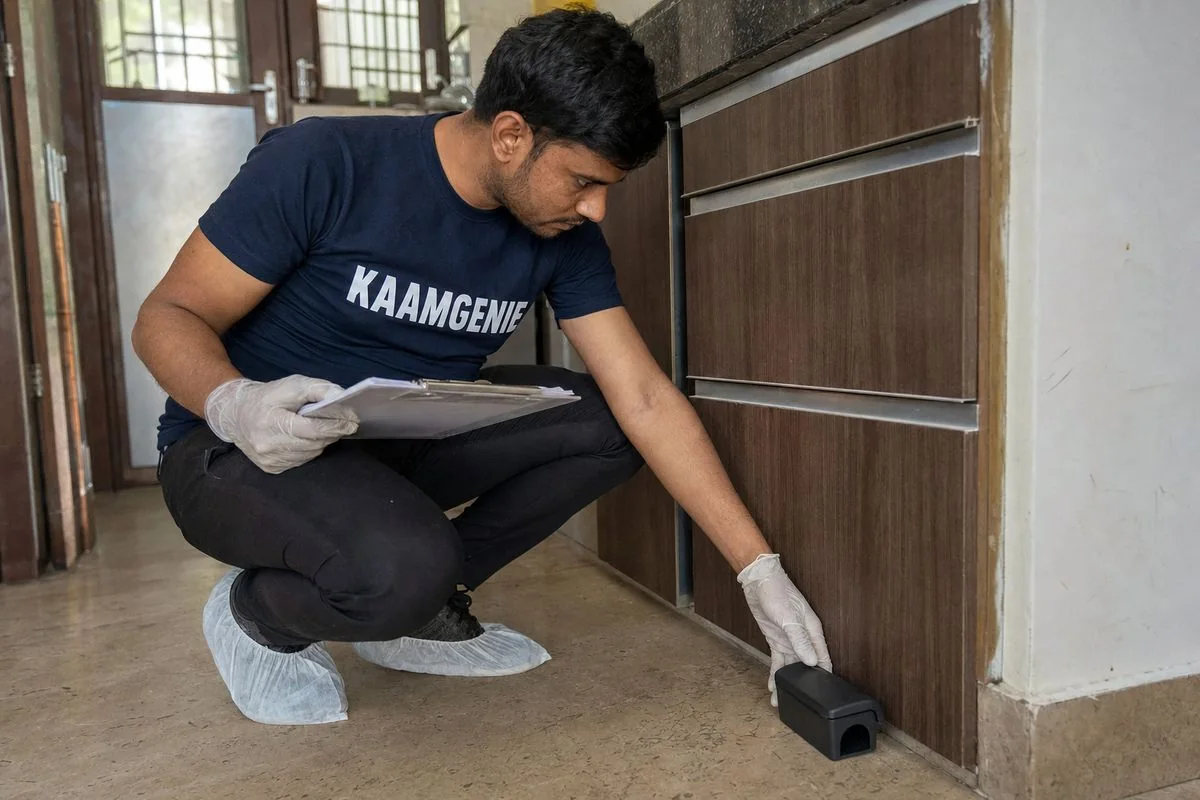
Quick answer — pest control AMC cost in Delhi (2026)
- What an AMC is: a yearly contract where a technician visits on a fixed schedule to keep pests under control, instead of you calling out a one-time team every time something crawls.
- What’s usually covered: general pest treatment — cockroaches, ants and the common crawling/flying pests — plus free call-backs between visits. Termite and bed bug are almost always separate add-ons.
- Visits per year: quarterly = 4 visits, bi-monthly = 6, and monthly for commercial or food premises. More visits cost more.
- Real cost (2026): a home AMC runs roughly ₹2,999–₹9,000/year depending on BHK and visit frequency; a shop or office runs ₹6,000–₹40,000+/year by size. GST 18% extra.
- AMC vs one-time: an AMC works out cheaper than two-plus separate call-outs in a year — and it stops the small problem becoming the expensive one.
- KaamGenie AMC from ₹2,999/year, with free call-backs, before/after photos and a GST invoice. Across Delhi — custom quote for larger sites.
What a pest control AMC actually is — and what it covers
An AMC stands for annual maintenance contract, and the idea is simple: instead of paying for a pest treatment each time you have a problem, you pay once for the whole year and the company commits to a set number of scheduled visits. A technician shows up on a fixed cadence — say once a quarter — treats the standard pests, and if anything flares up in between, you call and they come back at no extra charge. It’s the same logic as an annual service plan for your AC or your car: regular upkeep is cheaper and less painful than waiting for a breakdown.
The part people get wrong is assuming an AMC covers everything that crawls. It usually doesn’t. A standard AMC covers general pest control — cockroaches, ants, silverfish, and the common crawling and flying nuisances — plus, in most plans, free call-backs between scheduled visits if those pests return. What it almost never includes by default are the two big-ticket, specialist jobs: termite treatment and bed bug treatment. Termite work needs drilling, chemical barriers and its own warranty; bed bugs need an intensive room-by-room protocol. Both are priced and contracted separately, and an honest company will tell you that up front rather than letting you assume your ₹3,000 home AMC will save you from a ₹2,499 termite job. Rodent and mosquito control sit in the middle — some plans bundle them, others treat them as add-ons, so always ask exactly which pests are named in the contract.
So when you read a quote, the first question isn’t the price — it’s which pests are covered, how many visits, and what counts as an add-on. Get that clear and the rupee figure makes sense. Get it fuzzy and you’ll feel cheated the first time you’re billed extra for the termites you assumed were included.
How many visits a year — and which frequency you actually need
The number of visits is the single biggest driver of an AMC’s price, so it’s worth understanding the standard options. Quarterly means four visits a year, one every three months — this is the default for most Delhi homes and light offices, and it’s usually enough to keep cockroaches and ants from ever building up. Bi-monthly means six visits, one every two months — a step up for homes with a recurring problem, ground-floor flats, or shops with some food handling. Monthly means twelve visits and is the standard for restaurants, cloud kitchens, clinics and any food-handling commercial site, where regulators and auditors expect frequent, documented treatment.
More visits cost more, but the right frequency isn’t about spending the most — it’s about matching the pressure your property is under. A second-floor 2 BHK in a quiet South Delhi colony genuinely does fine on quarterly. A kirana shop in a crowded Laxmi Nagar market with sacks of grain and constant foot traffic needs bi-monthly at least. A restaurant kitchen near Karol Bagh needs monthly, full stop. If a salesperson pushes a home onto a monthly plan “to be safe,” that’s usually padding the bill; if they put a busy food shop on quarterly, that’s cutting a corner that will fail an inspection.
| Home size | Quarterly (4 visits) | Bi-monthly (6 visits) | What’s covered |
|---|---|---|---|
| 1 BHK / studio | ₹2,999–₹3,800 | ₹4,200–₹5,500 | General pest (cockroach, ant) + call-backs |
| 2 BHK | ₹3,500–₹4,800 | ₹5,000–₹6,800 | General pest + call-backs |
| 3 BHK | ₹4,500–₹6,500 | ₹6,500–₹9,000 | General pest + call-backs |
| 4 BHK / villa / bungalow | ₹6,500–₹9,500 | ₹9,000–₹13,000 | General pest + call-backs |
Termite and bed bug are not in those figures — if you want them covered, they’re quoted on top. A termite barrier for a typical Delhi home starts around ₹2,499 and carries its own warranty; bed bug work runs from about ₹1,299 per room. Bundling them into a single annual conversation is fine; just see them as separate line items, not freebies.
Want a year of cover instead of one-off call-outs?
Our home AMC starts at ₹2,999/year — scheduled visits, free call-backs in between and a GST invoice. Tell us your BHK and we’ll quote the right plan.

Commercial AMC cost in Delhi — shops, clinics and offices
Commercial premises are quoted differently from homes, because the variables are area, footfall and how much food is involved. A small retail shop is a world away from a 200-cover restaurant or a 5,000 sq-ft office floor, so commercial AMC pricing is built around size and visit frequency rather than a flat home-style rate. The other big difference is documentation: a commercial client almost always needs an audit-ready pest log, before/after photos and a GST invoice for every visit, because a health inspector, an FSSAI auditor or a corporate ISO review will ask for them.
| Premises | Typical frequency | AMC per year (approx) |
|---|---|---|
| Small shop / clinic (up to 1,000 sq-ft) | Quarterly–bi-monthly | ₹6,000–₹12,000 |
| Restaurant / cloud kitchen / cafe | Monthly | ₹15,000–₹36,000 |
| Office floor (up to 5,000 sq-ft) | Quarterly–monthly | ₹15,000–₹40,000 |
| Warehouse / large or multi-floor site | Monthly | Custom quote |
Two honest notes on commercial quotes. First, a real number comes after a site survey, not over the phone — the technician needs to see your kitchen, your storage, your basement and your drainage before pricing it. Second, be suspicious of a quote that looks too cheap for the size; a 200-cover restaurant on a few thousand rupees a year is a contract that exists on paper to satisfy an inspector, not one that will actually keep the kitchen clean. For food premises in particular, the cheap-paper-contract route is exactly what gets a place shut down when a real inspection finds droppings the “AMC” never addressed.
AMC vs one-time — the math on when a contract saves money
Here’s the question worth doing on the back of an envelope: does an AMC actually save you money, or is it just convenient? The answer depends on how often you’d otherwise call someone out. A single one-time general treatment for a 2 BHK in Delhi runs around ₹999–₹1,500. If you genuinely only have a problem once a year, a one-time visit is cheaper than an AMC — no argument. But most homes with any recurring pressure end up calling twice or three times a year, and that’s where the contract pulls ahead, because an AMC’s per-visit cost is lower and the free call-backs absorb the flare-ups you’d otherwise pay full rate for.
Work it through for a typical 2 BHK over a year. Two separate one-time call-outs plus one panicked emergency visit can easily total ₹3,500–₹4,500, and you’re still reacting rather than preventing. A ₹3,500–₹4,800 bi-monthly AMC gives you six scheduled visits plus call-backs for roughly the same money — far more cover for the same spend. The crossover point is simple: if you’d call a one-time team more than twice in a year, an AMC is cheaper and less stressful. If you truly wouldn’t, stick with one-time. The trap to avoid is the false economy of repeatedly paying emergency one-time rates because each individual call feels small.
| Approach | What you get | Rough annual cost |
|---|---|---|
| One one-time visit | Single treatment, no call-backs | ₹999–₹1,500 |
| Three one-time visits over the year | Three separate treatments, full rate each | ₹3,500–₹4,500 |
| Quarterly AMC (4 visits) | 4 scheduled visits + free call-backs | ₹3,500–₹4,800 |
| Bi-monthly AMC (6 visits) | 6 scheduled visits + free call-backs | ₹5,000–₹6,800 |
Pest control AMC cost in Delhi by property type (2026)
Typical entry-level annual AMC price by property type — GST 18% extra, larger sites quoted on survey.
Running a shop, clinic or office?
Commercial AMC plans are quoted by size and visit frequency — monthly for food premises, quarterly for offices. Audit-ready records and a GST invoice every visit.
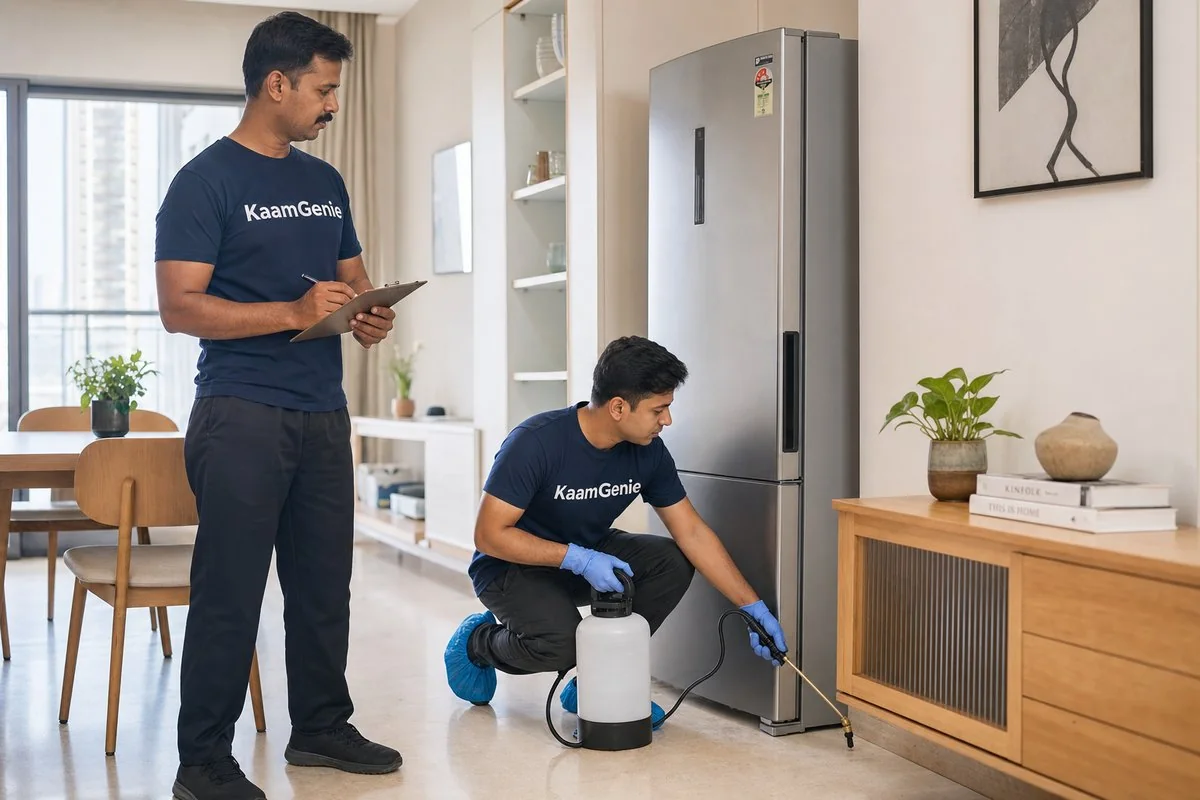
What’s included vs what costs extra
The fastest way to judge an AMC is to read what’s actually written into it, line by line, rather than trusting the headline price. A good contract spells out the covered pests, the number and cadence of visits, whether call-backs are free, and what sits outside the plan. Here’s the realistic split you should expect.
- Included in a standard AMC: general pest control (cockroaches, ants, silverfish and similar), the agreed scheduled visits, and free call-backs between visits if covered pests return.
- Often included or cheaply bundled: rodent control with bait stations, and basic mosquito or fly management — ask whether these are named in your contract or charged separately.
- Almost always extra: termite treatment (its own barrier job and warranty, from ~₹2,499) and bed bug treatment (intensive room protocol, from ~₹1,299/room).
- Records you should get: before/after photos, a GST invoice per visit, and an audit-ready pest log — essential for shops, clinics and offices, and a good sign of a serious provider even for homes.
If a quote is vague on any of these, push for specifics in writing before you sign. “Full pest control” on a one-line WhatsApp message is not a contract — the named pests, the visit schedule and the call-back terms are.
Contract red-flags to check before you sign
Most AMC complaints I hear aren’t about price — they’re about a contract that didn’t say what the customer assumed. A few minutes of checking saves a year of frustration. Watch for these before you commit:
- Vague pest list. If the contract says “general pest control” without naming the pests, you have no leverage when something it doesn’t cover shows up. Insist on a named list.
- No free call-backs. The whole point of an AMC is that flare-ups between visits are handled. If call-backs are billed extra, it’s a glorified prepaid voucher, not real cover.
- Termite/bed bug implied but not stated. A salesperson hinting they’re “taken care of” without it being written down means you’ll be billed later. Get it in writing or treat them as separate.
- A price that’s too cheap for the property. A restaurant or large office AMC for a few thousand rupees a year is a paper contract that will fail a real inspection.
- No GST invoice or records. Cash-only with no paperwork means no proof for an audit and no recourse if visits are skipped.
- No survey before quoting. An honest commercial number comes after someone sees the site. A firm price over the phone for a shop or office is a guess, and usually a low one to win the deal.
None of this means AMCs are a con — for most Delhi homes and every serious shop or office, a contract is the cheaper, calmer way to stay pest-free. It just means you should buy one the way you’d buy any annual plan: read the terms, name the pests, confirm the visits, and keep the paperwork.
KaamGenie AMC — what we offer across Delhi
Our home AMC starts at ₹2,999 a year and is built the honest way: a named pest list, scheduled visits (quarterly or bi-monthly to suit your home), free call-backs in between, before/after photos and a GST invoice every visit. Termite and bed bug are quoted separately and clearly, never smuggled in or implied. For shops, clinics and offices we quote a commercial AMC after a site survey, with the visit frequency matched to your footfall and an audit-ready pest log for inspections. We run AMCs across Delhi — South Delhi colonies, East and West Delhi, the central markets and the corporate districts. Coming soon: Gurgaon, Noida, Faridabad and Ghaziabad. No honest company promises a property pest-free forever — scheduled visits are exactly how you keep it that way. Tell us your BHK or your floor size and we’ll quote the right plan. Call 95603 66362.
Frequently asked questions
How much does a pest control AMC cost in Delhi in 2026?
A home pest control AMC in Delhi runs roughly ₹2,999–₹9,000 a year depending on your BHK and how many visits you choose — quarterly (4 visits) is cheaper, bi-monthly (6 visits) costs more. Shops, clinics and offices run from about ₹6,000 to ₹40,000+ a year by size and frequency. GST 18% is extra. Our home AMC starts at ₹2,999/year.
What does a pest control AMC actually cover?
A standard AMC covers general pest control — cockroaches, ants, silverfish and the common crawling and flying pests — plus the agreed scheduled visits and free call-backs between visits if those pests return. Rodent and mosquito control are sometimes bundled, sometimes add-ons. Termite and bed bug treatment are almost always priced separately.
Are termite and bed bug treatment included in a pest control AMC?
Usually not. Termite work needs drilling, chemical barriers and its own warranty, and bed bugs need an intensive room-by-room protocol, so both are almost always quoted as separate add-ons. A termite barrier for a typical Delhi home starts around ₹2,499 and bed bug treatment from about ₹1,299 per room. Always confirm in writing whether they’re in your contract.
How many pest control visits do I get in a year with an AMC?
It depends on the plan you pick. Quarterly means 4 visits a year (one every three months), bi-monthly means 6 visits (one every two months), and monthly means 12 visits. Most Delhi homes do well on quarterly; busy shops need bi-monthly; restaurants and food premises need monthly. More visits cost more, so match the frequency to how much pest pressure your property is under.
Is a pest control AMC cheaper than paying for one-time visits?
It is if you’d otherwise call someone out more than twice a year. A single one-time treatment for a 2 BHK runs about ₹999–₹1,500, so if you only ever have one problem a year, one-time is cheaper. But three separate call-outs can total ₹3,500–₹4,500, which is roughly what a bi-monthly AMC with 6 visits and free call-backs costs — far more cover for the same money.
How much is a home pest control AMC for a 2 BHK in Delhi?
A 2 BHK home AMC in Delhi runs roughly ₹3,500–₹4,800 a year on a quarterly plan (4 visits) and ₹5,000–₹6,800 on a bi-monthly plan (6 visits). That covers general pest control and free call-backs. Termite and bed bug, if you want them, are quoted on top. GST 18% is extra.
How much is a commercial pest control AMC in Delhi?
By size and footfall. A small shop or clinic up to 1,000 sq-ft runs roughly ₹6,000–₹12,000 a year; a restaurant or cloud kitchen on monthly visits runs ₹15,000–₹36,000; an office floor up to 5,000 sq-ft runs ₹15,000–₹40,000. Warehouses and large multi-floor sites are custom quotes. An honest commercial number comes after a site survey, not over the phone.
What’s the difference between quarterly, bi-monthly and monthly AMC visits?
Quarterly is 4 visits a year (every 3 months), the default for most homes and light offices. Bi-monthly is 6 visits (every 2 months), a step up for recurring problems, ground-floor flats or shops with some food handling. Monthly is 12 visits, standard for restaurants, cloud kitchens, clinics and any food premises where auditors expect frequent, documented treatment.
What records should I get with a pest control AMC?
A serious AMC gives you before/after photos of treated areas, a GST invoice for each visit, and an audit-ready pest log recording the date, areas covered and products used. For shops, clinics and offices these are essential for FSSAI, health and ISO audits. Even for homes, a company that hands you photos and an invoice is a better bet than a cash-only one with no paperwork.
What are the red flags in a pest control AMC contract?
Watch for a vague pest list with no named pests, call-backs that aren’t free, termite or bed bug implied but not written down, a price too cheap for the property size, no GST invoice or records, and a firm commercial price given over the phone without a site survey. Get the named pests, visit schedule and call-back terms in writing before you sign.
Does an AMC guarantee my property stays pest-free?
No honest company promises a property pest-free forever — an office pantry refills daily, a shop sees constant footfall, and homes near markets or drains face steady pressure. What an AMC does is keep pests under control with scheduled visits and free call-backs, so a problem is caught small instead of becoming an infestation. Ongoing scheduled treatment is how you keep it that way.
How quickly can KaamGenie start a pest control AMC in Delhi?
We can usually arrange the first visit quickly and offer same-day treatment where slots allow, but for an AMC it’s best to confirm your BHK or floor size, agree the visit frequency and book the first slot on a date that suits you. For shops and offices we survey the site first so the quote and schedule are accurate. Our home AMC starts at ₹2,999/year — call 95603 66362.
Lock in a year of pest cover, from ₹2,999
Scheduled visits, free call-backs and a GST invoice every time — an honest AMC with a named pest list and no hidden add-ons. Homes, shops and offices across Delhi.
Sources & references
- Central Insecticides Board & Registration Committee (CIB&RC) — the Indian regulator that approves the pest-control products and concentrations used under maintenance contracts.
- Food Safety and Standards Authority of India (FSSAI) — sets the pest-control and Integrated Pest Management expectations for restaurants, shops and food premises that drive monthly AMC visits.
- National Centre for Disease Control (NCDC) — tracks urban pest and vector patterns in Indian cities relevant to scheduled control.
- Indian Council of Medical Research (ICMR) — publishes research on pest biology and integrated pest management protocols.
Last verified: 13 June 2026. If you find any of these links broken, please let us know.