
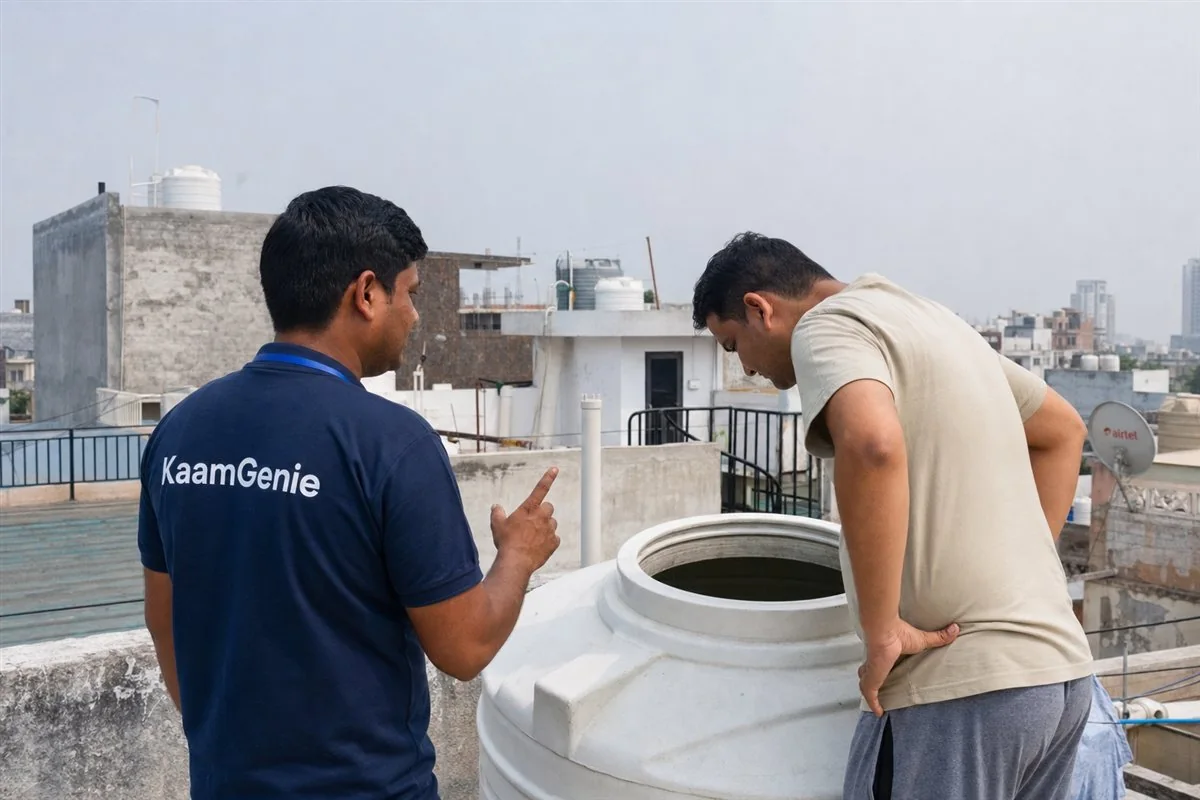
The short answer
- DIY is fine for a small (~500L or less), accessible rooftop plastic tank you can scrub from outside — shut the inlet, drain, scoop the sludge, scrub with a soft nylon brush, rinse, disinfect, rinse again.
- Never climb inside a large or underground tank. A closed tank is a confined space — low oxygen and toxic gas from rotting sludge can kill in minutes. This is not caution for caution’s sake; people die this way every year.
- Call a professional for any underground sump (UGR), shared society/tower tank, deep tank you’d have to enter, heavy hard-water scale, or a tank that feeds a food business.
If you’re reading this wondering “is my tank a DIY one?” — the table below answers it in ten seconds.
| Your tank | DIY? | Why |
|---|---|---|
| Small rooftop plastic tank (up to ~500L), reachable from outside | Yes | You can scrub every surface without entering it |
| Large rooftop tank (1,000L+) you’d have to climb into | No | Confined space — oxygen/gas risk once you’re inside |
| Underground sump / reservoir (UGR) | No — never | Deepest, worst-ventilated, most dangerous tank of all |
| Shared society / high-rise tower tank | No | Size, height, and shared liability — needs a crew |
| Tank with heavy hard-water scale or rust | No | Needs controlled descaling + jet wash, not home acid |
| Tank feeding a shop, PG, cloud kitchen or clinic | No | Needs disinfection record for FSSAI-style compliance |
Not a DIY tank? Book a real clean
Underground sumps, society towers and scaled tanks need a trained crew with confined-space gear. Photos, disinfection and a record every time. ₹699 onwards.
The one safety rule that comes before everything else
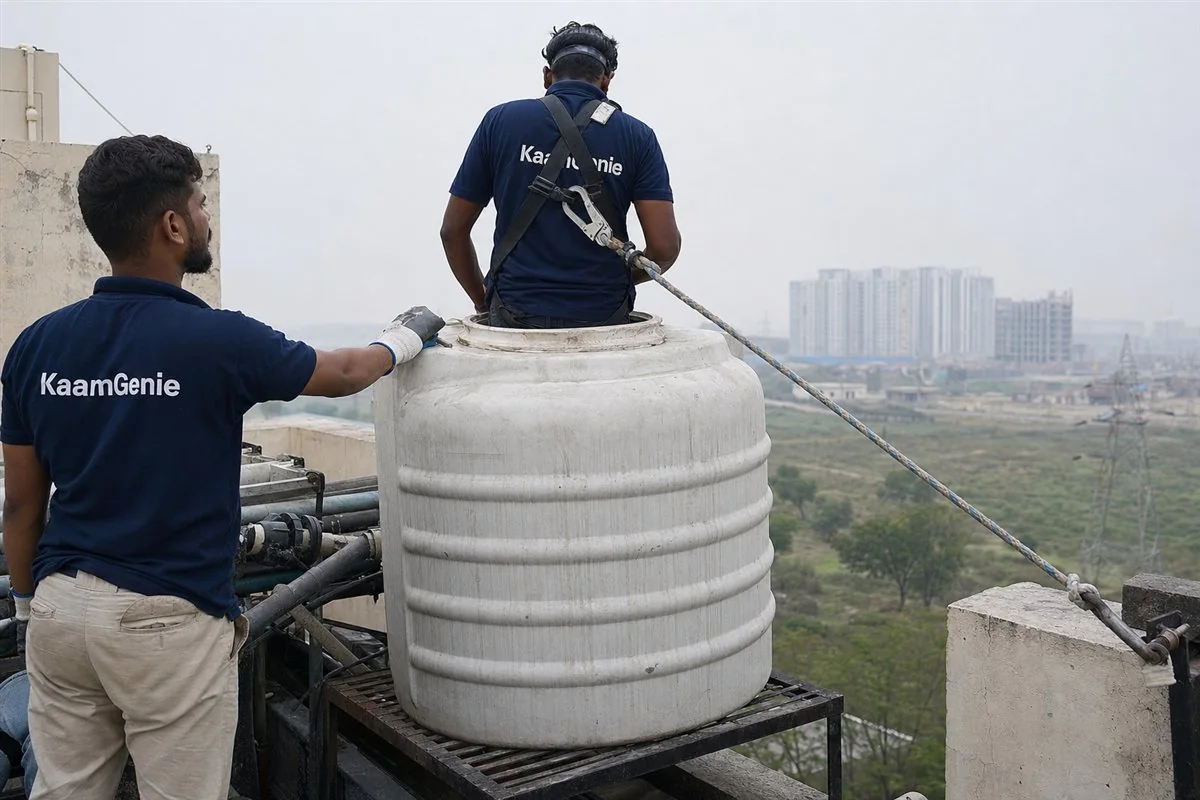
Before any how-to, the rule that matters most: never climb inside a tank you cannot easily get out of, and never enter an underground sump at all. A water tank with the lid mostly closed is what safety engineers call a confined space. The sludge sitting at the bottom slowly decomposes and releases gases, while oxygen gets used up. The result is an invisible pocket of low-oxygen or toxic air. You can lose consciousness within a minute of climbing in — and the person who climbs in after you to help is usually the second casualty.
This is not theoretical. Every year, across India, people die cleaning tanks and sewers exactly this way — often a homeowner or an untrained helper trying to save a few hundred rupees. It is the single reason professional crews exist: we test the air, force-ventilate, wear harnesses, and always keep one person stationed outside. If your tank is big enough that you would have to step inside it, it is big enough that you must not clean it yourself. Full stop.
So this guide splits cleanly in two. First, the safe DIY method for the one kind of tank a homeowner can genuinely handle. Then, an honest account of when to put the brush down and book water tank cleaning in Noida instead.
DIY: how to clean a small, accessible rooftop tank
This applies to a single plastic (Sintex-type) rooftop tank of roughly 500 litres or less, sitting on a flat, accessible roof, where you can reach every wall and the floor with a long brush while standing or kneeling outside it. That describes a lot of plotted Authority houses and independent floors in sectors like Sector 44 and Sector 50. If yours fits, here is the method.
What you’ll need
- A long-handled soft nylon brush — never a metal or wire brush, which scratches plastic and creates grooves where bacteria hide
- A bucket and a mug or small scoop for the sludge
- Rubber gloves and a basic face mask
- A sponge or clean cloth
- Mild food-grade detergent or plain baking soda for scrubbing
- A little chlorine (sodium hypochlorite / household bleach) for the disinfection step only
Notice what is not on that list: no acid, no toilet cleaner, no strong descaler. Those leave residue in water you will then drink, and can damage the tank.
Step 1 — Shut the inlet and drain
Close the inlet (ball) valve so no fresh water flows in while you work. Then empty the tank through its outlet, or by running the taps below. If the water inside is still clean, catch the last of it in buckets — you can use it for the rinse later, or for mopping and plants.
Step 2 — Scoop out the sludge
Once it’s empty, you’ll see a layer of silt at the bottom — fine sand, dust, and on Noida’s groundwater, a reddish iron-and-calcium grit. Reach in with the mug and scoop it into a bucket. Do not push it down the tank outlet; it will only settle in your own pipes downstream. This sediment layer is the single most important thing to remove, and it’s exactly what cheap “rinse-and-run” cleaners leave behind.
Step 3 — Scrub every surface
Make a paste with mild detergent or baking soda and water. With your soft nylon brush, scrub all four walls top to bottom, the floor in overlapping passes, the corners and seams, and the underside of the lid (condensation collects bacteria there). Take your time — this is the step that does the real work. If you can’t comfortably reach a corner or the far floor from outside, that’s your signal the tank is too big for DIY.
Step 4 — Rinse and bail
Rinse the walls and floor with clean water and bail or sponge out the dirty water, so the grime you just loosened doesn’t simply resettle when you refill. Repeat until the rinse water comes out clear.
Step 5 — Disinfect, wait, rinse again
Wipe the walls and floor with a weak chlorine solution, close the lid, and leave it for about 30 minutes. That pause — the contact time — is what actually kills bacteria; chlorine that’s rinsed off immediately does almost nothing. Then rinse one final time, restore the inlet, and refill. Use the first refill for non-drinking purposes, or let it stand a few hours, before you drink from the tank.
Done properly on a small tank, the whole job is about 60–75 minutes. It’s honest, it’s cheap, and it works — for that one type of tank.
DIY home clean of a small ~500L rooftop tank — time per step
Disinfection takes longest because the chlorine needs contact time to work
Roughly 60–75 minutes total for a small accessible tank — most of it is the disinfection wait. A large, deep, or underground tank is a completely different job and not safe to attempt at home.
When you must call a professional
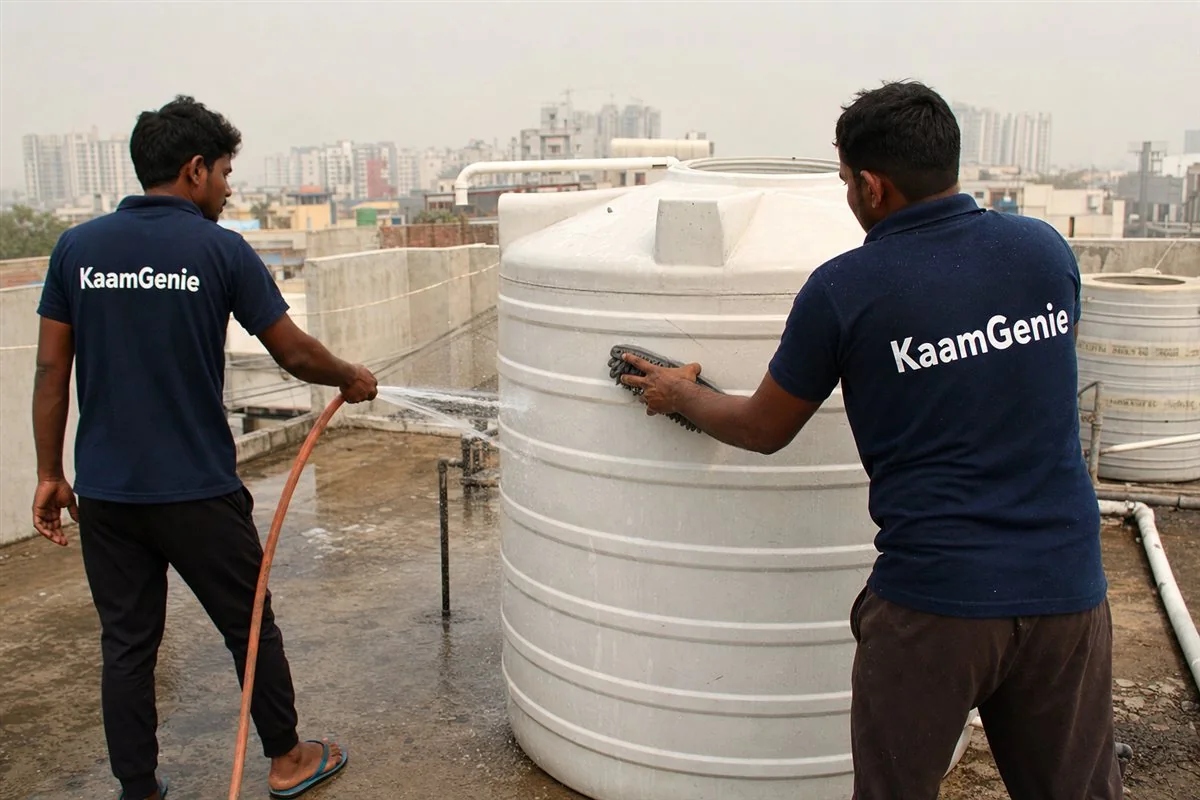
Here are the cases where DIY stops making sense — for safety, for results, or both:
- Any underground sump or reservoir (UGR). This is the deadliest tank to clean and never a DIY job. Across the Noida Expressway high-rise belt and Greater Noida West townships, big UGRs feed the rooftop tower tanks above — and they collect the most sludge. We cover them in detail in our guide to underground sump cleaning in Noida.
- Shared society and high-rise tower tanks. Height, volume and shared liability put these firmly in professional territory; see society water tank cleaning in Noida.
- Any tank large enough that you’d have to climb in. The moment a tank requires entry, it’s a confined space — air testing and ventilation are non-negotiable.
- Heavy hard-water scale or rust. Noida’s borewell groundwater leaves a chalky calcium-and-iron crust that ordinary scrubbing won’t shift. Proper, controlled descaling is a pro job — more on that in hard-water tank cleaning in Noida.
- Tanks feeding a shop, PG, cloud kitchen or clinic that need a disinfection record for FSSAI-style compliance.
- You’re simply not sure. If you have to ask whether it’s safe to enter, the answer is no — book a crew.
What you’re paying a professional for isn’t just labour — it’s the jet wash that reaches pores a brush can’t, measured food-grade disinfection with proper contact time, confined-space safety gear, and a documented before/after record. Across NCR, that’s the standard our water tank cleaning services are built around.
A realistic middle path for most Noida homes
You don’t have to pick one forever. A sensible routine for a Noida household: DIY-clean your small accessible rooftop tank every 3 months to keep sediment down, and book a professional clean once or twice a year for the deeper disinfection, the descaling, and the record. Tanker-fed homes in Greater Noida West and the new Expressway towers should lean more on professionals, simply because tanker water carries more sediment and the tanks tend to be larger.
If you’d rather skip the DIY entirely — many people do, especially in plotted houses around Sector 18 where a tank sits awkwardly — that’s a perfectly reasonable choice. The goal is clean, safe water, not a badge for doing it yourself.
Want it done right without lifting a brush?
We’ll handle the scoop, scrub, jet wash, disinfection and record — and we’ll never put anyone in a tank unsafely. Residential ₹699 onwards.
The bottom line for Noida homeowners
A small, accessible rooftop tank is the one tank you can safely and effectively clean yourself — and now you know exactly how. Everything bigger, deeper, scaled, shared, or underground belongs to a trained crew, not because we want the work, but because the confined-space risk is real and the results need equipment you don’t have at home. When in doubt, don’t climb in. Book water tank cleaning in Noida and let the people with the harness, the jet wash and the air tester handle it.
To book, call +91 95603 66362 or use the booking form on this site — we’ll confirm shortly.
Frequently asked questions
Can I clean my rooftop water tank myself?
Yes — but only if it is a small, accessible rooftop tank (roughly 500L or less) that you can reach into and scrub from outside without climbing in. Shut the inlet, drain it, scoop out the sludge, scrub every wall with a long soft nylon brush, rinse, disinfect with a weak chlorine solution and rinse again. The moment you would have to physically enter the tank, or it is an underground sump or a shared society tank, stop and call a professional.
Is it safe to go inside a water tank to clean it?
No — never enter a large or underground water tank yourself. A closed or partly closed tank is a confined space that can hold pockets of low-oxygen or toxic gas (from decomposed sludge or leftover cleaning chemicals). People die in India every year from entering tanks and sumps. Professionals use oxygen testing, forced ventilation, harnesses and a second person stationed outside. If a tank is big enough that you would need to climb in, it is big enough that you must not do it yourself.
What do I need to clean a small overhead tank at home?
A long-handled soft nylon brush (never metal — it scratches plastic and creates spots for bacteria), a bucket and mug or scoop for the sludge, rubber gloves and a face mask, a sponge or cloth, a mild food-grade detergent or plain baking soda, and a little chlorine for the disinfection rinse. You do not need a pressure washer for a small tank, but you do need to be able to reach the floor and every corner from outside.
What household chemicals should I NOT use to clean a drinking water tank?
Avoid acid (toilet/bathroom acid), strong descaling agents, detergent powders with heavy fragrance, and any industrial cleaner. These leave residue you will then be drinking and can damage the tank surface. Stick to a mild food-grade detergent or baking soda for scrubbing, and a measured weak chlorine solution only for the final disinfection — followed by a thorough rinse. If your tank has heavy hard-water scale that needs acid treatment, that is a job for a professional, not a home experiment.
Why can’t I clean my underground sump myself?
An underground reservoir (UGR) is the single most dangerous tank to clean. It is deep, often poorly ventilated, and the sludge at the bottom releases gases as it decomposes — so oxygen levels can be dangerously low the moment you climb in. You cannot test or ventilate it safely with home equipment. Across Noida and Greater Noida West, sumps are the tanks we most often get called to after a DIY attempt went wrong. Always use a crew with confined-space gear for any underground tank.
How do I disinfect my tank after scrubbing it?
After scrubbing and rinsing out the dirty water, wipe the walls and floor with a weak chlorine (sodium hypochlorite) solution, close the lid, and leave it for about 30 minutes of contact time — that pause is what actually kills the bacteria. Then rinse once more with clean water, refill, and use the first refill for non-drinking purposes (or let it stand) before drinking from the tank. Skipping the contact time is the most common DIY mistake; spraying chlorine and rinsing immediately does very little.
How often should I DIY-clean a tank in Noida?
For a small rooftop tank on Noida’s hard borewell or mixed supply, every 3 months is a sensible DIY interval, and at minimum twice a year. Tanker-fed homes in Greater Noida West and new Expressway towers usually need it more often because tanker water carries more sediment. If you are seeing yellow water, smell, or sediment sooner than that, clean it immediately — those are signs it is already overdue.
When should I stop and call a professional instead?
Call a professional whenever the tank is an underground sump or UGR, a shared society or high-rise tower tank, larger than about 500L, deep enough that you would need to climb in, has heavy hard-water scale or rust, or supplies a food business that needs an FSSAI-style cleaning record. Also call one if you simply are not sure — a small accessible rooftop tank is the only case where DIY is genuinely safe, and even then a professional clean once a year gives you photos, disinfection contact time and a proper record.
Does DIY cleaning work on Noida’s hard borewell water scale?
Light scale yes, heavy scale no. Noida and Greater Noida groundwater is hard, and over a year or two it leaves a chalky calcium and iron layer that ordinary scrubbing and food-grade detergent will not shift. Removing it properly needs controlled descaling and a jet wash, which is a professional job — using strong acid yourself risks damaging the tank and leaving residue in your drinking water. For scaled tanks, book a hard-water cleaning rather than attempting it at home.
Sources & references
- Bureau of Indian Standards (BIS) — IS 10500:2012 is the canonical Indian Standard for drinking water specification, defining acceptable limits for physical, chemical, and biological parameters.
- WHO Guidelines for Drinking-water Quality, 4th edition — the global reference for water quality standards, including guidance on storage and disinfection.
- Food Safety and Standards Authority of India (FSSAI) — defines water quality requirements for food businesses, including hygiene standards for stored water and acceptable disinfection chemicals.
- WHO Fact Sheet on Drinking Water — overview of safe drinking water requirements and contamination risks.
- CPHEEO — Manual on Water Supply and Treatment — the Government of India’s engineering manual covering tank design, cleaning protocols, and disinfection practices.
Last verified: 30 June 2026. If you find any of these links broken, please let us know.