
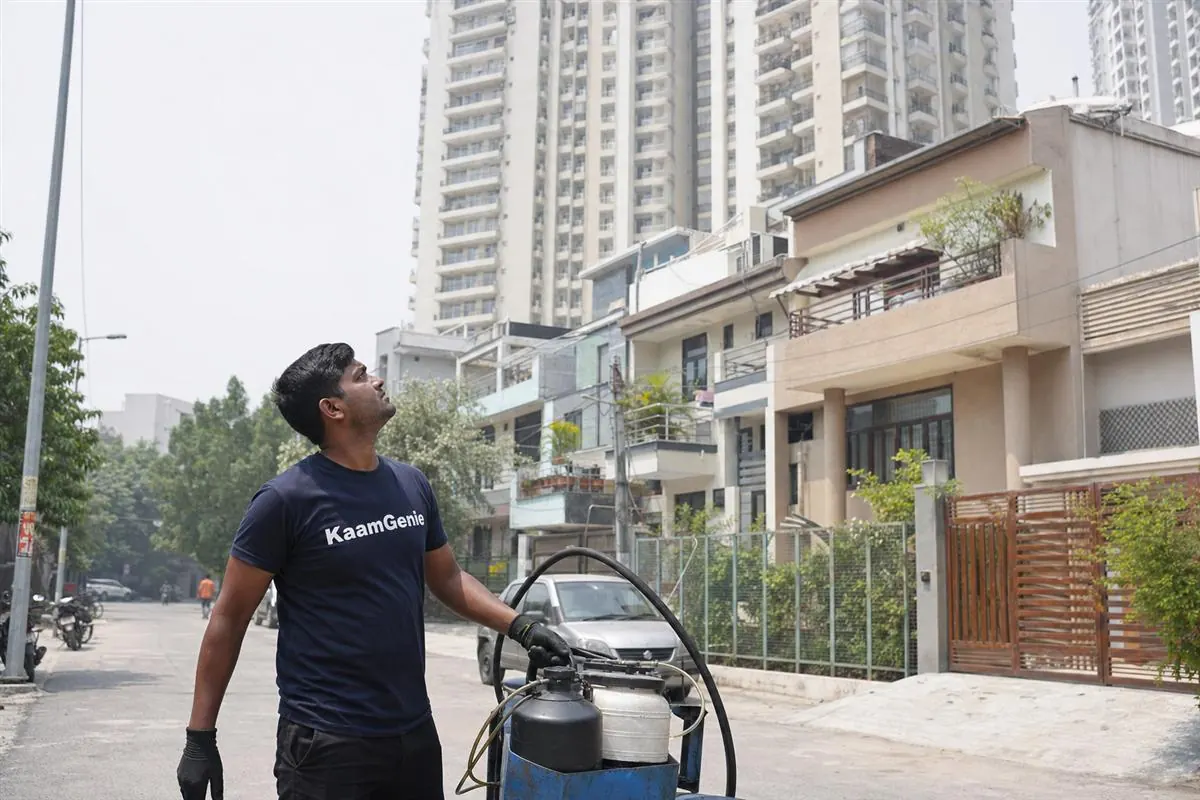
The short version
- Different systems. High-rise = shared underground reservoir (UGR) + overhead tanks on each tower. Plotted house / builder floor = one or two individual Sintex/plastic terrace tanks (sometimes a small sump).
- Different bookers. A society clean is booked by the AOA/RWA from the maintenance budget. A plotted-house clean is booked directly by the owner or tenant.
- Different access. Towers need staging, height/ladder access and confined-space safety for the UGR. A plotted terrace tank is a straightforward single-tank job.
- Different paperwork. Societies need a per-tank certificate for every tank; a plotted house gets one cleaning record for its tank.
- Different pricing. Plotted/builder-floor cleaning is fixed from ₹699 onwards; society/UGR work is custom-quoted per tank.
- Same water problem. Both sit on Noida’s hard borewell groundwater — calcium and iron scale — so both lean toward a quarterly schedule.
Not sure which you are? If you draw water from a shared society system, it’s a high-rise job. If your tank serves only your home, it’s a plotted/builder-floor job.
| What differs | High-rise society / tower | Plotted house / builder floor |
|---|---|---|
| System & tank type | Shared underground reservoir (UGR), often split into compartments, pumped up to overhead tanks on each tower (large RCC / plastic) | One or two individual Sintex / plastic terrace tanks (500–2,000L); sometimes a small ground sump |
| Who is responsible / books | AOA / RWA or facility agency; paid from the common maintenance budget | Individual owner or tenant; booked and paid directly |
| Access & safety | Staged tower-by-tower; ladder / height access; confined-space gear for the UGR | Single terrace tank; quick, low-complexity access |
| Number of tanks per visit | Many — UGR compartments plus every tower’s rooftop tanks | Usually one or two |
| Frequency | Quarterly (shared source contaminates hundreds of flats) | Every 3–4 months; twice a year minimum |
| Certificates | Separate per-tank certificate for every tank in the inventory | One cleaning record with before/after photos |
| Cost | Custom-quoted per tank; tiny per-flat share | Fixed from ₹699 onwards |
| Typical Noida sectors | 137, 150, Expressway corridor, Greater Noida West | Established sectors 14–62 (e.g. 18, 62) |
Not sure which job is yours?
Tell us your tank setup and we’ll tell you straight — a fixed price for a plotted/builder-floor tank, or a per-tank survey for a society. Residential cleaning ₹699 onwards.
The system: shared reservoir vs your own terrace tank
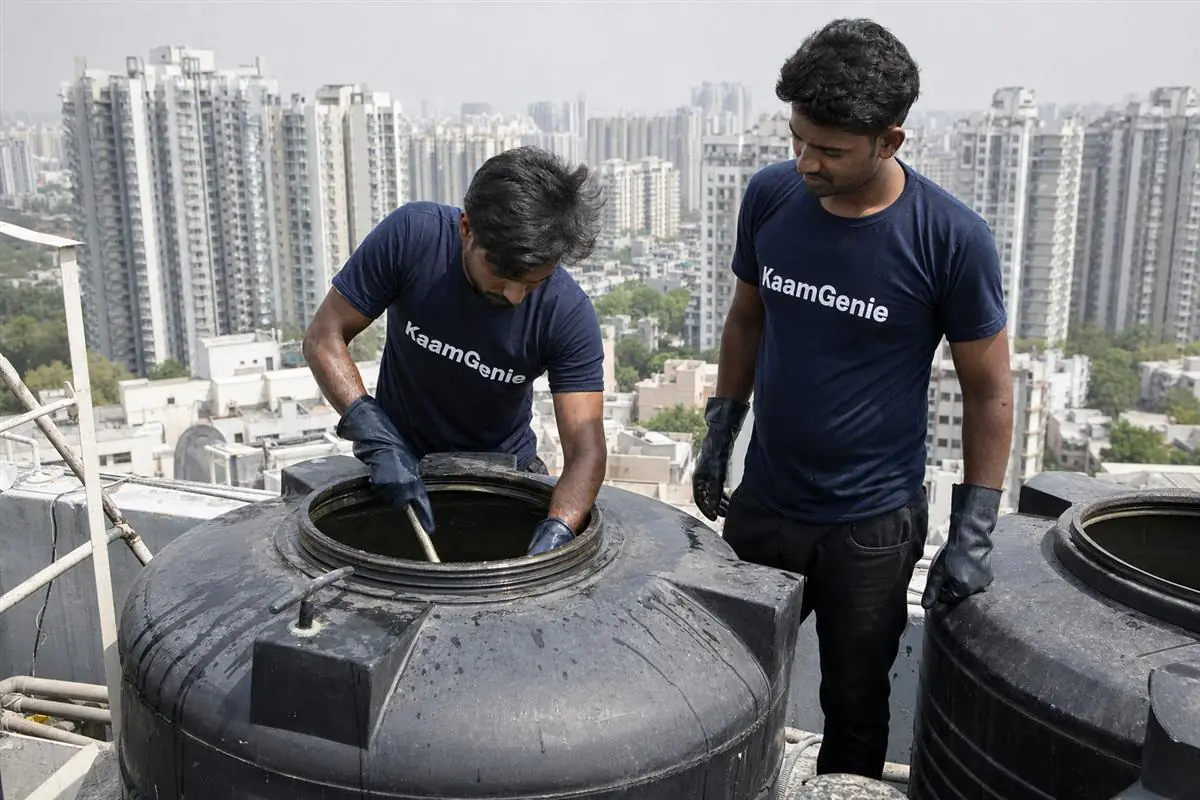
The biggest difference isn’t the chemicals or the brushes — the 8-step method is the same everywhere. It’s the plumbing. In a Noida high-rise, water arrives into one large underground reservoir (UGR) at the base of the complex, usually split into compartments (a domestic side and a flushing or fire side). Pumps lift it up to overhead tanks on each tower’s roof, and from there it gravity-feeds down to flats. So the water in a 14th-floor kitchen has passed through two shared tanks before it reaches the tap. A real society clean has to cover both stages, and there can be a dozen or more tanks in a single inventory. We cover the whole staged process in our dedicated society and high-rise water tank cleaning guide for Noida.
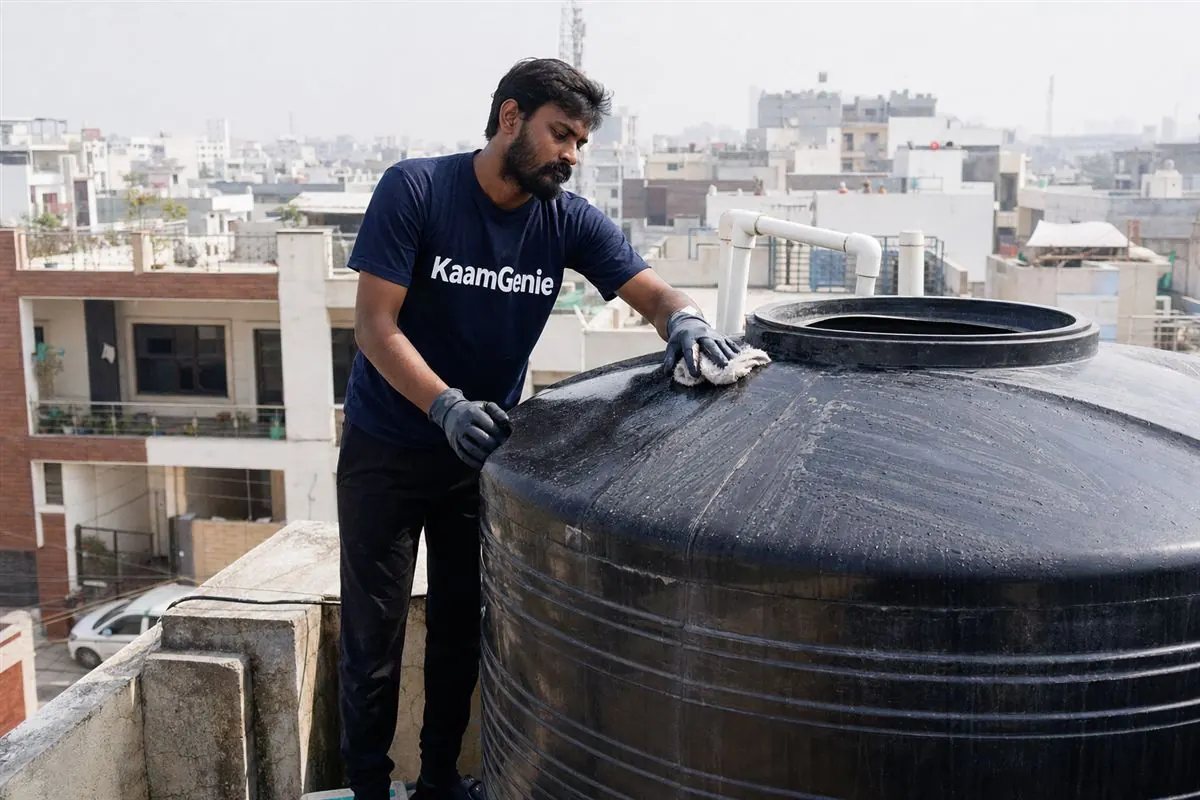
A plotted house or independent builder floor is the opposite of shared. Each home — or each floor in a builder-floor building — typically has its own Sintex or plastic terrace tank of 500 to 2,000 litres, sometimes fed from a small ground-level sump. Nobody else draws from it. That single dedicated tank is the entire job. It’s why a plotted clean is quick and self-contained, while a society clean is a logistics exercise. The material of that terrace tank matters too — plastic and concrete need slightly different handling, which we break down in our Sintex vs concrete tank cleaning piece.
Who is responsible — and who actually books it
This is the difference residents feel most. In a high-rise, the tanks are common property, so an individual flat owner can’t (and shouldn’t) book a UGR clean on their own. It’s arranged by the society — the AOA, the RWA, or the builder’s facility/maintenance agency in newer complexes — and paid from the common maintenance budget. If you live in a tower and your water looks off, the right move is to raise it with the committee, not call a cleaner for “your” tank, because there is no tank that is only yours.
In a plotted house or builder floor, the tank serves one home, so the owner or tenant books it directly and pays a fixed price. No committee, no budget cycle, no waiting for a quarterly slot. You see a problem, you book, it’s done that morning. There’s a common grey area worth flagging: in a builder-floor building with separate owners on each floor, each floor’s tank is that owner’s responsibility — there’s rarely a “society” to organise it, so it falls to whoever uses the tank.
Access and safety: staging vs a single morning
Because a high-rise has hundreds of homes on a shared supply, you can’t just switch the water off. The work is staged: the crew cleans one tower’s overhead tanks while the others keep drawing from their own, and the UGR is done compartment-by-compartment so one half feeds the society while the other is cleaned. The UGR itself is confined-space work — it needs ventilation, gas checks, a standby person and harnesses. Rooftop tower tanks add height and ladder access. A 6–8 tower society is typically spread across one or two days with no block losing water for more than a short refill window.
A plotted-house tank needs none of that staging. It’s a single tank, usually reachable on the terrace, and the household just stores a bucket or two of water for the roughly 90-minute job. Drain, de-sludge, scrub, jet-wash, vacuum, disinfect, refill — back in service the same morning. If the plotted house has a ground sump, that part is treated with the same confined-space care as a society UGR, just at a far smaller scale.
Tanks cleaned per booking — typical Noida job
Why a society visit is a project and a plotted-house visit is a single job
Illustrative tank counts: a society visit covers UGR compartments plus every tower’s rooftop tanks, which is why it’s quoted per tank and staged across days. A plotted/builder-floor visit is a single fixed-price job. Actual counts depend on the building.
Frequency: both fight Noida’s hard water
Here’s where the two converge. High-rise or plotted, most of Noida draws on hard borewell groundwater — high in calcium and iron — especially during supply shortfalls and in newer sectors. That mineral load drops out as scale and rust-coloured sediment far faster than it would on soft municipal water. So both setups need cleaning more often than a textbook would suggest.
For a high-rise, quarterly is the realistic standard, because a dirty shared UGR doesn’t affect one family — it contaminates hundreds of flats at once. For a plotted house or builder floor, every three to four months is sensible, with twice a year as the absolute floor that BIS IS 10500 and CPHEEO guidance support for stored drinking water. One extra factor pushes plotted homes toward quarterly: a small plastic terrace tank sitting in direct Noida sun warms up and can grow algae quickly, especially in summer. So the honest answer for both is: don’t wait for the water to look wrong.
Certificates and paperwork
Every clean we do — society or single home — ends with before/after photos and a cleaning record. The difference is volume and purpose. A society needs a separate per-tank certificate for every UGR compartment and every tower tank, listing the tank ID, capacity, date, crew and chemicals. The committee needs that to prove to residents and auditors that the whole inventory was done — not just the easy-to-reach tanks.
A plotted house gets a single cleaning record for its tank. It’s mostly for your own peace of mind, and it’s genuinely useful at resale or when handing a rented house over to a new tenant — proof the tank was professionally cleaned on a known date. If your plotted home was a recently handed-over builder unit, our water tank cleaning for a new flat in Noida guide covers the construction-debris first clean that new units almost always need.
Cost: fixed price vs custom per-tank quote
A plotted house or builder-floor tank is fixed and published — residential single-tank cleaning starts at ₹699 onwards, scaling with tank size and how many tanks you have. You know the price before we arrive. A high-rise society is custom-quoted per tank: every UGR compartment and every tower’s rooftop tanks are priced by capacity and access difficulty, then totalled. The headline number is bigger because it covers the whole building’s storage — but spread across all the flats, each home’s share of a quarterly society clean is tiny, often a few rupees a month. For the full breakdown of what drives any quote, see our water tank cleaning cost guide for Noida.
Which one are you — and where we clean it
The rule of thumb is simple. If you draw water from a shared society system with a pump room and a UGR, it’s a high-rise job — raise it with your committee and we’ll survey and quote per tank. If your tank serves only your home, it’s a plotted/builder-floor job you can book directly at a fixed price. We run both across Noida from one water tank cleaning in Noida service: the newer high-rise belts like Sector 137, Sector 150 and Greater Noida West (Noida Extension), and the established plotted sectors like Sector 18 and Sector 62. Many sectors are mixed, so when you book we ask about your actual tank setup rather than guessing from the address.
To book, call +91 95603 66362 or use the form on this site — tell us whether it’s a single tank or a society inventory and we’ll take it from there.
Book the right job for your home
Single Sintex tank on a builder floor, or a full society UGR-plus-tower survey — same trained crew, food-grade disinfectant, photos and a certificate. Residential ₹699 onwards; society custom-quoted.
Frequently asked questions
What is the main difference between cleaning a high-rise tank and a plotted-house tank in Noida?
Scale and system. A Noida high-rise stores water in two stages — a shared underground reservoir (UGR) feeding overhead tanks on each tower’s roof — so a real clean covers many tanks, is staged tower-by-tower so no block loses water, and is managed by the society’s AOA/RWA. A plotted house or builder floor usually has one or two individual Sintex/plastic terrace tanks owned by that household, so it is a quick single-tank clean booked directly by the owner or tenant from ₹699 onwards.
Who books the water tank cleaning — the society or the resident?
In a high-rise it is the society — the AOA, RWA or facility/maintenance agency books and pays from the common maintenance budget, because the UGR and tower tanks are shared common property. In a plotted house or independent builder floor, the individual owner or tenant books directly, because each tank serves only that home. This is the single biggest practical difference for residents: in a tower you raise it with the committee, in a plotted house you simply book it yourself.
How much does water tank cleaning cost for a plotted house versus a high-rise society in Noida?
A plotted house or builder-floor tank is a fixed, published price — residential single-tank cleaning starts at ₹699 onwards, scaling with tank size and number of tanks. A high-rise society is custom-quoted per tank, because every UGR compartment and every tower’s overhead tanks are priced by capacity and access, then totalled. Spread across all the flats, the per-flat share of a society clean is tiny, but the headline number is larger because it covers the whole building’s storage, not one home’s tank.
How often should each type clean its tanks in Noida?
Both sit on Noida’s hard borewell groundwater, so both scale up faster than soft municipal water. For high-rise societies, quarterly is the realistic standard because a dirty shared UGR contaminates hundreds of flats at once. For plotted houses and builder floors, every three to four months is sensible, and at minimum twice a year per BIS and CPHEEO guidance. A smaller plastic terrace tank in direct sun can also grow algae quickly, which pushes the plotted-home schedule toward quarterly too.
Do plotted houses in Noida have underground reservoirs too?
Sometimes, but smaller and simpler. Many plotted houses in established sectors like 14–50 run a single ground-level sump that feeds a pump up to one or two terrace tanks, while others rely on direct supply into rooftop Sintex tanks only. They rarely have the large split-compartment UGR a high-rise needs. If a plotted house does have an underground sump, that sump is confined-space work and should be cleaned as carefully as a society UGR, just at a much smaller scale.
Why does a high-rise clean need staging but a plotted house does not?
Because a high-rise has hundreds of homes drawing from shared tanks, you cannot simply switch the water off. The crew stages the work — cleaning one tower’s overhead tanks and one UGR compartment at a time while the rest of the society keeps drawing water — so no block runs dry for more than a short refill window. A plotted house has its own dedicated tank serving only that home, so there is nothing to stage; the household stores a little water for the 90-minute job and the tank is back in service the same morning.
What tank types are typical in Noida builder floors and plotted houses?
Mostly individual plastic terrace tanks — Sintex and similar three-layer or four-layer plastic tanks of 500 to 2,000 litres, one per floor on many independent builder-floor buildings. Older plotted houses sometimes have a masonry or RCC overhead tank or a ground sump. High-rises, by contrast, use large RCC underground reservoirs plus big plastic or RCC overhead tanks on each tower. The material matters for method, which is why we treat plastic and concrete tanks differently.
Do you give a cleaning certificate for a single plotted-house tank?
Yes. Every clean — plotted house or society — comes with before/after photos and a cleaning record listing the date, tank type and capacity, chemicals used and crew. The difference is volume: a plotted house gets one record for its tank, while a society gets a separate per-tank certificate for every UGR compartment and every tower tank, because the committee needs to prove the whole inventory was covered. For a single home, the record is mainly for your own peace of mind and resale or rental handovers.
Which Noida sectors are high-rise and which are plotted?
Broadly, the newer tower belts — Sector 137, Sector 150, the Noida–Greater Noida Expressway corridor and Greater Noida West (Noida Extension) — are dominated by high-rise societies with UGR-plus-tower systems. The older, established sectors roughly from 14 to 62, including Sector 18 and Sector 62, have far more plotted houses, independent builder floors and low-rise blocks with individual terrace tanks. Plenty of sectors are mixed, which is why we ask about your specific tank setup when you book rather than assuming from the address.
Sources & references
- Bureau of Indian Standards (BIS) — IS 10500:2012 is the canonical Indian Standard for drinking water specification, defining acceptable limits for physical, chemical, and biological parameters.
- WHO Guidelines for Drinking-water Quality, 4th edition — the global reference for water quality standards, including guidance on storage and disinfection.
- Food Safety and Standards Authority of India (FSSAI) — defines water quality requirements for food businesses, including hygiene standards for stored water and acceptable disinfection chemicals.
- WHO Fact Sheet on Drinking Water — overview of safe drinking water requirements and contamination risks.
- CPHEEO — Manual on Water Supply and Treatment — the Government of India’s engineering manual covering tank design, cleaning protocols, and disinfection practices.
Last verified: 27 June 2026. If you find any of these links broken, please let us know.