
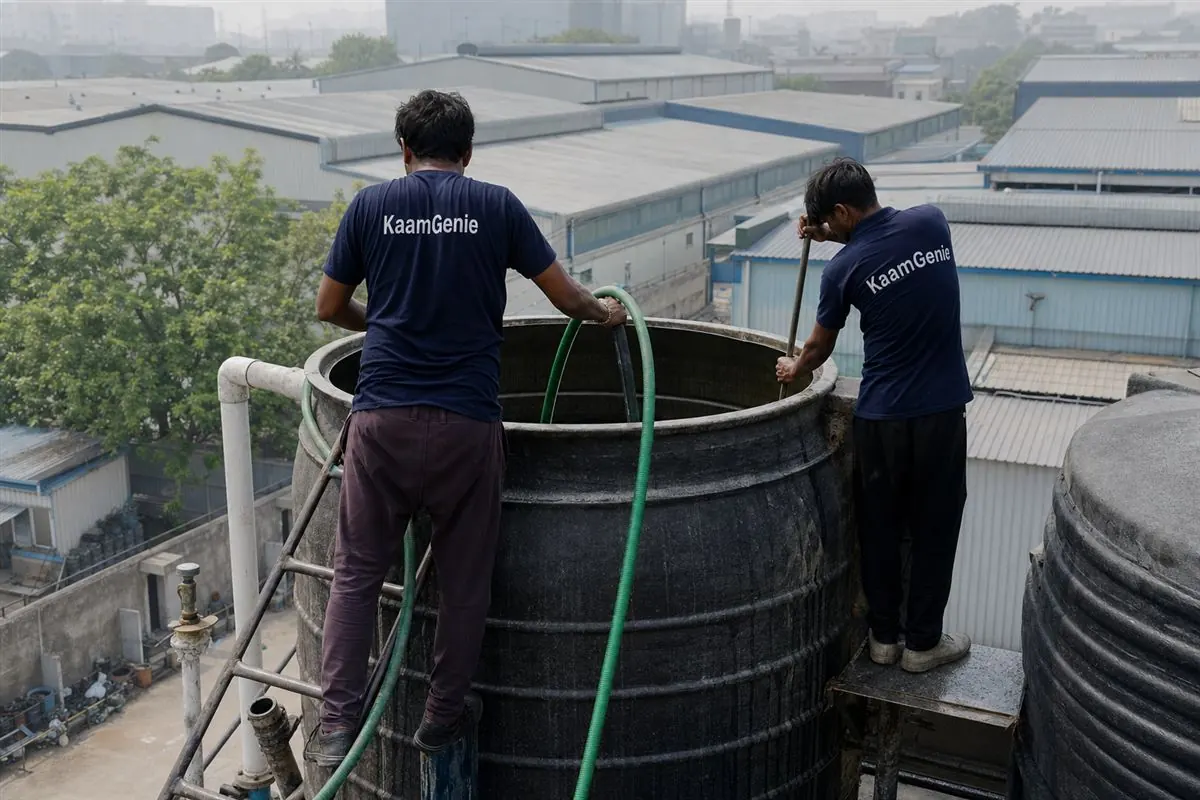
Quick answer — industrial water tank cleaning in Gurgaon & Manesar
- Who it’s for: factories and units in Udyog Vihar, IMT Manesar (auto, two-wheeler ancillary, FMCG packaging), Kherki Daula, and the New Gurgaon / Sector 37D–Pataudi Road manufacturing belt.
- Why it’s different: ~10x residential water flow, heavy hard-water scale, large underground reservoirs (UGRs), confined-space entry, FSSAI-grade canteen hygiene, and audit documentation.
- Pricing band: small commercial (5,000L) from ₹4,999, medium (10,000L) ₹7,999, large process/storage (25,000L) ₹14,999, factory UGR / cluster custom quote.
- Scheduled shutdown cleaning: overnight (9 PM–5 AM) and maintenance-day slots so the production line and canteen don’t pause.
- Documentation: GST invoice, safety method statement, photo proof, water-test lab report, FSSAI-aligned canteen record, vendor-master support.
- Contracts: quarterly or annual AMC — the norm for export-oriented Manesar units under ISO audit pressure.
Why a factory tank is not just a bigger home tank
The most expensive phrase in any Gurgaon plant-maintenance budget is “same job, bigger tank.” A residential operator who charges ₹1,500 for a kothi sump will sometimes quote ₹6,000 for a 50,000-litre factory reservoir on the assumption that it’s simply scaled-up work. It isn’t. Four things change the moment you cross from a home tank into an industrial unit, and each one changes the equipment, the crew, and the paperwork — which is why our water tank cleaning services are scoped very differently for a factory than for a flat.
Water turnover is roughly 10x. A 200-worker unit in Udyog Vihar with a canteen, washrooms and process make-up can pull 18,000–25,000 litres in a single shift. High turnover means biofilm builds aggressively around the float valve, inlet and overflow, while Gurgaon’s hard borewell groundwater leaves a heavy mineral crust on the reservoir walls. A standard residential brush-and-rinse misses both zones entirely.
Confined-space entry becomes a regulated activity. A small residential sump is a confined space on paper; a 50,000-litre concrete UGR is one in legal practice. Oxygen can drop below 19.5%, hydrogen sulphide can pool from sludge breakdown, and a single worker with no standby will not get out if something goes wrong. Proper protocol means harness, lifeline, gas monitor, a blower for forced ventilation, and a minimum of one supervisor plus two crew. Any operator quoting a factory job with one labourer and a bucket is uninsurable under Indian factory-safety norms.
The worker canteen is a food-safety asset. The tank that feeds the canteen and drinking-water dispensers sits under FSSAI scrutiny, especially where a contract caterer runs the kitchen. That line needs food-grade disinfection and a dated cleaning record that can be produced during a food-safety or customer audit — not a generic invoice.
The cost of the wrong vendor is operational, not financial. If a residential operator cleans your reservoir during shift hours, the canteen and washrooms lose water for 4–6 hours — 200 workers without water, who under the Factories Act 1948 can refuse to work. The ₹3,000 you “saved” becomes a production loss many times larger. Scheduled shutdown cleaning isn’t a premium in industrial work; it’s the only correct way to run the job.
| Tank / asset | Indicative price | Scope | Crew | Time on site |
|---|---|---|---|---|
| Small commercial (5,000L) | ₹4,999 | Single tank, full protocol + report | 1 supervisor + 2 crew | 3–4 hours |
| Medium process/storage (10,000L) | ₹7,999 | Single tank or 2 small tanks | 1 supervisor + 2 crew | 4–5 hours |
| Large reservoir (25,000L) | ₹14,999 | Single UGR, descaling included | 1 supervisor + 3 crew | 6–8 hours (shutdown) |
| Factory UGR + overhead (50,000–100,000L) | ₹25,000–45,000 | Reservoir + receiving sump + distribution tanks | 1 supervisor + 4–6 crew | 1–2 nights |
| Canteen / drinking-water line | From ₹4,999 | Food-grade clean + FSSAI-aligned record | 1 supervisor + 2 crew | 3–4 hours |
| Quarterly AMC (mid-size unit) | ₹28,000–45,000/yr | 4 visits + water tests + reports | Standard crew per visit | Per-visit |
| Plant cluster / campus | Custom quote | All tanks + documentation pack | Standard crew per visit | Per-visit |
Industrial site survey — no obligation
We’ll visit your Gurgaon or Manesar unit, map every tank including the receiving sump and fire-hydrant reservoir, and send a fixed-scope quote within 24 hours. Scheduled-shutdown and weekend slots available. ₹699 onwards for residential; factory work custom-quoted.
The Gurgaon & Manesar industrial belt — what the tanks actually look like
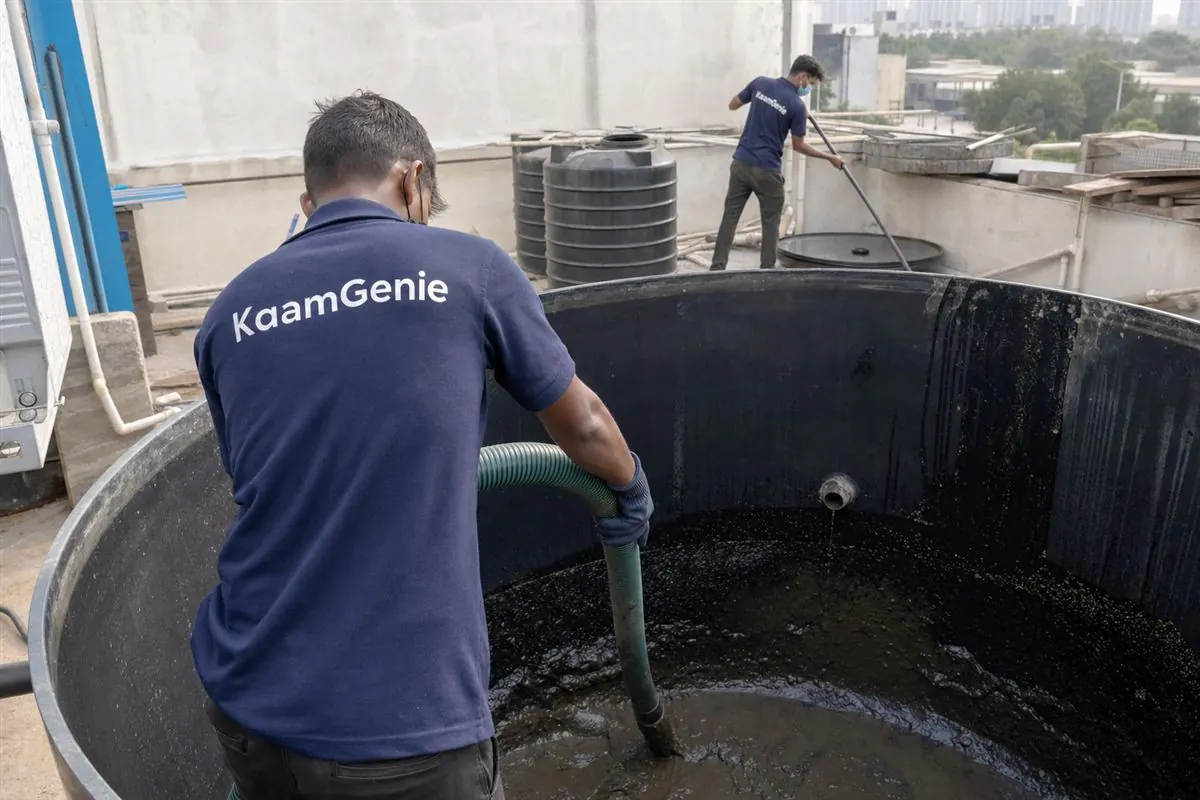
Gurgaon’s industrial map has a few distinct belts, and each has its own tank profile, water source and access pattern. If you run maintenance or admin at a unit in any of these, here’s what the job realistically involves.
Udyog Vihar (Phases I–V). A dense mix of garment, light engineering, electronics assembly, IT-adjacent units and corporate canteens packed close to the Delhi border. Most units sit on a mix of HUDA/GMDA supply, borewell and tanker top-up, so the receiving sump is the critical asset. Tanks are typically 10,000–30,000-litre concrete reservoirs at ground level, with overhead distribution tanks feeding the floors. Single-shift units here give a long after-hours window, which is why quarterly AMCs are easy to schedule. We cover this belt in detail on our Udyog Vihar water tank cleaning page.
IMT Manesar. Auto-component manufacturers, two-wheeler ancillaries and FMCG packaging plants, most built after 2010 so the metalwork is cleaner but the volumes are far larger — 50,000–100,000-litre reservoirs are common. Manesar carries the heaviest audit pressure of any belt because most units export and run under ISO 9001 / ISO 14001, so the post-clean water-test report is the document that matters most. Annual AMC with quarterly visits is the norm here.
Kherki Daula and the Pataudi Road / Sector 37D belt. Mid-size manufacturing, warehousing and newer industrial sheds along the toll–Pataudi Road stretch into New Gurgaon. Many of these units rely heavily on water tankers because piped supply is patchy, which makes the receiving sump the single most important tank on site — if it’s dirty, every drop the plant drinks for weeks is contaminated. We do a lot of receiving-sump-first work across the New Gurgaon belt.
Cyber City / corporate campuses. Strictly speaking these are office rather than factory tanks, but the engineering is industrial: large basement sumps, rooftop tank clusters, intermediate pump-room tanks, and a fire-hydrant reservoir that almost nobody remembers. We find the fire-hydrant tank untouched for 5+ years in most buildings because it isn’t in the daily plumbing loop. The Cyber City tank cleaning scope is built around sequencing all of these in one overnight window.
What changes our approach across these belts is the water source (GMDA vs borewell vs tanker), the shift pattern (single vs continuous process), accessibility (rooftop vs ground reservoir vs deep sump) and audit pressure. None of this is visible over a phone call, which is why we always survey before we quote.
Heavy sediment, hard-water scale and why first-cleans take a full shift
Gurgaon sits on hard groundwater, and most industrial units blend borewell water with tanker and piped supply. The result inside a reservoir is two layered problems. On the floor you get sediment — sand, silt, iron particles, dead insects and settled solids — that in a tank neglected for 18–36 months can reach 100–200 mm deep. On the walls you get a mineral crust: calcium and magnesium scale that water alone will never shift, concentrated around the inlet, outlet and float valve where flow is highest.
That’s why a factory first-clean is not a brush-and-rinse. The sequence is drain, hand-scoop and vacuum the sludge into sealed drums, chemical or mechanical descaling of the walls depending on the crust type, high-pressure jet wash into corners and behind fittings, then food-grade chlorination with full WHO-recommended contact time before refill. On a 50,000-litre UGR this is a full-shift job, sometimes two nights, and it’s the part residential operators consistently under-scope. The fix is to put the unit onto a schedule afterwards so the sediment never gets that deep again — which is exactly what an annual maintenance contract for Gurgaon tanks is designed to do.
Worker canteen & drinking-water lines — FSSAI-grade hygiene
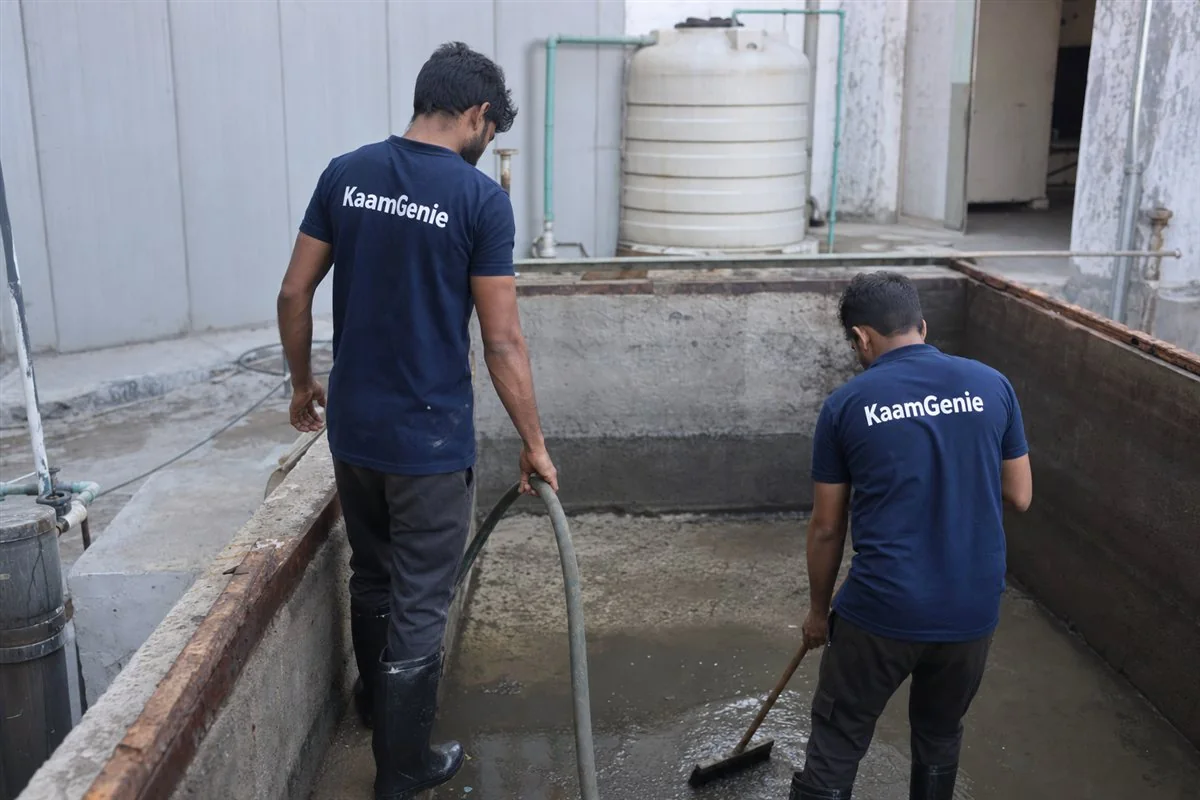
The tank that feeds the worker canteen and drinking-water dispensers is the one line where food-safety rules apply directly. Most factory canteens in Gurgaon are run by contract caterers, and during an FSSAI inspection or a customer food-safety audit, the management is expected to produce proof that the water supply is cleaned and documented. A generic GST invoice does not satisfy that requirement.
For these lines we use food-grade sodium hypochlorite at the WHO-recommended contact time, polish the drinking-water dispenser line after the main clean, and issue a separate dated cleaning record formatted to slot straight into the catering compliance folder. If your plant also serves a hostel or a residential officers’ block, the same standard applies there — the principle for canteen and potable lines is identical to how we handle society and shared-residential tanks in Gurgaon, just at industrial scale.
Scheduled shutdown cleaning — how we keep the line running
The entire value of industrial cleaning is doing it without stopping production. Here’s how a job runs end to end, so you know what your maintenance head is signing up for.
T−7 days: site survey. Our supervisor visits in daytime, maps every tank, photographs access points, identifies which tanks are coupled so we sequence drain-downs correctly, confirms the shutdown window and any security clearance. Output: a one-page fixed-scope quote with line items per tank.
T−3 days: paperwork. We share the GST invoice format, work-order acceptance copy, safety method statement, MSDS sheets, crew police-verification copies and the vendor master form so procurement can onboard us before the job, not after.
T−1 day: confirmation. WhatsApp confirmation with the maintenance manager: crew names, arrival time, expected completion, and the water-shutdown notice for the canteen and washrooms (we draft the worker communication if you want).
Job night. Crew signs the gate-pass register, equipment moves in, an on-site toolbox talk is signed, then sequential tank work: drain, descale, scrub, jet-wash, food-grade chlorination with contact time, refill, sample. Each tank generates a before/during/after photo set and a per-tank checklist.
T+1 morning: handover. WhatsApp summary with photo set and signed checklist. Water is back on before the morning shift; the line never stops.
T+2 to T+4 days: lab report. Samples go to a lab; the report comes back with bacterial count, residual chlorine, TDS and hardness, and we email it with the dated cleaning documentation to maintenance and procurement.
Where the night goes — 50,000L factory UGR, scheduled-shutdown first clean
Descaling and sludge removal dominate because hard-water scale and deep sediment are the real work
Roughly 7–8 hours across one overnight shutdown for a heavily-scaled 50,000L reservoir. A maintained tank on AMC takes a fraction of this because the sediment and scale never accumulate.
Confined-space safety — not optional inside a reservoir
Any job that involves entry into the tank is a confined-space activity under Indian factory-safety norms. Our crew runs a pre-entry oxygen check (must read 19.5–23.5%) and a hydrogen-sulphide check (below 10 ppm) on a calibrated multi-gas monitor, and logs the reading on the pre-entry checklist. If either reading is off, the blower runs for 20–40 minutes and we re-test — nobody enters until both clear.
Crew composition is one supervisor plus two crew minimum: one inside doing the work, one at the entry as standby and lifeline holder, one managing equipment. Every entrant wears a full-body harness with a retractable lifeline on a tripod or overhead anchor, chemical-resistant gloves and a respirator when descaling chemicals are in use. The gas monitor stays on the inside crew member, the blower runs continuously, and a permit-to-work is counter-signed by your facility manager. We carry workmen’s compensation and third-party liability cover for the work on your premises. If your current vendor sends one person in with no standby, no monitor and no harness, the liability for any incident sits with you.
Put your plant on a documented schedule
Quarterly or annual AMC for Gurgaon & Manesar units — scheduled-shutdown visits, lab water tests, FSSAI canteen records and a continuous audit trail. One PO, one onboarding, no surprises.
AMC vs one-time — the procurement math for a factory
For a home the AMC question is about convenience. For a factory it’s about three things: opex predictability, audit readiness, and avoiding repeat onboarding. A one-time booking is quoted per visit, raised as a separate PO each time, and goes through full procurement approval on every cycle — four cleanings a year means four POs and four audit trails. A quarterly AMC is a single annual contract, single PO, predictable dates, with per-visit cost typically 15–25% lower because we commit crew and equipment slots in advance, and the water-test reports become a continuous compliance trail that’s audit-ready without extra work.
The break-even sits around two cleanings a year. Beyond that, AMC almost always wins on total cost of ownership, which is why most export-oriented Manesar units sign annual contracts. One-time still makes sense for a spot situation — a new plant commissioning, taking over a leased Udyog Vihar unit, or recovering from a contamination incident. If you want to see how the numbers fall for your specific tank sizes, our Gurgaon water tank cleaning cost guide walks through the bands, and our commercial water tank cleaning page covers offices, hotels and restaurants on the same documentation standard.
Booking industrial water tank cleaning in Gurgaon
If you run a unit in Udyog Vihar, IMT Manesar, Kherki Daula or the New Gurgaon manufacturing belt, the right first step is a daytime site survey, not a phone quote. We map every tank — including the receiving sump and the fire-hydrant reservoir nobody remembers — and send a fixed-scope quote within 24 hours. To see the full area coverage and book, start at our water tank cleaning in Gurgaon hub, or call +91 95603 66362 and we’ll arrange a supervisor visit within 48 hours.
Frequently asked questions
How much does industrial water tank cleaning cost in Gurgaon and Manesar?
Indicative bands: small commercial 5,000L tank from ₹4,999, medium 10,000L ₹7,999, large process/storage 25,000L ₹14,999, factory underground reservoir (UGR) 50,000–100,000L ₹25,000–45,000, full plant cluster custom quote. GST 18% extra. Scheduled-shutdown (after-hours) work is included, not a premium line. Anything quoted below half this band usually skips confined-space safety and lab water testing — ask before you sign the PO.
Can the cleaning happen during a planned shutdown so the line does not stop?
Yes — scheduled shutdown cleaning is the default for industrial work in Gurgaon and IMT Manesar, not an add-on. We slot the job into your weekly maintenance shutdown or an overnight window (typically 9 PM to 5 AM, before the morning shift) and coordinate the water-shutdown notice for the canteen and washrooms. Single-shift Udyog Vihar units have a long after-hours window; continuous-process Manesar plants get a Sunday or maintenance-day slot.
Do you provide FSSAI-aligned documentation for the worker canteen tank?
Yes. The canteen and drinking-water line is cleaned with food-grade sodium hypochlorite at WHO-recommended contact time, and we issue a separate dated cleaning record suitable to produce during an FSSAI or customer food-safety audit. Most factory canteens in Gurgaon are run by contract caterers who need this proof on file, so we format it to slot straight into the catering compliance folder.
What documentation do you give for procurement and ISO audits?
Standard pack: GST invoice, work-order acceptance copy, safety method statement, MSDS for every chemical used, crew police-verification copies, vendor master form, water-test lab report, and a per-tank before/during/after photo set with a signed pre-entry checklist. Export-oriented Manesar units under ISO 9001 / ISO 14001 pressure value the water-test report most — it is the objective proof the job was done.
Why is factory tank sediment so much heavier than a home tank?
Two reasons. First, water turnover is roughly 10x a residential block, so suspended solids and biofilm build up faster around inlets, outlets and float valves. Second, Gurgaon’s hard borewell groundwater and tanker supply leave a heavy mineral crust on reservoir walls. A factory UGR that has not been cleaned in 18–36 months routinely has 100–200 mm of sludge on the floor, which is why first-clean jobs take a full shift and include chemical descaling, not just a brush-and-rinse.
Do you clean large underground reservoirs and process/storage tanks, not just rooftop tanks?
Yes — for industrial sites the underground reservoir (UGR) and the receiving sump are usually the critical assets. We carry high-capacity submersible drainage pumps, an industrial wet/dry vacuum and a high-pressure jet wash sized for 50,000–100,000L concrete reservoirs. We clean potable storage tanks, process-water storage, overhead distribution tanks and the receiving sump for tanker-fed units, and we sequence drain-downs so the plant wakes up to clean water everywhere.
What confined-space safety do you follow inside a large reservoir?
A pre-entry oxygen check (must read 19.5–23.5%) and hydrogen-sulphide check (below 10 ppm) on a calibrated multi-gas monitor, full-body harness with a retractable lifeline on a tripod anchor, and a minimum of one supervisor plus two crew — one inside, one as standby at the entry. A blower runs for forced ventilation throughout, monitoring is continuous, and a permit-to-work is counter-signed by your facility manager. We carry workmen’s compensation and third-party liability cover for the work on your premises.
Is an AMC worth it for a factory, or should we book one-time?
For anything more than two cleanings a year, a quarterly AMC almost always wins on total cost of ownership. Per-visit cost typically drops 15–25%, you raise one annual PO instead of four, vendor onboarding happens once, and the water-test reports become a continuous compliance trail that is audit-ready without extra work. One-time makes sense for spot situations — a new Manesar plant commissioning, taking over a leased Udyog Vihar unit, or recovering from a contamination incident.
How do we book a site survey for our Gurgaon or Manesar plant?
Call 95603 66362 or WhatsApp wa.me/919560366362 with your unit type (factory / process plant / packaging / auto-component), approximate tank and UGR capacity, location, and preferred survey window. Our supervisor visits within 48 hours during your working hours, maps every tank including the often-forgotten receiving sump and fire-hydrant reservoir, and sends a fixed-scope quote within 24 hours. No survey charge, no obligation.
Sources & references
- Bureau of Indian Standards (BIS) — IS 10500:2012 is the canonical Indian Standard for drinking water specification, defining acceptable limits for physical, chemical, and biological parameters.
- WHO Guidelines for Drinking-water Quality, 4th edition — the global reference for water quality standards, including guidance on storage and disinfection.
- Food Safety and Standards Authority of India (FSSAI) — defines water quality requirements for food businesses, including hygiene standards for stored water and acceptable disinfection chemicals.
- WHO Fact Sheet on Drinking Water — overview of safe drinking water requirements and contamination risks.
- CPHEEO — Manual on Water Supply and Treatment — the Government of India’s engineering manual covering tank design, cleaning protocols, and disinfection practices.
Last verified: 30 June 2026. If you find any of these links broken, please let us know.