
The short version
- This is the newest belt in the region. The Jewar / YEIDA corridor and the Yamuna Expressway sectors are being built right now — new societies, plotted homes and worker housing everywhere.
- There is no piped municipal supply yet. Almost everything runs on borewell groundwater and supplied tankers pumped into storage tanks.
- No treatment plant means the tank is the last barrier. With raw borewell and tanker water, a dirty tank directly contaminates everything you drink and wash with.
- New tanks carry construction sludge. Cement slurry, sand, grit and pipe residue sit in the reservoir and rooftop tanks at handover.
- The first clean matters most. A thorough clean at handover clears the build residue and sets a documented baseline.
- Then clean every three to four months — hard borewell and tanker water scale and silt tanks faster than treated piped water.
- Worker housing is the highest-risk group — heavily used, rarely maintained, shared tanker-filled tanks.
If your tank in the YEIDA belt has never had a real food-grade clean since handover, you are almost certainly drawing water over construction sediment right now.
| Factor | The Jewar / YEIDA situation | What it means for your tank |
|---|---|---|
| Age of construction | Brand-new towers, plotted homes and worker housing, still being built | Tanks carry construction debris and need a first clean at handover |
| Water source | Borewell groundwater + supplied tankers; little or no piped supply yet | Raw, untreated water stored directly — the tank is the last barrier |
| Water hardness | Hard groundwater, high in calcium and iron | Scale and rust-coloured sediment build up fast on tank walls |
| Tanker deliveries | Variable-quality water pumped straight into the reservoir | Silt settles between deliveries and builds a sludge layer |
| Worker housing | Large, heavily used, shared tanker-filled tanks and drums | High waterborne-disease risk without a regular schedule |
| Right schedule | First clean at handover, then every 3–4 months | Quarterly, not the once-a-year minimum written for treated water |
Book a first clean for your new tank
New society, plotted home or worker-housing site in the Jewar / YEIDA belt? We clear the construction sludge, disinfect to food-grade standard, and document it with photos and a certificate. ₹699 onwards residential; society/site custom-quoted.
Why the airport corridor is its own thing
Drive south from the established Noida Expressway high-rises, down the Yamuna Expressway towards the Jewar site of the Noida International Airport, and the landscape changes completely. Where older Noida is planned, settled and largely piped, the YEIDA belt is a construction frontier — new societies coming up between fields, plotted residential sectors filling in, and dense worker housing clustered around the airport works. It is the single fastest-growing pocket in the region, and almost everything in it is only a year or two old.
That youth is exactly what makes its water different. Two facts dominate. First, the buildings are new, so their tanks were never properly commissioned for drinking water and still carry construction residue. Second, and more importantly, there is no large piped municipal supply out here yet. The water comes from borewell groundwater pumped up locally, and from tankers trucked in and discharged into storage tanks. There is no treatment plant in the chain. In older, piped localities the municipal works treat and disinfect water before it ever reaches you; out here that step simply does not exist, and your storage tank quietly becomes the last barrier between a raw source and your tap. That is why we treat the YEIDA corridor as a distinct discipline within our wider water tank cleaning in Noida coverage, and why our pillar water tank cleaning services page exists for exactly this kind of raw-water, no-mains situation.
The borewell-and-tanker setup, and why the tank is everything
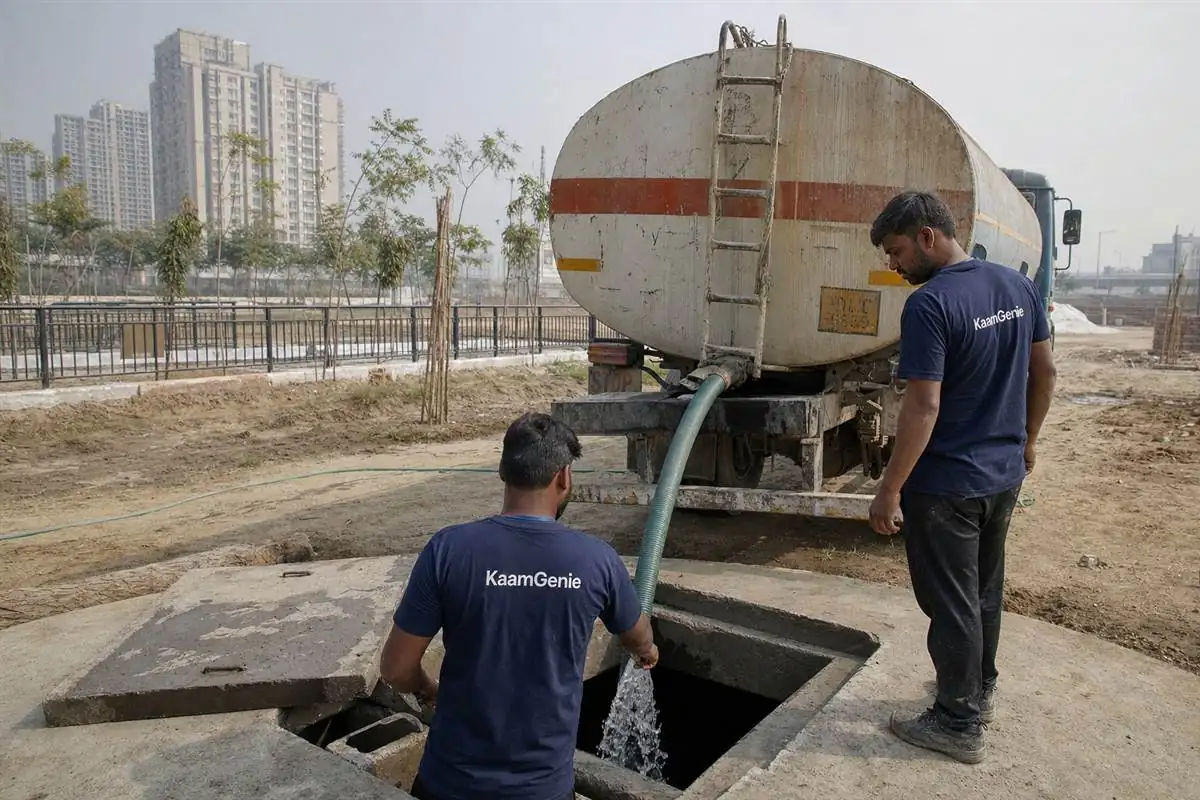
In a typical new society or plotted home along the Yamuna Expressway, water reaches your tap through stored storage, not a live mains. A borewell pump or an incoming tanker fills the underground reservoir (UGR) at the base of the building or plot. From there, pumps lift it up to the rooftop overhead tanks, and gravity feeds it down to your taps. Every drop you use has been sitting in at least one of those tanks — often two.
Because nothing in that chain is treated, the cleanliness of the tank is the cleanliness of your water. There is no chlorine dosing upstream to fall back on, no filtration plant catching what the tank misses. If silt from the last tanker has settled on the reservoir floor, if iron from the borewell has stained the walls, if construction sludge is still sitting where the builder never cleaned it — all of that is in the water your family drinks and bathes in. This is the opposite of an old piped colony, where a neglected tank is a secondary problem behind treated mains water. In the Jewar / YEIDA belt the tank is the primary control, which is why most cheap operators get it exactly backwards by rinsing the easy rooftop tank and ignoring the underground reservoir that everything else draws from. Our guide to Noida’s water supply and what it means for your tank goes deeper into how borewell and tanker sources behave in storage.
Problem one: construction sludge in brand-new tanks
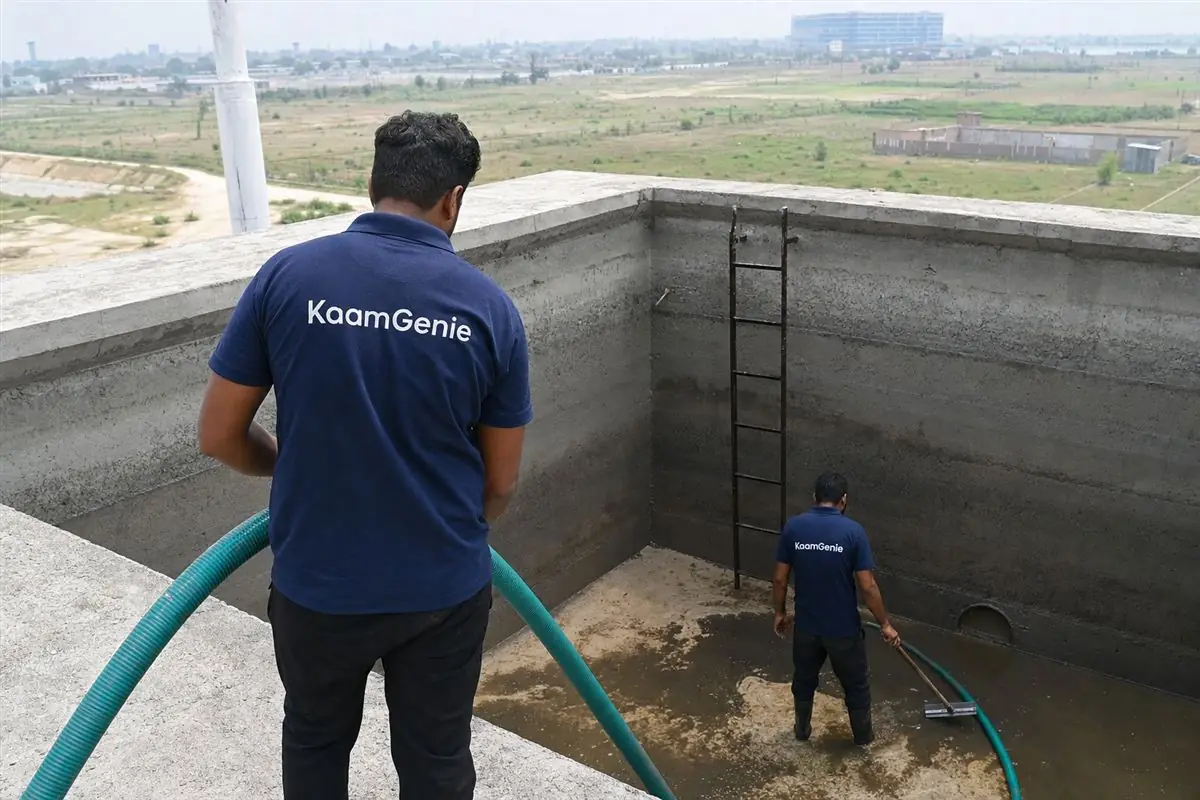
The most common thing we find in a new YEIDA-sector tank is not contamination from neglect — the building is too young for that. It is residue from the build itself. During construction and when the plumbing is first commissioned, the riser lines are flushed, and that flushing carries cement slurry, fine sand and grit, brick dust and pipe residue straight into the underground reservoir and the rooftop tanks, where it settles as a layer of sludge on the floor.
The builder’s housekeeping team nominally “maintains” the tanks in this period, but a proper food-grade clean is rare — a quick rinse is the most you can usually expect. So the first families to move into a new Jewar-corridor tower are drawing drinking water straight over a bed of construction debris. The fix is simple and non-negotiable: a thorough first clean at handover that drains the tank, scoops and vacuums out the build sediment, scrubs and disinfects every surface, and is documented with before/after photos and a certificate as the society’s baseline. This is the resident-level version of the same issue we cover in our water tank cleaning for a new flat in Noida guide — and in a no-mains belt like this it matters even more, because there is no treated supply masking the problem.
Problem two: hard borewell and tanker water means a real schedule
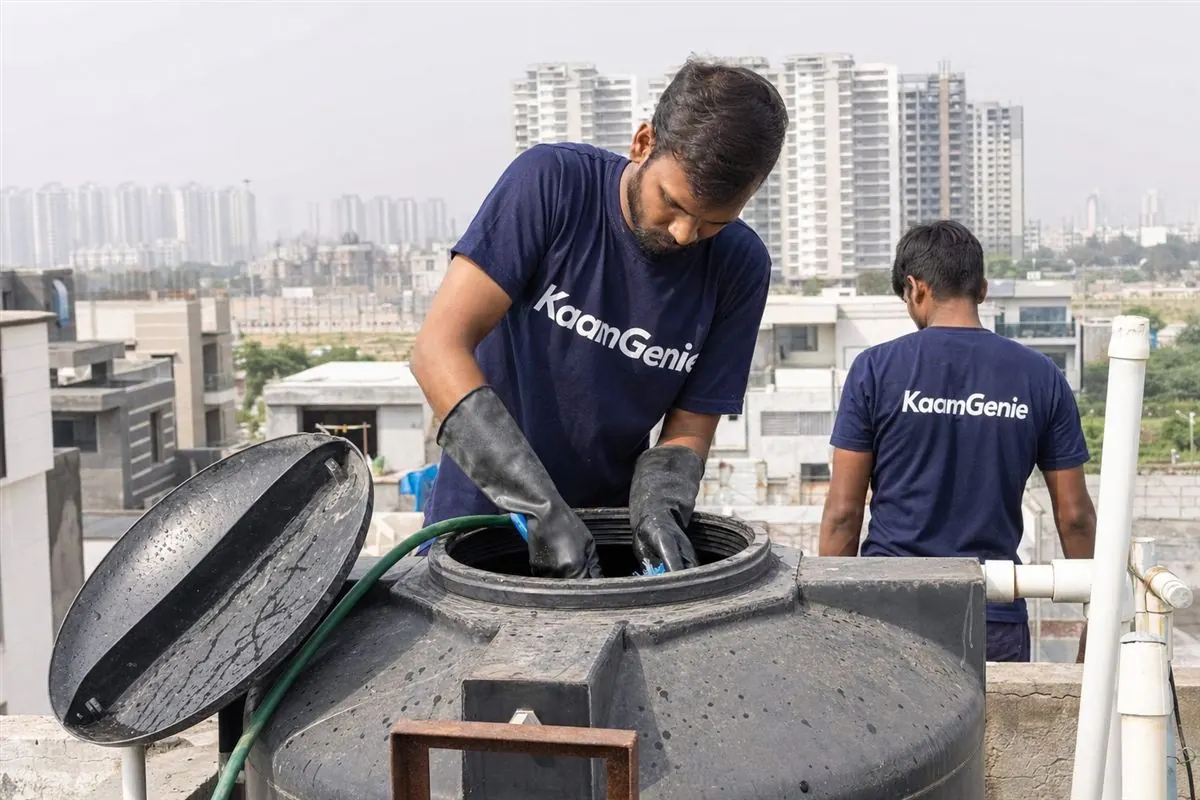
The second problem is the water itself. The groundwater across this belt is genuinely hard — high in calcium and iron — and that mineral load drops out as chalky scale and rust-coloured sediment on tank walls far faster than soft, treated water would. Tanker water adds its own load: it varies in quality depending on the source and how clean the delivery tanker is, and it is pumped straight into your reservoir carrying whatever silt it brought with it. Between deliveries, that silt settles and builds.
BIS IS 10500 and CPHEEO guidance support cleaning stored drinking-water tanks at least twice a year as a floor — but that floor is written for benign, treated water. On raw borewell and tanker supply with no treatment in the chain, a six-monthly clean means the tank is already re-scaling and silting well before the next visit. The realistic standard here is every three to four months: a quarterly rhythm that keeps the tank genuinely clean rather than clean-on-paper. For the chemistry of why hard groundwater behaves this way and what it does to tank walls, see our dedicated hard water tank cleaning guide for Noida.
Worker housing: the highest-risk tanks in the belt
There is one group in the Jewar / YEIDA corridor whose tanks deserve a special mention, because they carry the greatest risk and get the least attention: worker and labour housing. The airport works and the surrounding construction draw a large temporary and semi-permanent workforce, and almost all of it lives on shared, tanker-filled tanks and drums. These are the most heavily used storage tanks in the whole belt — dozens of people per tank — and the least maintained, often never cleaned at all between deliveries.
That combination is exactly how waterborne illness spreads. A shared tank that is filled by tanker, never disinfected, and drawn from by a large group is a textbook contamination risk. We clean and disinfect worker-housing tanks, drums and reservoirs to the same food-grade standard as any home, and we will set up a regular schedule for site contractors who want to look after the people on their sites. It is some of the most genuinely useful tank work we do anywhere in the region.
How fast a YEIDA-belt tank dirties vs a treated-mains tank
Illustrative re-soiling speed after a clean — raw borewell and tanker water with no treatment upstream builds sediment far faster
Illustrative, not measured figures — the point is the order: a new YEIDA-belt tank starts dirty and re-soils far faster on raw borewell and tanker water than a tank fed by treated mains. That is why a first clean plus a quarterly schedule is the realistic standard here.
Set up a quarterly schedule out in the YEIDA belt
On borewell and tanker water, a one-off clean doesn’t hold. We’ll do the first thorough clean, then keep your home, society or site on a fixed three-to-four-month rhythm with photos and certificates every visit.
How a clean is done out here — and how to book it
The process itself is the same thorough 8-step job we run on any tank, with extra time spent on the heavy construction sediment in new tanks: inspect and photograph, drain, hand-scoop and vacuum out the slurry and grit, scrub every wall and the floor with food-grade brushes, jet-wash the corners and fittings, vacuum the dirty rinse water, disinfect with food-grade sodium hypochlorite, refill, and hand over before/after photos and a certificate. For a society we do this for the underground reservoir and every tower’s rooftop tank, documenting each one separately so the committee can prove the whole system — not just the convenient tanks — was actually done.
We serve the whole belt, running jobs out along the Yamuna Expressway into the YEIDA sectors and the Jewar corridor, and we connect naturally to the established high-rise pockets just up the road. If your society sits in the Expressway high-rise belt at Sector 150 or Sector 168, or out towards the Greater Noida core around Pari Chowk, the same crew and the same fixed pricing apply; you can see the full area list on our Greater Noida water tank cleaning hub. The simplest way to book is through our water tank cleaning in Noida hub or a quick call — tell us your sector or society and we’ll confirm the slot. To book, call +91 95603 66362 or use the booking form on this site — we’ll confirm shortly. Residential single-tank cleaning is ₹699 onwards; society, reservoir and worker-housing work is custom-quoted after a free survey.
Frequently asked questions
Why is the Jewar and YEIDA airport belt different for water tank cleaning?
The Jewar / YEIDA corridor around the upcoming Noida International Airport is the newest growth belt in the whole region. Almost everything here was built in the last few years and is still being built, so the tanks are new and carry construction debris, and there is no large piped municipal network yet — societies, plotted homes and worker housing run on borewell groundwater and supplied tankers. New tanks plus untreated borewell and tanker water means contamination builds up fast, so the first clean at handover matters most and a regular schedule matters more here than in older, piped parts of the city.
There’s no piped water in my Jewar/YEIDA society yet — does that change anything?
Yes, it makes the tank far more important. With no treated piped supply, every drop you use is stored — borewell water pumped up into the underground reservoir and rooftop tanks, or water delivered by tanker into the same tanks. There is no treatment plant between the source and your tap; the storage tank is effectively the last barrier before your water. That means a dirty tank directly contaminates everything you drink and wash with, so on raw borewell and tanker water a clean, well-maintained tank is doing work that a treatment plant does elsewhere.
My flat is brand new — why does the tank still need cleaning?
Because new does not mean clean. During construction and plumbing commissioning, the lines are flushed and cement slurry, fine sand, grit, brick dust and pipe residue settle into the underground reservoir and rooftop tanks. The builder’s housekeeping rarely does a proper food-grade clean — a quick rinse at most. So the first residents in a new Jewar or YEIDA-sector tower are often drawing drinking water straight over a bed of construction sludge. A thorough first clean at handover clears that residue and gives the society a documented baseline.
How often should a new society in the YEIDA and Yamuna Expressway sectors clean its tanks?
Start with a full clean at handover, then clean every three to four months. BIS IS 10500 and CPHEEO guidance set a floor of at least twice a year for stored drinking-water tanks, but that floor assumes benign, treated water. The YEIDA belt runs on hard borewell groundwater and tanker deliveries with no treatment in between, which scales and silts tanks faster, so a quarterly schedule is the realistic default rather than the once-a-year minimum.
We rely on tanker water — how does that affect the tank?
Tanker water varies in quality depending on its source and how clean the delivery tanker is, and it is usually pumped straight into your underground reservoir with whatever sediment it carries. That fine silt settles to the bottom of the tank between deliveries and builds into a sludge layer over time. Because the tanker is filling the same stored tank your home draws from, the only practical control you have is keeping that tank clean — which is why tanker-fed homes and societies need a regular cleaning schedule rather than a one-off.
Do you cover worker housing and labour-camp tanks near the airport site?
Yes. The Jewar / YEIDA corridor has a large amount of temporary and semi-permanent worker housing serving the airport and construction sites, almost all of it on shared tanker-filled tanks and drums. These are among the most heavily used and least maintained tanks in the whole belt, so they carry a real waterborne-disease risk for the people relying on them. We clean and disinfect shared worker-housing tanks, drums and reservoirs to the same food-grade standard as any residential job, and can set up a regular schedule for site contractors.
Do you actually travel out to Jewar and the YEIDA sectors?
Yes. We serve the whole Noida and Greater Noida belt and run jobs out along the Yamuna Expressway into the YEIDA sectors and the Jewar / Noida International Airport corridor. For a single home we usually club the visit with other bookings in the same belt; for a society or worker-housing site we schedule a dedicated crew. The easiest way is to book through our Noida hub or call us, tell us the sector or society, and we will confirm the slot for your area.
What does the first clean of a new-construction tank involve?
The same thorough 8-step process as any tank, but with extra attention to the heavy construction sediment. We inspect and photograph, drain the tank, hand-scoop and vacuum out the cement slurry, sand and grit that has settled on the floor, scrub every wall and the floor with food-grade brushes, jet-wash the corners and fittings, vacuum the dirty rinse water, disinfect with food-grade sodium hypochlorite, and refill — then hand over before/after photos and a certificate. For a society we do this for the underground reservoir and every tower’s rooftop tank and document each one separately.
How much does it cost out in the Jewar/YEIDA belt?
Residential single-tank cleaning starts at ₹699 onwards, the same fixed pricing we use across Noida. Society work, underground reservoirs and worker-housing sites are quoted per tank by capacity and access and then totalled, after a free tank-inventory survey. Spread across the many flats or beds that share a society or site reservoir, each person’s share of a full clean is small — far cheaper than the bottled water and stomach trouble that follow a neglected tank on raw borewell and tanker supply.
Sources & references
- Bureau of Indian Standards (BIS) — IS 10500:2012 is the canonical Indian Standard for drinking water specification, defining acceptable limits for physical, chemical, and biological parameters including calcium and iron.
- WHO Guidelines for Drinking-water Quality, 4th edition — the global reference for water quality standards, including guidance on storage and disinfection.
- Food Safety and Standards Authority of India (FSSAI) — defines water quality requirements for food businesses, including hygiene standards for stored water and acceptable disinfection chemicals.
- WHO Fact Sheet on Drinking Water — overview of safe drinking water requirements and contamination risks.
- CPHEEO — Manual on Water Supply and Treatment — the Government of India’s engineering manual covering tank design, cleaning protocols, and disinfection practices.
Last verified: 30 June 2026. If you find any of these links broken, please let us know.