
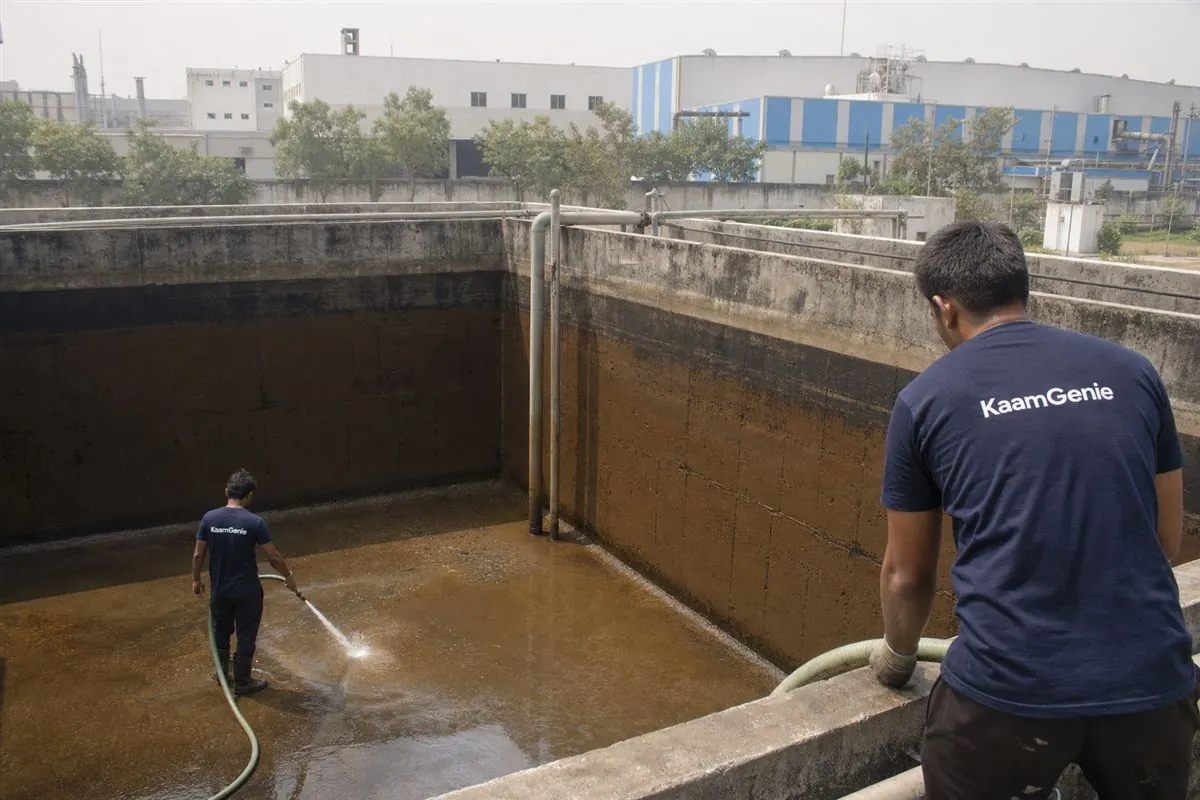
The short version for Manesar residents, societies & factories
- Manesar is an industrial-plus-residential belt — IMT factories, worker housing and new societies all rely on the same hard, tanker-fed water.
- The supply is hard borewell and tanker water, so scale and sediment build fast on tank walls and fittings.
- Most buildings store water in large underground reservoirs (UGR) the tankers fill, pumped up to rooftop tanks — the whole chain needs cleaning, not just the top.
- Worker housing, hostels and factory canteens have very high water turnover, so they need cleaning every three to four months.
- Single home from ₹699 onwards; society, UGR, worker-housing and industrial work is quoted custom after a quick survey.
If your Manesar water leaves a white-grey scale or a gritty residue, the tank is overdue — the supply is treated up to your tank, but the tank itself decides what you actually drink.
| Factor | Why it matters in Manesar / IMT | What it means for cleaning |
|---|---|---|
| Industrial + residential mix | Factories, worker housing and new societies side by side | One crew for homes, societies and industrial tanks |
| Hard borewell + tanker supply | High calcium/magnesium; little soft surface water | Faster scale; clean every 4–6 months |
| Large underground reservoirs | Tankers fill big UGRs as the first storage point | UGR collects the heaviest grit — clean it first |
| Worker housing & hostels | Very high turnover; one tank serves many people | Clean every 3–4 months on a contract |
| Industrial dust & air | More airborne grit settling into open tanks | Tighter lids + more frequent sediment removal |
Book a clean for your Manesar tank
Home, society, worker housing or factory in Manesar / IMT — we clean the full tank chain and document every job. Single home ₹699 onwards; society & industrial custom.
Manesar isn’t the rest of Gurgaon — and its tanks aren’t either
Most people picture Gurgaon as glass towers on Golf Course Road and DLF condominiums. Manesar, about 20 kilometres further down NH-48, is a different animal. This is industrial Gurgaon — the IMT (Industrial Model Township) sectors packed with auto plants, component suppliers, garment units and warehouses, ringed by the dense worker housing that keeps them running, with a steadily growing belt of residential societies and builder floors filling in between. A single locality here can have a thousand-litre rooftop tank on an independent house, a hostel block serving two hundred labourers, and a factory with a 100,000-litre underground reservoir — all within a few hundred metres.
That mix is exactly why tank cleaning in Manesar can’t be treated as a copy-paste of the rest of the city. The buildings are different, the water is harder, the storage is bigger, and the usage patterns are far more intense. Our water tank cleaning in Gurgaon crews handle all of it, but the approach for an IMT factory looks nothing like the approach for a flat on Sohna Road.
Industrial water, worker housing, and new societies all in one belt
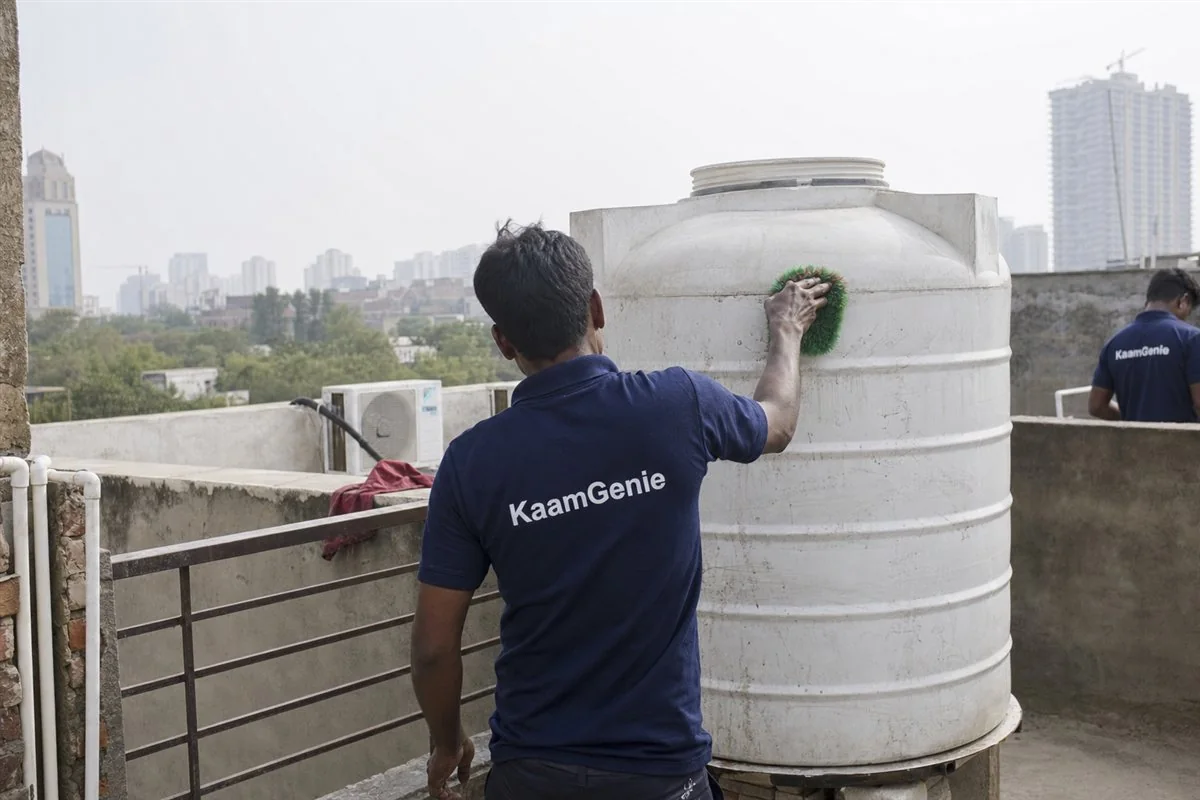
Break Manesar down by who actually owns the tanks and you get three very different jobs. Factories and warehouses in IMT store water for process use, washrooms, fire reserves and canteens — usually in big underground reservoirs topped up by tankers. The canteen and drinking-water tanks among those have to meet food-safety hygiene, so they need the same careful, food-grade approach we use for restaurants.
Worker housing and labour hostels are the most demanding residential case in NCR. One tank can serve dozens or hundreds of people, the water turns over constantly, and a single contaminated tank affects everyone downstream at once. High turnover sounds like it should keep a tank clean, but it does the opposite — it pulls a steady stream of sediment and bio-film off the walls and floor faster than a low-use tank, so these need cleaning every three to four months on a fixed schedule.
New societies and builder floors — the apartments and independent floors that have come up across the Manesar sectors and along the highway — have their own quirk: the all-important first clean. A newly handed-over building’s tanks carry construction debris, and that’s a heavier job than routine maintenance. For the full picture across the city, our complete guide to water tank cleaning in Gurgaon walks through process, frequency and pricing for each building type.
The water itself: hard, tanker-fed, and stored a long time
Manesar doesn’t sit on a generous old municipal pipeline. Its supply is a mix of treated canal water reaching parts of the belt, a great deal of borewell groundwater, and heavy reliance on private and HSIIDC tankers to fill the gaps — especially through summer. Two of those three sources are hard: loaded with dissolved calcium and magnesium, with very little soft surface water to dilute them.
Hard water leaves a white-grey scale on everything — tank walls, float valves, inlet fittings, the inside of pipes. In a soft-water area that buildup is slow; here it is fast, and it causes two problems. Scale narrows fittings and jams ball valves, and — more importantly — scale is a rough surface that bio-film grips onto, so a scaled tank gets dirty again much quicker than a smooth one. We go into the chemistry and the right cleaning method in our piece on hard water tank cleaning in Gurgaon. The short version for Manesar: the once-a-year habit most people have isn’t enough here.
There’s a second factor specific to an industrial township — the air. IMT Manesar carries more airborne dust and grit than a residential pocket, and any tank with a loose or broken lid pulls that straight in. Combine hard water, tanker-borne sediment and industrial dust, and a Manesar tank accumulates a noticeably heavier deposit than a comparable tank in central Gurgaon.
The underground reservoir is the tank that matters most
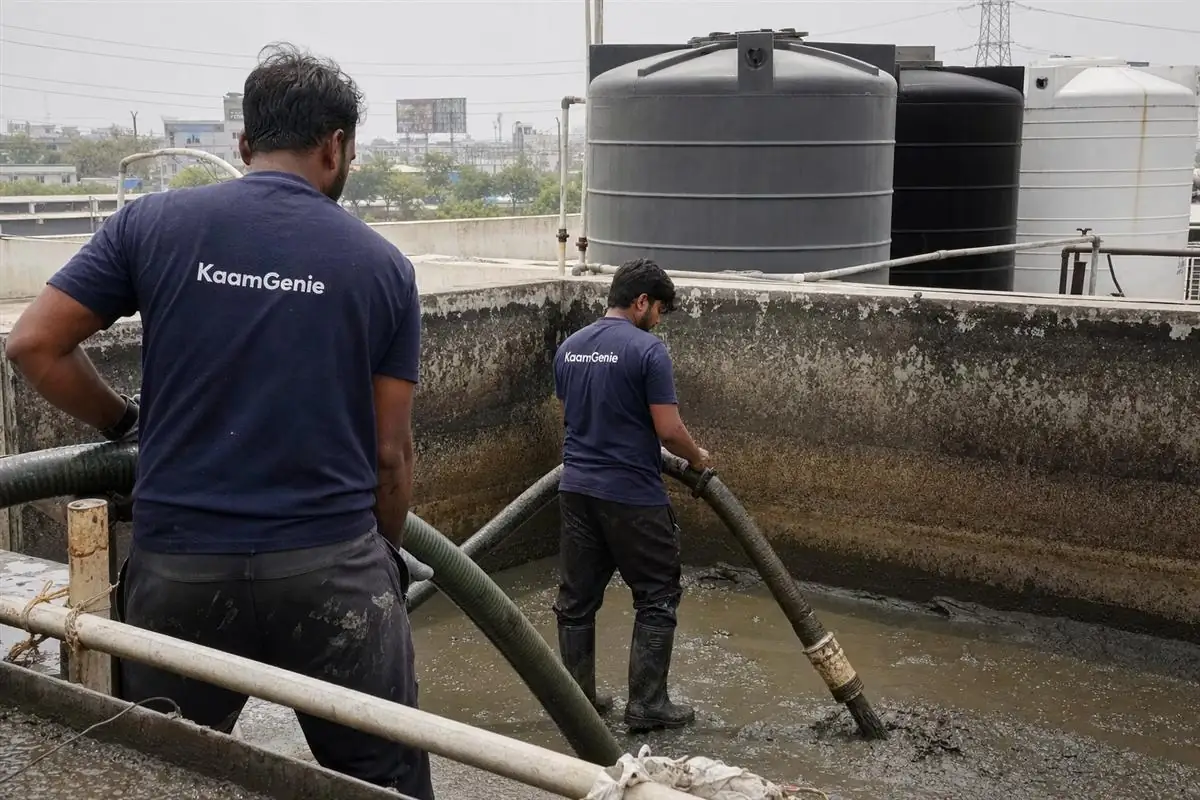
Because so much water in Manesar arrives by tanker, almost every building of any size stores it the same way: tanker or borewell water fills a large underground reservoir (UGR) — the sump — which is then pumped up to rooftop tanks and distributed from there. It’s a chain, and the single most common mistake we see is cleaning only the rooftop tank because it’s the visible one.
That doesn’t work. The UGR is the first point of storage, so it collects the heaviest grit — everything a tanker carries in settles there first. If the sump is left sitting on sediment and scale, every pump cycle lifts that contamination up into the freshly cleaned rooftop tank. A real job cleans the full chain — underground reservoir, any intermediate tanks, and the rooftop tanks — in the right order. For shared society tank farms specifically, our society water tank cleaning in Gurgaon guide explains how we sequence multi-tank buildings so no block loses supply for long.
What actually settles in a Manesar tank
People are often surprised by the before-photos, because the water looked clear at the tap. The chart below is a rough breakdown of what we typically pull out of a Manesar tank — by relative volume, weighted by the hard-water, tanker and industrial-dust reality of the belt.
What we remove from a Manesar tank — by relative volume
Hard-water scale and borewell silt dominate; bio-film is the dangerous small part
Indicative composition from cleans we’ve done across Manesar and IMT tanks — not a measured study. The exact mix varies by source, building type and how long the tank went between cleans.
Factories, hostels and canteens: cleaning around the work
The thing that makes industrial and worker-housing tanks tricky isn’t the cleaning itself — the eight-step process is the same everywhere — it’s scheduling. A factory can’t take its process water offline mid-shift, and a hostel can’t leave two hundred people without water at peak hours. So we plan around the work: we survey the tank farm, agree a window that fits the shift pattern, and stage the job tank by tank so there’s always a buffer of supply available. Canteen and drinking-water tanks get the food-grade, FSSAI-acceptable disinfection treatment, the same standard we apply to restaurant tanks — this isn’t a place to cut corners on chemicals.
For sites that want the cleaning handled without anyone having to remember to book it, an annual contract is the sensible route. We cover how those work — scheduling, per-tank certificates and consolidated audit reports — in our water tank cleaning AMC in Gurgaon guide. Across NCR more broadly, you can see the full scope of our water tank cleaning services on the main services page.
Where we work around Manesar
We cover the whole Manesar belt and the sectors that connect it to the rest of the city — IMT industrial pockets, the worker-housing clusters, and the residential societies and builder floors in and around the Manesar sectors. The same crew and the same fixed pricing extend up the corridor too: into New Gurgaon and its new high-rise sectors, the SPR pocket around Sector 82, and across to Sohna Road. For the full menu of services across the city — residential, society, UGR, commercial and industrial — start at the hub for water tank cleaning in Gurgaon.
Get a survey for your factory or society tank farm
UGR + rooftop tanks, canteen and worker-housing tanks, staged around your shifts with per-tank certificates. One consolidated quote for IMT Manesar units and societies.
Clean water in Manesar, whatever the building
Manesar runs on stored water more than almost anywhere else in Gurgaon — hard, tanker-fed, sitting in big reservoirs that feed everything from a single family to an entire factory floor. That makes the tank, not the source, the thing that decides whether the water is safe. The fix is the same whether you own one rooftop tank or manage a whole IMT tank farm: clean the full chain properly, then keep it on a schedule that respects how hard and how heavily used the water here really is. Start at the hub for water tank cleaning in Gurgaon and we’ll take it from there — survey, fixed quote, certificates, done.
To book, call +91 95603 66362 or use the booking form on this site — we’ll confirm shortly.
Frequently asked questions
Where exactly do you clean around Manesar and IMT Manesar?
Across the whole Manesar belt — IMT Manesar industrial sectors, the factory and warehouse clusters along NH-48, the worker housing and labour hostels, and the newer residential societies and builder floors that have come up in and around Sector 1 to Sector 8 Manesar and along the highway towards New Gurgaon. We clean residential, society, commercial and industrial tanks with the same trained crew and proper documentation.
We run a factory in IMT Manesar — can you clean our industrial and canteen water tanks?
Yes. Industrial units are a big part of our Manesar work. We clean large underground reservoirs, overhead process and utility tanks, and the canteen and drinking-water tanks that have to meet food-safety hygiene. We work around shift timings so production isn’t disrupted, stage the job tank by tank, and hand over a cleaning certificate and before/after photos per tank for your records and any audit.
Why does Manesar need tank cleaning more often than central Gurgaon?
Two reasons. First, the supply is hard — Manesar leans on borewell groundwater and tankers, both high in dissolved calcium and magnesium, which scale tank walls and fittings fast. Second, it is an industrial belt, so there is more airborne dust and grit settling into tanks. Hard scale is also where bio-film grips, so a Manesar tank gets dirty again quicker than a soft-water tank — every four to six months is a sensible schedule here, not once a year.
We manage worker housing and labour hostels — how often should those tanks be cleaned?
More often than ordinary homes, because the water turnover is very high and the same tank serves a lot of people. We recommend cleaning worker-housing and hostel tanks every three to four months. High usage means heavier sediment load and faster bio-film build-up, and a single contaminated tank can affect dozens of residents at once. A regular schedule with certificates is the responsible setup, and it works out cheaper per head than people expect.
Manesar gets canal and treated water now — why clean the tank if the supply is treated?
Treatment only controls the water up to your tank. Whatever the source — NCR canal supply, borewell or tanker — once water sits in a storage tank it picks up sediment, scale and bio-film from the tank walls and floor, and from dust entering through a loose lid. Disinfectant from the source dissipates within hours. So the cleanliness of the water you actually drink depends on the cleanliness of the tank, not just the treatment plant. That is why even treated supply needs a clean tank to stay safe.
Do you clean the large underground reservoirs that the tankers fill?
Yes — the big underground reservoirs (UGR) are usually the most important tanks to clean in Manesar. Because so much of the supply arrives by tanker, the UGR is the first point of storage and collects the heaviest sediment and tanker-borne grit. We clean the full chain — underground reservoir, any intermediate tanks, and the rooftop tanks they feed — because cleaning only the overhead tank while the dirty sump keeps pumping up to it just re-contaminates the clean water.
How often should a new society along NH-48 in Manesar clean its tanks?
For a newly handed-over society, the very first clean matters most because the tanks carry construction debris — cement slurry, sand and pipe shavings — from the build. After that first clean, twice a year is the baseline, and every four months is better given Manesar’s hard, tanker-fed supply and the dust of an industrial area. The underground reservoir usually needs the most attention. We give each tank its own certificate so the RWA or AOA has a clear audit trail.
Do you clean the small rooftop tanks on builder floors and independent houses in Manesar?
Yes. Plenty of Manesar is independent houses and builder floors with a single overhead plastic tank, and those are our bread-and-butter residential jobs. The full process is the same — drain, scoop the sediment, scrub the walls with food-grade brushes, jet-wash, vacuum and disinfect with food-grade chlorine — just scaled to a smaller tank. A standard residential clean starts at ₹699 onwards and takes about 75 to 90 minutes.
What does water tank cleaning cost in Manesar?
A single residential overhead tank starts at ₹699 onwards. Society, underground-reservoir, worker-housing and industrial work is quoted custom after a quick survey, because the price depends on tank count, capacity and access rather than a flat rate. We give a fixed written quote before we start, so there are no surprises on the invoice — and for societies and factories we provide one consolidated quote covering all the tanks.
Can you clean all the tanks for a whole industrial unit or society in one contract?
Yes, and that is the most cost-effective way to do it. We survey the full tank farm, give a per-tank schedule and a single consolidated quote, then stage the work so each block or section is down for the shortest possible window. You get individual certificates per tank, before/after photos and a consolidated report. Many Manesar factories and societies fold this into an annual maintenance contract so the cleaning happens on schedule without anyone having to chase it.
Sources & references
- Bureau of Indian Standards (BIS) — IS 10500:2012 is the canonical Indian Standard for drinking water specification, defining acceptable limits for physical, chemical, and biological parameters.
- WHO Guidelines for Drinking-water Quality, 4th edition — the global reference for water quality standards, including guidance on storage and disinfection.
- Food Safety and Standards Authority of India (FSSAI) — defines water quality requirements for food businesses, including hygiene standards for stored water and acceptable disinfection chemicals.
- WHO Fact Sheet on Drinking Water — overview of safe drinking water requirements and contamination risks.
- CPHEEO — Manual on Water Supply and Treatment — the Government of India’s engineering manual covering tank design, cleaning protocols, and disinfection practices.
Last verified: 29 June 2026. If you find any of these links broken, please let us know.