
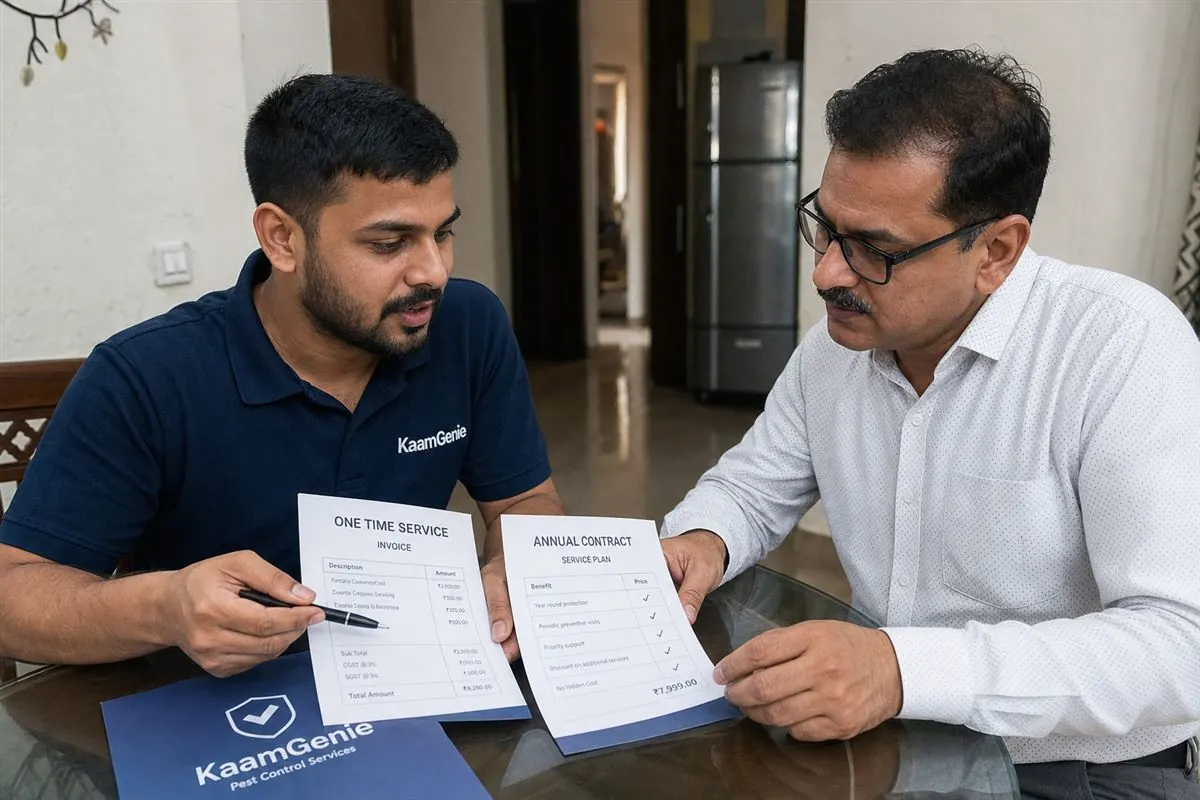
Quick answer — one-time vs AMC pest control in Delhi (2026)
- One-time treatment (2026): a single service from ₹999 (general/home), with a short warranty window. Best when the problem is a one-off and your home isn’t a magnet for pests.
- AMC (annual maintenance contract): from ₹2,999 a year — quarterly visits plus free re-treatment between visits if pests come back. Best when the problem keeps returning.
- The maths: if you call out a service 3–4 times a year anyway, the AMC is cheaper. If you genuinely need it once a year, the one-off wins.
- Get an AMC if: you run a restaurant or kitchen, live in a society with shared walls, are on the ground floor or near a park/drain, or keep seeing the same pest come back.
- Skip the AMC if: you had a single flare-up, live in a higher floor with a tight, dry flat, and rarely see anything.
- GST 18% extra on both. No honest service promises a pest-free home forever — an AMC manages the problem, it doesn’t cure your building. We cover all of Delhi.
The real question isn’t price — it’s how often the pest comes back
Before you compare the ₹999 one-off with the ₹2,999 AMC, stop and answer one thing: is your pest problem a one-time accident, or does it keep coming back? That single answer decides everything. A family in a fourth-floor flat in Mayur Vihar who saw three cockroaches after a kitchen renovation has a one-time problem. A restaurant in Connaught Place, a ground-floor flat in Lajpat Nagar backing onto a drain, or a society block in Dwarka where the neighbour’s kitchen is on the other side of your wall — those are recurring problems by their very nature. No single spray fixes a recurring problem, because the pests aren’t really gone; they’re next door, or in the shared shaft, waiting to walk back in.
So the choice between a one-time treatment and an annual maintenance contract isn’t about being a careful spender or a careless one. It’s about matching the tool to the problem. Pay once for a one-off problem; pay for a year of coverage for an ongoing one. Everything below is just me showing you which is which, with Delhi numbers, so you don’t overpay for protection you don’t need — or underpay and end up calling out three separate times in a year for the same roaches.
What a one-time treatment actually gets you
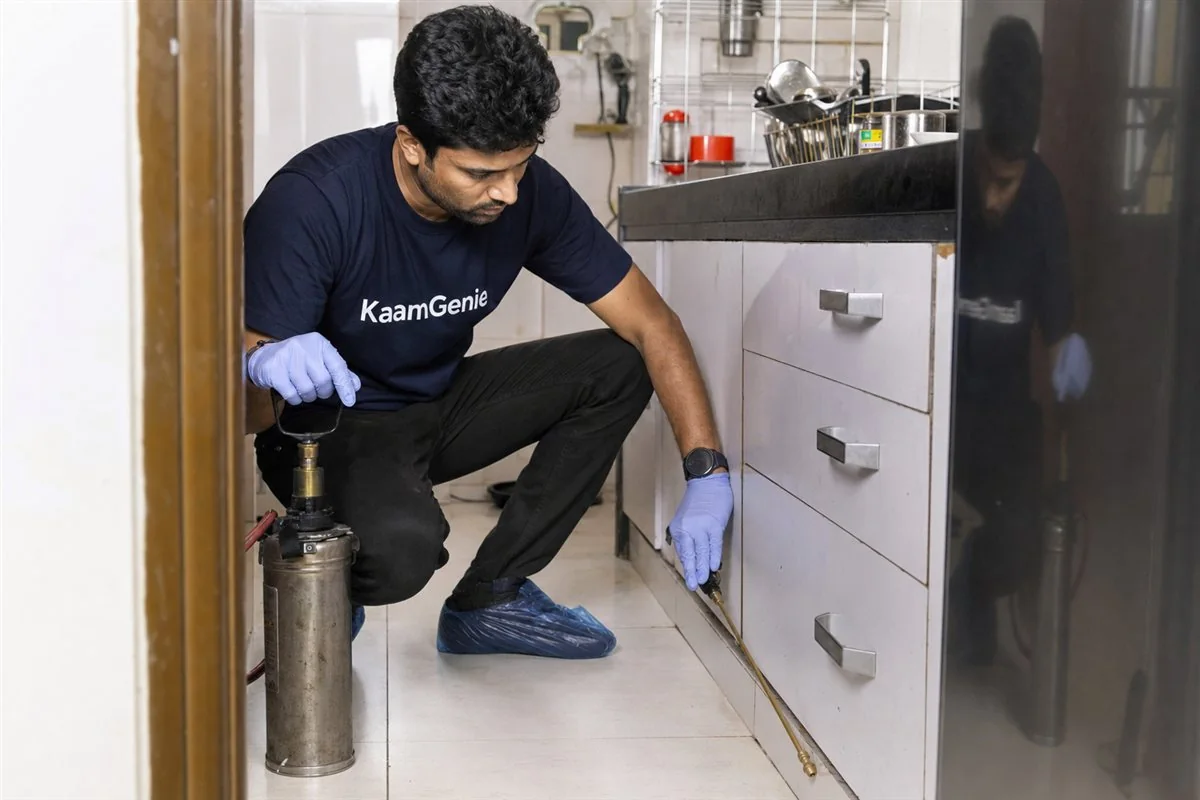
A one-time pest control service in Delhi starts at ₹999 for general/home treatment (a cockroach gel-bait job starts lower, from ₹599; a rodent job from ₹999; mosquito from ₹699). For that, a technician comes once, treats your home properly — gel bait in the kitchen, residual spray on resting surfaces, whatever your pest needs — and leaves you with a short warranty window, usually somewhere between 15 and 45 days depending on the pest and the package. If the pest reappears within that window, a good service comes back free. After it lapses, you’re on your own until you book again.
For a genuinely one-off problem, this is the right call and I’ll tell you so on the phone. You don’t need a year-long contract because you don’t have a year-long problem. The trap is using one-offs to manage a recurring problem — calling out a ₹999 service every few months because the same cockroaches or rats keep coming back. Do that three or four times in a year and you’ve quietly spent ₹3,000–₹4,000 in scattered call-outs, with no continuity, no record of what was used, and a fresh warranty clock each time. That is exactly the situation an AMC is built for.
| What you get | One-time treatment | Annual AMC |
|---|---|---|
| Starting price (2026) | From ₹999 | From ₹2,999 / year |
| Number of visits | One | Quarterly (4 a year), scheduled |
| Re-treatment if pests return | Only inside the warranty window | Free between visits, all year |
| Coverage | The pest you booked for | Usually multiple common pests in one plan |
| Records | One GST invoice | GST invoice + audit-ready records of every visit |
| Best for | A genuine one-off flare-up | A problem that keeps coming back |
What an AMC actually includes (and what it doesn’t)
An annual maintenance contract from ₹2,999 a year is not a magic shield — it’s a schedule plus a safety net. Here’s what a real AMC in Delhi gives you, and I’m spelling it out because some operators are vague on purpose.
- Quarterly scheduled visits. Four treatments a year, roughly one every three months, timed so you’re covered through the seasons — the monsoon mosquito-and-cockroach surge, the winter rodent push indoors, the lot. You don’t have to remember to book; they come to you.
- Free re-treatment between visits. This is the part that earns the contract its keep. See a roach in week six, well before the next scheduled visit? You call, they come back, you pay nothing. With one-offs that same call-out is another ₹999.
- Multiple pests under one plan. A typical home AMC covers the common crowd — cockroaches, ants, mosquitoes, general crawling insects — rather than just the one pest you happened to book. Specialised jobs like termite treatment, bed bugs or heavy rodent work are often add-ons; ask exactly what’s in and what’s extra before you sign.
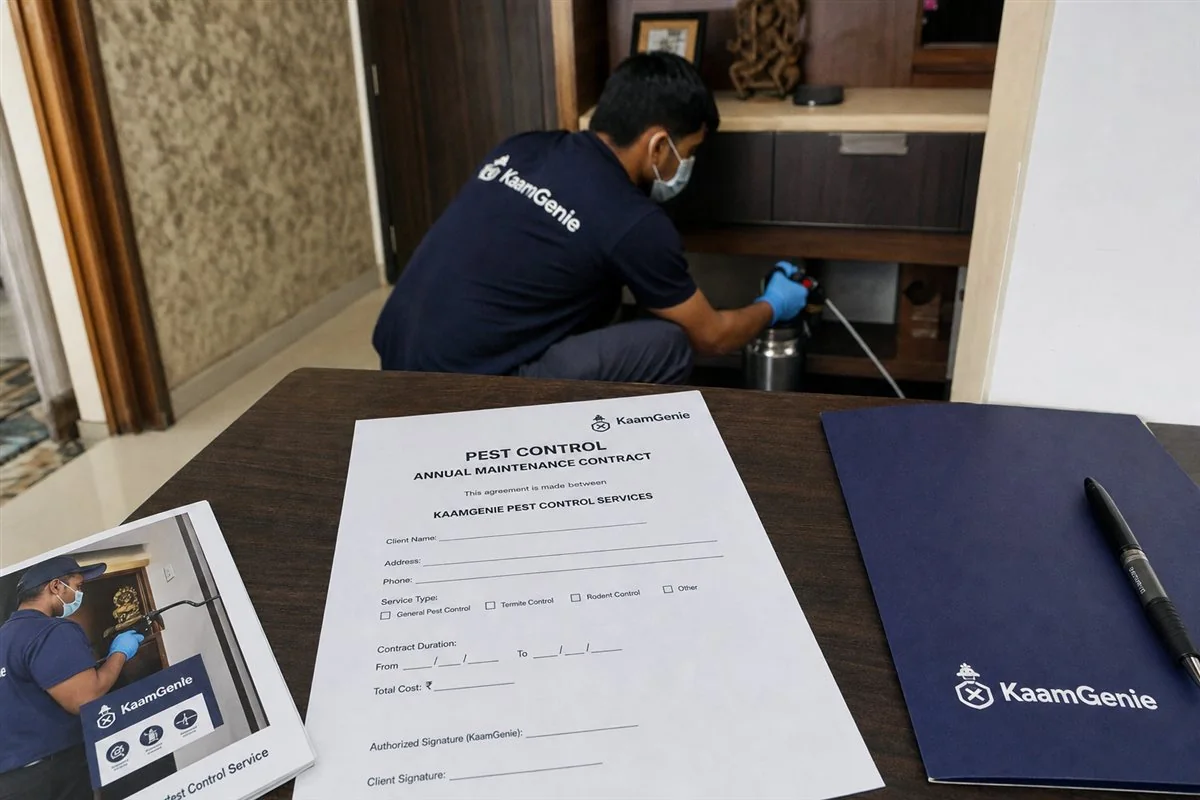
- Proper records. Every visit is logged. You get a GST invoice and audit-ready records of what was treated and when — which matters enormously if you’re a restaurant facing an FSSAI inspection, or an RWA answerable to residents.
And the honest limits: an AMC does not make your home pest-proof forever. If you live on a ground floor next to a park, mosquitoes will keep arriving; the AMC keeps knocking them back, it doesn’t seal your building. It also won’t fix the structural stuff — the gap under your door, the broken drain cover, the food left out overnight. A good technician will point those out, but the contract treats pests; it doesn’t renovate your flat. Anyone promising a “100% pest-free guarantee for a year” is overselling, and you should read that as a warning sign, not a feature.
Not sure which one fits your home?
Tell us your floor, your pest and how often it comes back — we’ll recommend the one-off (₹999) or the AMC (₹2,999/year) honestly, with no pressure. GST 18% extra.
The honest maths: when the AMC actually saves you money
Let’s do the sums properly, because this is where most articles wave their hands. The break-even is simple. An AMC is ₹2,999 a year. A one-off is ₹999. So the AMC starts paying for itself the moment you’d otherwise call out a service three times in a year — three one-offs is ₹2,997, basically the same money, but you get four visits plus unlimited free re-treatments instead of three disconnected sprays. Call out four or more times and the AMC is comfortably cheaper, and far less hassle.
Work it the other way and the one-off wins clearly: if you truly only need pest control once this year, paying ₹2,999 for an AMC to use one visit makes no sense — pay the ₹999 and move on. The grey zone is two call-outs a year (₹1,998 in one-offs versus ₹2,999 AMC); there the one-off is cheaper on paper, but the AMC buys you the free re-treatments and the records, which may be worth the extra ₹1,000 if your problem is unpredictable. Here’s how a typical year looks for three kinds of Delhi home.
| Your situation | Pay-per-call (one-offs) | AMC for a year | Better choice |
|---|---|---|---|
| Higher-floor flat, one flare-up all year | 1 × ₹999 = ₹999 | ₹2,999 | One-time |
| Average home, two call-outs a year | 2 × ₹999 = ₹1,998 | ₹2,999 | Either — depends on hassle |
| Ground floor near park/drain, recurring | 4 × ₹999 = ₹3,996 | ₹2,999 (+ free re-visits) | AMC |
| Restaurant / busy kitchen | 6+ × ₹999 = ₹5,994+ | Custom AMC, scheduled | AMC, clearly |
The chart below is the same idea in one glance — what a recurring-problem home spends across a year if it keeps paying per call-out, versus taking the AMC. Once you’re calling someone out every quarter anyway, the contract is the cheaper and calmer option.
A recurring-problem Delhi home: pay-per-call vs AMC over one year (2026)
What you spend if the same pest keeps coming back and you keep booking one-offs, versus one AMC.
If you want the full breakdown of what drives an AMC price up or down — home size, number of pests, how many visits — we’ve set it out separately in our pest control AMC cost guide for Delhi. It’s the companion to this page when you’ve decided an AMC is right and want to sanity-check the quote.
Who should get an AMC in Delhi (and who genuinely shouldn’t)
This is the part I’d give a friend over chai, so let me be blunt about both sides.
Get an AMC if you’re any of these:
- You run a restaurant, cafe, cloud kitchen or food business. This isn’t optional, really. Food premises attract pests constantly, and FSSAI expects a documented, ongoing pest-control programme — not a spray when the inspector is at the door. An AMC gives you the scheduled visits and the audit-ready records that keep your licence clean. Pay-per-call simply doesn’t cut it here.
- You live in a society or apartment with shared walls and shafts. Your cockroaches and rats treat the whole building as one home, travelling through common pipes and the rubbish chute. Treating only your flat while the block is untreated is a losing game — which is exactly why a building-wide contract works better. We’ve written a full guide to society and RWA pest control AMCs in Delhi if you’re on the committee.
- You’re on the ground floor, or near a park, drain, nullah or open plot. Mosquitoes, rodents and crawling insects have a constant supply line. You’ll be calling someone every season anyway, so lock in the AMC.
- The same pest keeps coming back no matter what you do. Recurring is the whole definition of an AMC problem. Stop paying per panic.
Skip the AMC — and just take a one-off — if:
- You had a single, explainable flare-up. Roaches after a renovation, ants after you left fruit out, a mouse that wandered in once. Treat it, fix the cause, move on.
- You’re on a higher floor in a tight, dry, well-sealed flat and genuinely rarely see anything. A yearly preventive one-off is plenty.
- Your problem is a one-time specialist job — say a termite treatment (from ₹2,499) with its own multi-year warranty, or a bed-bug clearance (from ₹1,299 a room). Those are project-priced, not really AMC territory.
Want the AMC maths for your exact flat?
Send us a photo of the problem on WhatsApp and we’ll quote the right plan — quarterly visits plus free re-treatment in between.
How to read an AMC quote without getting stung
If you’ve decided an AMC makes sense, don’t just sign the first ₹2,999 number you’re shown. Ask these five questions and you’ll separate a real plan from a flimsy one:
- How many visits, and are they scheduled or on-call? A proper AMC is quarterly at minimum, booked in advance, not “call us if you see something.”
- Is re-treatment between visits actually free, and unlimited? Get it in writing. This is the clause that makes the contract worth more than scattered one-offs.
- Which pests are covered, and which are add-ons? Cockroaches, ants and mosquitoes are usually in. Termites, bed bugs and serious rodent-proofing are often extra — know before you sign, not after.
- What records do I get? You want a GST invoice and audit-ready records of every visit — essential for food businesses and societies. (No legitimate firm hands out a “certificate” that means nothing; insist on real, dated records of work done.)
- What products, and are they safe for my home? Licensed services use CIB&RC-approved chemicals at the correct dose. Tell them about kids, pregnant women, asthmatics, fish and pets, and a good team will plan around them.
One last bit of plain advice. The cheapest AMC isn’t always the best, and the dearest isn’t always thorough. What you’re really buying is reliability — someone who turns up on schedule, comes back fast when you call, uses the right products, and keeps honest records. Judge the contract on those, not on a single headline price. If you want the wider context on what every pest job costs in this city, our pest control cost guide for Delhi 2026 lays out the full price list.
So — one-time or AMC? The short version
If your pest problem is a one-off and your home isn’t a magnet for them, take the one-time treatment from ₹999, fix whatever caused it, and don’t pay for protection you won’t use. If the same pest keeps coming back — because you run a kitchen, share walls with neighbours, sit on the ground floor, or back onto a drain or park — take the AMC from ₹2,999 a year, because you’d spend more than that in scattered call-outs anyway and get far less peace of mind. The maths almost always agrees with common sense once you’re honest about how often the problem returns. We serve homes, societies and businesses across Delhi — from Dwarka, Janakpuri and Rohini to Saket, Lajpat Nagar and Greater Kailash to Mayur Vihar, Preet Vihar and Laxmi Nagar, plus Central and North Delhi. Coming soon: Gurgaon, Noida, Faridabad and Ghaziabad. Call 95603 66362 and we’ll tell you, honestly, which one your home actually needs.
Frequently asked questions
Is a pest control AMC worth it in Delhi in 2026?
It depends on how often your problem comes back. An AMC costs from ₹2,999 a year for quarterly visits plus free re-treatment, while a one-off is from ₹999. If you’d call out a service three or more times in a year — common for restaurants, ground-floor flats and societies — the AMC is cheaper and far less hassle. If you genuinely need pest control only once, the one-off wins.
What is the difference between one-time pest control and an AMC?
A one-time treatment is a single visit (from ₹999) with a short warranty window, usually 15–45 days. An AMC (annual maintenance contract, from ₹2,999/year) gives you quarterly scheduled visits across the year plus free re-treatment any time pests return between visits, and usually covers several common pests rather than just one.
How much does a pest control AMC cost in Delhi in 2026?
A residential AMC starts from around ₹2,999 a year for a typical flat, covering quarterly visits and free re-treatment between them. Price rises with home size, the number of pests covered and how many visits you want. Restaurants and societies are quoted custom. GST 18% is extra on all of it.
How many visits does a pest control AMC include?
A standard residential AMC includes quarterly visits — four scheduled treatments a year, roughly one every three months — timed across the seasons. On top of that, you get free re-treatment any time a covered pest reappears between scheduled visits, which is the part that makes the contract worth more than scattered one-offs.
When does an AMC become cheaper than paying per call-out?
At about three call-outs a year. Three one-off treatments cost roughly ₹2,997 (3 × ₹999), almost the same as a ₹2,999 AMC — but the AMC gives you four scheduled visits plus unlimited free re-treatments instead of three disconnected sprays. Call out four or more times a year and the AMC is comfortably cheaper.
Who should get a pest control AMC in Delhi?
Restaurants and food businesses (FSSAI expects an ongoing documented programme), societies and apartments with shared walls and shafts, ground-floor flats near a park, drain or open plot, and anyone whose pest problem keeps coming back. These are recurring situations where a single spray never holds, so a year of scheduled coverage makes sense.
Who should NOT bother with an AMC?
If you had a single explainable flare-up — roaches after a renovation, ants after leaving food out, a mouse that wandered in once — and you live in a tight, dry, higher-floor flat where you rarely see anything, just take a one-time treatment from ₹999, fix the cause and move on. Paying ₹2,999 to use one visit makes no sense.
Does an AMC cover all pests, including termites and bed bugs?
Usually a home AMC covers the common crowd — cockroaches, ants, mosquitoes and general crawling insects. Specialised jobs like termite treatment (from ₹2,499, with its own multi-year warranty) and bed-bug clearance (from ₹1,299 a room) are typically project-priced add-ons rather than part of the standard AMC. Always confirm what’s included before you sign.
Is re-treatment really free under an AMC?
Under a proper AMC, yes — if a covered pest reappears between your scheduled quarterly visits, the technician comes back at no extra charge. Get this clause in writing, and check whether it’s unlimited. It’s the single most valuable part of an AMC, because with one-offs that same call-back would cost you another ₹999.
Does an AMC guarantee a pest-free home?
No, and be wary of anyone who promises it. An AMC manages and suppresses pests with scheduled treatment and quick re-visits — it doesn’t seal your building or fix structural gaps under doors and drains. If you’re on a ground floor next to a park, pests will keep arriving and the AMC keeps knocking them back. Anyone guaranteeing a 100% pest-free year is overselling.
What records should I get with an AMC?
You should receive a GST invoice and audit-ready records of every visit — what was treated, with what, and when. This matters most for restaurants facing FSSAI inspections and for RWAs answerable to residents. Insist on real, dated records of the work done rather than a vague piece of paper.
Is AMC pest control safe for children and pets?
When done properly, yes. Licensed services use CIB&RC-approved products at the correct dose. Tell the technician in advance about children, pregnant women, asthmatics, fish tanks and pets, vacate treated rooms for the time advised, and ventilate afterwards. A team that won’t walk you through safety on a recurring contract is one to avoid.
Let’s pick the right plan for your home
One-off from ₹999 or AMC from ₹2,999/year — we’ll recommend honestly based on your floor, your pest and how often it returns. We cover all of Delhi.
Sources & references
- Food Safety and Standards Authority of India (FSSAI) — sets the food-premises hygiene and pest-management expectations behind why restaurants need an ongoing AMC.
- Central Insecticides Board & Registration Committee (CIB&RC) — the Indian regulator that approves the insecticides and doses used in licensed AMC treatments.
- National Centre for Disease Control (NCDC) — tracks urban pest and vector patterns across Indian cities including Delhi.
- Indian Council of Medical Research (ICMR) — publishes research on integrated pest management and the limits of one-off chemical control.
Last verified: 12 June 2026. If you find any of these links broken, please let us know.