
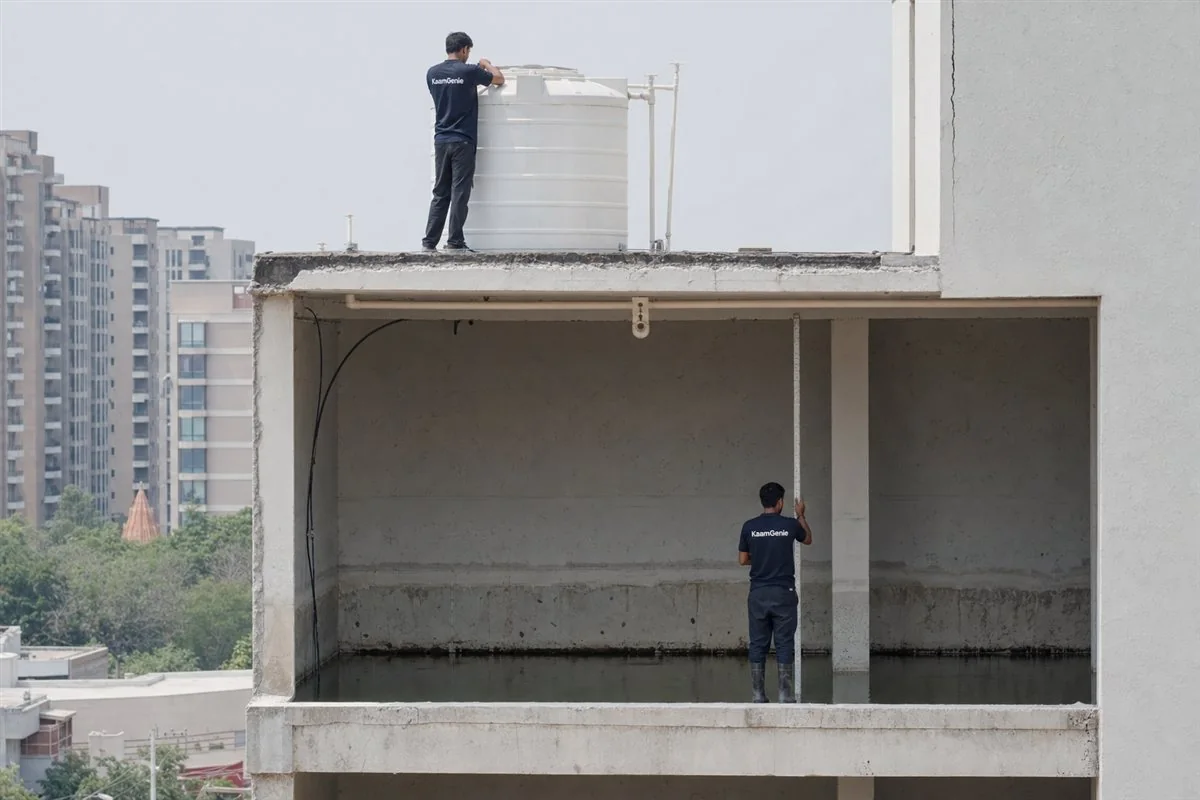
The short version
- In Gurgaon, the underground reservoir (UGR / sump) is almost always dirtier than the rooftop overhead tank (OHT).
- The UGR is the first point of storage — tanker water and hard borewell water dump their silt here, and it settles to the floor.
- Always clean the underground tank first, then the overhead tank — otherwise you refill a clean rooftop tank with dirty water.
- Underground cleaning is a confined-space job: more time, more equipment, more safety, and usually a higher price.
- Clean both every 4–6 months; tanker-fed buildings should do the UGR even more often.
Most people in Gurgaon picture “tank cleaning” as a man on the roof scrubbing a black Sintex tank. That is half the picture. The other half is hidden below your feet — a large concrete underground reservoir, often holding several thousand litres, that every drop of your water passes through before it is pumped up to the roof. If you only ever clean the rooftop tank, you are cleaning the cleaner of the two and ignoring the one that does the real dirty work. This guide explains how overhead and underground tanks differ in a typical Gurgaon home, builder floor or society, and why the order you clean them in matters as much as the cleaning itself. If you just want a crew to handle it, here is our water tank cleaning in Gurgaon.
Why almost every Gurgaon building stores water twice
Gurgaon — the Millennium City — grew faster than its piped water network. Across DLF colonies, the Golf Course Road and Golf Course Extension condominiums, Sohna Road, the Southern Peripheral Road and the new Dwarka Expressway towers, supply is a mix of HUDA/GMDA piped water, hard borewell groundwater, and a very large quantity of water delivered by private water tankers. None of that arrives at a steady, reliable pressure that could feed taps directly.
So buildings store. Incoming water — from the pipe, the borewell or the tanker — first fills a large underground reservoir (UGR), also called the sump, usually a concrete chamber sunk into the ground near the gate or basement. A pump then lifts that water up to the overhead tanks (OHT) on the roof, and gravity sends it down to your taps. This two-stage setup is near-universal here, from independent builder floors in Sushant Lok to 30-storey towers in Sector 82 and New Gurgaon. It is reliable — but it means there are two very different tanks to keep clean.
| Factor | Overhead tank (OHT) | Underground reservoir (UGR / sump) |
|---|---|---|
| Position in supply | Second — fed by pump from UGR | First — receives tanker / borewell / pipe water |
| Main contamination | Calcium scale, bio-film, algae | Heavy silt, sand, sludge, settled sediment |
| Typical size | 500–2,000 L (home), larger in towers | Several thousand to tens of thousands of litres |
| Access | Open rooftop, easy lid | Confined space, narrow opening, below ground |
| Safety needs | Standard care | Ventilation, lighting, spotter, no solo entry |
| Time to clean | 75–90 minutes | 2–2.5 hours (society UGR: 3–5 hrs) |
| Cleaning order | Second | First |
Get both tanks cleaned in the right order
Underground reservoir first, overhead tank second, in one coordinated Gurgaon visit. Before/after photos and a cleaning record. ₹699 onwards for a standard residential tank; UGR and society quoted custom.
Why the underground reservoir is the dirtier of the two
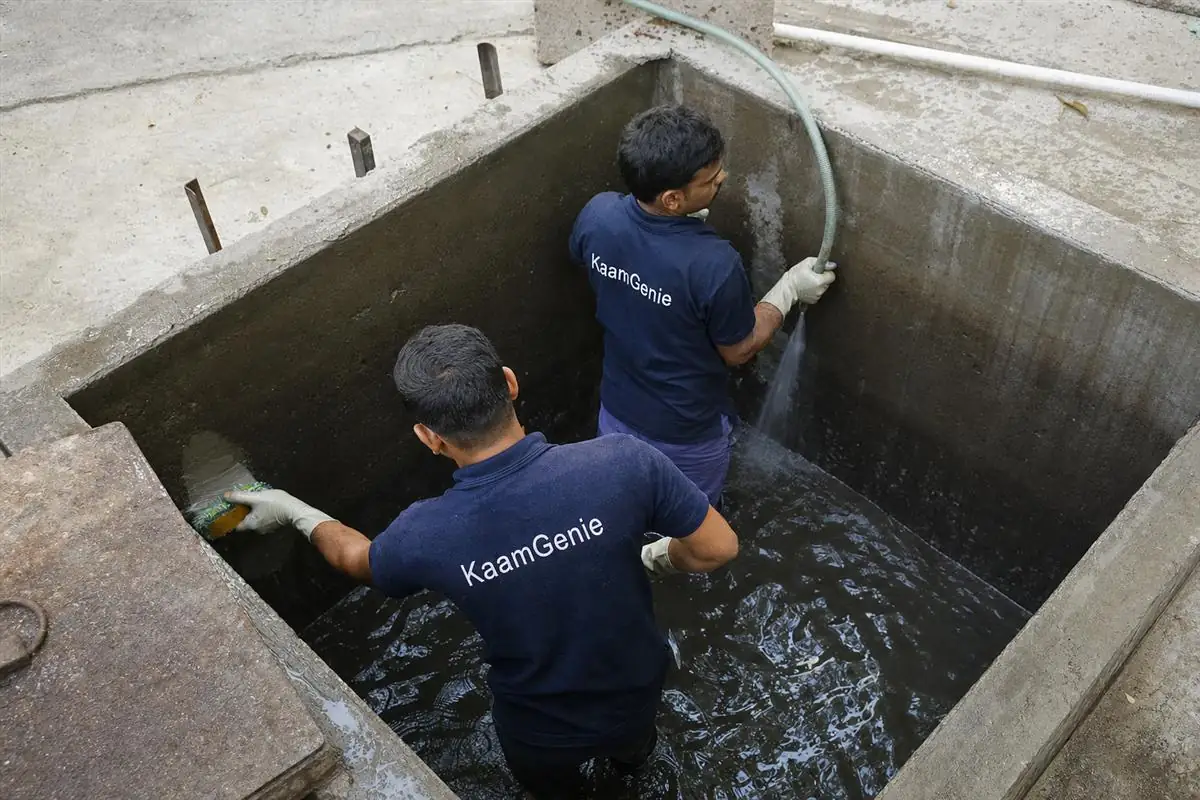
Here is the physics of it. The UGR is the first place incoming water lands. Tanker water in Gurgaon varies a lot in quality and frequently carries suspended silt; borewell groundwater here is hard and sandy. When that water sits in the underground chamber, even briefly, the heavier particles obey gravity and sink. The reservoir effectively behaves like a settling tank: the dirt drops to the bottom, and the relatively clearer water near the top is what the pump draws up to the roof.
That is why, when we open a neglected UGR in Gurgaon, we routinely find a thick layer of grey-brown sludge across the floor — sometimes several centimetres of silt, sand and organic matter — plus slimy bio-film on the lower walls. The overhead tank fed by that same supply is usually noticeably cleaner, because it received water that had already left most of its silt behind below. The OHT’s problems are different: it sits warm on the roof, the water is fairly still, so it grows more calcium scale, algae near any light gap, and bio-film. Both need cleaning — but they are dirty in different ways, and the UGR carries the bigger load. Our dedicated guide on underground sump cleaning in Gurgaon goes deeper on the sump itself.
The hard-water angle matters too. Gurgaon’s groundwater is mineral-heavy, and that hardness shows up differently in each tank. In the UGR it mostly arrives as sediment; in the OHT it slowly deposits as scale on walls and around the inlet and outlet. If your water has ever looked cloudy or left white deposits, our note on hard water and tank cleaning in Gurgaon explains what is actually happening.
The order that matters: underground first, overhead second
This is the single most important point in this article, and the one corner-cutters get wrong. Because the overhead tank is filled by pumping water up from the underground reservoir, the cleaning sequence is not optional:
- Clean the underground reservoir first. Drain it, remove the sludge, scrub, jet-wash, vacuum, disinfect.
- Then clean the overhead tank. Drain, scrub, disinfect.
- Then refill the OHT from the now-clean UGR.
If you reverse this — clean the rooftop tank first, then run the pump — you drag dirty water and freshly disturbed sediment out of the UGR and push it straight up into the tank you just finished cleaning. Within a day the rooftop tank is cloudy again and the customer rightly feels cheated. We have been called to re-do exactly this kind of botched job in Sushant Lok and DLF more than once. A crew that cleans only the roof and never asks about the sump is, frankly, not thinking about your water — it is thinking about finishing quickly.
Confined-space safety: the real reason UGR cleaning is a different job
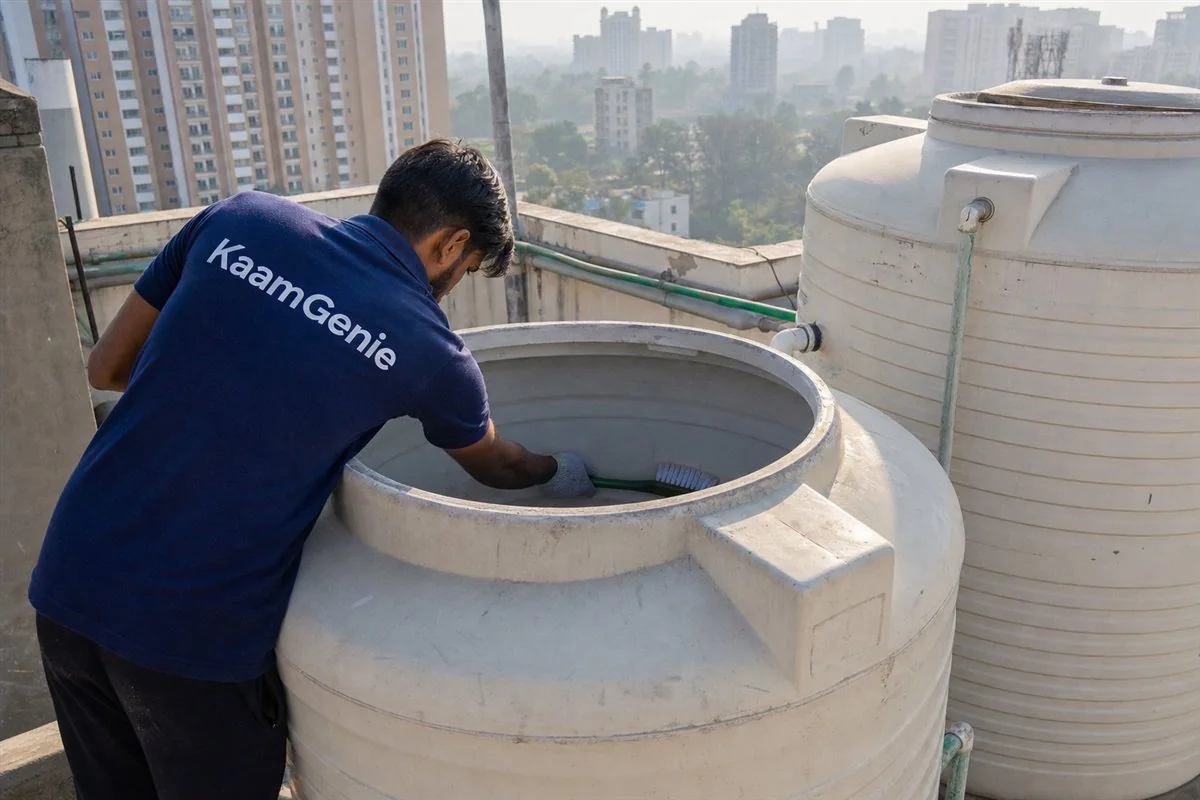
An overhead tank sits in open air on the roof. You lift the lid, there is fresh air all around, and a person can work without much risk beyond the usual care. An underground reservoir is the opposite: it is a confined space — a sealed concrete chamber with one narrow opening and no real ventilation. When water and organic matter sit stagnant down there, they can produce foul gases and lower the oxygen level inside. Entering an unventilated sump without precautions is genuinely dangerous, and it is not something to improvise.
A professional UGR cleaning therefore looks different from a rooftop job. We ventilate the chamber and let it air out before anyone goes in, use proper lighting, keep a second crew member stationed at the opening as a spotter, and never send one person in alone. There is dewatering equipment to pump the chamber dry, and the sediment is scooped and carried out rather than flushed into the building’s drains. This is also why the underground tank takes longer and costs more — the safety setup and the sheer volume of sludge are real work, not padding. The CPHEEO and BIS references at the foot of this page set out the engineering and water-quality basis for handling stored water properly.
Where the dirt sits — typical neglected Gurgaon building
Relative contamination load by tank, before cleaning
Indicative pattern from Gurgaon tanker-fed buildings — the underground reservoir carries most of the sediment because it stores incoming water first. Your tank may vary.
Frequency: how often each tank really needs it in Gurgaon
For most homes, builder floors and societies here, the sensible rhythm is to clean both tanks every 4 to 6 months. But the two tanks do not soil at the same rate, so the nuance is:
- Tanker-fed buildings — common along Dwarka Expressway, SPR and parts of New Gurgaon — should clean the underground reservoir more often, roughly every 3 to 4 months, because that is where tanker silt collects.
- Overhead tanks can usually run to the 5–6 month mark on a clean supply, but should never be skipped, because scale and bio-film build quietly.
- Societies and RWAs often put the UGR on a tighter schedule than the tower tanks, and bundle everything into a contract — see society water tank cleaning in Gurgaon.
- After the monsoon or a long vacancy, bring both forward — standing water and ingress accelerate everything.
The cleanest practice, regardless of building type, is to do both in the same visit so the whole chain — sump to roof to tap — is consistent. Cleaning one and not the other just moves the problem along the pipe.
Cost: why the underground tank is quoted differently
Pricing follows the work, and the two tanks involve different amounts of it. A standard residential overhead tank cleaning starts at ₹699 onwards. An underground reservoir almost always costs more, and is quoted custom, because it holds far more water, has much more sediment to remove, needs dewatering pumps, and demands the confined-space safety setup and longer crew time described above. A society UGR feeding multiple towers is a project in its own right.
That gap is real cost, not a markup — more litres, more sludge, more labour, more risk. If you want the full breakdown by tank type and capacity, our Gurgaon cost guide lays out typical ranges, and you can compare the broader NCR picture on our water tank cleaning services page. The one thing to be wary of is a flat “whole building” price that suspiciously ignores how big your sump is — that usually means the sump is about to be skipped.
What this means for different Gurgaon homes
The overhead-versus-underground balance shifts with how you live:
- High-rise condominiums (Golf Course Road, Sector 82, DLF Phase 5) typically have one or more large shared UGRs feeding multiple tower tanks — the UGR is the critical job and is best handled on a society contract. Book your block via water tank cleaning in DLF Phase 5 or Sector 82.
- Independent builder floors and plotted homes often have a smaller private sump plus an individual rooftop tank — both are manageable in a single visit.
- New-tower belt homes in New Gurgaon (Sectors 76–95) are heavily tanker-dependent, so the UGR deserves the tighter schedule.
For a fuller home-by-home view, our companion piece on high-rise vs plotted water tank cleaning compares the two living types directly, and the Delhi version of this very topic — overhead vs underground tank cleaning in Delhi — covers the same principle for readers across the border.
Not sure how big your underground sump is?
Send us a photo on WhatsApp. We’ll tell you what cleaning both tanks involves and give you a clear quote — no obligation.
The bottom line for Gurgaon
Your water is only as clean as the dirtiest tank it passes through — and in Gurgaon, that is almost always the underground reservoir. The overhead tank gets the attention because it is visible, but the sump below does the heavy lifting of catching tanker silt and hard-water sediment, and it is the harder, riskier, more important clean of the two. Get the order right (UGR first, OHT second), keep the underground tank on a tighter schedule if you are tanker-fed, and clean both in one coordinated visit. That is what actually keeps the water arriving clean at your tap. When you are ready, book water tank cleaning in Gurgaon and we will handle both tanks in the right sequence, with photos and a record at the end.
Frequently asked questions
Which is dirtier in Gurgaon — the overhead tank or the underground reservoir?
In Gurgaon, the underground reservoir (UGR) is almost always the dirtier of the two. It is the first point of storage, it is fed by water tankers and hard borewell groundwater that carry suspended silt and sand, and being below ground it acts like a settling tank where sediment drops to the floor. The overhead tank gets the relatively clearer water that has already left the silt behind in the UGR, so it collects less, though it still needs cleaning for bio-film and scale.
Why should the underground reservoir be cleaned before the overhead tank?
Because the overhead tank is filled by pumping water up from the underground reservoir. If you clean the rooftop tank first and then run the pump, you push dirty UGR water and disturbed sediment straight back up into the tank you just cleaned. The correct sequence is always underground reservoir first, then overhead tank, so the freshly cleaned rooftop tank is refilled with water from a freshly cleaned UGR.
How often should I clean the overhead tank versus the underground tank in Gurgaon?
For most Gurgaon homes and societies we recommend cleaning both every 4 to 6 months. Tanker-fed buildings and hard-water areas should lean towards the shorter end because the UGR fills with silt faster. Many societies clean the underground reservoir slightly more often than the overhead tanks, since the UGR takes the brunt of the incoming sediment. The cleanest practice is to do both in the same visit so the supply chain stays consistent.
Is underground tank cleaning more expensive than overhead tank cleaning?
Usually yes. An underground reservoir holds far more water, has more sediment to remove, often needs dewatering pumps, and requires confined-space safety gear and a longer crew time. A standard residential overhead tank cleaning starts at ₹699 onwards, while underground reservoirs, society UGRs and commercial tanks are quoted custom based on capacity and access. The price gap reflects real differences in labour, equipment and risk, not a markup.
Why is confined-space safety a bigger deal for underground tanks?
An underground reservoir is a confined space with a single narrow opening and poor natural ventilation. Stagnant water and organic sludge can release foul gases and lower the oxygen level, which is genuinely dangerous for anyone entering. A proper crew ventilates the chamber, tests or allows it to air out, uses lighting and a spotter at the opening, and never sends a single person in alone. An overhead tank on an open rooftop carries far less of this risk.
My building is tanker-fed — does that change the cleaning schedule?
Yes. A large part of Gurgaon, especially the new-tower belt along Dwarka Expressway and the Southern Peripheral Road, relies heavily on water tankers. Tanker water varies in quality and often carries more suspended silt than a clean piped supply, and it all lands in the underground reservoir first. Tanker-fed buildings should clean the UGR more frequently — every 3 to 4 months is sensible — because that is where the incoming load settles out.
Can one visit clean both the overhead and underground tanks together?
Yes, and it is the recommended approach. We clean the underground reservoir first, then the overhead tank, in a single coordinated visit. This keeps the whole supply chain clean at once, avoids refilling a clean rooftop tank from a dirty UGR, and is more efficient than booking two separate appointments. For societies with multiple towers we schedule the UGR and all connected rooftop tanks in a planned sequence.
Does Gurgaon’s hard borewell water affect the two tanks differently?
It does. Gurgaon’s groundwater is hard, high in dissolved minerals. In the underground reservoir this shows up mostly as settled silt and sandy sediment from tankers and borewells. In the overhead tank it shows up more as calcium and mineral scale on the walls and around fittings, because the water sits and slowly deposits scale. Both need attention, but the cleaning emphasis differs — heavy sediment removal below, scale removal above.
How long does underground reservoir cleaning take compared to a rooftop tank?
A standard residential overhead tank takes roughly 75 to 90 minutes. An underground reservoir or sump usually takes 2 to 2.5 hours because of the larger volume, slower dewatering, heavier sediment removal and the extra safety setup. A large society UGR can take 3 to 5 hours, sometimes with two crew members working in rotation. Cleaning both in one visit therefore runs longer than a rooftop-only job, but it is done properly in one go.
Sources & references
- Bureau of Indian Standards (BIS) — IS 10500:2012 is the canonical Indian Standard for drinking water specification, defining acceptable limits for physical, chemical, and biological parameters.
- WHO Guidelines for Drinking-water Quality, 4th edition — the global reference for water quality standards, including guidance on storage and disinfection.
- Food Safety and Standards Authority of India (FSSAI) — defines water quality requirements for food businesses, including hygiene standards for stored water and acceptable disinfection chemicals.
- WHO Fact Sheet on Drinking Water — overview of safe drinking water requirements and contamination risks.
- CPHEEO — Manual on Water Supply and Treatment — the Government of India’s engineering manual covering tank design, cleaning protocols, and disinfection practices.
Last verified: 29 June 2026. If you find any of these links broken, please let us know.