
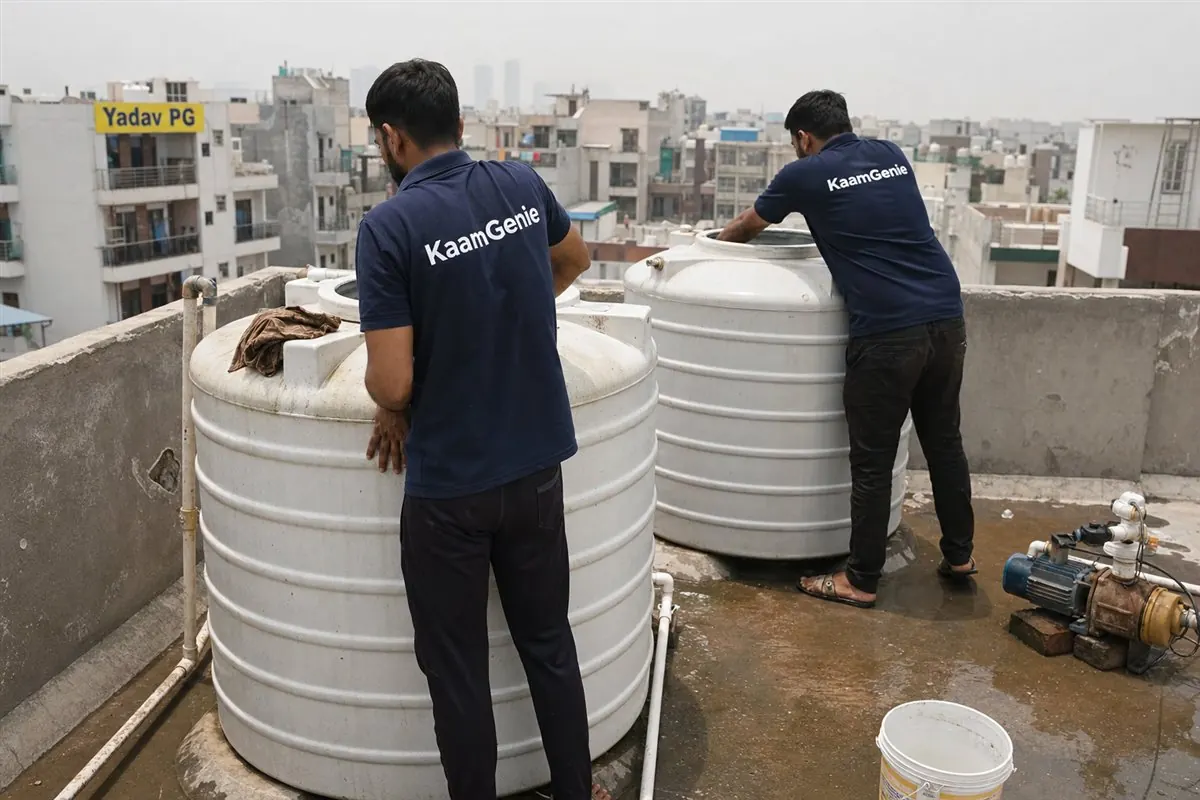
The short version for PG owners and residents
- Whose job: the operator or owner running the PG — safe stored water is part of a serviced room, like housekeeping or the RO.
- How often: a normal home cleans every six months; a PG of 15–60 people should clean quarterly at minimum, busiest buildings every two months.
- Why so often: heavy occupancy + Gurgaon’s hard, tanker-fed water = sediment and biofilm rebuild within weeks.
- What it costs: from ₹699 onwards per overhead tank; multi-tank and sump buildings quoted per tank or whole-building.
One neglected tank in a crowded PG doesn’t inconvenience one family — it reaches every single resident at once. That’s exactly why high-occupancy buildings can’t run on a household schedule.
| Building type | Typical occupancy | Sensible cleaning cycle | Why |
|---|---|---|---|
| Family flat / builder floor | 3–6 people | Every 6 months | Baseline public-health guidance |
| Small independent PG | 10–20 people | Every 3–4 months | Higher draw, fast turnover |
| Large PG / hostel | 20–40 people | Every 3 months | Heavy use, shared kitchen |
| Co-living building | 40–100+ people | Every 2–3 months | UGR + multiple tower tanks |
| PG with attached mess/kitchen | Any | Every 2–3 months | Food-prep water hygiene |
Run a PG or co-living in Gurgaon?
Get every tank and the sump done in one coordinated visit — full process, before/after photos, a certificate per tank. ₹699 onwards.
Why PG and co-living tanks are a different problem
A standard Gurgaon flat has three or four people drawing on its tank. A PG building on the same plot might have thirty. The tank doesn’t get bigger to match — it just works ten times harder. Water turns over fast, the tank is refilled constantly from borewells and water tankers of uneven quality, and every refill carries in another dose of sediment. That’s the first reason a PG tank fouls so quickly.
The second is the water itself. Gurgaon’s groundwater is genuinely hard, and large parts of the PG belt — Sikanderpur, Chakkarpur, the lanes off Sushant Lok — lean heavily on tanker supply when the borewell and municipal lines fall short. Hard, tanker-fed water deposits more calcium scale and silt than soft municipal supply, and that settles to the bottom of the tank as a sludge layer.
The third is biology. Rooftop tanks sit in the sun and stay warm. Warm water plus the constant trickle of organic matter from heavy use is the perfect nursery for biofilm — the slippery bacterial layer that coats tank walls. Biofilm doesn’t wait six months; it re-establishes itself within weeks of a cleaning. Put all three together and a PG tank that was spotless in January can look genuinely fouled again by April. This is the same hard-water dynamic behind water tank cleaning in Gurgaon generally, just accelerated by occupancy.
Whose job is it — operator, owner, or resident?
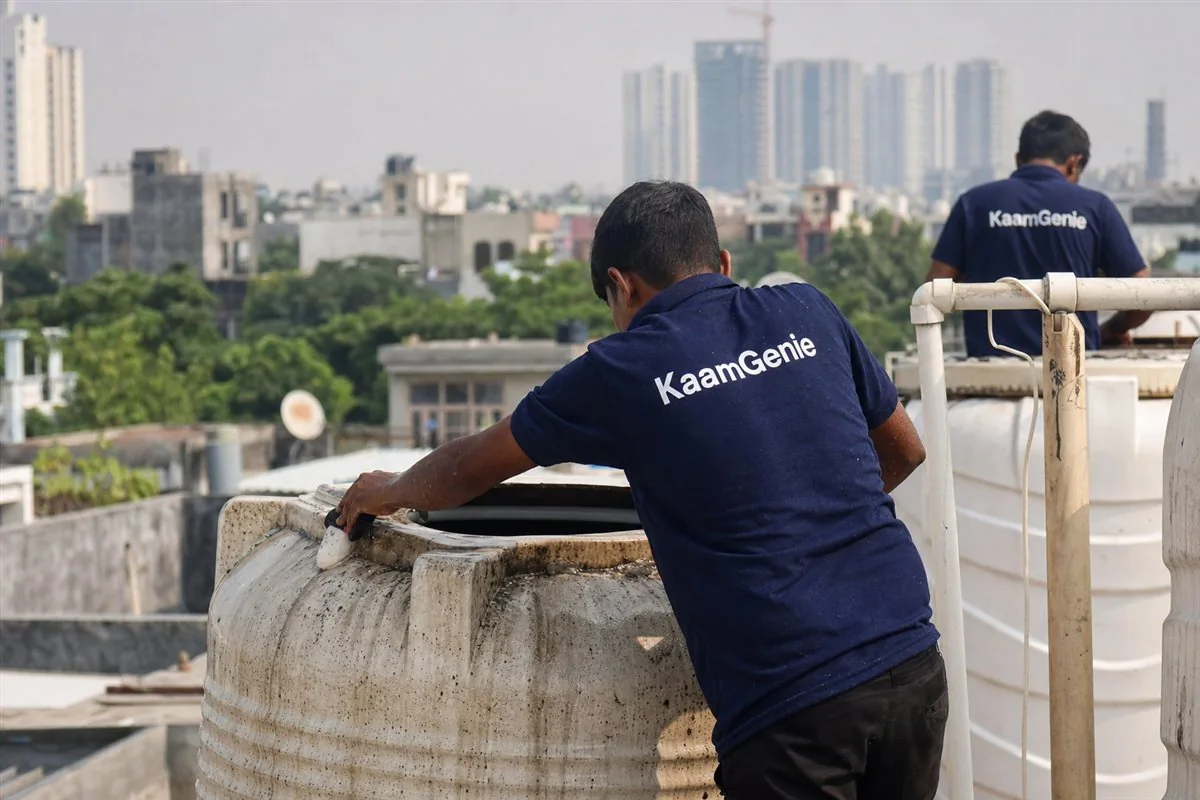
The honest answer is short: it’s the operator’s job. A paying guest or co-living resident isn’t renting an empty flat — they’re buying a serviced room. Safe stored water is part of that service, the same way housekeeping, Wi-Fi and a working RO filter are. So whoever runs the PG — an independent landlord-operator on a builder floor, or the operations team of a branded co-living chain — owns the cleaning schedule and pays for it. It is not something residents are expected to arrange between themselves.
That said, residents are not powerless, and they have every right to ask. The water you drink, cook with and shower in comes from the same tank whether or not your name is on a maintenance bill — the same principle we cover for renters in our guide to water tank cleaning for tenants in Gurgaon. If you’re a resident worried about the water, the right move is to ask the operator, in writing, for the last-cleaned date and the certificate. More on exactly how to do that below.
For larger co-living buildings the structure looks more like a managed society: a big underground reservoir (UGR) at the base feeds pumps that lift water to rooftop tower tanks, and a facility team handles upkeep. In that setting the responsibility and scheduling mirror what we describe in our piece on society water tank cleaning in Gurgaon — just on a building rather than a whole complex.
How often a PG tank really needs cleaning
Standard public-health guidance — the kind that informs the WHO drinking-water guidelines and Indian practice — suggests cleaning stored water tanks roughly every six months for an ordinary home. A PG is not an ordinary home, and applying the household number to a thirty-person building is how tanks end up neglected.
Our field rule of thumb for Gurgaon PGs:
- Small PG (10–20 residents): every 3–4 months.
- Large PG or hostel (20–40 residents): every 3 months.
- Co-living building (40–100+ residents): every 2–3 months, with the UGR on the tighter end.
- Any PG with an attached mess or kitchen: every 2–3 months, because the same water touches food.
The cheapest way to stay on schedule is to stop treating cleaning as a reaction to complaints and book it on a fixed cycle — the same logic behind how often you should clean a water tank in Gurgaon. A standing quarterly slot costs less per visit than emergency call-outs after residents start posting about cloudy water, and it keeps the building permanently ahead of the biofilm.
What residents notice first — the warning signs
In a PG the early signals show up across the whole building at once, which is actually useful: when five people mention the same thing in the same week, the tank is the obvious suspect. Watch for:
- Yellow or cloudy water from taps, especially first thing in the morning after water has sat overnight.
- A musty or earthy smell when the tap first runs.
- Grit or fine sediment at the bottom of a glass or in the kettle.
- Skin or hair complaints — itchiness, dryness, hair fall — that several residents report together.
- A run of stomach upsets in the building with no other obvious cause.
None of these should be waved away. In a crowded building they’re the tank telling you it’s overdue, and they map directly onto the broader classic signs we see across Cyber City corporate housing and the wider PG belt. If residents are flagging any of them, the tank should be inspected the same week, not at the next routine slot.
What a proper PG cleaning actually involves
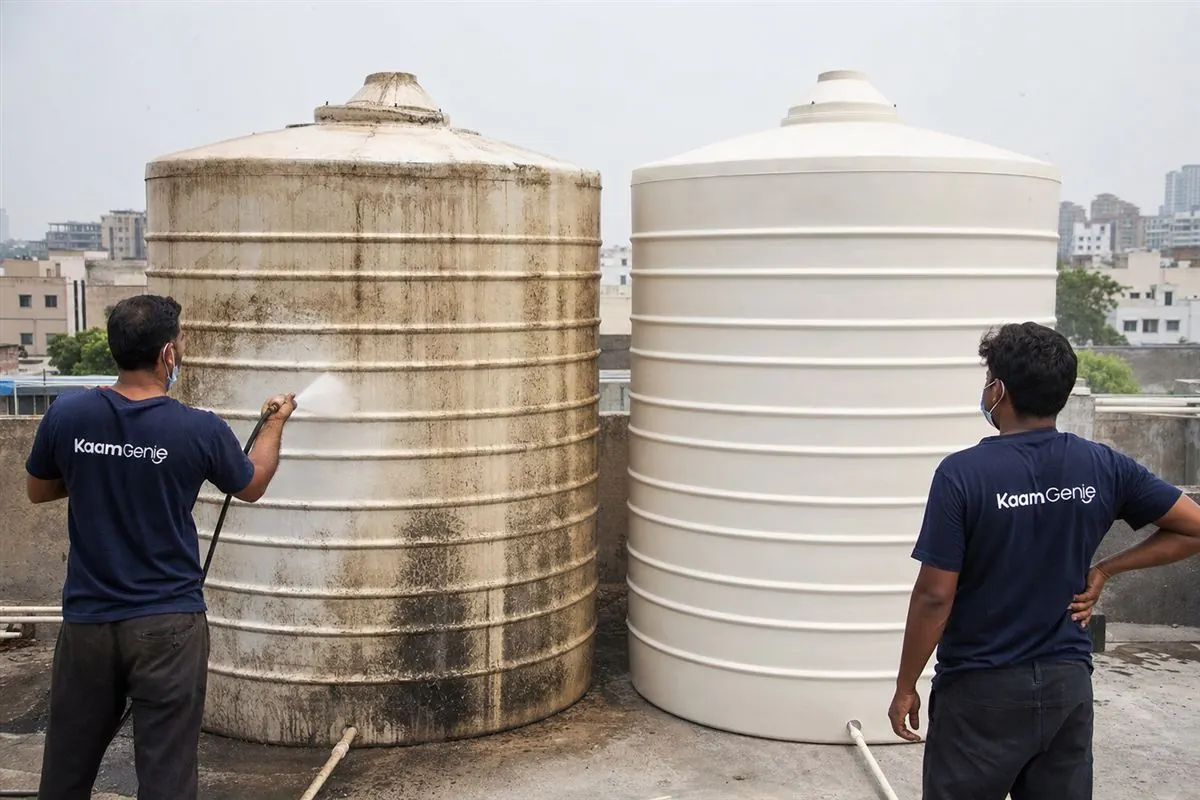
A real cleaning is the same rigorous process whether it’s one family tank or a row of PG tanks — the difference is volume and coordination, not corners cut. Each tank gets:
- Drain the old water (usable water preserved in a drum for non-drinking use so the building isn’t left dry).
- Sludge and sediment removal by hand — the calcium and silt layer that hard, tanker-fed water leaves on the floor.
- Manual scrubbing of every wall and the floor with food-grade brushes, never metal.
- High-pressure jet wash into corners, seams and behind fittings where biofilm hides.
- Food-grade disinfection with a proper contact time to kill what scrubbing dislodged.
- Refill, final check, and a dated certificate with before/after photos, per tank.
For a PG that certificate earns its keep twice. It’s proof of upkeep when a resident or a parent asks what the water situation is — a genuine selling point in a competitive market. And if the PG has an attached mess or kitchen, it’s the document that supports food-hygiene compliance for the water that touches food prep. We’re part of the wider network of water tank cleaning services across NCR, so the same standard applies whether it’s a single tank or a multi-block co-living building.
Multiple tanks, minimum disruption
Most PGs aren’t one tank — they’re two or three rooftop tanks plus a sump, and co-living buildings add a full underground reservoir. The efficient approach is one coordinated visit rather than piecemeal call-outs. We assess every tank and the sump on arrival, sequence the cleaning so the building keeps supply for as much of the job as possible, and clean them in one go with a separate certificate per tank.
Scheduling matters in a PG more than anywhere. The trick is to clean during the late-morning lull, after residents have left for work in Cyber City, Udyog Vihar or the Golf Course Road offices and before they’re back — so taps are barely touched during the actual cleaning window. A single overhead tank is done in roughly 75 to 90 minutes; a sump takes longer. A whole building is usually a half-day with the right-sized crew, and residents typically don’t notice beyond a brief dip in pressure. PGs across Sushant Lok and the Sohna Road belt run exactly this way on a standing quarterly slot.
Why occupancy drives cleaning frequency
Relative rate at which sediment and biofilm rebuild — indicative, based on occupancy and Gurgaon water
Longer bars mean faster fouling and a tighter cleaning cycle. The driver is people-per-tank, amplified by Gurgaon’s hard, tanker-fed water — not the calendar.
What it costs — and why it’s trivial per resident
A single residential-size overhead tank starts at ₹699 onwards. Because most PGs have several tanks plus a sump, the real number is a per-tank or whole-building quote rather than one flat figure — larger co-living buildings with a big underground reservoir and multiple tower tanks are priced on size and access. Our Gurgaon tank cleaning cost guide breaks down the per-tank ranges so you can budget a real figure instead of guessing.
Here’s the part operators tend to miss when they hesitate over the cost: spread across residents, it’s almost nothing. A quarterly cleaning of a PG’s tanks, divided across thirty residents, works out to a few rupees per person per month. Set that against what a single review mentioning “dirty water” does to occupancy in a market where prospective residents read every listing, and clean tanks are one of the cheapest pieces of reputation insurance a PG can buy. If the building doubles as a commercial operation with a mess, the same standard as commercial water tank cleaning in Gurgaon applies to the food-prep water.
Put your PG on a clean-water schedule
Quarterly or two-monthly cleaning for every tank and sump — one visit, photos and a certificate per tank, minimal disruption to residents. ₹699 onwards.
If you’re a resident: how to get it done
You can’t book the building’s shared tank yourself — it isn’t your asset — but you can absolutely get it moving. Keep it factual and in writing:
- Message the operator or manager — not a verbal mention in passing, but a WhatsApp or email so there’s a record.
- Be specific — note how long it seems to have been, and attach a photo if the water looks or smells off.
- Ask for the certificate — requesting the last cleaning certificate by name signals you know what a real cleaning leaves behind.
- Go as a group — a joint request from several residents is far harder to ignore than one person chasing.
Most operators clean when asked, because the maths is obvious: a cleaning costs a fraction of what a few reviews mentioning dirty water cost in lost occupancy. If a building keeps stalling even after a written, photo-backed request, that’s a data point about how the whole place is run — and worth weighing when your agreement comes up for renewal.
The bottom line for Gurgaon PGs and co-living
High occupancy changes the entire equation. A tank serving a family can run on a six-month cycle; a tank serving thirty people in a tanker-fed Gurgaon building can foul again in a quarter. Responsibility sits with the operator, the sensible cycle is quarterly or tighter, and the cost per resident is small enough to be a rounding error against the goodwill and health on the line. The smart operators treat it as a fixed standing schedule, not a fire to put out after residents complain.
Whether you run a six-room PG off Sushant Lok or a multi-block co-living building near Cyber City, you can sort every tank through our water tank cleaning in Gurgaon service — one visit, every tank and sump, a certificate each, and a standing slot so it never slips. Clean water is the cheapest amenity a PG can offer, and the one residents notice fastest when it’s missing.
Frequently asked questions
In a Gurgaon PG or co-living, who is responsible for cleaning the water tank?
The operator or owner who runs the PG. A paying guest or co-living resident is buying a serviced room, so safe stored water is part of what the operator is responsible for delivering, the same way they handle housekeeping and the RO filter. In a branded co-living property the facility or operations team owns the schedule; in an independent PG run out of a builder floor it is the landlord-operator. Residents do not arrange it themselves, but they are well within their rights to ask for the last-cleaned date and the certificate before or during their stay.
How often should a PG or co-living water tank be cleaned in Gurgaon?
Public health guidance points to cleaning stored water tanks roughly every six months for an ordinary household. A PG is not an ordinary household. With 15 to 60 people drawing on the same tanks every day, plus Gurgaon’s hard borewell water and heavy tanker reliance, sediment and biofilm build up far faster. For most PGs and co-living buildings in Gurgaon, quarterly cleaning is the sensible minimum, and the busiest high-occupancy properties are better off on a two-monthly cycle.
Why do PG and co-living water tanks get dirty faster than normal homes?
Three reasons stack up. First, occupancy: a tank sized for a family is being hammered by ten times the people, so water turns over fast and the tank is constantly being refilled from tankers and borewells of variable quality. Second, Gurgaon’s water itself is hard and tanker-fed, which pushes more sediment and scale in. Third, warm rooftop tanks plus near-constant nutrients from heavy use are ideal conditions for biofilm, the slimy bacterial layer that re-grows on tank walls within weeks. The result is that a PG tank can look fouled again only two or three months after a cleaning.
What does it cost to clean a PG or co-living water tank in Gurgaon?
A single residential-size overhead tank starts at ₹699 onwards. Most PGs have more than one tank, plus often an underground sump or reservoir, so the realistic cost is a per-tank or whole-building quote rather than a single figure. Larger co-living buildings with a big underground reservoir and several rooftop tower tanks are quoted on size and access. The cost per resident works out to a few rupees a month on a quarterly schedule, which is trivial against the goodwill, reviews and health risk at stake.
As a PG resident, can I get the operator to clean the tank?
Yes, by asking the right way. Put it in writing to the operator or the building manager: mention how long it has apparently been since the last cleaning, attach a photo if the water looks or smells off, and ask for the cleaning certificate. A group request from several residents carries far more weight than one person chasing alone. Most operators clean when asked because a few bad reviews mentioning dirty water costs them far more than a cleaning does. If they keep stalling, that tells you something about how the place is run.
Will the cleaning disrupt residents or cut off the water supply?
Disruption is minimal and brief. The work happens on the rooftop or in the sump area, not inside rooms. We can stage it tank by tank so part of the building keeps supply, and we usually preserve usable water in a drum for non-drinking use during the job. A single overhead tank is done in roughly 75 to 90 minutes; a sump takes longer. The practical move for a PG is to schedule cleaning for late morning when most residents are at work, so taps are barely touched during the actual window.
What is included in a PG water tank cleaning, and do I get a certificate?
Every tank gets the full process: drain, hand-removal of sludge and sediment, manual scrubbing of walls and floor with food-grade brushes, high-pressure jet wash, food-grade disinfection with a proper contact time, and refill. You get before and after photos and a dated cleaning certificate listing tank type, capacity and chemicals used. For a PG that certificate matters twice over: it is proof of upkeep for residents and parents who ask, and it is the document to show if a food licence or any inspection ever comes up for an attached kitchen or mess.
Our PG has several tanks across different floors — can you do them all in one visit?
Yes. Multi-tank PGs and co-living buildings are routine for us. We assess all the tanks and the sump on arrival, plan the sequence so supply is interrupted as little as possible, and clean them in one coordinated visit with a separate certificate per tank. A larger crew or a half-day slot is allocated where the building has a big underground reservoir feeding multiple rooftop tower tanks. One scheduled visit is far more efficient than calling someone out tank by tank.
Can dirty PG tank water actually make residents sick?
Yes. A neglected tank shared by dozens of people is one of the more efficient ways to spread waterborne illness. Biofilm and sediment in stored water can harbour bacteria that cause stomach upsets, typhoid and skin and hair problems, and in a crowded PG one contaminated tank affects everyone at once. An RO purifier at the drinking point helps but does not fix the tank that feeds the kitchen, the showers and the taps. Regular cleaning of the actual storage tank is the only real fix, which is exactly why high-occupancy buildings should be on a tighter schedule than a normal home.
Sources & references
- Bureau of Indian Standards (BIS) — IS 10500:2012 is the canonical Indian Standard for drinking water specification, defining acceptable limits for physical, chemical, and biological parameters.
- WHO Guidelines for Drinking-water Quality, 4th edition — the global reference for water quality standards, including guidance on storage and disinfection.
- Food Safety and Standards Authority of India (FSSAI) — defines water quality requirements for food businesses, including hygiene standards for stored water and acceptable disinfection chemicals.
- WHO Fact Sheet on Drinking Water — overview of safe drinking water requirements and contamination risks.
- CPHEEO — Manual on Water Supply and Treatment — the Government of India’s engineering manual covering tank design, cleaning protocols, and disinfection practices.
Last verified: 29 June 2026. If you find any of these links broken, please let us know.