
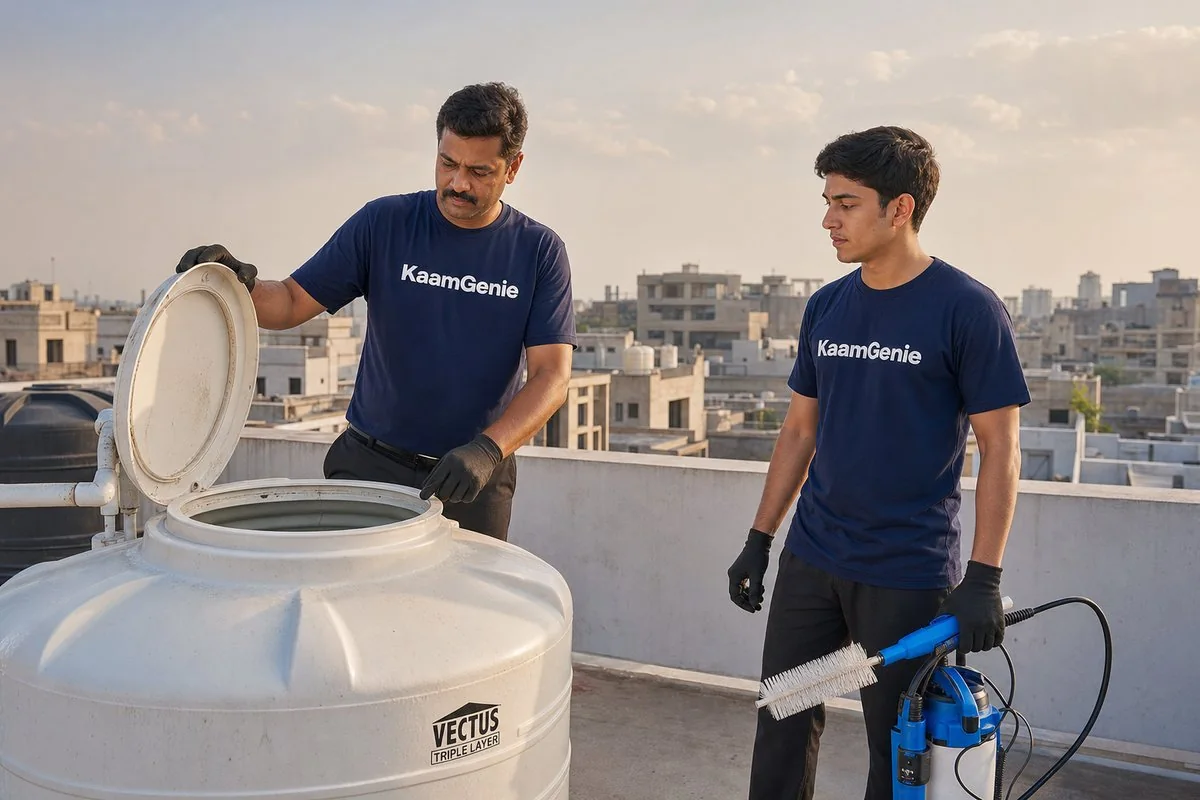
Pre-monsoon urgent checklist — do these before May 30
- Book the cleaning by May 30 — later slots slip into the first week of June and rain may already have started
- Inspect the lid + replace the rubber gasket — this is the single highest-impact monsoon prep step
- Vacuum six months of summer dust + sediment from the tank floor — not just rinse it
- Check / replace the inlet pipe — this is where rooftop dust enters with first rain
- Inspect the overflow pipe + insect mesh — mosquito breeding starts within 5-7 days of monsoon humidity
- Flush internal plumbing after cleaning — old residue in pipes can re-contaminate the fresh tank
- Get the inspection report on WhatsApp — one-page summary, before/after photos, GST invoice
If you can do only one home maintenance task this month, this is it. The monsoon doesn’t wait.
Why April-May is the most important tank cleaning of the year in Delhi
Most Delhi families clean the tank twice a year. If you can only do it once, do it in April-May. Here’s why this window matters more than any other 60-day period in the year.
By the end of April, your tank has been through six straight months of Delhi’s dry season. October to March is when fine particulate matter peaks in the air — PM2.5 and PM10 readings are off the charts — and every speck of that dust eventually settles somewhere. Some of it settles on your rooftop. From the rooftop it migrates into the tank through small gaps in the lid, around the inlet pipe, and through the overflow if the mesh is broken. Six months in, the floor of a typical Delhi overhead tank has 2-4 cm of fine grey-brown sediment that wasn’t there in October.
By the end of May, the temperature inside the tank is the highest it’s been all year. Plastic tanks regularly cross 40°C internal temperature in unshaded rooftop conditions. That warmth is exactly what biofilm-forming bacteria need to multiply — a slimy, slightly-yellow coating starts forming on the tank walls and the underside of the lid. Biofilm is the real reason summer tank water "smells different" — it’s not the water, it’s the colony living on the inside surfaces.
And then the monsoon arrives. Officially Delhi’s southwest monsoon onset is around 27-29 June, but pre-monsoon showers start in the second half of June. The first heavy shower does three things at once: it washes rooftop dust through any tank gap, it raises the humidity inside the tank to mosquito-breeding levels, and it stirs up the existing summer sediment so it suspends in the drinking water you pump down to your kitchen. If you haven’t cleaned the tank by the time that first heavy shower lands, you are going to drink the consequences for the next three months.
This is the entire argument for the April-May window. It’s not seasonal hype — it’s the most predictable annual cycle in Delhi water hygiene, which is exactly why it pays to book a pre-monsoon tank cleaning before the first showers arrive.
What 6 months of summer does to your Delhi tank
Let’s break down exactly what’s happening inside a typical Delhi overhead tank between November and May. We’ve measured this across hundreds of customer tanks and the pattern is remarkably consistent.
Sediment deposit. Fine dust enters the tank through the lid gap and the inlet, then settles to the floor over months. The depth varies by location — tanks in inner Delhi with high traffic exposure accumulate faster than tanks in greener pockets like Vasant Vihar or Greater Kailash. A typical six-month deposit is 2-4 cm of fine sediment. You can’t see it from above because it sits on the floor, but every time the pump cycles or someone fills a high-pressure bath, that sediment puffs up into the water column.
Biofilm formation. The biofilm layer is the slimy coating you can sometimes feel if you rub the inside wall of an empty tank. It’s a microbial community — not always dangerous on its own, but it harbours every type of bacteria that does pass through the water. Coliform counts in summer-biofilm tanks are routinely 5-10x higher than in freshly cleaned tanks. The biofilm grows faster in heat, so by May it’s at its annual peak.
Lid seal degradation. The rubber gasket around the tank lid is the unsung hero of clean water. It’s also the part nobody ever looks at. Six months of direct summer sun — reaching 50°C+ surface temperatures — bakes the rubber until it becomes brittle, cracks, and shrinks. The gap between the lid and the tank widens. That gap is exactly where the first monsoon rain will push rooftop debris into the tank.
Mosquito risk. Even with a sealed lid, the overflow pipe is a potential mosquito entry point if the mesh has corroded or gone missing. Pre-monsoon humidity (50-70% by mid-June) plus warm tank water plus a 3mm entry point is the textbook recipe for Aedes aegypti breeding. The dengue mosquito needs almost nothing — just standing water and an opening. Delhi NCR dengue cases spike every July-October. The tanks that contribute are the ones that weren’t inspected in May.
What pre-monsoon prep should include (more than just cleaning)
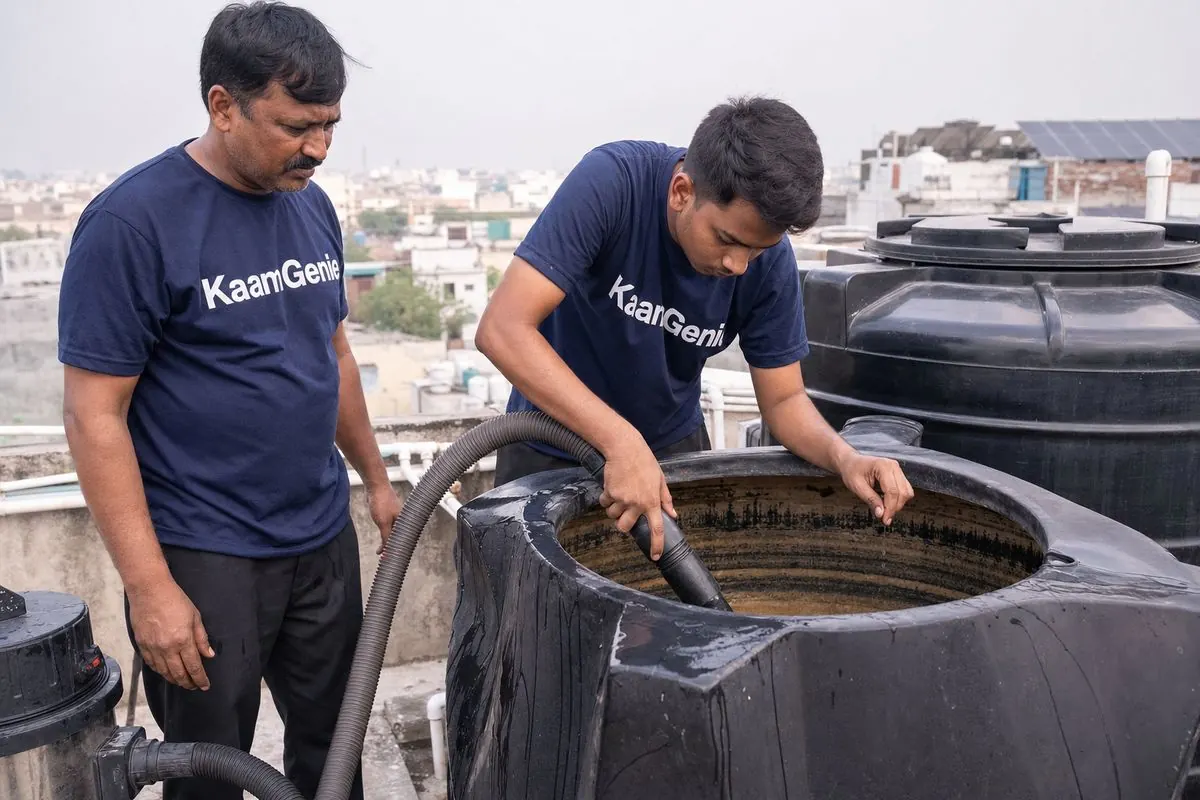
This is where a lot of vendors skip steps and Delhi homeowners get short-changed. A real pre-monsoon visit is not a tank rinse. It’s a tank rinse plus four mechanical inspections that decide whether the monsoon damages your water supply.
1. Lid check. The crew opens the lid, checks for cracks (especially on plastic tanks where summer UV cracks the top), inspects the locking mechanism, and confirms it sits flat across the tank rim with no warping. A warped lid lets in rain through the gap even if the gasket is fine.
2. Gasket replacement. The rubber seal between lid and tank is replaced if it shows any cracking, hardening or shrinkage. This is a 5-minute job with the right part on hand and it costs ₹250-450. We carry standard sizes on the van so it happens in the same visit. Honestly, almost every gasket older than 18 months needs replacing in Delhi conditions, so plan for it.
3. Inlet pipe inspection. The inlet is the pipe that fills your tank from the municipal supply or pump. Where it enters the tank, there should be a tight grommet or seal. Pre-monsoon, we check that grommet, verify the pipe isn’t loose, and check whether the inlet has a backflow mesh. A loose inlet is one of the most common rainwater entry routes.
4. Overflow pipe + mosquito mesh. The overflow pipe carries excess water out when the tank is full. It also can carry mosquitoes IN if the mesh is missing or torn. We check the mesh, replace it if needed (₹150-300 in materials), and confirm the pipe drains away from the building rather than back onto the rooftop.
Skip any of these four and you’ve had a tank wash, not a pre-monsoon prep. The point of the April-May visit is to ready the tank for three months of being rained on. The cleaning is necessary but not sufficient.
Book before monsoon hits — slots are filling fast
Fixed-price pre-monsoon package — cleaning + lid + gasket + inlet + overflow inspection. Before/after photos on WhatsApp, GST invoice. Same-day where possible.
Pre-monsoon 8-step cleaning checklist
This is the exact sequence we follow on every pre-monsoon visit. Each step has a purpose. Skip any and you’ve weakened the whole job. Print this and check it against whoever you book.
| Step | What’s checked / done | Why it matters in pre-monsoon | Time |
|---|---|---|---|
| 1. Drainage | Tank fully emptied; final wet-vac of floor water | So summer sediment doesn’t dilute the cleaning | 15 min |
| 2. Sediment vacuum | 6 months of dust and silt vacuumed from floor | Removes the layer that will otherwise re-suspend in rain | 20 min |
| 3. Wall scrubbing | Food-grade nylon brushes on all interior surfaces | Lifts peak summer biofilm before disinfection | 15 min |
| 4. High-pressure jet wash | 80-120 bar industrial jet on walls and floor | Reaches biofilm that brushing can’t | 15 min |
| 5. Lid + gasket inspection | Visual check; gasket replaced if cracked or shrunk | Stops first monsoon shower from pushing debris in | 10 min |
| 6. Inlet + overflow check | Pipe seals, grommets, mosquito mesh inspected | Closes the two main monsoon entry routes | 10 min |
| 7. Disinfection | Food-grade sodium hypochlorite 5%, 20-min contact | Kills residual biofilm before refilling | 25 min |
| 8. Final rinse + refill | Disinfectant flushed; before/after photos sent | Tank is monsoon-ready, documentation on file | 15 min |
End-to-end, a single standard kothi overhead tank takes 90-120 minutes. Society tanks scale up to 2-3 hours. The pre-monsoon visit takes 15-20 minutes longer than a routine cleaning because of steps 5 and 6 — the inspections that don’t happen on a standard visit. Worth every minute.
Lid + gasket inspection — the often-skipped step
If we had to pick the single highest-impact line item on the pre-monsoon checklist, it’s this one. And it’s the one that gets skipped most often.
Most Delhi tank cleaning vendors do not carry rubber gaskets on the van. They open the lid, clean the tank, close the lid, and move on. The customer pays ₹600-900, the tank looks clean, and nobody notices that the gasket is cracked. Then the first heavy June shower happens, water seeps in around the lid, and the homeowner can’t figure out why the tank is dirty again two weeks after a fresh cleaning.
The fix is genuinely simple: inspect the gasket on every pre-monsoon visit, and replace it if it’s cracked, hardened, or has shrunk away from the lid edge. Standard rubber gaskets for Indian tank lids come in 3-4 common diameters. We carry all of them on the van. Replacement takes 5 minutes and costs ₹250-450 in materials.
What you should ask any vendor before they finish the job: "Did you check the lid gasket? Is it intact or does it need replacing?" If the answer is "looks fine" without them actually showing you, ask them to open the lid again and physically point at the gasket. Cracking or shrinkage is visible at a glance once you know to look. This one question protects you from three months of monsoon contamination.
Inlet pipe + overflow pipe — common monsoon failures
The other two mechanical failure points in monsoon are the inlet pipe and the overflow pipe. Both fail in predictable ways.
Inlet pipe failures. The inlet enters the tank through a hole in the lid or upper wall. Around that pipe there should be a tight rubber grommet that seals the gap. Over years, the grommet hardens or falls out completely, leaving an open hole around the pipe. Rooftop dust falls in through that gap; in monsoon, water does too. The fix is a new grommet (₹100-200) or a silicone seal applied around the pipe. Either is a 10-minute job during the cleaning visit.
Overflow pipe failures. The overflow is the pipe that drains excess water when the tank is full. The outer end should have a fine mesh (sometimes called a "mosquito mesh" or "insect screen") to stop mosquitoes from flying back up the pipe into the tank. In Delhi humidity, that mesh corrodes — especially if it’s a basic galvanised iron mesh. By the time monsoon hits, the mesh often has holes or is missing entirely. Replacement mesh is ₹150-300 and we install it during the visit. Stainless steel mesh lasts 5-7 years; cheap GI mesh lasts about 18 months. We install stainless.
Both of these checks are inspections, not guesses. A vendor who didn’t physically look at the inlet and overflow pipes did not do a pre-monsoon visit. They did a cleaning. The two are not the same.
Society / RWA pre-monsoon checklist
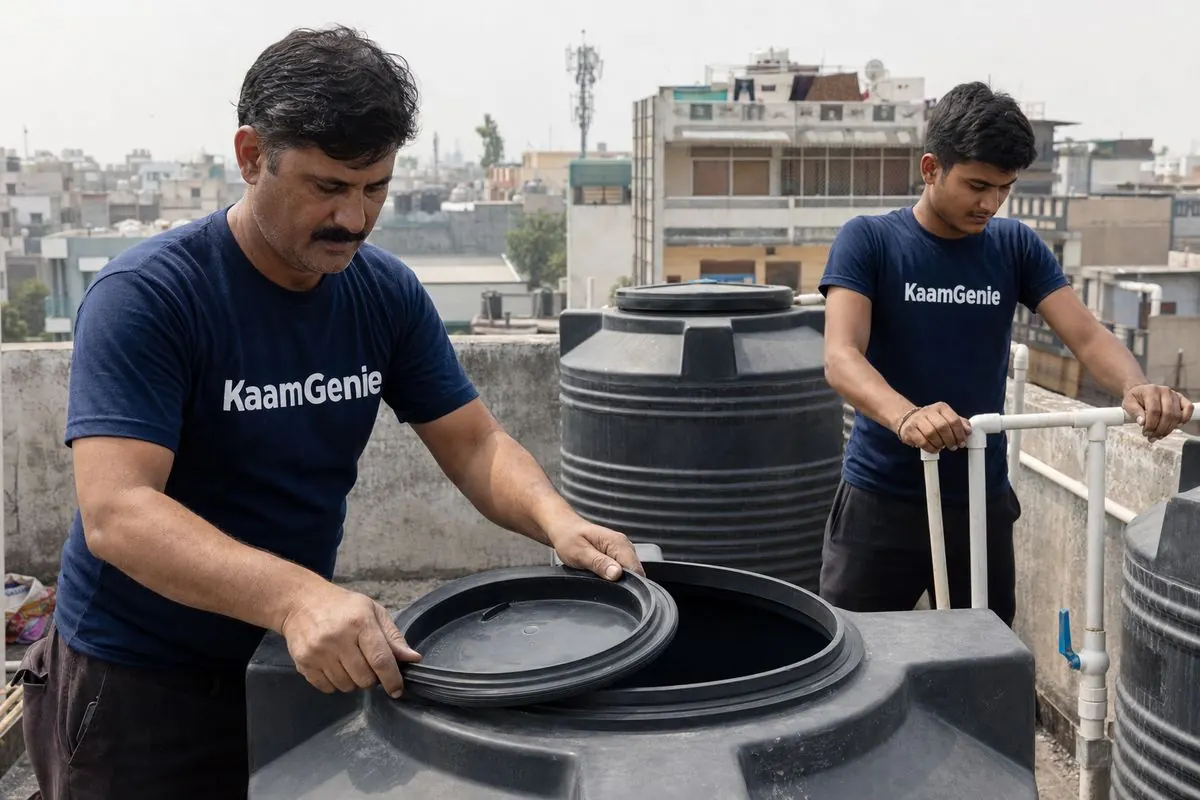
For RWA managers and society committees, pre-monsoon is a different scale of operation but the same principles apply. A typical Delhi society has between two and twelve overhead tanks plus one or more underground sumps. Doing all of them in one coordinated visit is faster, cheaper, and safer than piecemeal scheduling.
The society pre-monsoon visit should cover:
- Every overhead tank cleaned + lid/gasket inspection
- Underground sump(s) cleaned with full confined-space protocol — see our sump cleaning safety guide
- Common areas: rooftop drainage clearance (so monsoon water flows away from tanks, not into them)
- Pump room inspection — the pump motors are often the second-most-water-vulnerable part of a society
- One consolidated cleaning report on email to the RWA secretary for AGM records
- Photos of each tank’s lid + gasket condition for the maintenance log
For societies on an annual AMC, the pre-monsoon visit is the most important one of the four scheduled cleanings — we tell every RWA to make sure their May visit is comprehensive even if other visits get compressed. If you’re a society without an AMC, this is the visit that justifies signing one. The per-tank cost on a four-visit annual contract is 15-25% lower than four ad-hoc cleanings, and the documentation is consistent for committee records.
Real Delhi pre-monsoon scenarios
Three patterns we see every single week across Delhi NCR in April-May. Recognise yourself in any of these?
The kothi with the leaking lid. Defence Colony customer called us in May 2025 with a complaint: "Water tastes earthy after every rainfall." We opened the lid and the gasket was completely gone — not cracked, gone. Rainwater was flowing straight in through the gap every time it rained. One new gasket, full cleaning, and the problem disappeared. Total cost: ₹1,150 including the gasket. The previous vendor had cleaned the tank twice that year without mentioning the gasket. This is the most common pattern we see.
The society with mosquito breeding. A Punjabi Bagh society RWA noticed mosquitoes around the rooftop in late May 2025. The president called us. We checked all eight rooftop tanks — six had intact overflow mesh, two had torn mesh with active mosquito breeding inside the tank. We treated both, replaced mesh on all eight as preventive, and the society avoided a dengue scare during monsoon. The mesh replacement across eight tanks cost ₹1,800 total. Cheap insurance.
The restaurant with the FSSAI risk. A Karol Bagh restaurant got 48-hour notice of a pre-monsoon FSSAI inspection in May 2025. They needed: tank cleaning, water TDS test, sealed lid confirmation, GST invoice. All in 48 hours. We did the cleaning the same evening, lab test report the next morning, full paperwork on file before inspector arrived. They passed. This is now a standard pattern in Karol Bagh, Connaught Place and Khan Market F&B districts — FSSAI ramps up checks ahead of monsoon and restaurants without paperwork get fined.
Common monsoon failures by tank type
Different tank materials and configurations fail in different ways during monsoon. Here’s the pattern we see most often, with rough repair costs.
| Tank type | Common monsoon failure | Cost to fix | Prevention |
|---|---|---|---|
| Plastic overhead (1,000-2,000L) | UV-cracked lid; gasket gone | ₹450-1,200 | Annual lid inspection; gasket replacement every 18 months |
| Plastic overhead (large, 3,000-5,000L) | Sun-warped lid; inlet grommet loose | ₹800-1,800 | Shade cover if exposed; grommet check every visit |
| Concrete overhead | Wall hairline cracks; lid hinge corrosion | ₹1,500-3,500 | Waterproofing reapplication every 3 years |
| Underground sump (concrete) | Rainwater seepage through wall; gas buildup | ₹2,500-6,000 | External waterproofing check; sump cleaning frequency ↑ |
| Stainless steel overhead | Gasket failure; overflow pipe corrosion | ₹500-1,500 | Gasket every 24 months; stainless overflow mesh |
| Loft / staircase tank | Trapped humidity; biofilm acceleration | ₹800-1,500 | Quarterly cleaning, not bi-annual |
| Society common tank (any) | One bad lid affecting all flats | Per-tank repair | Coordinated pre-monsoon AMC visit |
The point of the table isn’t to scare anyone. It’s to make clear that "I cleaned my tank last year" is not the same as "my tank is monsoon-ready". The mechanical condition of the lid, gaskets, inlet and overflow matters more than the cleanliness of the water itself.
Cost in pre-monsoon (April-May) vs off-season
One question we get a lot: does pre-monsoon cleaning cost more than other times of year? Honest answer — not really, and where it does, it’s justified. Here’s the breakdown.
| Service | Off-season price (Jul-Feb) | Pre-monsoon price (Apr-May) | Off-season saving |
|---|---|---|---|
| Small kothi overhead (up to 1,000L) | ₹800 | ₹800 | Same price |
| Standard kothi overhead (1,000-2,000L) | ₹1,000 | ₹1,000 | Same price |
| Kothi overhead + sump combo | ₹2,500 | ₹2,800 | ₹300 (sump extra effort in heat) |
| Society tank (per tank, 1,000-2,000L) | ₹750 | ₹800 | ₹50 |
| Lid + gasket replacement | ₹250-450 | ₹250-450 | Same price |
| Overflow mesh replacement | ₹150-300 | ₹150-300 | Same price |
| Pre-monsoon full package (single tank) | n/a | ₹1,200-1,800 | Bundle saves ₹150-300 vs ad-hoc |
| Society pre-monsoon comprehensive (AMC) | n/a | 15-25% off ad-hoc rates | Worth signing AMC at this visit |
The genuinely smart move financially: do your pre-monsoon cleaning AS part of an annual AMC. The per-visit cost is lower, the documentation is consistent for tax and insurance purposes, and you stop having to remember when the last cleaning was. We use the pre-monsoon visit as the anchor visit of the AMC year — the most thorough one, with the most inspections, and the most detailed report.
The monsoon doesn’t wait — book your slot now
Pre-monsoon slots fill 3-7 days ahead in May. Lock in your date now and we’ll handle the rest. Fixed price, before/after photos, GST invoice on WhatsApp.
What KaamGenie includes in pre-monsoon packages
Every pre-monsoon visit from KaamGenie includes the following as standard. Nothing on this list is an upsell — it’s all part of the fixed package price quoted upfront.
- Full 8-step cleaning of the tank (drainage, vacuum, scrub, jet wash, disinfection, rinse, refill)
- Lid inspection — physical opening and visual check
- Rubber gasket inspection — replacement quoted upfront if needed
- Inlet pipe + grommet check
- Overflow pipe + mosquito mesh inspection
- Before-and-after photos on your WhatsApp
- One-page pre-monsoon inspection report (for RWA, FSSAI, or your own records)
- GST invoice on email and WhatsApp
- 30-day callback guarantee — if anything looks wrong, we come back free
- Optional water quality test (TDS, chlorine residual, visual) — ₹500 add-on
For full price details across all tank types and society configurations, see our Delhi water tank cleaning page. To lock in your pre-monsoon slot, call +91 95603 66362, message us on WhatsApp, or use the booking form on this page.
Frequently asked questions
Why is April-May the best time for tank cleaning in Delhi?
April-May is when six months of dry-season dust has settled inside the tank, biofilm is at its annual peak, and the monsoon is about 4-6 weeks away. Cleaning now resets the tank before the first rain pushes contaminants in through cracked lids and broken seals. Skip this window and you spend the entire monsoon drinking water with last summer’s residue.
What if I clean in June or July instead?
You’ll be cleaning during or after rain has already entered the tank through gaps. The first heavy shower carries rooftop dust, leaf debris and bird droppings straight in through any cracked lid. June-July cleanings cost the same money but only solve part of the problem — you needed the seal fixed before the rain, not after.
Is lid + gasket replacement included? Cost?
A basic visual lid check is included in every cleaning. Rubber gasket replacement is ₹250-450 extra depending on tank model. A complete new lid (if yours is cracked beyond repair) is ₹800-1,800 depending on size and material. We carry standard sizes on the van so it happens in the same visit.
What’s the mosquito breeding risk in monsoon?
Aedes aegypti (the dengue mosquito) needs only standing water and a way in. A 3mm gap in your tank lid is enough. Once monsoon humidity rises, eggs hatch in 5-7 days inside the tank. A pre-monsoon lid seal + gasket check is the single highest-impact dengue prevention you can do at home in Delhi.
Will rainwater contaminate my tank?
Only if your tank lid is compromised. A properly sealed tank with intact gasket and overflow pipe shouldn’t take any rainwater. But Delhi summer heat degrades rubber gaskets, and 2-3 years of UV exposure cracks plastic lids. That’s why the pre-monsoon inspection matters more than the cleaning itself.
Can I delay cleaning till after monsoon?
Strongly advise against it. Pre-monsoon (April-May) and post-monsoon (September-October) are both important, but if you can only afford one, pre-monsoon is the priority. Going into rainy season with a dirty tank means three months of waterborne illness risk. Post-monsoon is a follow-up, not a substitute.
What about borewell tanks in pre-monsoon?
Borewell tanks need MORE pre-monsoon attention, not less. Rising water tables in monsoon stir up sediment in the aquifer, so TDS spikes and silt deposits accelerate. We recommend pre-monsoon cleaning + filter check + a follow-up in August for outer Delhi and Gurgaon borewell-fed homes.
FSSAI requirements for restaurants in monsoon?
FSSAI inspection frequency increases during monsoon because waterborne illness reports rise. Restaurants should have a documented pre-monsoon cleaning before May 31, water TDS report, sealed lid certificate, and GST invoice on file. We provide all four in one visit. Failed inspections during monsoon cost more than the cleaning ever would.
How long does pre-monsoon prep take?
Standard kothi pre-monsoon prep (tank cleaning + lid check + gasket + inlet/overflow inspection) takes 90-120 minutes per tank. Society tanks 2-3 hours. Sump combo adds 45 minutes. We do before/after photos, send them to your WhatsApp, and you get a one-page inspection report.
When should I book? Will you be busy in May?
Yes — May is our peak booking month. We add slots but they fill 3-7 days ahead. The safe answer: book by mid-May for a slot before May 31. After that we still take bookings, but you may slip into the first week of June, which is acceptable but cuts it fine. Earlier is better.
Sources & references
- Delhi Jal Board (DJB) — municipal water supply authority and recommended cleaning cadence for residential storage in Delhi NCR.
- Bureau of Indian Standards (BIS) — IS 10500 drinking water specification and storage tank maintenance guidelines.
- India Meteorological Department (IMD) — official southwest monsoon onset dates for Delhi NCR and pre-monsoon shower predictions.
- Food Safety and Standards Authority of India (FSSAI) — commercial kitchen water storage and monsoon-period inspection requirements.
Last verified: 4 June 2026. If you find any of these links broken, please let us know.