
Honest sump cleaning prices in Delhi (2026)
- Small kothi sump (up to 2,000L): ₹1,500
- Standard kothi sump (2,000-5,000L): ₹2,000-2,500
- Large kothi sump (5,000-10,000L): ₹2,800-3,500
- Sump + overhead combo (kothi): ₹2,500-3,000
- Society sump (10,000-25,000L): ₹4,500-5,500
- Society sump (25,000L+): Custom quote, AMC recommended
- Annual AMC (4 visits): typically 15-25% off per-visit pricing
If you’re quoted ₹500 for a sump cleaning, something is being skipped — usually the safety gear. Read on.
What an underground sump actually is
A sump — or underground water tank — is a concrete or fibreglass storage tank built below ground level, usually outside or under a kothi. Most Delhi plot houses have one storing 2,000-10,000 litres of municipal supply, which then gets pumped up to the rooftop overhead tank — which is why our sump and tank cleaning services usually cover both in a single visit. Society buildings often have larger ones at 15,000-50,000 litres.
Sump cleaning is a separate service — not just "bigger overhead tank cleaning" — because of three things that make it dangerous and expensive in equal measure:
- Confined space. Once a crew member descends through the lid, they’re in an enclosed concrete box with limited air circulation. Toxic gases accumulate. Falls are catastrophic.
- Anaerobic environment. Without sunlight or oxygen circulation, sumps grow different microbes than rooftop tanks — including sulphur-reducing bacteria that produce hydrogen sulfide. That’s the "rotten egg" smell people often ignore until it’s too late.
- Heavier sediment. Sand, silt and mineral scale settle to the bottom over months. Cleaning needs vacuum extraction, jet wash, and proper chlorine treatment — not just scrubbing.
Real Delhi sump cleaning cost in 2026
Below is the honest pricing across Delhi NCR for sump cleaning. Numbers are market-checked across South Delhi, West Delhi and East Delhi vendors plus our own published rates.
| Sump type & size | Typical Delhi range | KaamGenie fixed price |
|---|---|---|
| Small kothi sump (up to 2,000L) | ₹1,200-2,000 | ₹1,500 |
| Standard kothi sump (2,000-5,000L) | ₹1,800-3,000 | ₹2,000-2,500 |
| Large kothi sump (5,000-10,000L) | ₹2,500-4,500 | ₹2,800-3,500 |
| Sump + overhead combo (kothi) | ₹2,500-4,000 | ₹2,500-3,000 |
| Society sump (10,000-25,000L) | ₹4,000-6,500 | ₹4,500-5,500 |
| Society sump (25,000L+) | ₹6,500-10,000 | Custom quote |
What inflates a quote unfairly: Vendors who quote ₹500 over the phone, then add ₹800 "deep clean" + ₹400 "chlorine" + ₹300 "after-photo" when they arrive. Our quotes include everything in the base price. No add-ons.
Need a sump cleaned this week?
Fixed-price visits. Real safety gear, before/after photos on WhatsApp, GST invoice. Same-day available where possible.
The 8-step safe sump cleaning process
Every sump cleaning at KaamGenie follows the same sequence. The order matters — skip step 1 and you risk killing your crew member. Skip step 7 and you’ve cleaned a tank but it’s not safe to drink from yet.
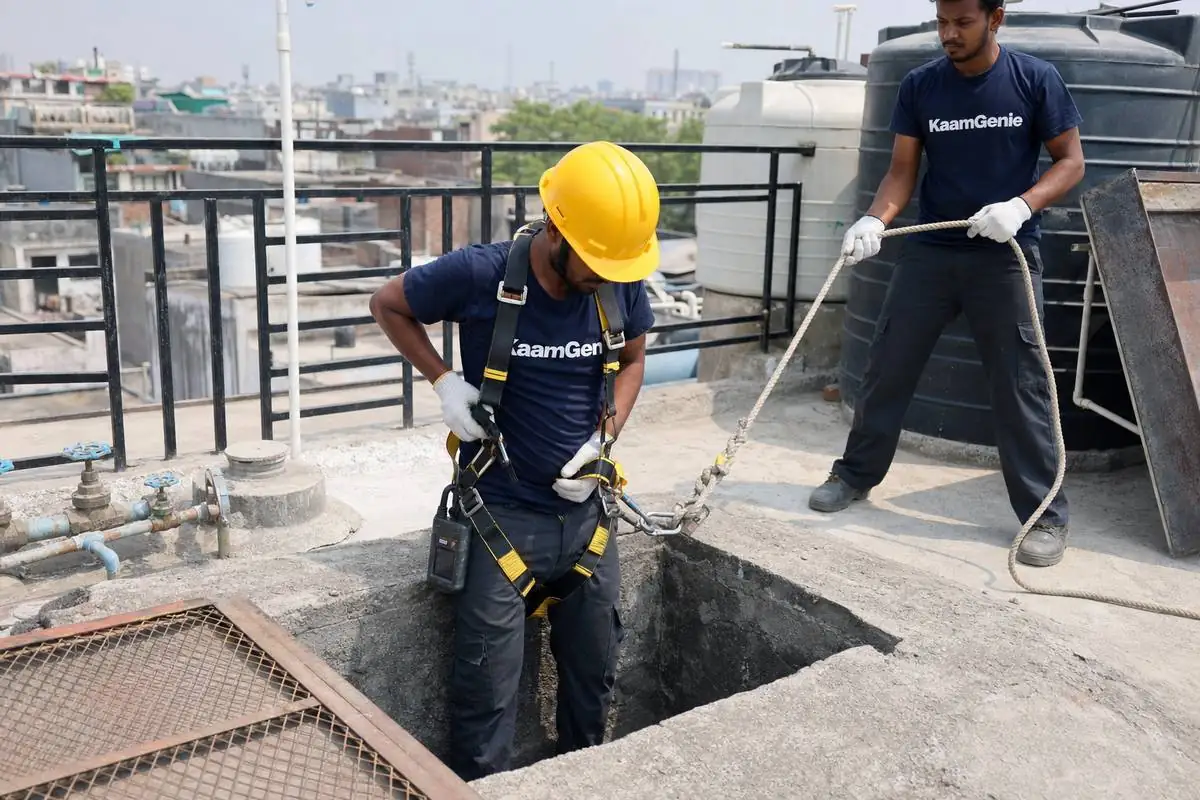
- Gas test before any entry. A handheld gas meter is lowered into the sump. It reads hydrogen sulfide, methane and oxygen levels. Only when readings are safe (O₂ ≥ 19.5%, H₂S < 10 ppm) does anyone descend. This step is the single biggest safety differentiator between professional and amateur vendors.
- Drainage. Existing water is pumped out completely. The last few centimetres at the floor get wet-vacuumed so nothing dilutes the cleaning chemistry.
- Descent with harness. One crew member descends wearing a full-body harness with safety rope held by a standby crew outside the sump. Hard hat, gloves, optional face mask. The standby crew’s only job is to monitor and pull up if needed.
- Sludge removal. Settled sediment at the bottom is scooped, then wet-vacuumed. This is months or years of accumulated silt, sand and biofilm — the actual contamination layer.
- Scrubbing. Food-grade nylon brushes on walls, floor, inlet and outlet pipes. Manual work, no shortcuts.
- High-pressure jet wash. 80-120 bar industrial jet dislodges remaining biofilm and mineral scale on walls. This is what brushing alone cannot reach.
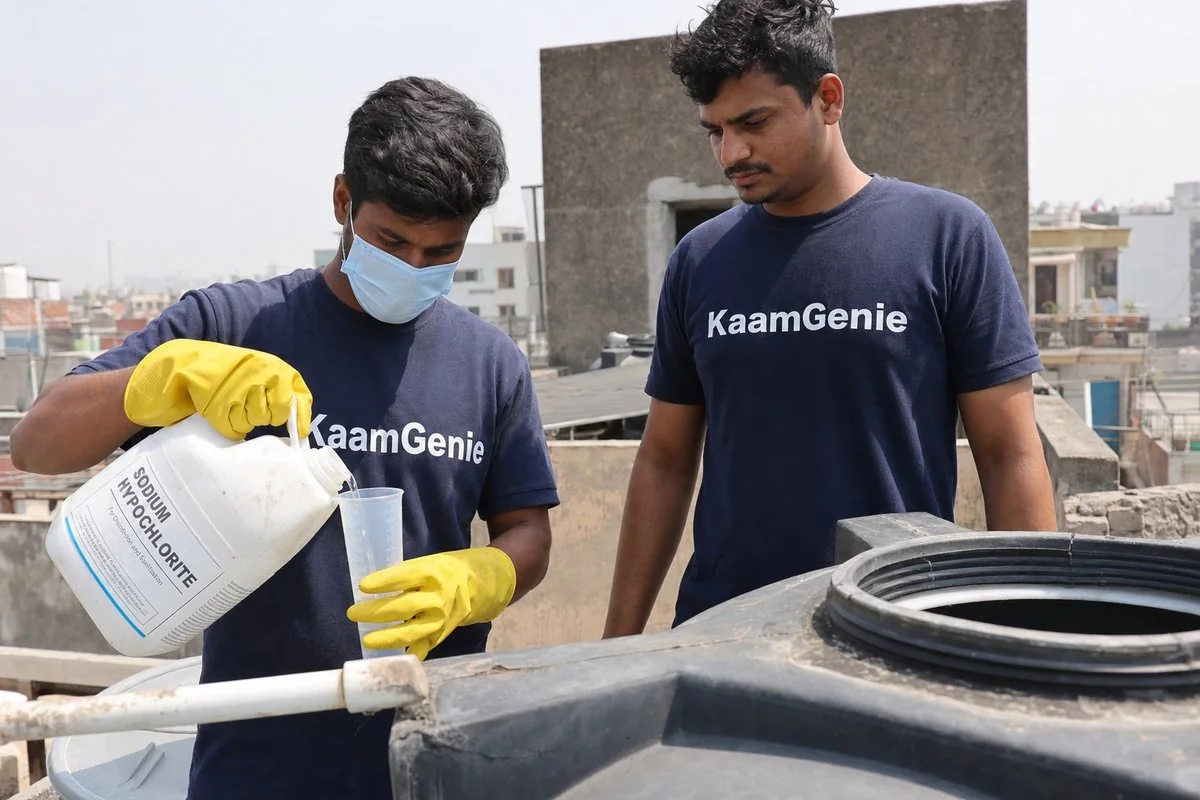
- Disinfection. Food-grade sodium hypochlorite 5%, 20-minute contact time. Chemistry needs time; we do not rush this step. The MSDS is available on request.
- Final rinse and refill. All disinfectant residue is flushed before refilling with your normal water supply. Before/after photos are sent to your WhatsApp the same day.
Why DIY sump cleaning genuinely kills people
This isn’t a sales tactic. People die every year in India descending into sumps without proper gear. The deaths are preventable and the pattern is depressingly consistent:
- Hydrogen sulfide. A few breaths at 700+ ppm are fatal within minutes. The "rotten egg" smell disappears at the same dose — your nose stops registering it because the gas paralyses your olfactory nerve. You can be dead before you realise anything is wrong.
- Oxygen displacement. Methane and CO₂ from organic decay displace breathable air. Below 16% oxygen, you lose consciousness in 2-3 breaths. No warning.
- Falls and entrapment. Wet concrete walls plus shoes designed for normal floors = head injury, broken legs, or simply being unable to climb back out.
- The "good Samaritan" cascade. A family member or neighbour sees someone collapse inside the sump, jumps in to help, and the same gases get them too. Mass-casualty sump deaths happen this way regularly in India.
For context: the National Crime Records Bureau and various municipal reports document over 50 sump and manhole deaths per year in Delhi NCR alone — mostly maintenance workers without proper gear, but also home owners attempting DIY cleaning.
What to verify in ANY vendor before they descend
Six non-negotiables. Any vendor reluctant to show them is cutting safety corners — send them home and book someone else:
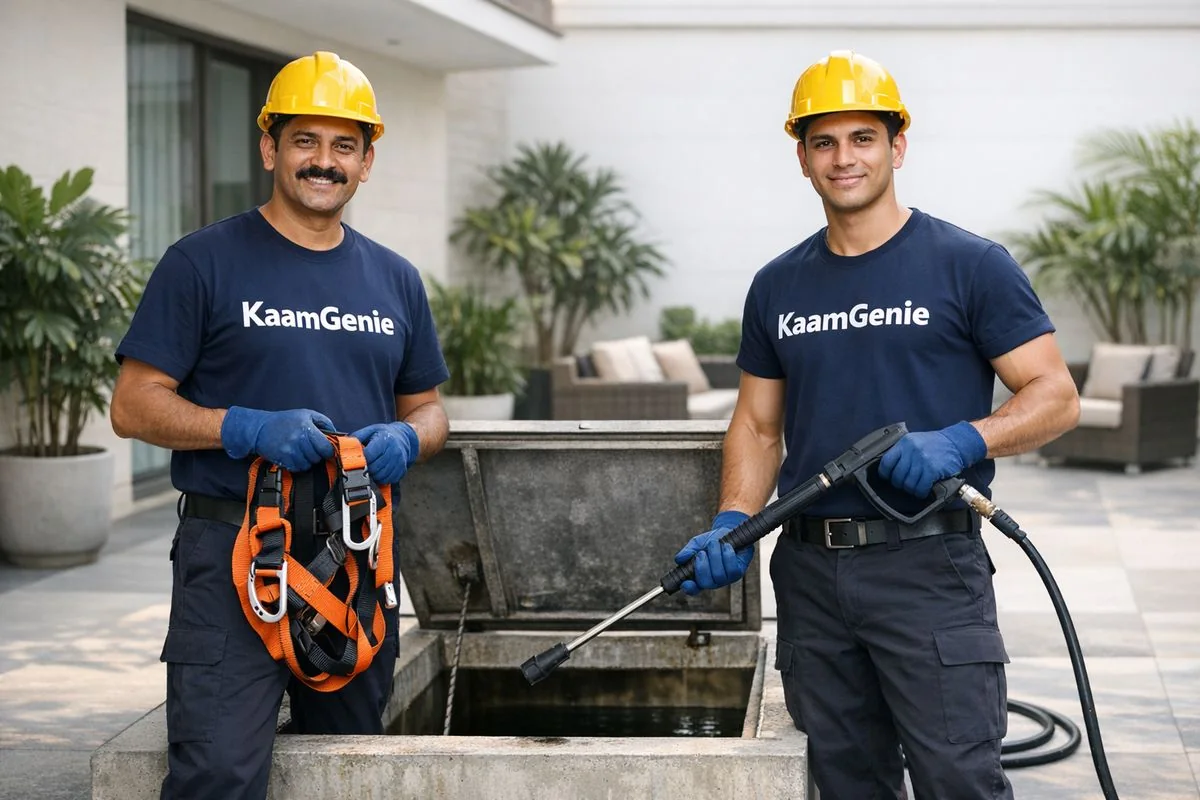
- Gas meter — visible, working, ideally with a digital reading screen
- Safety harness — full-body with chest D-ring, not just a waist belt
- Standby crew member — one person stays out of the sump, holding the rope, watching
- Hard hat + gloves — non-negotiable
- Food-grade chlorine — not pool chlorine, not industrial bleach. Ask for MSDS
- Phone number that picks up — insurance for if anything goes wrong after
How fast contamination builds between cleanings
The table below shows sludge depth at the bottom of a typical kothi sump in inner Delhi, measured at 0, 3, 6, 12 and 24 months without cleaning. Numbers are from our own measurement across 200+ kothi sumps in 2024-2025.
| Time since last cleaning | Sludge depth at sump floor | What this means |
|---|---|---|
| Right after cleaning | 0.5 cm | Baseline, normal |
| After 3 months | 1.5 cm | Mild — routine cycle |
| After 6 months | 3 cm | Noticeable — clean now |
| After 12 months | 6 cm | Severe — biofilm accelerating |
| After 24 months | 11 cm | Critical — water-quality compromised |
Past 6 months, the rate accelerates because the existing sludge layer becomes a substrate for new microbial growth — biofilms accelerate the deposition cycle. That’s why the 6-month cadence isn’t arbitrary; it’s the inflection point before things get bad.
Recommended sump cleaning frequency for Delhi
| Sump type | Recommended frequency | Why |
|---|---|---|
| Individual kothi sump (single family) | Twice a year | March-April (pre-summer) + October-November (post-monsoon) |
| Society sump (high turnover) | Every 3 months | Higher water cycling, more sediment, RWA contract usually covers this |
| Restaurant / FSSAI commercial | Every 6 months | BIS guideline; FSSAI inspection documentation required |
| Borewell-fed sump (outer Delhi) | Every 4 months | Higher TDS = faster mineral scale buildup |
| New construction (first cleaning) | Immediately + repeat in 3 months | Construction debris settles deep; second cleaning catches what first missed |
Real Delhi customer scenarios we see most
Three patterns come up again and again across our bookings:
The "didn’t realise" kothi owner. Bought a Defence Colony bungalow two years ago. Never knew there was a sump because the previous owner managed it. Calls us when the water starts smelling. Our first visit usually requires double the time (sludge is years deep). Bi-annual cleaning thereafter solves it permanently.
The "RWA changed vendors" society. A Punjabi Bagh society RWA realised the ₹800 monthly contractor wasn’t actually cleaning the sump — just dipping a pole and leaving. We re-do the cleaning, document with photos, then move them to a published quarterly contract. Saves them money and gives them inspection paperwork.
The "FSSAI inspector visit next week" restaurant. Karol Bagh restaurant got 24-hour notice of inspection. Sump cleaning + water TDS test + GST invoice + photographic documentation done in a single visit. They pass inspection. We see this pattern weekly in Connaught Place and Khan Market F&B too.
RWA, restaurant, or kothi owner?
Get an annual sump contract with documentation: cleaning records, water quality reports, GST invoices — everything inspectors and accountants need.
What KaamGenie charges
For full transparency, our sump cleaning pricing across Delhi NCR:
- Small kothi sump (up to 2,000L) — ₹1,500
- Standard kothi sump (2,000-5,000L) — ₹2,000-2,500
- Large kothi sump (5,000-10,000L) — ₹2,800-3,500
- Sump + overhead combo — ₹2,500-3,000
- Society/commercial — quoted on visit, AMC discount available
Detailed pricing on our underground sump cleaning service page. To book, call +91 95603 66362 or use the booking form on this site.
Frequently asked questions
How much does sump cleaning cost in Delhi?
Kothi sumps run ₹1,500-3,500 depending on size. Society sumps from ₹4,000. Combos with overhead tank are usually ₹2,500-3,000 because crew + equipment are already on-site.
Why is sump cleaning more expensive than overhead tank cleaning?
Confined-space safety gear (harness, gas meter, standby crew), 30-45 extra minutes per visit, and larger chemical doses. The premium reflects real safety overhead, not markup.
Can I clean my sump myself to save money?
Strongly advise against it. Hydrogen sulfide, methane and oxygen displacement kill DIY cleaners every year. The ₹1,500 saved isn’t worth your life.
How often should sumps be cleaned in Delhi?
Twice a year minimum for individual kothi sumps. Society sumps quarterly. Restaurant FSSAI sumps every 6 months per BIS guidelines.
Do you do kothi sump + overhead tank combo?
Yes. Combo pricing of ₹2,500-3,000 vs ₹1,500 + ₹1,200 separately. Same crew, same visit. Most kothi customers book this together.
What safety gear should I verify the vendor has?
Five non-negotiables: harness, gas meter, hard hat + gloves, standby crew outside, food-grade chlorine with MSDS. Vendor reluctant to show any of these? Send them home.
How long does sump cleaning take?
For a 2,000-3,000L kothi sump, 90-120 minutes for the full 8-step process. Combo with overhead adds 45 minutes.
What if my sump has bad odour or visible sludge?
Strong rotten-egg odour means hydrogen sulfide buildup. Heavy sludge means months of accumulation. Both need professional cleaning urgently — don’t wait for the next scheduled visit.
Can sumps be cleaned during monsoon?
Yes. Post-monsoon (September-October) is actually the highest-impact single cleaning of the year due to stormwater seepage. Mid-monsoon is fine if the sump is overflowing or odorous.
Do you provide water-quality testing after cleaning?
On request. TDS + chlorine residual + visual within 24 hours. Standard with annual contracts; ₹500 add-on for ad-hoc bookings. Useful for FSSAI kitchens and RWA documentation.
Sources & references
- Delhi Jal Board (DJB) — municipal water supply authority and recommended cleaning cadence for residential storage.
- Bureau of Indian Standards (BIS) — IS 10500 drinking water specification and tank maintenance guidelines.
- Food Safety and Standards Authority of India (FSSAI) — commercial kitchen water storage and inspection requirements.
- OSHA confined-space entry standards (29 CFR 1910.146) — informs our gas-test and standby-crew protocol.
Last verified: 4 June 2026. If you find any of these links broken, please let us know.