
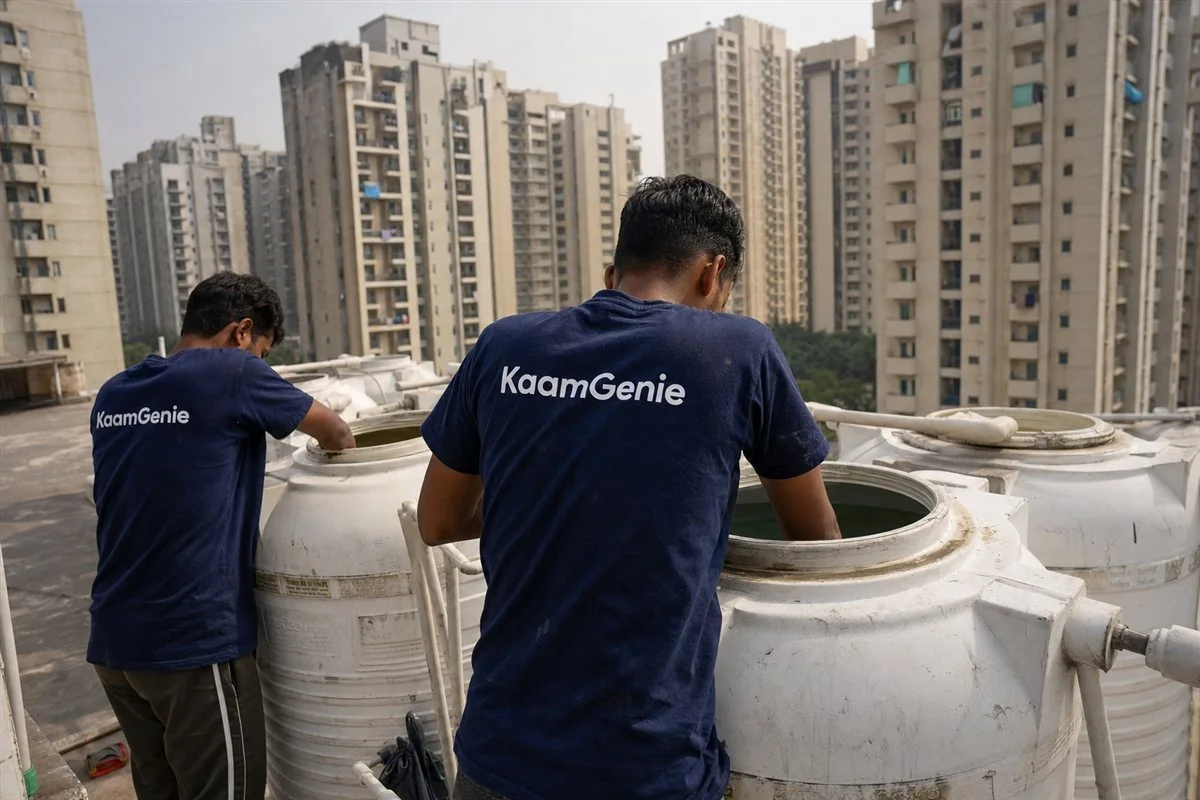
The short version for committee members
- Sign an annual contract, don’t call ad-hoc. An AMC fixes four dated visits, locks a per-tank price and keeps the records in one place — and usually costs 15–25% less than four separate one-off calls.
- Run a real tender. Give every vendor the same tank inventory and scope, and insist on per-tank pricing so the bids are comparable.
- Name one accountable person. Secretary or maintenance head drives it, treasurer signs the budget — so the contract doesn’t fall through the cracks at handover.
- The UGR must be in the price. The commonest trick is a cheap quote that quietly skips the underground reservoir.
- Tie payment to certificates. Per-tank certificate with photos, every visit, or the instalment isn’t released.
This is the contract-and-committee guide. For how the cleaning is physically staged tower-by-tower, read our companion society & high-rise tank cleaning guide for Noida.
Why a contract beats a one-off call
A single home can get away with phoning a cleaner when the water starts tasting odd. A 300-flat society in Sector 137 cannot run that way. The water serving hundreds of families passes through a shared underground reservoir and a stack of tower tanks, and keeping all of that clean is a recurring obligation — not a one-time errand. The moment a society treats tank cleaning as an annual afterthought, two things happen: cycles get missed whenever the responsible committee member is travelling, and every fresh booking becomes a price negotiation from scratch.
An annual maintenance contract (AMC) solves both. It fixes the dates a year in advance, locks a per-tank price the treasurer can budget against, and — crucially — keeps the documentation in one continuous record the committee can show at the AGM. The cleaning still has to be done properly each visit; the contract is simply the management wrapper that makes sure it actually happens, on time, with proof. That’s the difference between a society whose tanks are genuinely clean and one whose tanks are only clean on paper.
Who actually decides — the committee, not “the society”
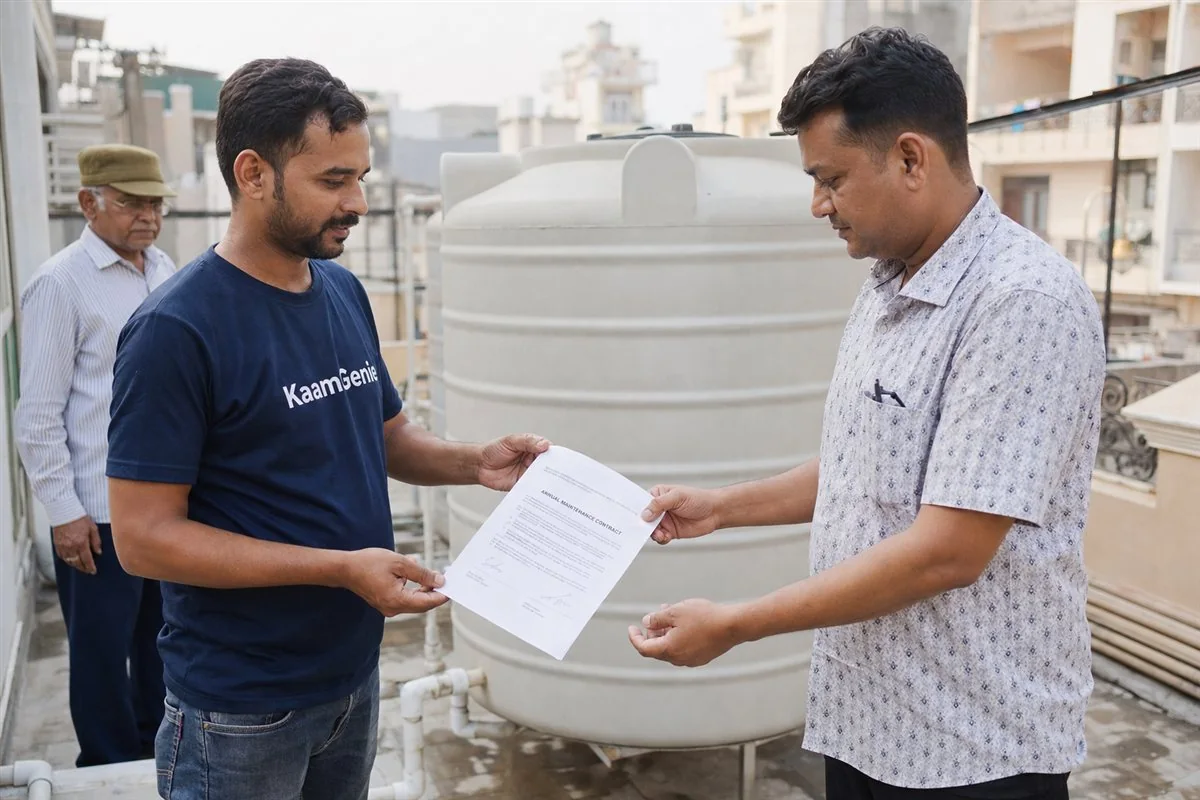
“The society will decide” is where good intentions go to die. Someone specific has to own the contract. The structure depends on which stage your complex is at:
- Builder-managed phase. While the developer still runs the complex, the facility manager arranges cleaning. This is convenient but opaque — residents rarely see the certificates, and the scope is whatever the builder’s housekeeping team decides.
- AOA / RWA formed. Once an Apartment Owners’ Association or Residents’ Welfare Association is registered and takes over common-area maintenance, the elected managing committee owns the contract. In practice the secretary or maintenance head drives the vendor process, the treasurer signs off the budget, and a larger society ratifies the award at a committee meeting or AGM.
The dangerous moment is the handover between these two, when neither side clearly owns the cleaning and the tanks can sit untouched for months. Whoever is taking over should explicitly put one named person on the tank-cleaning contract and add the four annual dates to the society calendar. For a deeper look at how the underlying AMC structure works, our Noida water tank cleaning AMC guide walks through plan types and inclusions.
How to run a fair tank-cleaning tender
A society shouldn’t accept the first quote a guard hands up from a man with a brush and a bucket. Run a short, structured tender — it takes a committee an afternoon and saves money and grief for a year:
- Build the tank inventory first. Walk the property with the maintenance team and list every tank: each underground reservoir (UGR) compartment and each tower’s rooftop tanks, with capacities and access notes. This single document is the spine of an honest comparison.
- Issue the same inventory and scope to three or four vendors. If each bidder is pricing a different mental picture of your property, the quotes are meaningless. Same inventory, same 8-step scope, same documentation requirement — for everyone.
- Insist on per-tank pricing, not a lump sum. A single round number hides whether the UGR is even included. Per-tank pricing forces the whole inventory into the open.
- Score on substance, then price. Scope, food-grade chemical specification, per-tank certificates, staging plan and confined-space safety come first; the headline number comes second. The cheapest bid is very often the one that silently drops the underground reservoir.
The table below is the scoring sheet we suggest committees use when the quotes come back.
| What to check | Good bid | Red flag |
|---|---|---|
| Tank inventory | Every UGR compartment + every tower tank listed by ID and capacity | “All tanks” with no list |
| Pricing format | Per-tank price, totalled and transparent | One lump sum, no breakdown |
| UGR included? | Reservoir priced as its own line item | Only rooftop tower tanks quoted |
| Disinfectant | Food-grade FSSAI-acceptable hypochlorite, named by spec | “Chemical / bleach” unspecified |
| Documentation | Per-tank certificate + before/after photos | No certificate, no photos |
| Staging plan | Tower-by-tower; UGR compartment-by-compartment | “Water off for the day” |
| Safety | Confined-space gear + standby person for UGR | Worker climbs in alone |
| Payment terms | Instalment released against certificate delivery | Full amount up front |
Get a per-tank tender quote for your society
We’ll survey your full tank inventory, quote per tank, and give you a written annual schedule and staging plan your committee can compare like-for-like. Residential single-tank cleaning ₹699 onwards; society/UGR custom-quoted.
What a good annual contract must cover
Once you’ve picked a vendor, the contract itself has to be written so that “a clean” means the same thing to both sides. These are the clauses we’d insist on if we were sitting on the committee:
- Full tank inventory annexed. The list of every UGR compartment and tower tank is attached to the contract, so “all tanks” is defined, not assumed.
- Defined 8-step scope per tank. Inspect, drain, de-sludge, scrub, jet-wash, vacuum, disinfect, certify — spelled out, so the reservoir gets a real clean and not a rinse.
- Food-grade disinfectant by specification. FSSAI-acceptable sodium hypochlorite named by spec and concentration, not the word “bleach.”
- Per-tank certificate with photos. One certificate per tank, every visit, with before/after images.
- Fixed quarterly schedule with resident notice. Four dated visits a year and a standard notice template for the lift lobbies.
- Staging plan in writing. Tower-by-tower and UGR compartment-by-compartment, so no block loses supply.
- Confined-space safety provisions. Ventilation, gas check, standby person and harness for the underground reservoir — a legal and moral duty.
- Payment tied to certificate delivery. Each instalment is released only when that visit’s certificates arrive.
- Termination clause. The committee can exit on notice if a visit is missed, the UGR is skipped, or certificates aren’t delivered.
That last pair — payment against documentation, plus a clean exit — is what keeps the relationship honest without ever needing a dispute. If you want to see the underlying job scope every one of these tanks deserves, our society staging guide covers the physical method, and our city-wide water tank cleaning services page sets out what we deliver to committees.
Documentation: the paperwork that protects the committee
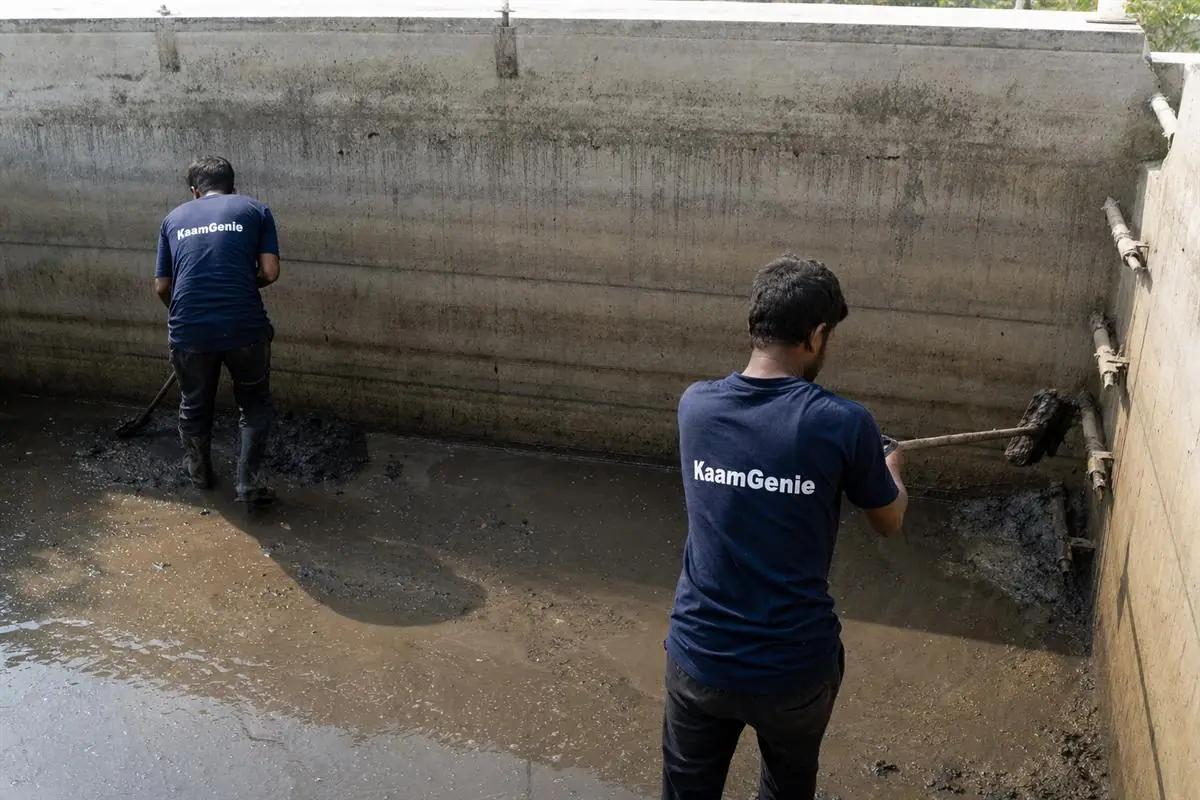
For an individual flat, the cleaning record is a nice-to-have. For a committee handling other people’s money and other people’s drinking water, it is the whole point. The documentation is what lets the secretary stand up at the AGM and prove the maintenance charges bought a real service, and what protects the committee if a resident ever raises a water-quality complaint.
Demand a separate certificate for every tank — each UGR compartment and each tower’s rooftop tanks — listing the tank ID, capacity, date, crew names, chemicals used, and before/after photographs. A single “society cleaned” slip proves nothing; it’s exactly the document a corner-cutter produces after doing only the easy rooftop tanks. The per-tank set is harder to fake because it forces the whole inventory to be accounted for, tank by tank. File every quarter’s certificates in one folder, and the contract effectively audits itself.
The AMC discount: why an annual deal pays
The financial case for an annual contract is straightforward. When a society books four separate one-off cleans across a year, it pays full per-visit rates every time, and the contractor re-surveys and re-mobilises from scratch on each call. An AMC lets the contractor schedule the whole year, keep your inventory and access notes on file, and plan crews efficiently — and that efficiency comes back to the society as a discount, typically in the 15–25% range against four full-price one-offs.
Annual cost — four one-off cleans vs a quarterly AMC contract
Illustrative: the AMC bundles the same four quarterly visits at a planned-year discount
Illustrative only — actual figures depend on tank count, capacity and access. The point is direction, not exact numbers: a planned annual contract removes the cost of re-surveying and re-mobilising on every call, and the bigger the inventory, the larger the saving. Ask for a per-tank quote both ways and compare.
But the discount, honestly, is the smaller benefit. The bigger one is that the cleaning actually happens. The recurring failure we see across Noida societies isn’t an expensive contract — it’s a forgotten one, where a busy committee meant to call “next month” and the UGR went a year without a clean. A dated quarterly AMC removes the human-memory risk entirely. For how the right frequency is decided on Noida’s hard groundwater, see our guide on how often to clean a water tank in Noida, and our Noida tank cleaning cost guide breaks down what actually drives a per-tank quote.
Setting up your society AMC?
Free tank-inventory survey, a per-tank annual quote, a written staging plan and per-tank certificates every quarter. We cover the high-rise belts across Noida and Greater Noida West. Society/UGR custom-quoted; residential ₹699 onwards.
The handover-year contract (new Noida towers)
If your AOA has just taken over a newly handed-over complex — common right now across the Noida Expressway high-rise belt and Greater Noida West — the first contract has a special job to do. New towers often carry construction residue in the UGR and rooftop tanks: cement slurry, sand, grit and pipe-flushing debris left from the build. The builder’s housekeeping rarely does a proper food-grade clean before handover. So the fresh committee’s very first move should be to commission a full UGR-plus-tower clean, document it with per-tank certificates as the society’s baseline, then roll straight into a quarterly AMC.
We run this for committees across the Expressway corridor — from the high-rise clusters of Sector 137 to the towers around Sector 78 and Sector 100. Keep the first term to a single year with quarterly visits: long enough to earn the AMC discount and let us learn your property, short enough that the committee can switch if standards ever slip.
Set up your society contract across Noida
Whether your committee is awarding a first contract after handover, replacing an agency that only ever did the rooftop tanks, or simply moving to a documented quarterly schedule, we work the high-rise belts across Noida and Greater Noida West — UGR plus every tower, staged so no block loses water, with a per-tank certificate for each one. Start at our water tank cleaning in Noida hub for sector coverage and booking, or call us to arrange a free tank-inventory survey and a per-tank annual quote your committee can compare like-for-like.
To book, call +91 95603 66362 or use the booking form on this site — we’ll confirm shortly.
Frequently asked questions
Should our RWA sign an annual contract or just call for cleaning each time?
For a high-rise society, an annual contract almost always wins. Ad-hoc calling means the committee re-negotiates price every quarter, the contractor has no incentive to keep your tank inventory on record, and cycles get missed when a committee member is travelling. An annual AMC fixes four dated visits, locks a per-tank price, keeps the documentation in one place, and typically discounts 15–25% against four separate one-off calls because the contractor can plan the year.
Who in the society decides on the tank-cleaning contract?
Once an AOA or RWA is formed, the elected managing committee owns the decision — usually the secretary or maintenance head drives it, the treasurer signs off the budget, and larger societies ratify the contract at a committee meeting or AGM. While the society is still builder-managed, the facility manager arranges it. The key is to name one accountable person so the contract does not fall through the cracks at handover.
How do we run a fair tank-cleaning tender for our society?
Start with a written tank inventory — every UGR compartment and every tower’s rooftop tank by capacity. Share the same inventory and scope with three or four vendors so quotes are comparable, and insist on per-tank pricing rather than a single lump sum. Score on scope, food-grade chemical spec, per-tank certificates, staging plan and confined-space safety, not on headline price alone. The cheapest bid usually skips the underground reservoir.
What clauses must a society water tank cleaning contract include?
A full tank inventory, a defined 8-step scope per tank, food-grade FSSAI-acceptable disinfectant named by specification, a per-tank certificate with before/after photos, a fixed quarterly schedule with resident notice, a tower-by-tower staging plan so no block loses water, confined-space safety provisions for the UGR, a fixed per-tank price with no surprise add-ons, payment tied to certificate delivery, and a termination clause if standards slip.
How much can an annual contract save versus per-visit cleaning?
Across a year of four quarterly cleans, an AMC typically saves a society 15–25% against booking four separate one-off visits at full per-visit rates. The saving comes from the contractor being able to schedule efficiently, keep your tank inventory and access notes on file, and avoid re-surveying each time. The bigger benefit is that the cleaning actually happens on schedule rather than being forgotten.
What documentation should the contractor hand over after each visit?
A separate cleaning certificate for every tank — each UGR compartment and each tower overhead tank — listing the tank ID, capacity, date, crew, chemicals used and before/after photos. Together these form the society’s audit trail. The committee keeps them to show residents at the AGM, to satisfy any water-quality complaint, and to prove the whole inventory was covered and not just the easy-to-reach rooftop tanks.
How long should the first society contract run?
A one-year term with quarterly visits is the sensible default for a first contract. It is long enough to earn the AMC discount and let the contractor learn your property, but short enough that the committee can switch if standards slip. Build in a review at the end of the first two cycles, and renew annually once you are confident the UGR and every tower are genuinely being done.
Can we change contractors mid-year if the work is poor?
Yes, if the contract is written properly. Include a termination clause that lets the committee exit on notice if certificates are not delivered, the UGR is skipped, or a visit is missed. Tying each payment to per-tank certificate delivery is the strongest protection — if the documentation does not arrive, the work is not signed off and the next instalment is not released. That keeps the contractor honest without needing a dispute.
Does the contract price cover the underground reservoir as well as the tower tanks?
It must, and you should check this line by line. The single most common gap in society contracts is a quote that silently covers only the rooftop tower tanks and leaves out the underground reservoir — the source tank that feeds everything. Insist the UGR compartments appear in the inventory with their own per-tank price. If a bid is suspiciously cheap, the missing UGR is usually the reason.
Sources & references
- Bureau of Indian Standards (BIS) — IS 10500:2012 is the canonical Indian Standard for drinking water specification, defining acceptable limits for physical, chemical, and biological parameters.
- WHO Guidelines for Drinking-water Quality, 4th edition — the global reference for water quality standards, including guidance on storage and disinfection.
- Food Safety and Standards Authority of India (FSSAI) — defines water quality requirements for food businesses, including hygiene standards for stored water and acceptable disinfection chemicals.
- WHO Fact Sheet on Drinking Water — overview of safe drinking water requirements and contamination risks.
- CPHEEO — Manual on Water Supply and Treatment — the Government of India’s engineering manual covering tank design, cleaning protocols, and disinfection practices.
Last verified: 30 June 2026. If you find any of these links broken, please let us know.