
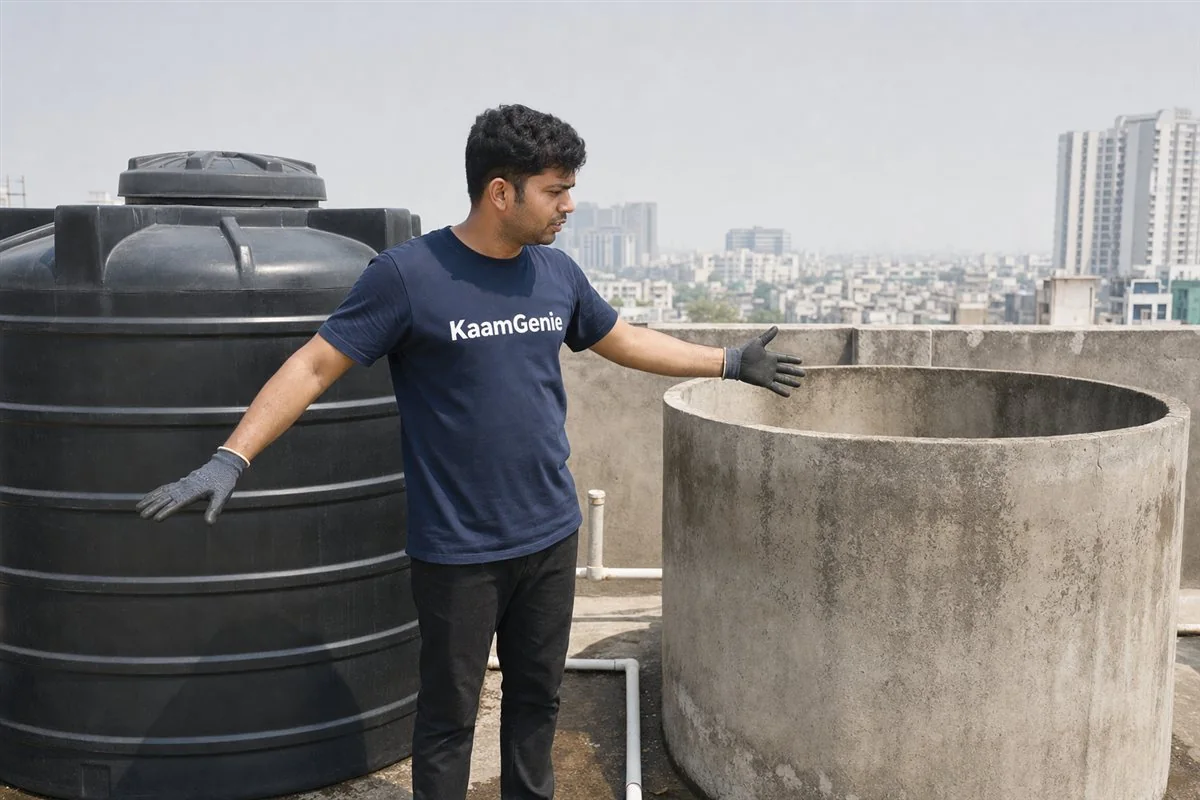
The short version
- Surface decides everything. Sintex/plastic is smooth and non-porous — dirt sits on top and rinses off. Concrete (RCC) is porous and rough — bio-film and scale grip into the pores.
- Plastic = quick clean. Rooftop Sintex tanks scrub, jet-wash, vacuum and disinfect fast. Residential single-tank cleaning ₹699 onwards.
- Concrete = bigger job. Underground RCC reservoirs need heavier descaling, food-grade sealing checks and confined-space safety — custom-quoted.
- Hard water hits concrete hardest. Noida’s calcium-heavy borewell water builds thick scale on porous RCC walls far faster than on smooth plastic.
- Algae is a plastic problem. Sun-exposed translucent tanks can grow algae; buried concrete stays dark but harbours more bio-film and sediment.
- Clean both on a quarterly rhythm. Concrete usually needs the more frequent end of the range.
If a cleaner treats your porous concrete reservoir like a quick plastic-tank rinse, you’re paying for half a job.
Why the material changes the cleaning
A water tank is really just a storage surface, and the nature of that surface decides how dirt attaches to it and how hard it is to get off. That’s the whole difference between a Sintex (plastic) tank and a concrete (RCC) one. In Noida you almost always have both somewhere in the chain — municipal or borewell water lands in a concrete underground reservoir, then gets pumped up to plastic overhead tanks on the roof, then flows down to your taps. For the basics of how those two positions in the chain differ, our companion guide on overhead vs underground tank cleaning covers the layout; here we’re focused specifically on the material and what it does to a clean.
Sintex/plastic tanks — the black, blue or white moulded tanks you see on every builder floor and rooftop — have a smooth, non-porous inner wall. Grime, calcium film and bio-film land on the surface but can’t grip into it, so they lift off with food-grade brushes and a rinse. Concrete (RCC) tanks — the cast reservoirs under older houses and at the base of society towers — have a porous, slightly textured wall. Over years that surface develops micro-pits where bio-film and calcium scale settle into the wall rather than just on it. Same water, same city, very different cleaning effort.
| Factor | Sintex / plastic | Concrete / RCC |
|---|---|---|
| Surface & porosity | Smooth, non-porous — dirt sits on top | Porous, slightly rough — dirt grips into pores |
| How it’s cleaned | Brush, jet wash, vacuum, disinfect — quick | Heavier descale + scrub + jet + disinfect + sealing check |
| Hard-water scaling | Thin film, wipes off | Thick calcium crust grips the pores |
| Algae risk | Higher if translucent & sun-exposed | Very low (buried, dark) but more bio-film |
| Typical location | Rooftop overhead tanks, flats, builder floors | Underground reservoirs, older society tanks |
| Access for cleaning | Easy — open lid, reach in | Confined space — ventilation & safety gear |
| Durability | 10–15 yrs; UV-ages, can crack | Decades if sealed; fails if it cracks/leaks |
| Frequency in Noida | Every 3–4 months | Quarterly (more if heavily scaled) |
| Cleaning cost | ₹699 onwards (residential) | Custom-quoted by capacity & access |
Got both kinds of tank? We clean both
Rooftop Sintex tanks and underground concrete reservoirs, cleaned the right way for each surface, in one visit. Residential single-tank ₹699 onwards; concrete/UGR custom-quoted.
Surface and porosity — the root of the difference
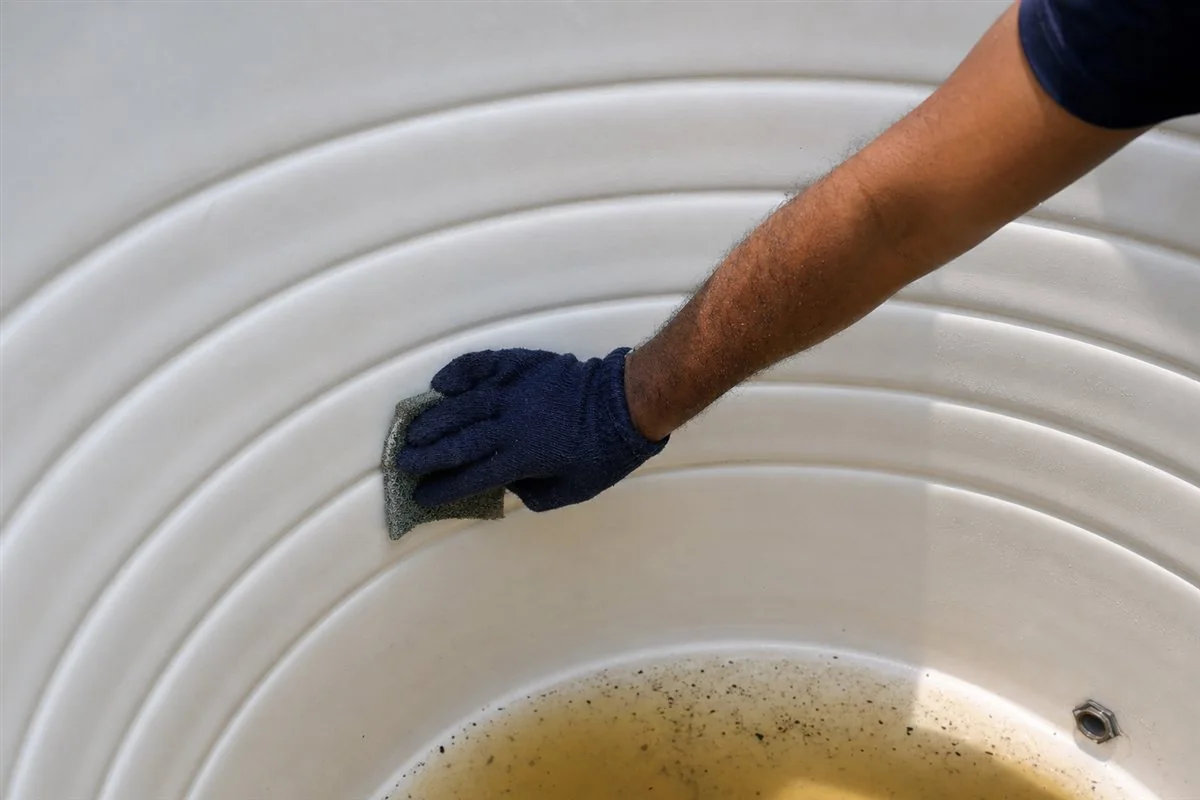
Run a gloved hand over the inside of a clean Sintex tank and it feels like a kitchen worktop — slick and continuous. Do the same in an old RCC reservoir and it feels like fine sandpaper. That texture is everything. On plastic, the contamination forms a film that has nothing to hold onto, so a food-grade nylon brush shears it off and a jet wash and rinse carry it away. The wall is genuinely clean in minutes.
Concrete is a different problem. The pores and micro-pits act like thousands of tiny pockets. Bio-film — the slimy bacterial layer that causes smells and stomach trouble — settles into them, and a surface rinse glides right over the top without touching what’s inside the pores. That’s why a concrete tank can look rinsed but still smell within days: the cleaner removed the easy top layer and left the rooted bio-film behind. A real concrete clean uses higher jet-wash pressure to drive water into the pores, longer manual scrubbing, and a food-grade disinfectant left to dwell so it actually penetrates and kills what’s in there.
How each one is actually cleaned
The core eight steps — inspect, drain, de-sludge, scrub, jet-wash, vacuum, disinfect, certify — apply to both. What changes is the intensity and the safety setup:
- Sintex / plastic (rooftop): Open the lid, drain, scoop the light sediment, scrub the smooth walls with food-grade nylon brushes, a moderate jet wash to clear corners and the lid threads, wet-vacuum the residue, then disinfect with food-grade sodium hypochlorite and rinse. Fast, because nothing is gripped into the wall. The main watch-points are using nylon (never metal) brushes and easing jet pressure on older, sun-aged plastic so it isn’t cracked.
- Concrete / RCC (underground): Same skeleton, heavier everywhere. More sludge collects at the bottom of a reservoir, so de-sludging takes longer. Calcium scale on the walls needs proper descaling, not just a brush. The jet wash runs harder to reach into the porous surface. And because it’s below ground, it’s confined-space work — ventilation, a standby person, gas checks and a harness are non-negotiable. The crew also checks the food-grade sealing or lining for cracks, because a failed seal lets groundwater seep in between cleans. The depth and access of these reservoirs is a job in itself — our guide to underground sump cleaning in Noida covers that side in detail.
This is also why the same crew clears a rooftop Sintex tank in well under an hour but spends two to three hours or more on a concrete reservoir. It’s not padding — the material genuinely demands it.
Hard water: where concrete really suffers
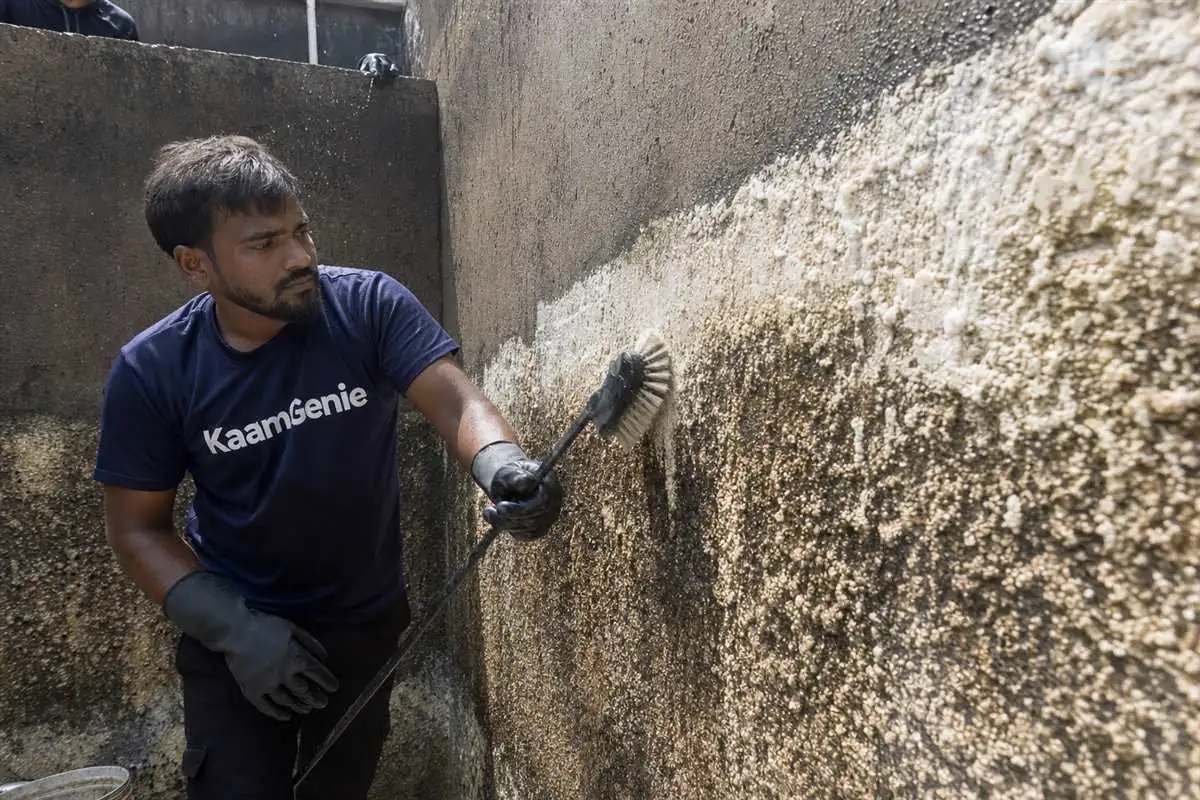
A lot of Noida and especially Greater Noida West runs on borewell and groundwater that is genuinely hard — high in calcium and iron. That mineral load drops out of the water as scale on whatever surface it touches. On a smooth Sintex wall it forms a thin chalky film that comes off with a brush. On a porous concrete wall it does something worse: the minerals crystallise into the pores and build a thick, crusty layer that bonds to the surface. Left for a year between cleans, an RCC reservoir wall can carry a scale crust you have to physically descale, not just wipe.
This is the single biggest reason concrete tanks in Noida need the more frequent, more thorough end of cleaning. The water chemistry is the same for both materials — the porous surface just punishes you harder for it. If you want the full picture of why Noida’s supply scales tanks so fast and what that does to taste, sediment and appliances, read our dedicated piece on hard-water tank cleaning in Noida; we won’t re-tread the water-chemistry detail here.
Algae and hygiene risk — opposite weaknesses
The two materials fail hygiene in almost opposite ways, which is worth understanding because it changes what you watch for.
Sintex/plastic’s weakness is light. A translucent or light-coloured plastic tank sitting in direct Noida sun lets sunlight pass through the wall. Sunlight plus warmth plus the trace nutrients in stored water is exactly what algae needs, and you get green or brownish growth inside — sometimes within weeks in summer. The fixes are easy: choose an opaque, dark tank or shade it, keep the lid properly sealed against light and dust, and clean on schedule. Because the wall is smooth, once you remove the conditions the algae has nothing to root into.
Concrete’s weakness is the dark. A buried reservoir gets no light, so it almost never grows algae — but the same darkness, stillness and porous surface make it an ideal home for bio-film and sediment. The contamination you can’t see is often worse than the green you can. That’s why a concrete tank that “looks fine” can still be the dirtiest tank in the building. Both risks are fully controlled by cleaning on the right rhythm with proper disinfection — they just need you to watch different warning signs.
Cleaning time by tank, same crew — Noida
Porous concrete and confined-space access make the reservoir the longer job
Illustrative timings for a clean using the same crew and the full 8-step scope. A smooth plastic tank finishes fast; a porous concrete reservoir takes longer because of heavier de-sludging, descaling and confined-space safety setup. Actual time depends on capacity, scale build-up and access.
Durability — and when material actually matters for replacement
Cleaning ease isn’t the only thing that separates the two. Sintex/plastic tanks are light, cheap and easy to install on a roof, which is exactly why builders use them for overhead storage. Their downside is lifespan: UV exposure ages the plastic over roughly 10–15 years, and an old tank can grow brittle or crack at the seams. Concrete/RCC tanks last for decades when they’re built and sealed properly, and for a large underground reservoir they’re often the only realistic option — you can’t practically mould a 50,000-litre plastic tank under a building. Their failure mode is structural: a crack or failed waterproofing lets groundwater seep in, which contaminates the stored water and needs sealing repair, not just cleaning.
So the honest answer to “should I switch concrete to plastic for easier cleaning?” is usually no. Keep concrete for the big underground reservoir and clean it well; keep plastic on the roof where its smoothness and light weight earn their keep. Replace concrete only when it’s genuinely cracked or leaking. If your building runs the common Noida setup — concrete reservoir feeding plastic rooftop tanks — the right move is to clean the whole chain together, which is also how we handle the difference between high-rise and plotted houses in Noida.
Which needs more care in Noida? Concrete — clearly
Putting it together: in Noida’s hard-water conditions, the concrete tank is the one that needs more attention, more often. It scales faster, holds bio-film in its pores, hides its dirt in the dark, sits in a confined space that makes a half-job tempting for cheap operators, and supplies the whole building as the source reservoir. The Sintex rooftop tank is genuinely the easy one — quick to clean, easy to inspect, and its main risks (algae, UV ageing) are simple to manage. Neither should be neglected, but if you only have budget and attention for one priority this quarter, the concrete reservoir is it.
We clean both, on the right rhythm for each, right across Noida and Greater Noida West — from the apartment belt around Sector 137 and the established sectors near Sector 78 to the fast-occupying towers of Greater Noida West (Noida Extension). Whether it’s a single rooftop Sintex tank or a society’s underground concrete reservoir plus every tower tank, you can book the whole job through our water tank cleaning in Noida hub.
Not sure which tank is the problem?
Book a clean and we’ll assess both your rooftop plastic tank and your concrete reservoir on arrival — before/after photos and a certificate for each. Residential ₹699 onwards; concrete/UGR custom-quoted.
Book a Sintex or concrete tank clean across Noida
Whether you need a quick rooftop Sintex clean before guests arrive, a heavy descale of a neglected concrete reservoir, or a full society job covering the underground RCC tank and every plastic tower tank, we bring the right method and gear for the surface — food-grade chemicals, confined-space safety where it’s needed, and a certificate per tank. Start at our water tank cleaning in Noida hub for sector coverage and booking.
To book, call +91 95603 66362 or use the booking form on this site — we’ll confirm shortly.
Frequently asked questions
Which is easier to clean — a Sintex (plastic) tank or a concrete (RCC) tank?
A Sintex/plastic tank is easier and faster. Its walls are smooth and non-porous, so scale and bio-film sit on the surface and lift off with food-grade brushes and a quick jet wash and rinse. A concrete (RCC) tank has a porous, slightly rough surface that holds bio-film and calcium scale in its pores, so it needs harder scrubbing, stronger descaling and a careful check of any food-grade lining or sealing. As a rule, a rooftop Sintex tank is a quick clean and a concrete underground reservoir is a longer, more involved job.
Why do concrete tanks in Noida scale up faster than plastic ones?
Two reasons combine. First, much of Noida and Greater Noida West runs on hard borewell and groundwater that is high in calcium and iron, so scale deposits quickly on any surface. Second, concrete is porous and slightly rough, which gives that scale far more texture to grip than a smooth plastic wall. The same hard water that leaves a thin film on a Sintex tank can build a thick, crusty calcium layer on an RCC wall, especially in older society reservoirs that are cleaned only once a year.
Do Sintex tanks get algae, and how do you stop it?
Yes, if light reaches the water. Translucent or light-coloured plastic tanks left in direct Noida sun let sunlight through the walls, and sunlight plus warmth plus nutrients grows green or brown algae inside. The fixes are simple: use an opaque, dark-coloured tank or shade it, keep the lid sealed so light and dust stay out, and clean and disinfect on schedule. A buried concrete reservoir gets no light so it rarely grows algae, but it makes up for it with bio-film and sediment in the dark.
How often should I clean a Sintex tank versus a concrete tank in Noida?
On Noida’s hard water, plan a rooftop Sintex tank every three to four months and a concrete underground reservoir at least every three months, or quarterly as a firm default. Concrete generally needs the more frequent end of the range because its porous walls re-scale and hold bio-film faster, and underground reservoirs collect more incoming sediment than a rooftop tank. Both should be cleaned more often than the twice-a-year minimum that suits soft municipal water.
Can the same crew clean both my rooftop Sintex tank and my underground concrete reservoir?
Yes. The same KaamGenie crew cleans both, but they switch method and gear between them. The rooftop Sintex tank is a smooth-wall scrub, jet wash, vacuum and food-grade disinfection. The underground concrete reservoir adds confined-space safety — ventilation, a standby person, gas checks and a harness — plus heavier descaling and a check of the food-grade sealing. We usually do the source reservoir and the rooftop tanks in one visit so the whole storage chain is clean at once.
Does cleaning a plastic tank cost less than a concrete tank in Noida?
Usually yes, because a standard rooftop Sintex tank is quicker and needs no confined-space setup — residential single-tank cleaning starts at ₹699 onwards. A concrete underground reservoir takes longer, needs safety gear and heavier descaling, and is larger, so it is custom-quoted by capacity and access. The material itself is only part of it; size, location and how scaled the tank has become drive the final price more than plastic-versus-concrete alone.
My concrete underground tank smells even after cleaning — why?
Usually because the clean was a rinse, not a real descale. Concrete is porous, so bio-film and organic matter sit inside the wall pores; if a crew only sprays water from above without physically scrubbing, jet-washing and disinfecting with proper contact time, the smell-causing bacteria survive in the pores and return within days. A genuine concrete clean removes the sludge, scrubs and jet-washes the walls, then disinfects with food-grade sodium hypochlorite at the right concentration and dwell time. If sealing has failed and groundwater is seeping in, that also needs fixing.
Are food-grade brushes safe on Sintex tank walls?
Yes, food-grade nylon brushes are exactly what plastic tanks need. What you must avoid is metal brushes or wire wool, which scratch the smooth plastic surface and create micro-grooves where bacteria and bio-film can hide — turning an easy-to-clean wall into a problem one. We use food-grade nylon bristles on both Sintex and concrete, adjusting only the stiffness and the jet-wash pressure to suit the surface and the tank’s age.
Should I replace my old concrete tank with a Sintex one?
Not just for cleaning convenience. A well-built, properly sealed RCC concrete tank is very durable and is often the only practical option for a large underground reservoir, which is hard to do in plastic at that scale. Sintex/plastic is ideal for rooftop overhead storage because it is light, smooth and easy to clean. Replace concrete only if it is cracked, leaking or has failed sealing that lets groundwater in — otherwise a good quarterly clean keeps an RCC tank perfectly hygienic.
Sources & references
- Bureau of Indian Standards (BIS) — IS 10500:2012 is the canonical Indian Standard for drinking water specification, defining acceptable limits for physical, chemical, and biological parameters.
- WHO Guidelines for Drinking-water Quality, 4th edition — the global reference for water quality standards, including guidance on storage and disinfection.
- Food Safety and Standards Authority of India (FSSAI) — defines water quality requirements for food businesses, including hygiene standards for stored water and acceptable disinfection chemicals.
- WHO Fact Sheet on Drinking Water — overview of safe drinking water requirements and contamination risks.
- CPHEEO — Manual on Water Supply and Treatment — the Government of India’s engineering manual covering tank design, cleaning protocols, and disinfection practices.
Last verified: 27 June 2026. If you find any of these links broken, please let us know.