
The short version
- Tanker water carries more sediment — fine sand, silt and iron from the source borewell, plus residue from the tanker barrel itself.
- Big UGRs act like settling tanks. The larger and stiller the underground reservoir, the more sludge drops out of even clear-looking tanker water.
- Greater Noida West / Noida Extension is heavily tanker-fed — new towers, large UGRs, and high consumption mean fast sludge build-up.
- Tanker-fed buildings need cleaning more often — roughly every 3 months for the UGR and tower tanks if you run mostly on tankers.
- The fix is the same 8-step clean with extra time on sludge removal and wet-vacuuming, plus a clean before and after the summer tanker season.
A purifier protects your glass. Cleaning the tank protects every tap in the building — and on tanker supply, the tank is where the dirt lands first.
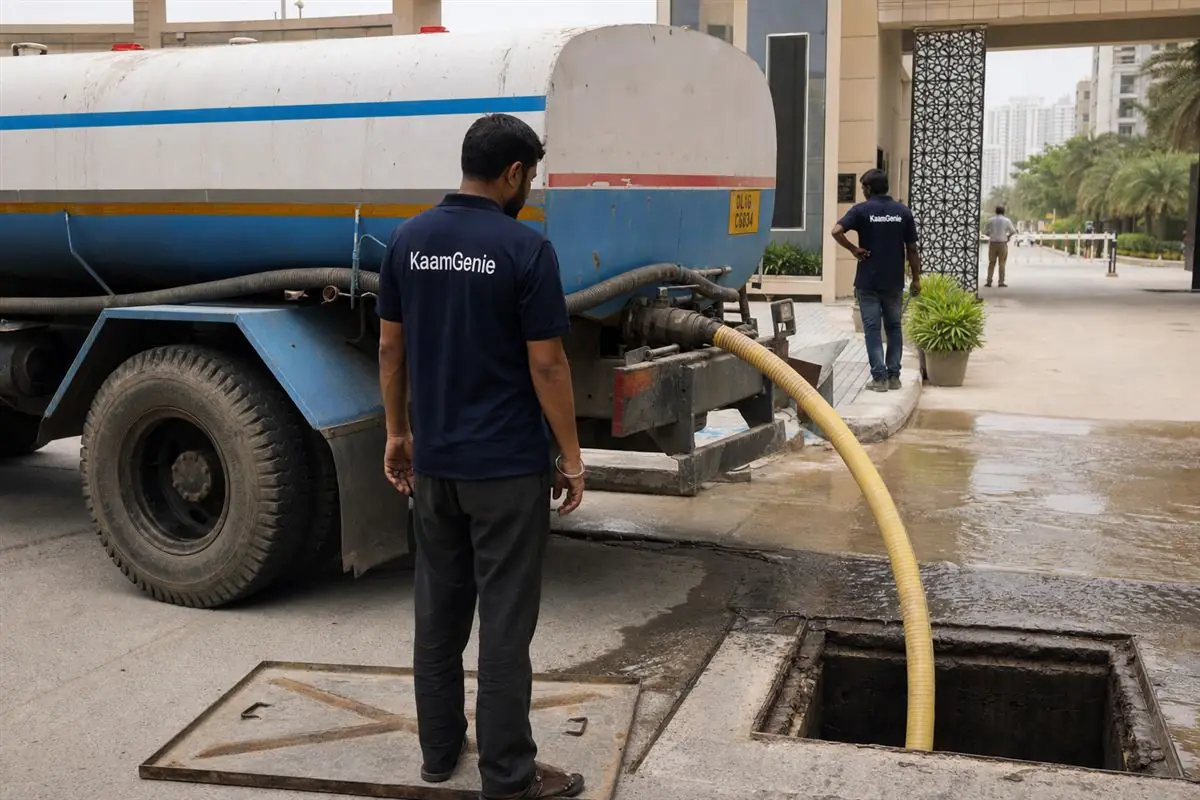
If you live along the Noida Expressway high-rise belt — Sectors 137, 150, 168, 75, 76, 78, 100 — or anywhere in the Greater Noida West township sprawl, you already know the rhythm. The Authority piped supply (Ganga Jal and canal water) covers a lot of Noida, but it does not always reach the newest, tallest towers in full, and demand outruns it every summer. The gap gets filled by private water tankers, and in Noida Extension whole societies have run on tankers from day one because the formal piped network arrived after the towers did.
That tanker water is not the problem on its own — it is treated, it is drinkable after your normal precautions, and it keeps thousands of flats running. The problem is what it does inside your storage. Tanker-fed buildings collect sediment faster, settle a thicker sludge layer in their underground reservoirs, and need water tank cleaning in Noida on a tighter schedule than buildings sitting comfortably on steady piped supply. This piece explains why, and what to do about it.
| Factor | Piped Ganga Jal / canal supply | Tanker water (Noida / Gr. Noida West) |
|---|---|---|
| Source | Treated surface water, closed pipeline | Borewell / ground source, road tanker barrel |
| Suspended sediment | Low — clarified before delivery | Higher — fine sand, silt, iron carry-over |
| Quality consistency | Fairly steady | Variable — depends on which source the tanker drew from |
| Sludge build-up in UGR | Slow | Fast — visibly thicker floor layer |
| Typical cleaning interval | Every 4-6 months | Every 3 months for heavy tanker dependence |
Tanker-fed tank? Get it cleaned right.
Extra time on sludge removal and vacuuming, food-grade disinfection, before/after photos. Residential ₹699 onwards; society UGRs quoted on size.
Why tanker water carries more sediment
Piped Ganga Jal reaches your building after it has been clarified, filtered and chlorinated at a treatment works, then carried through a sealed pipe network. By the time it hits your inlet, most of the suspended solids are gone. Tanker water takes a very different route. It is usually drawn from a borewell or a ground source, sometimes through an intermediate ground-level storage, then pumped into a road tanker and driven across Noida to your gate.
Every one of those handoffs adds load. Borewell and ground water in the Noida and Greater Noida belt is naturally harder and often carries fine sand, silt and dissolved iron — the same minerals behind the scaling we cover in Noida hard water tank cleaning. The tanker barrel itself is the part people forget: those steel and plastic barrels are cleaned rarely, so each load picks up whatever settled from the last one. The water that arrives can look clear, but it is carrying a heavier suspended-solids load than treated piped supply, and that load has to go somewhere once the water sits still.
Big UGRs are settling tanks — that’s the catch
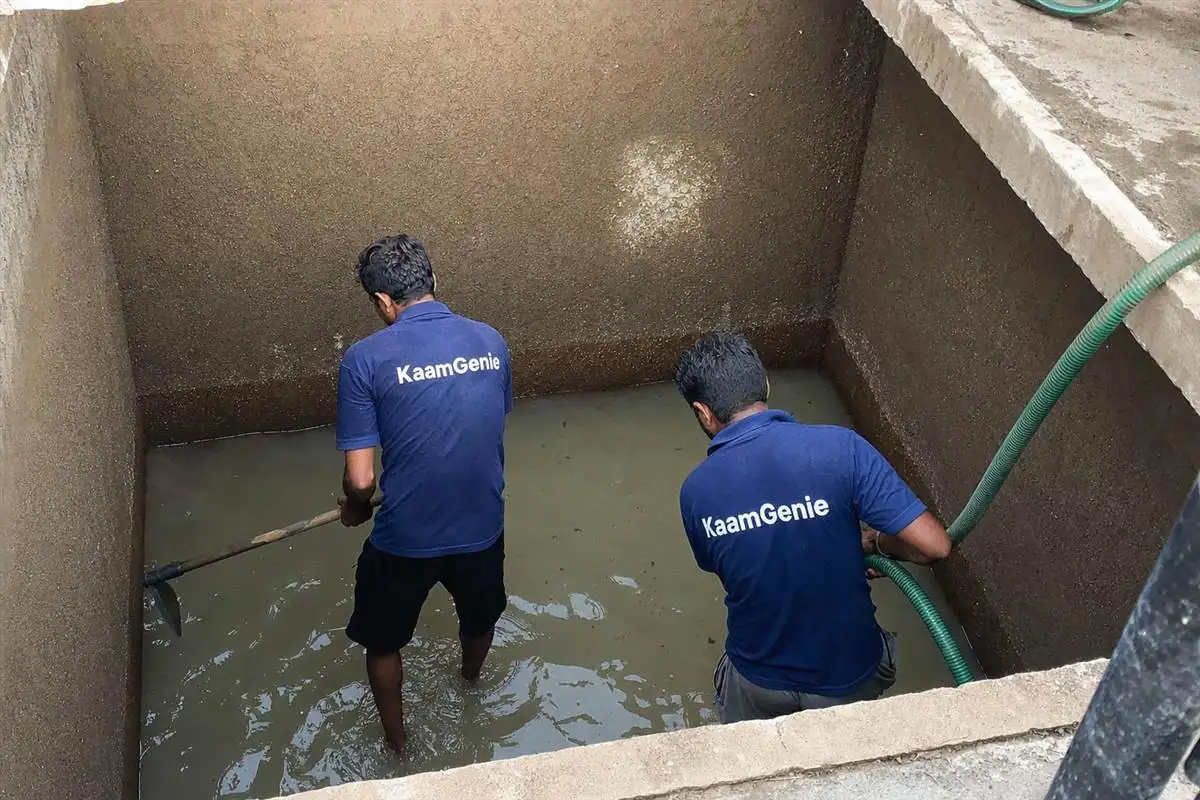
Where it goes is the floor of your tank. Most tanker-fed buildings in Noida and Greater Noida store their water in a large underground reservoir (UGR) at ground or basement level, which then pumps up to rooftop tower tanks that gravity-feed the flats. A tanker does not fill rooftop tanks directly — it dumps into the UGR, and the UGR is exactly the wrong shape for keeping water clean.
A big, still body of water behaves like a settling tank. Suspended particles that stay invisible while the water is moving drop straight to the bottom the moment it sits. The larger the reservoir and the longer the water dwells before being pumped up, the more sediment settles out. So a 20,000-litre society UGR being topped up by tankers two or three times a day accumulates a sludge layer far faster than a small rooftop tank on piped supply. The water on top can look fine to anyone who lifts the lid — meanwhile the bottom 20% of the tank is building a soft, muddy layer that breeds bio-film and feeds bacteria. This is the same dynamic we explain in our guide to underground sump cleaning in Noida, only accelerated by the tanker load.
Relative sludge build-up by supply type — same tank, 90 days
Illustrative, based on what our Noida crews typically pull out of each tank type
The same supply settles far more sludge in a large, still underground reservoir than in a small rooftop tank — which is why tanker-fed UGRs are the priority tank to keep on a tight schedule.
Why Greater Noida West / Noida Extension feels it worst
Noida Extension is the clearest case in the whole NCR. The towers went up fast, the population arrived faster, and the formal piped network reached many societies only after they were already occupied. The result is a township belt that has leaned on tankers and borewells from the start — large UGRs, high per-tower consumption, and a lot of new RCC reservoirs whose rough concrete floors hold sediment and bio-film more readily than smooth plastic. Add the region’s naturally hard groundwater and you get tanks that build sludge and scale at the same time.
The same pattern shows up wherever tanker dependence is high: the Expressway high-rise belt during the summer crunch, builder-floor pockets with shared sumps, and the newer Greater Noida sectors around Pari Chowk. If you want the area-specific version, we go deeper in water tank cleaning in Greater Noida West. For tanker-heavy townships, the booking that matters most is the UGR, not the individual flat tank — that is where the contamination concentrates before it is pumped up to everyone.
What a tanker-fed clean does differently
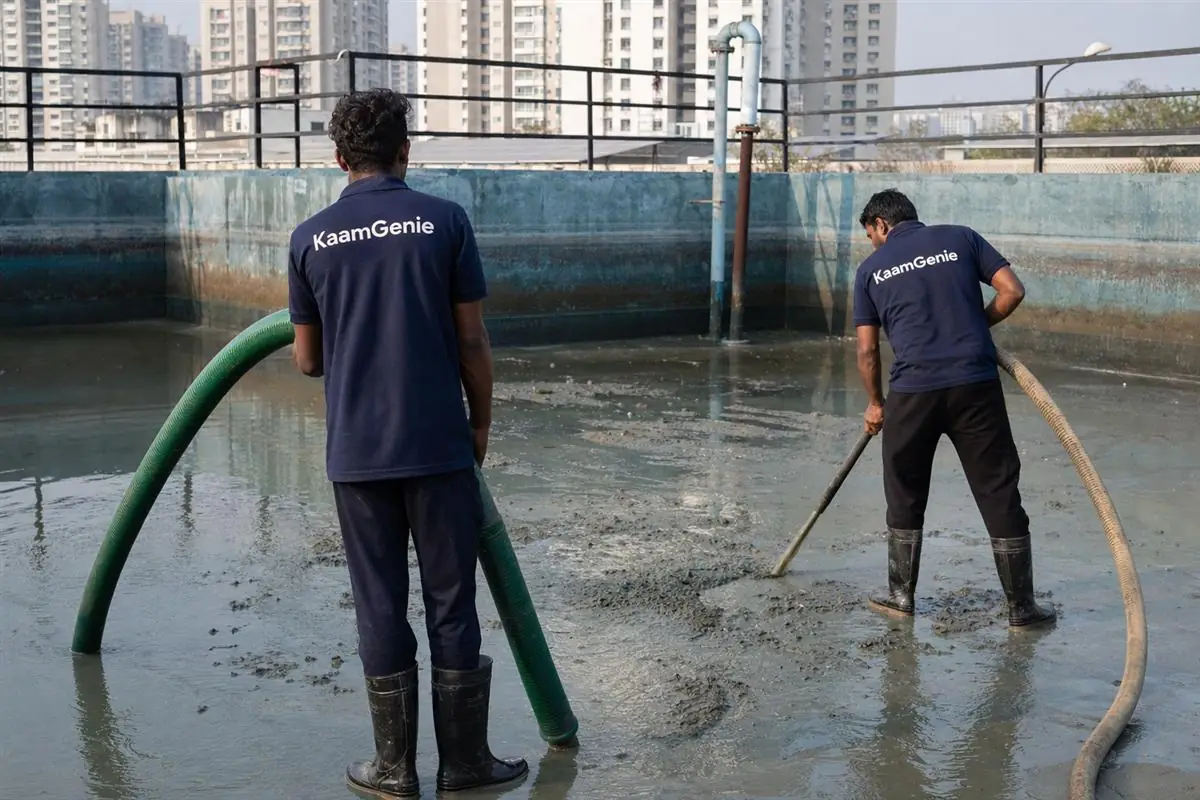
The core process is the same proven eight steps — inspect, drain, remove sludge, scrub with food-grade brushes, high-pressure jet wash, wet-vacuum, disinfect with food-grade chlorine, then refill and certify. What changes for a tanker-fed tank is where the time goes. Two steps get noticeably longer:
- Sludge and sediment removal — the bottom layer is thicker, so there is more to scoop by hand before the floor is clear.
- Wet-vacuuming — there is more fine silt suspended in the rinse water, and all of it has to be lifted out before disinfection or it simply resettles.
If the building also runs on hard borewell water between tanker loads, we add a de-scaling pass for the calcium and iron deposits on the walls. The disinfection step itself does not change — food-grade sodium hypochlorite at the correct concentration, full contact time, then rinse. None of this is exotic; it is the standard job done with the right amount of time for a dirtier tank. You can see the full method on our water tank cleaning services page, and the area-specific arrangements across the city are on the Noida water tank cleaning hub.
How to reduce the risk between cleanings
You cannot change the tanker source, but you can cut how much it costs you. A few habits make a real difference for tanker-fed buildings:
- Keep the UGR sealed. Tanker filling means the lid is opened often — make sure it closes flush every time, with an intact gasket and mesh on the overflow and vent. An open or cracked lid lets in dust, leaves and lizards on top of the tanker load.
- Let the inlet settle, draw from above. Where the plumbing allows, the pump should draw from above the floor, not scrape the very bottom where sediment sits.
- Tighten the schedule. If you run mostly on tankers, every 3 months for the UGR and tower tanks. If tankers are only a summer thing, clean before and after the season.
- Note the tanker source. If a society uses a regular tanker supplier, a basic water test once in a while tells you whether the source itself is the issue or whether the tank is doing the damage.
- Keep the certificate. For an RWA or facility team, the dated cleaning record is the proof the common tanks are on a schedule — useful when residents ask about water quality. Annual contracts are covered in our piece on society water tank cleaning in Noida.
Done together, these turn a tank that builds heavy sludge into one that stays manageable — and they make each clean faster and cheaper because the crew is not fighting two years of neglect.
Booking for a tanker-fed society in Noida Extension?
We quote the underground reservoir and tower tanks together, work around your tanker timings, and hand the RWA a dated certificate. Society UGRs priced on size.
Book tanker-fed tank cleaning across Noida
Whether you’re a flat owner in Greater Noida West / Noida Extension, a tower society on the Sector 150 Expressway belt, or a plotted home near Pari Chowk in Greater Noida, the answer to tanker-built sludge is the same: a proper clean on a schedule that matches how much tanker water you actually use. Compare your options, area by area, on our water tank cleaning in Noida hub — and when you’re ready, we’ll work around your tanker timings and hand you a dated certificate at the end.
To book, call +91 95603 66362 or use the booking form on this site — we’ll confirm shortly.
Frequently asked questions
Why does tanker water make my tank dirtier than piped supply?
Tanker water is filled from borewells, ground sources, and intermediate storage, then carried in a road tanker whose own barrel is rarely cleaned. It picks up fine sand, silt, iron and the residue sitting inside the tanker. Piped Ganga Jal arrives clarified and chlorinated through a closed line. So a tanker-fed underground reservoir collects a thicker, faster-building layer of sediment than a building on steady piped supply.
How often should a tanker-fed building in Greater Noida West clean its tanks?
Every 3 months for the underground reservoir (UGR) and the rooftop tower tanks if the building runs largely or fully on tankers, which is common across Noida Extension. Lighter tanker dependence (a few summer months) can stretch to every 4-6 months. The rule of thumb: the more tanker trips your society takes, the more often the tanks settle sludge and the more often they need cleaning.
Does tanker water need a different cleaning method than borewell or Ganga water?
The 8-step process is the same, but tanker-fed tanks need more time on two steps: sludge and sediment removal, because the bottom layer is thicker, and the wet-vacuum stage, because there is more fine silt to lift before disinfection. Tanks that also see hard borewell water need de-scaling on top. We assess the supply mix on arrival and adjust the scrubbing and vacuum time accordingly.
The tanker water looks clear — why is there still sludge at the bottom of our UGR?
Clear water still carries suspended fine particles. The moment it sits still in a large underground reservoir, those particles settle out under gravity and form a layer on the floor. A big UGR is essentially a settling tank: the larger and stiller the water body, the more sediment drops out of even clear-looking tanker water. That is why the floor of a UGR is always dirtier than the water looks from the top.
We get tanker water only in summer. Should we still clean before and after the tanker season?
Yes. A clean before peak summer means your tank starts the heavy tanker months from a clean baseline, and a clean after the season clears out the sediment that built up while you were running on tankers. Two cleanings around the tanker season is the single most effective schedule for seasonally tanker-dependent buildings in Noida and Greater Noida.
Who pays for tank cleaning in a tanker-fed society — the builder, RWA, or residents?
For common tanks — the underground reservoir and shared tower tanks — it is a society or RWA maintenance cost, usually paid from the maintenance fund, not by individual flats. In newer Greater Noida West towers still under builder maintenance, the facility management team arranges it. Individual flat tanks, where they exist, are the resident’s responsibility. We can quote the common tanks and individual tanks separately so the split is clear.
Can cleaning the tank fix the smell and taste of tanker water?
It fixes the part caused by the tank — the musty, earthy or rotten-egg smell that comes from settled sludge, bio-film and stagnation in the reservoir. A proper clean and disinfection removes that. What it cannot change is the source water itself; if the tanker source is genuinely high in iron or hardness, you may still need a softener or filtration. But a large share of bad-water complaints in tanker-fed buildings trace back to a dirty tank, not the tanker.
How long does it take to clean a large underground reservoir that a tanker fills?
A society UGR in the 10,000-30,000 litre range typically takes 3-5 hours, sometimes a half-day with two crews, because tanker-fed reservoirs hold a thick sediment layer that takes longer to scoop and vacuum out. Smaller residential sumps run 2-2.5 hours. We confirm the time after we see the tank size, access, and how heavy the sludge layer is.
Is tanker water safe to drink after the tank is cleaned?
After a proper clean and food-grade disinfection, water from non-drinking taps is safe immediately and the storage system is no longer adding contamination. For drinking, always run tanker-sourced water through your RO/UV purifier, because cleaning the tank does not certify the source water. The clean removes the tank-side risk; the purifier handles whatever the tanker source brought in. You need both.
Sources & references
- Bureau of Indian Standards (BIS) — IS 10500:2012 is the canonical Indian Standard for drinking water specification, defining acceptable limits for physical, chemical, and biological parameters.
- WHO Guidelines for Drinking-water Quality, 4th edition — the global reference for water quality standards, including guidance on storage and disinfection.
- Food Safety and Standards Authority of India (FSSAI) — defines water quality requirements for food businesses, including hygiene standards for stored water and acceptable disinfection chemicals.
- WHO Fact Sheet on Drinking Water — overview of safe drinking water requirements and contamination risks.
- CPHEEO — Manual on Water Supply and Treatment — the Government of India’s engineering manual covering tank design, cleaning protocols, and disinfection practices.
Last verified: 30 June 2026. If you find any of these links broken, please let us know.