
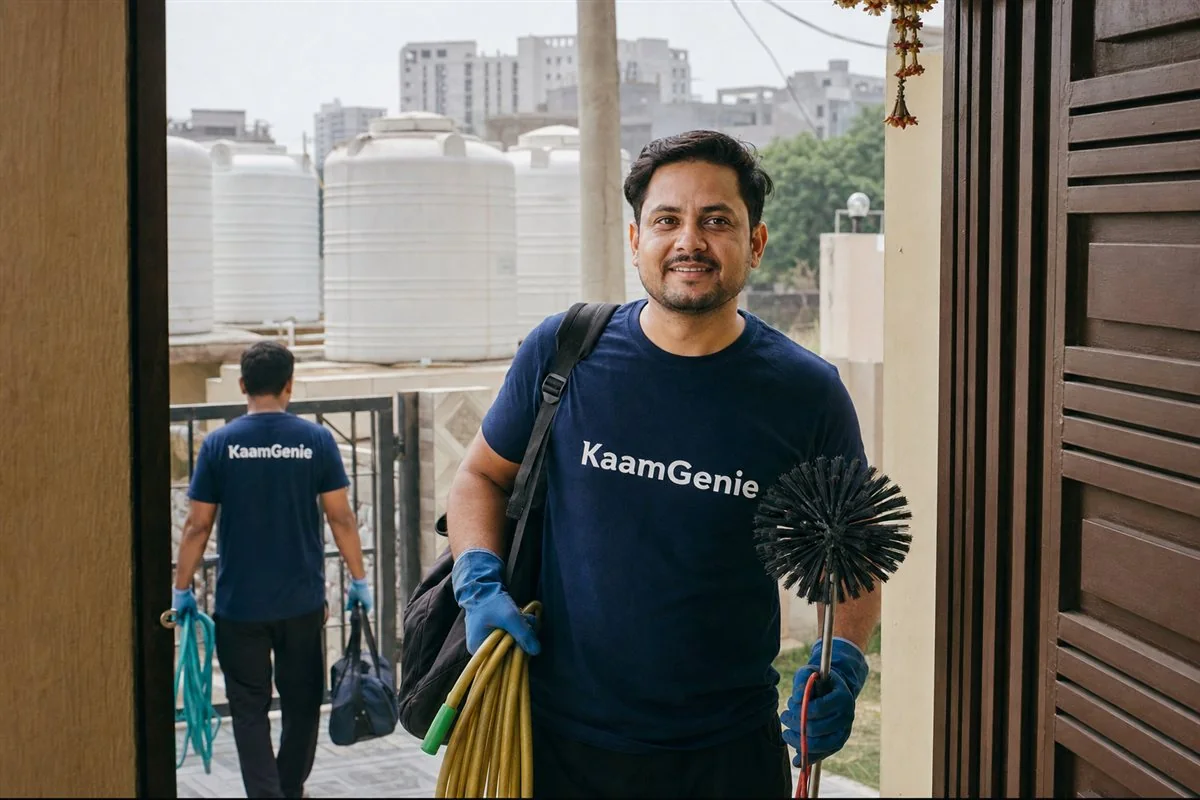
The short answer
- Home overhead tank (up to 1,000L): ₹699 onwards
- Underground sump / reservoir (UGR): custom by size & access
- Society / builder-floor shared tank: quoted by capacity
- Commercial / restaurant tank: custom, with documentation
- How often: every 4–6 months (Gurgaon’s hard water & tanker reliance push it to the lower end)
- What you should get: before/after photos on WhatsApp, food-grade disinfection, a GST invoice
If a tanki saaf karne wala quotes ₹250–300 on the phone, be careful — that price means food-grade chlorine or the jet wash is being skipped. A real cleaning costs what it costs.
What “tanki saaf karne wala” really means — and why finding a good one is hard
In most Gurgaon homes the search is the same. The water from the tap looks a little off, or it’s simply been a year or two, and someone says — “tanki saaf karwa lo”. So you look for a paani ki tanki saaf karne wala on your phone, in the society WhatsApp group, or you ask the guard for a local number. And that’s where the trouble usually starts.
The honest problem is that “tanki saaf karne wala” is not a regulated trade. Anyone with a bucket, a brush and a bottle of bleach can call themselves one. Some are genuinely good. Many are not — they arrive, throw some water around the inside of the tank, maybe sprinkle a little hardware-shop bleach, and leave in fifteen minutes claiming “ho gaya”. You’ve paid for a rinse, not a cleaning, and the sediment and biofilm that make your family sick are still sitting at the bottom of the tank.
This guide is written to help you tell the difference. The good news is that the signs of a reliable tanki saaf cleaner are simple to spot once you know what to look for — and a proper, documented water tank cleaning in Gurgaon is far more affordable than most people fear.
Paani ki tanki saaf karne ka rate in Gurgaon (2026)
Prices vary by tank type, size and how easy the tank is to reach. Here is the honest range for Gurgaon — a standalone home tank starts at ₹699 onwards, and bigger or harder jobs are quoted by size. Use this as your reality check: anything dramatically below it usually means a corner is being cut somewhere you can’t see.
| Tank type | Typical size | Price (Gurgaon) | Time |
|---|---|---|---|
| Overhead plastic tank | 500–1,000L | ₹699 onwards | 60–90 min |
| Larger overhead tank | 1,500–2,000L | Custom by size | 75–100 min |
| Underground sump / UGR | 2,000–10,000L | Custom by size & access | 2–2.5 hrs |
| Builder-floor shared tank | Per floor / common | Quoted by capacity | 90–120 min |
| Society / AOA reservoir | 10,000L+ | Custom (AMC available) | 3–5 hrs |
| Commercial / restaurant | Varies | Custom + documentation | 2–4 hrs |
If you want the full breakdown of what goes into each number, our dedicated Gurgaon water tank cleaning cost guide walks through every tank type and what affects the final quote. For an overview of how the whole service works across the city, the complete Gurgaon water tank cleaning guide is the place to start.
Book a reliable tanki saaf karne wala today
Fixed price, no hidden add-ons. Before/after photos on WhatsApp, food-grade chlorine, GST invoice. ₹699 onwards for a home tank.
How to spot a reliable tanki saaf karne wala (and the red flags)
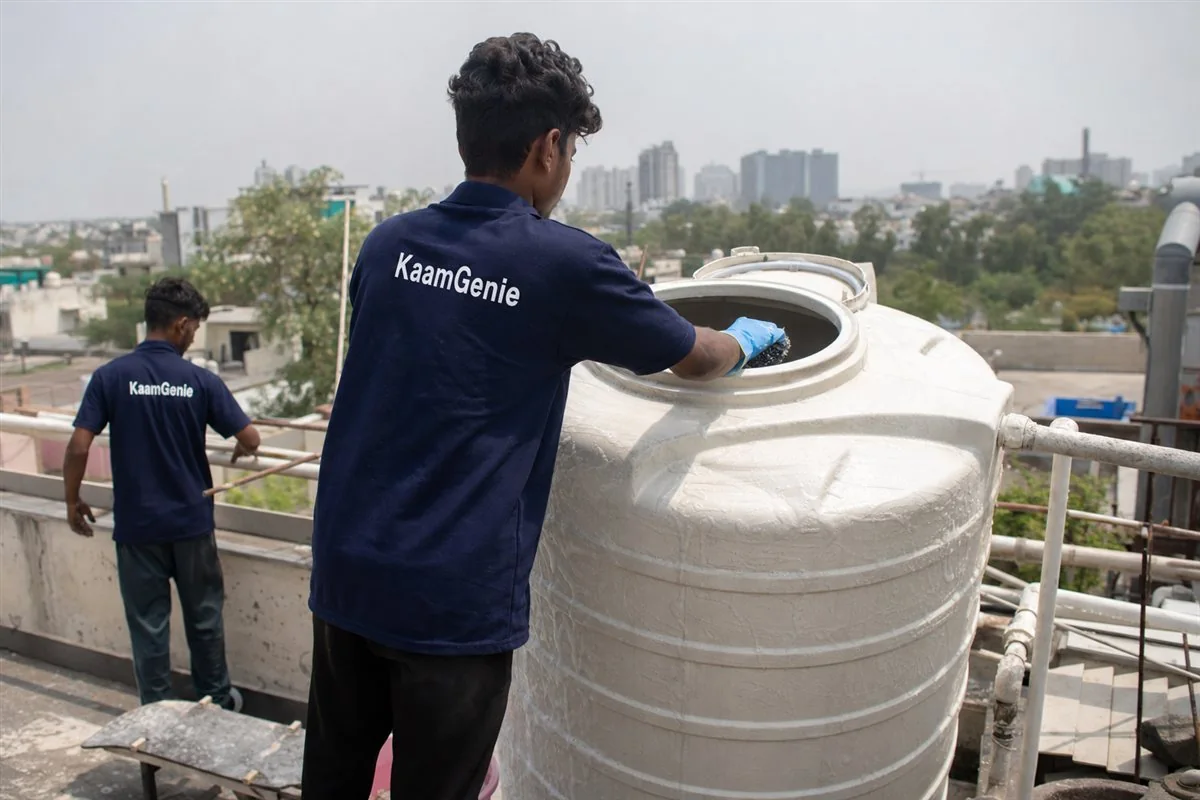
You don’t need to be an expert to judge whether a cleaner is genuine. Here are the things a trustworthy paani ki tanki saaf karne wala does — and the warning signs of one to avoid:
- A fixed price, quoted before the visit. A reliable cleaner tells you the price up front and sticks to it. Red flag: a low phone quote that grows on arrival — “chlorine alag se, photos alag se, jet wash alag se”.
- They physically open and inspect the tank first. A good cleaner looks inside, checks the sludge depth, and shows you the “before” condition. Red flag: starts pouring water in without ever looking.
- Someone actually goes in and scrubs. Walls, floor, corners, around the inlet/outlet pipes. Red flag: only spraying water down from the lid.
- They carry away the sludge. You should see a bucket of black silt leave your roof. Red flag: nothing removed — the worst contamination is still inside.
- Food-grade disinfectant, not hardware bleach. Ask what they use. Red flag: a Domex/Harpic-type bottle — those are not safe for drinking-water tanks.
- Before/after photos and a GST invoice. A genuine service documents the job. Red flag: no photos, no bill, no record, no recourse.
The simplest way to skip all this guesswork is to book through a verified service rather than an anonymous number. When you book water tank cleaning services through KaamGenie you get the same trained, ID-carrying crew, a fixed price, and a written record every time — whether you’re in MG Road, Sushant Lok or Sector 56.
What a proper tanki saaf job actually looks like
A real cleaning is a process, not a splash of water. When our crew arrives for a home tank in Gurgaon, this is roughly what happens — and what you should expect from any good tanki saaf karne wala:
- Inspect & photograph. Open the lid, check the condition, take the “before” photo.
- Drain. Empty the old water; the last couple of inches are vacuumed so disinfectant doesn’t get diluted.
- Remove the sludge. The silt, sediment and scale at the bottom — the part that matters most — scooped out by hand and vacuum.
- Scrub. Food-grade nylon brushes on every wall, the floor, the corners and around the pipes.
- Jet wash. A high-pressure jet removes biofilm and hard-water scale a brush can’t reach.
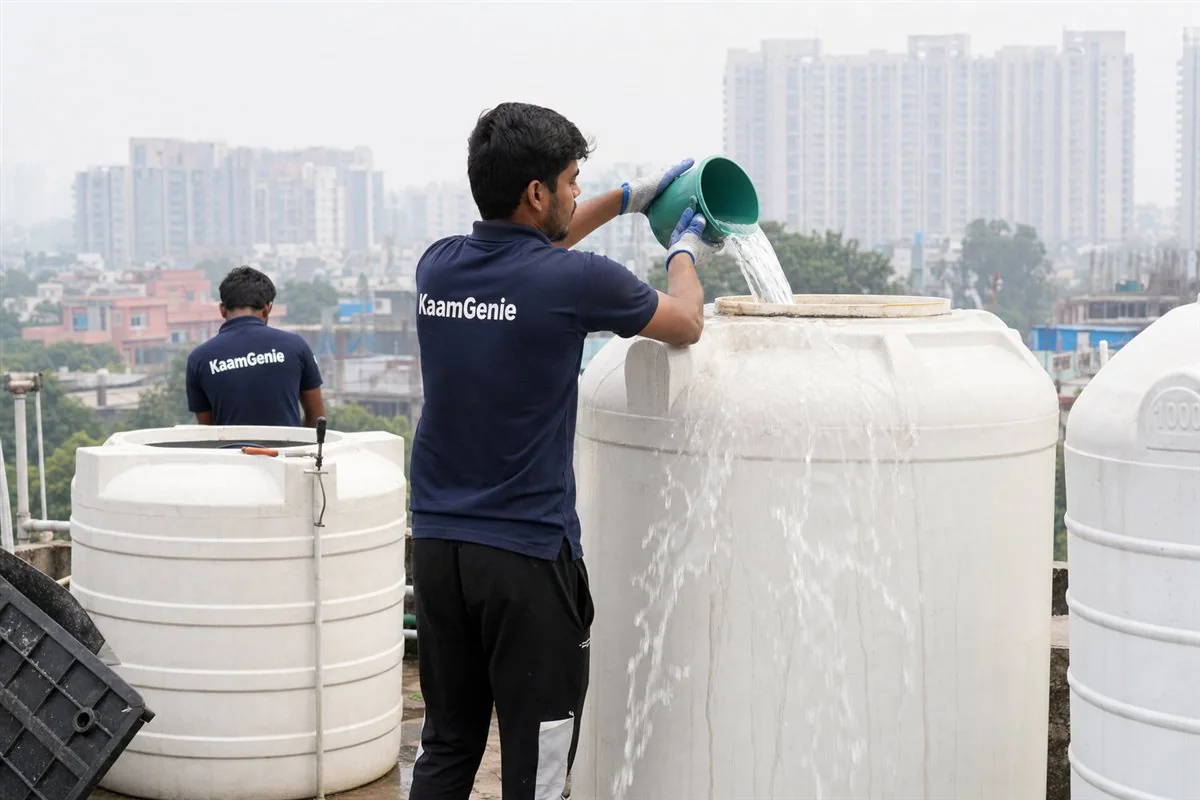
- Disinfect. Food-grade sodium hypochlorite with a 20-minute contact time — this is the step that actually kills bacteria.
- Rinse & refill. Flush out the disinfectant, refill, and take the “after” photo.
The whole thing takes about 60–90 minutes for a 1,000L home tank. That 20-minute disinfection contact time cannot be rushed — the chemistry simply needs time to work. So if a cleaner is in and out in fifteen minutes, you now know exactly which steps were skipped. We don’t re-explain the full method here because we’ve documented every stage in our 8-step water tank cleaning process guide.
Why Gurgaon tanks get dirty faster — hard water and tankers
Gurgaon — the Millennium City — has a water story that’s different from most of Delhi NCR. Large parts of the city, especially New Gurgaon, Sohna Road and the older sectors, run on hard borewell groundwater with high TDS. Hard water leaves calcium and iron scale on tank walls far faster than soft municipal water, and that rough, scaled surface becomes the perfect hiding place for bacteria and biofilm.
On top of that, a huge number of Gurgaon homes, builder floors, condominiums and the new high-rise belt along Golf Course Extension, SPR and the Dwarka Expressway depend heavily on water tankers. Tanker water is a lifeline, but it carries its own sediment and is only as clean as the tanker that delivered it — and it almost always lands in a big underground reservoir (UGR) before being pumped up to the rooftop tank. That means two storage points collecting silt instead of one.
Put the hard water and the tanker reliance together and the conclusion is simple: most Gurgaon tanks need cleaning every 3–4 months, not the textbook 6. If your home runs mostly on borewell or tanker supply, our guide to hard water tank cleaning in Gurgaon explains the extra scale problem in detail, and if you have a big underground tank, the Gurgaon underground sump cleaning guide covers what that job involves.
How often Gurgaon tanks really need cleaning — by water source
Months between cleanings before sediment and bacteria build up (lower = needs cleaning more often)
Indicative guidance based on KaamGenie’s Gurgaon service experience and BIS recommendations — your own tank may need cleaning sooner if you notice colour, smell or sediment.
Not sure how dirty your tank is? Book a cleaning and see
The before-photos surprise even longtime customers. Standard home cleaning ₹699 onwards — same-day available if you book in the morning.
Society, builder floor or commercial? The job is different
A standalone home tank is a simple, fixed-price booking. But Gurgaon is full of AOA/RWA condominium societies, independent builder floors with shared tanks, and corporate hubs like Cyber City and Udyog Vihar — and those tanks are a different kind of job. A society reservoir can hold 10,000–50,000 litres, needs a larger crew and confined-space safety gear, and is best handled on an annual contract (AMC) with quarterly visits rather than ad-hoc calls.
For these, the cleaner you choose matters even more, because the residents’ maintenance fund is paying and the AOA needs documentation for its accounts and AGM. If you’re on a society committee, our guide to society water tank cleaning in Gurgaon covers how to set up a proper contract, and if you want help choosing a vendor at all, the best water tank cleaning service in Gurgaon comparison lays out what to check before you sign.
How to book your tanki saaf karne wala
Booking is the easy part. You don’t need to chase an unknown number or haggle over hidden charges. To get a verified crew for water tank cleaning in Gurgaon:
- Call or WhatsApp +91 95603 66362 — replies usually come within an hour during business hours.
- Tell us your tank type and area — home overhead, sump, society or commercial, and your locality (MG Road, Sushant Lok, Sector 56, Golf Course Road, Sohna Road, DLF Phases, New Gurgaon, and so on).
- Get a fixed price up front — ₹699 onwards for a home tank, custom quote for bigger jobs, no surprises on arrival.
- Pick a slot — same-day is usually possible if you book in the morning; weekends available at no extra charge.
After the job you get your before/after photos and GST invoice on WhatsApp the same day. That’s it — a clean tank, safe water for the next few months, and a written record you can keep. No follow-up spam, no upsell calls.
Frequently asked questions / Aksar pucha jaata hai
Gurgaon mein tanki saaf karne ka kitna kharcha aata hai?
A standard home overhead tank (paani ki tanki up to 1,000L) starts at ₹699 onwards in Gurgaon. Underground sumps and large reservoirs (UGR) cost more because of size and confined-space safety gear, and society or commercial tanks are quoted custom by size. If a tanki saaf karne wala quotes ₹250–300 over the phone, they are almost certainly skipping food-grade disinfection or the jet wash — a real job cannot be done that cheap.
Gurgaon mein bharosemand tanki saaf karne wala kaise dhundhe?
Look for four things: a fixed price quoted before the visit (no add-ons on arrival), before/after photos sent on WhatsApp, food-grade chemicals (not hardware-shop bleach), and a GST invoice. A reliable person will physically scrub inside the tank and carry away a bucket of sludge — not just spray water from the top and leave in 15 minutes. Booking through a verified service like KaamGenie means the same trained crew, ID-carried, and a written record every time.
Kitne din mein ek baar tanki saaf karwani chahiye Gurgaon mein?
Every 6 months is the BIS recommendation for a home tank. In Gurgaon we suggest every 4 months for many homes because of hard borewell groundwater and heavy tanker-water reliance — both leave faster sediment and scale buildup than soft municipal supply. Societies, builder floors with shared tanks, and any tank fed mostly by tankers should be done every 3–4 months.
Paani saaf dikh raha hai, phir bhi tanki saaf karwana zaroori hai?
Yes. Bacteria, biofilm and the silt layer at the bottom of the tank are not visible from a tap. Water can look perfectly clear while E. coli and coliform multiply in the sediment. By the time you see a yellow tinge, smell something, or family members get a stomach upset, the contamination is already advanced. A ₹699 cleaning every few months is far cheaper than a doctor’s visit.
Gurgaon ka hard borewell paani tanki ko zyada kharab karta hai?
Yes. Large parts of Gurgaon — especially New Gurgaon, Sohna Road and the older sectors — rely on hard borewell groundwater with high TDS. Hard water leaves calcium and iron scale on tank walls much faster than soft water, and that scale becomes a hiding place for bacteria. Tanker water adds its own sediment. Together they mean Gurgaon tanks usually need cleaning more often than the textbook 6 months.
Tanki saaf karne mein kitna time lagta hai?
A typical 1,000L home overhead tank takes about 60–90 minutes for the full process — drain, sludge removal, scrubbing, jet wash, disinfection and refill. Underground sumps take 2–2.5 hours. Society reservoirs and commercial UGRs take 3–5 hours depending on size and access. If someone finishes a home tank in 15–20 minutes, they did not do the real job.
Kya main khud apni paani ki tanki saaf kar sakta hoon?
A small, easy-to-reach rooftop tank you can rinse yourself — but it won’t be a professional cleaning. You’d be missing food-grade disinfectant, the right brushes, and a high-pressure jet that removes biofilm and hard-water scale. Never enter an underground sump yourself — toxic gases like hydrogen sulphide collect inside and take lives every year. For ₹699 onwards it is not worth the risk.
Kya kaam ke baad before/after photos aur invoice milte hain?
Yes. On every KaamGenie booking the crew takes before and after photos and sends them to you on WhatsApp the same day, along with a GST invoice. That record is your proof the job was done — and for society AOAs/RWAs and commercial kitchens it doubles as compliance documentation for audits and FSSAI inspections.
Gurgaon mein kaun se area cover hote hain? Same-day booking hoti hai?
We cover all of Gurugram — MG Road, Sushant Lok, Sector 56, Golf Course Road, Golf Course Extension, Sohna Road, DLF Phases 1–5, Cyber City, Udyog Vihar, New Gurgaon and the Dwarka Expressway belt. Same-day booking is usually possible if you book in the morning. Call or WhatsApp +91 95603 66362 — replies usually come within an hour during business hours.
Society ya builder floor ki tanki ka rate alag hota hai?
Yes. A standalone home overhead tank is ₹699 onwards, but a shared society tank, a large underground reservoir, or a builder-floor common tank is quoted by capacity and access. AOAs and RWAs usually take an annual contract (AMC) with quarterly visits, which works out cheaper per visit and includes a photo report to the residents’ WhatsApp group plus a GST invoice for the maintenance accounts.
Sources & references
- Bureau of Indian Standards (BIS) — IS 10500:2012 is the canonical Indian Standard for drinking water specification, defining acceptable limits for physical, chemical, and biological parameters.
- WHO Guidelines for Drinking-water Quality, 4th edition — the global reference for water quality standards, including guidance on storage and disinfection.
- Food Safety and Standards Authority of India (FSSAI) — defines water quality requirements for food businesses, including hygiene standards for stored water and acceptable disinfection chemicals.
- WHO Fact Sheet on Drinking Water — overview of safe drinking water requirements and contamination risks.
- CPHEEO — Manual on Water Supply and Treatment — the Government of India’s engineering manual covering tank design, cleaning protocols, and disinfection practices.
Last verified: 30 June 2026. If you find any of these links broken, please let us know.