
Quick answer — termites in wooden furniture in Delhi (2026)
- How to spot them: mud tubes on the back of an almirah, wood that sounds hollow when tapped, fine powdery frass under furniture, blistered or rippled paint, and a small heap of discarded wings after the first rains.
- Why Delhi furniture is at risk: humidity, monsoon damp, and furniture that sits flush against damp walls or directly on the floor — giving subterranean termites the ground contact and moisture they need.
- DIY has limits: kerosene, sprays and over-the-counter powders only kill what you can see. The colony lives in the wall or floor below and keeps feeding — professional drill-fill-inject plus surface treatment reaches it.
- Can the piece be saved? If the frame is still solid, yes — treat it and keep it. If the wood is hollow and the structure has gone, treatment stops further loss but the piece may need replacing.
- Real cost (2026): a whole-home anti-termite treatment that protects all your furniture starts around ₹2,499; treating a few pieces in isolation is rarely worth it on its own.
- We cover all of Delhi — no honest service promises termites can never return, which is why a treatment with a written warranty matters.
How to spot termites in your wooden furniture
Termites are quiet workers. By the time most Delhi families realise an almirah or a door frame is infested, the colony has often been feeding for months — eating the wood from the inside out and leaving the painted surface looking almost normal. The trick is to learn the early signs, because catching it in week six instead of month six is the difference between treating a piece and throwing it away. Here is what I tell people to look for when they call about “deemak” in the furniture.
The clearest tell is mud tubes — thin, brownish ribbons of dried mud running up the back or underside of an almirah, along a skirting board, or up a wall behind the bed. Subterranean termites build these pencil-width tunnels to travel from the soil to the wood without exposing themselves to air, so a mud tube is a near-certain sign the colony is active. Next is hollow-sounding wood: tap along a door frame, a bed leg or the side of a wardrobe with your knuckle, and where it sounds papery or drum-like instead of solid, the inside has already been eaten away. Then there’s frass — a fine, sawdust-like powder, sometimes in tiny pellets, that collects under furniture or on shelves; it’s the digested wood the termites push out.
Two more signs are easy to miss. Blistered, rippled or bubbling paint on a door or window frame — where the surface looks like it has water damage but there’s been no leak — usually means termites have eaten the wood right up to the paint film. And after the first monsoon showers in Delhi, you may find a small heap of discarded wings near a window sill or under a tube light; that’s the winged reproductive termites (alates) that swarm to start new colonies, and finding their wings indoors means a colony is nesting in or very close to your home. If you see any of these, stop poking at the wood — disturbing an active gallery can scatter the termites and make treatment harder.
| Sign | What you’ll notice | What it tells you |
|---|---|---|
| Mud tubes | Thin brown mud ribbons on the back/underside of furniture or up a wall | Active subterranean colony travelling from soil to wood |
| Hollow-sounding wood | Papery, drum-like sound when you tap the frame or leg | Interior already eaten; structural strength gone |
| Frass / fine powder | Sawdust-like dust or tiny pellets under or inside furniture | Termites are feeding right now and clearing waste |
| Blistered paint | Rippled or bubbling paint with no water leak nearby | Wood eaten up to the paint film from inside |
| Discarded wings | Small heap of identical wings near a window or light | Swarmers nesting in/near the home, usually after first rains |
| Tight or jamming doors | A wooden door or drawer that suddenly sticks | Warping from moisture in termite galleries |
Why Delhi homes are so prone to furniture termites
People often ask me why their furniture in Delhi gets termites when the same almirah was fine for years somewhere else. The answer is a combination of climate and how we place furniture. Delhi swings from bone-dry summers to a humid, waterlogged monsoon, and subterranean termites — the species behind almost all furniture damage here — need three things: cellulose (wood), moisture and access from the soil. Our monsoon and the damp that lingers in ground-floor flats, basements and older Lutyens-era and South Delhi houses give them the moisture; the wood gives them the food; and the way we arrange rooms hands them the access.
Look at a typical Delhi bedroom. The heavy wooden almirah is pushed flush against an outer wall — often a wall that shares damp with the bathroom or takes monsoon seepage. The bed sits directly on the floor. The wooden door frame is set into the masonry and touches the ground. Each of these is a bridge: termites move up from the soil, through tiny cracks in the floor or wall plaster, and straight into the wood with no exposed gap for you to spot. Ground-floor and stilt-parking buildings, common across Delhi, are especially vulnerable because the furniture is closer to the soil and the moisture table. Add the fact that a lot of Indian furniture is made of softer, untreated mango or rubberwood rather than seasoned, treated timber, and you have an open invitation. None of this means your home is dirty — termites are about moisture and wood contact, not hygiene.
Found mud tubes or hollow wood in your furniture?
Don’t wait for the next shelf to give way. Our technician will inspect your almirahs, doors and beds and treat the colony, not just the surface. Termite service from ₹2,499.
DIY limits vs professional treatment
When the panic sets in, the first instinct is to reach for whatever’s under the sink — kerosene, a can of insect spray, neem oil, or a packet of anti-termite powder from the local hardware shop. I won’t pretend these do nothing. Rubbing kerosene or spraying a surface kills the termites you can see at that moment and may slow things for a few days. But here is the honest, uncomfortable truth: those termites are the workers, and they are the disposable part of the colony. The queen and the nest sit elsewhere — usually in the soil under your floor or inside the wall cavity behind the furniture — pumping out thousands of replacements. Kill the surface workers and the colony simply sends more. That is why DIY almost always “works” for a fortnight and then the problem comes back worse.
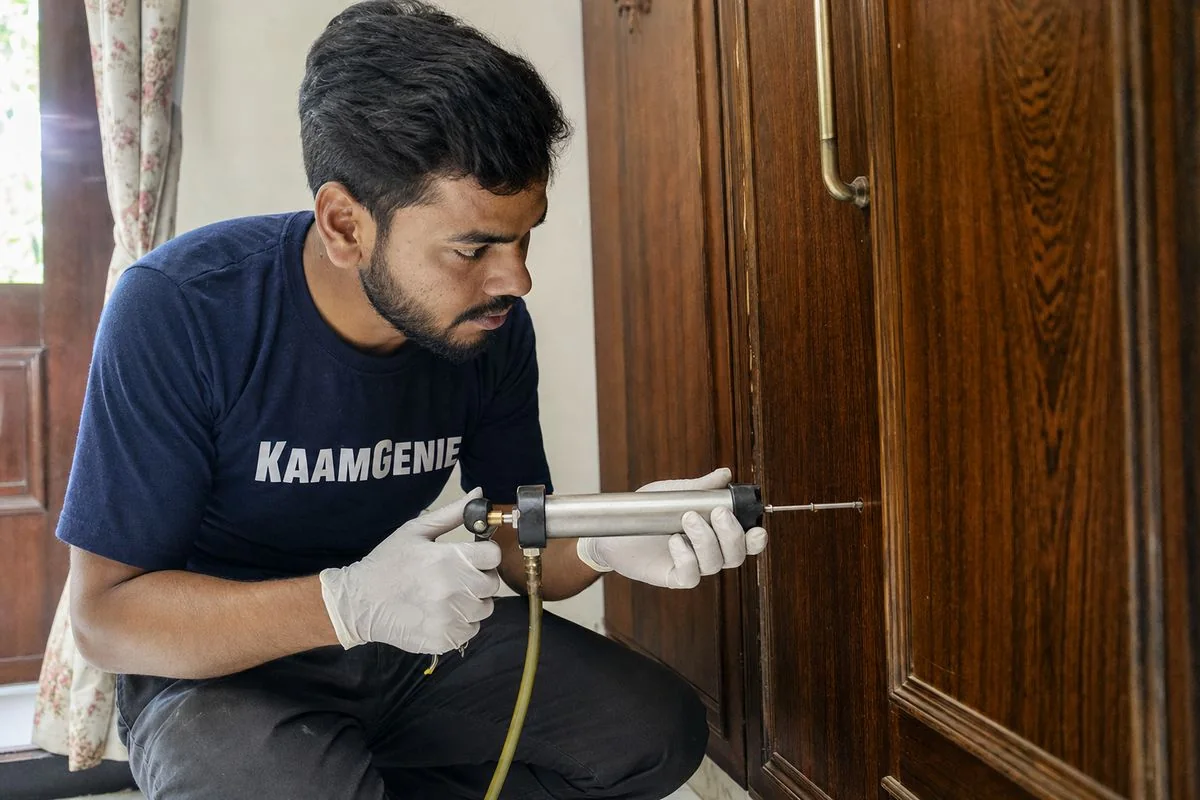
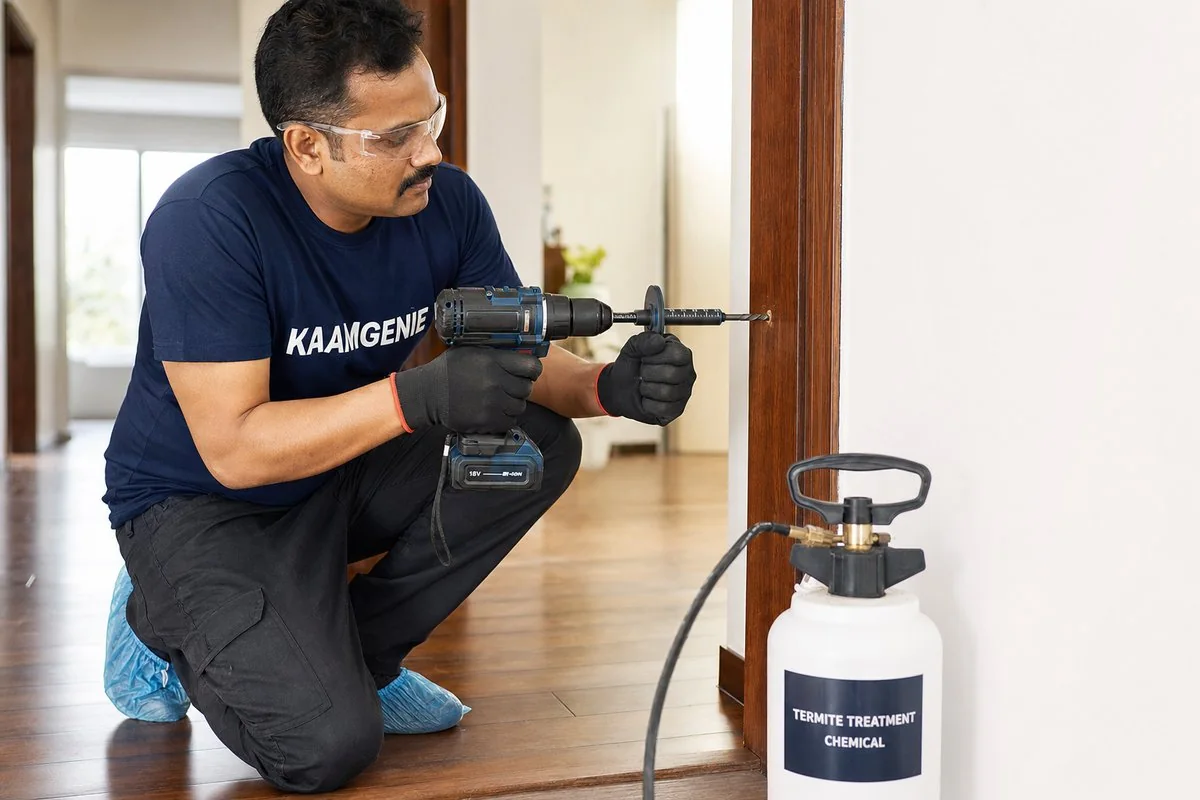
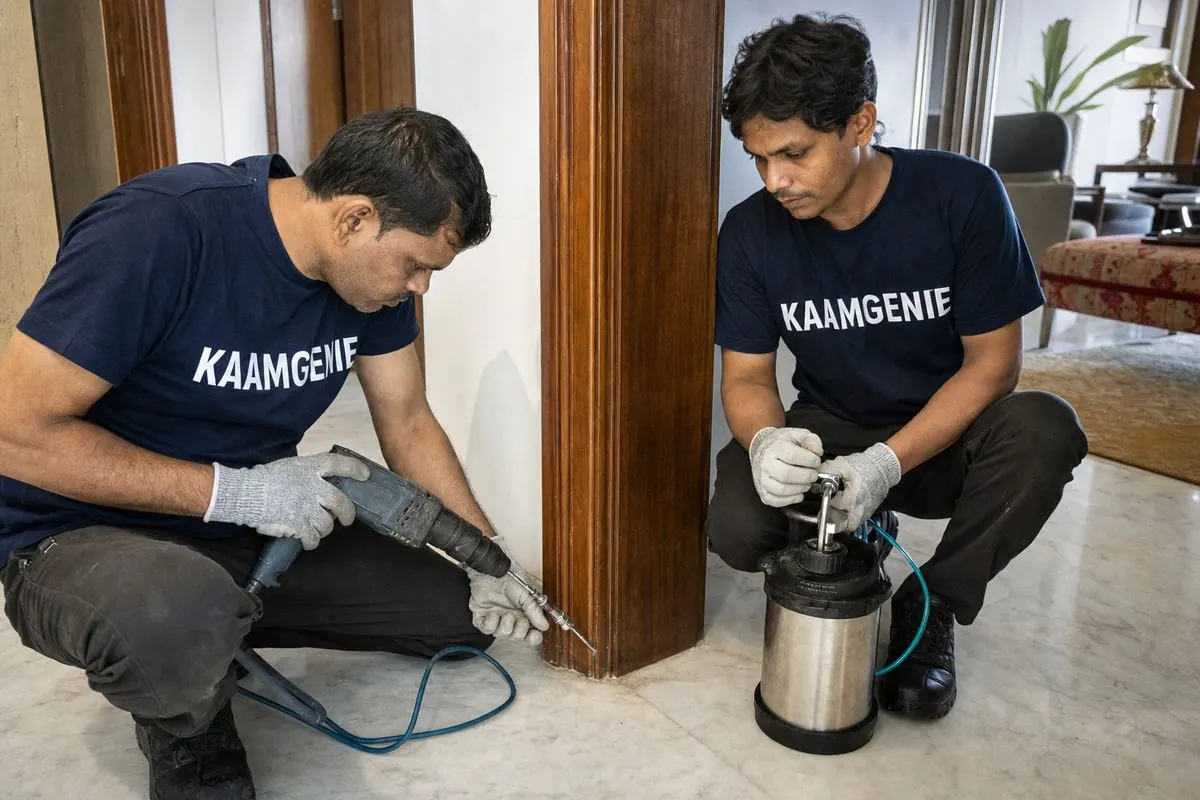
Professional treatment is a different mechanism entirely. For furniture, a technician uses the drill-fill-inject method: small holes are drilled at an angle into the infested wood and into the floor or wall junction where the termites enter, and a termiticide is injected under pressure so it spreads through the galleries and into the soil contact point. This is paired with a surface treatment of the exposed wood and the surrounding floor and skirting. Because the chemical reaches the soil and the entry route, it hits the colony’s supply line, not just the foragers. Modern termiticides are also designed to be non-repellent — the termites can’t detect them, so they walk through the treated zone, carry the chemical back, and pass it through the colony. That’s the part a spray can never do. It’s also why a real treatment comes with a written warranty: the company is staking its reputation on having reached the nest, not just the visible bugs.
| Factor | DIY (kerosene / spray / shop powder) | Professional drill-fill-inject |
|---|---|---|
| What it reaches | Only the termites you can see on the surface | The galleries, the floor junction and the soil colony |
| Effect on the colony | None — queen and nest keep breeding | Non-repellent chemical carried back to the nest |
| How long it lasts | Days to a couple of weeks, then returns | Years, with a written warranty |
| Risk | Kerosene is flammable; scatters termites to new spots | Targeted, controlled application by a trained technician |
| Records | None | Before/after photos and a GST invoice |
| Cost (2026) | A few hundred rupees, repeated forever | From ₹2,499 for a whole-home treatment |
Where furniture termites show up most in Delhi homes
Across the homes we treat, the damage isn’t random — it clusters on the pieces that combine wood, ground contact and moisture. Almirahs and wardrobes are the runaway leaders, because they’re big, heavy, pushed against walls and rarely moved. Wooden door and window frames come next, since they’re set into damp masonry and touch the floor. Then beds and their legs, kitchen cabinets near the sink, and finally sofas with wooden frames and decorative pieces. The rough pattern below is what we see on inspection, and it tells you where to look first.
Where furniture termites show up most in Delhi homes (2026)
Rough share of furniture termite cases we find on inspection, by piece.
The reason almirahs top the list is worth understanding, because it shapes prevention. A wardrobe is the perfect termite target: a large surface of untreated wood, jammed against a wall where you never look, with the base resting on or near the floor. By the time saris and bedsheets stored inside start showing damage, the back panel is often a shell. The lesson isn’t to fear your almirah — it’s to pull it out and check behind it twice a year, and to keep its base off direct floor contact.
| Furniture | Termite risk | Why |
|---|---|---|
| Almirah / wardrobe | Very high | Large wood surface, against damp wall, base near floor, rarely moved |
| Wooden door & window frames | High | Set into damp masonry, direct floor contact |
| Beds & wooden legs | High | Legs touch the floor; mattress traps moisture |
| Kitchen cabinets | Medium-high | Sink moisture and food residue nearby |
| Sofa with wooden frame | Medium | Hidden internal frame; risk where it meets a wall |
| Wooden flooring / skirting | Medium | Direct, continuous floor and wall contact |
| Metal / engineered-board units | Low | Little or no natural cellulose for termites to feed on |
Can the furniture be saved, or must you replace it?
This is the question every family asks once the shock wears off, and the honest answer is: it depends entirely on how far the damage has gone, and treatment and saving are two separate things. Treatment stops the termites and protects everything around the piece. Whether the piece itself survives is about its remaining structure.
If you caught it early — mud tubes and a bit of frass, but the frame still feels solid when you tap and press it — the furniture can usually be saved. The technician treats it, the active termites die off, and once the damaged surface is filled and refinished the almirah or door carries on for years. I’ve seen plenty of solid teak and sheesham pieces come back fine because the owner acted in time. If, on the other hand, the wood is hollow and crumbling — a shelf gives way, a leg collapses, the back panel powders when you press it — the structural wood is gone and no chemical rebuilds it. In that case treatment still matters (it kills the colony so it doesn’t move to your other furniture), but the piece itself may need replacing or significant carpentry. The worst mistake is to throw out the infested almirah, buy a new one, place it in the same spot against the same damp wall, and skip the treatment — the new furniture is eaten within a year or two. Treat the room first, then bring in the replacement.
Want your wooden furniture protected, not just sprayed?
A proper drill-fill-inject treatment reaches the colony in the wall or floor and comes with a written warranty. Whole-home anti-termite from ₹2,499.
Protecting new furniture and preventing termites coming back
The cheapest termite job is the one you never have to do, and prevention for furniture is genuinely within your control. The single biggest factor is breaking the contact between wood, moisture and soil. When you bring in a new almirah, bed or cabinet, don’t shove it flat against an outer or bathroom-adjacent wall — leave a small gap so air moves behind it and you can see the back. Keep heavy wooden furniture off direct floor contact where you can, using small stands or feet so the base isn’t sitting on a cold, damp slab. Fix the boring things that feed termites: a leaking bathroom wall, a seeping window, water pooling near a ground-floor room after the monsoon.
Beyond that, ventilation and inspection do most of the work. Open up and air out wardrobes and store rooms during the dry months; damp, shut cupboards are where trouble starts. Pull the almirah out twice a year — ideally before and after the monsoon — and check the back and base for mud tubes. If you’re buying solid-wood furniture, ask whether the timber is seasoned and treated; if you’re building in wardrobes or wooden flooring during a renovation, that’s the moment to get a pre-construction or whole-home anti-termite treatment done, because protecting the soil and structure before the furniture goes in is far cheaper than fixing damage later. And once you’ve had a professional treatment, keep the warranty paperwork and book the free re-inspections it usually includes — that’s how you catch any return early.
What treating furniture termites costs in Delhi (2026)
Here’s the part people most want a straight answer on, and I’ll give you the real framing rather than a vague “it depends.” The important thing to understand is that termites are a property problem, not a per-piece problem. Because the colony lives in the soil and travels through the walls and floor, treating one almirah in isolation while ignoring the room around it rarely makes sense — the colony just feeds on the next piece. That’s why the sensible, cost-effective approach is a whole-home or whole-room anti-termite treatment that protects all your furniture at once, with a written warranty.
As a 2026 guide, a professional termite treatment starts from ₹2,499. The final figure depends on the size of the home, the number of entry points and how severe the infestation is — a compact flat with one affected almirah is at the lower end, while a large house with multiple infested rooms costs more because there’s far more soil junction and woodwork to treat. Treating a single piece on its own can sometimes be quoted, but once you add the technician’s visit and the need to treat the floor junction it feeds from, you’re often close to the whole-room price anyway — with far less protection. The chart below shows why a one-time DIY spray that you repeat forever costs more in the long run than a single warrantied treatment.
DIY repeats vs one professional treatment over 3 years (2026)
Rough total spend — repeated sprays that never reach the colony vs one warrantied treatment.
A last word of caution on price: be wary of anyone who quotes a treatment over the phone without seeing the furniture, or whose rate sounds too good to be true — a real anti-termite job uses a measured dose of registered termiticide and takes time to drill and inject properly. An honest quote comes after an inspection, and a credible service hands you before/after photos and a GST invoice, not just a verbal “ho gaya.” We treat homes right across Delhi — from South Delhi colonies like Greater Kailash and Saket to West and North Delhi — and we’ll tell you honestly whether a piece can be saved or is past it. Call 95603 66362 and save your almirah before the next shelf goes.
Frequently asked questions
How do I know if my wooden almirah has termites?
Look for mud tubes — thin brown ribbons of dried mud on the back or base of the almirah — and tap the wood: where it sounds hollow or papery, the inside has been eaten. Other signs are a fine sawdust-like powder (frass) on the shelves, blistered or rippled paint with no water leak, and a small heap of discarded wings near a window after the first monsoon rains. Any one of these means an active colony, so get it inspected before more shelves give way.
Can termite-damaged furniture be saved or do I have to throw it out?
It depends on how far the damage has gone. If the frame still feels solid when you tap and press it, the piece can usually be saved — treatment kills the termites and the surface is filled and refinished. If the wood is hollow and crumbling, the structure is gone and no chemical rebuilds it, so the piece may need replacing. Either way, treat the room and soil junction first; otherwise a new almirah placed in the same spot gets eaten within a year or two.
Does kerosene or shop-bought spray get rid of furniture termites?
Only temporarily. Kerosene, insect sprays and over-the-counter powders kill the worker termites you can see, but the queen and nest sit in the soil or wall behind the furniture and keep breeding replacements. That’s why DIY works for a couple of weeks and then comes back worse. A professional drill-fill-inject treatment reaches the colony’s supply line, which is what actually stops it.
What is the drill-fill-inject method for furniture termites?
The technician drills small holes at an angle into the infested wood and into the floor or wall junction where the termites enter, then injects a termiticide under pressure so it spreads through the galleries and the soil contact point. It’s paired with a surface treatment of the exposed wood and nearby floor and skirting. Modern termiticides are non-repellent, so termites walk through the treated zone and carry the chemical back to the colony.
How much does termite treatment for furniture cost in Delhi in 2026?
A professional termite treatment in Delhi starts from around ₹2,499. Because the colony lives in the soil and travels through walls and floors, the cost-effective approach is a whole-home or whole-room treatment that protects all your furniture at once, rather than treating one piece in isolation. The final price depends on home size, number of entry points and how severe the infestation is. An honest quote comes after an inspection, not over the phone.
Why does my furniture in Delhi keep getting termites?
Delhi’s humid monsoon plus furniture placed flush against damp walls or directly on the floor gives subterranean termites everything they need: wood, moisture and ground access. Ground-floor and stilt-parking flats are especially vulnerable because furniture is closer to the soil. A lot of Indian furniture is also made of softer, untreated wood. Breaking the wood-to-soil-and-damp contact, plus a warrantied treatment, is how you stop the cycle.
Which furniture is most at risk from termites?
Almirahs and wardrobes top the list — large untreated wood surfaces pushed against damp walls and rarely moved. Then wooden door and window frames set into masonry, beds and their legs, kitchen cabinets near the sink, and sofas with wooden frames. Wooden flooring and skirting are also at risk from direct floor contact. Metal and engineered-board units are far safer because they offer little natural cellulose to feed on.
How can I protect new wooden furniture from termites?
Break the contact between wood, moisture and soil. Leave a small gap behind new almirahs and beds instead of pushing them flat against an outer or bathroom-adjacent wall, keep heavy pieces off direct floor contact with small feet or stands, and fix damp walls and leaks. Air out wardrobes in the dry months and check behind furniture twice a year. If you’re renovating, get a pre-construction or whole-home anti-termite treatment before the furniture goes in.
What does termite frass look like?
Frass is the digested wood that termites push out of their galleries. It looks like a fine, sawdust-like powder or tiny pellets and collects under or inside furniture, on shelves, or along a skirting board. Finding a small heap of it where there’s no obvious source of sawdust is a strong sign of active termites feeding nearby — check the wood above and behind it for mud tubes and hollow spots.
Are the discarded wings near my window a sign of termites?
Often, yes. After the first monsoon showers, winged reproductive termites (alates) swarm to start new colonies and then shed their wings. A small heap of identical wings near a window sill or under a tube light usually means a colony is nesting in or very close to your home. It’s a signal to get an inspection rather than just sweep the wings away.
Is termite treatment safe for my family and pets?
Done by a trained technician with registered, measured-dose termiticides, treatment is safe when the area is vacated for the advised time and ventilated afterwards. Tell the technician about young children, pregnant family members, pets and anyone with asthma so they plan the timing and products. Be cautious of anyone claiming a treatment is completely harmless with no precautions needed — the responsible approach is still to keep the treated area clear briefly and air it out.
Will termites come back after treatment?
A proper drill-fill-inject treatment that reaches the soil and colony lasts for years, which is why a credible service gives a written warranty and usually includes free re-inspections. No honest company promises termites can never return — conditions change, neighbouring soil can be a source — so keep your warranty paperwork, book the re-inspections, and fix any new damp issues. Catching a return early under warranty is far cheaper than starting over.
Save your wooden furniture before the next shelf goes
Let us inspect your almirahs, doors and beds, treat the colony at its source, and back it with a written warranty. Whole-home anti-termite from ₹2,499, across Delhi.
Sources & references
- Central Insecticides Board & Registration Committee (CIB&RC) — the Indian regulator that approves the termiticides and concentrations used for anti-termite treatment.
- Bureau of Indian Standards (BIS) — publishes IS 6313 on anti-termite measures for buildings, the basis for treatment methods referenced here.
- National Centre for Disease Control (NCDC) — tracks Indian urban pest patterns relevant to households in Delhi.
- Indian Council of Medical Research (ICMR) — publishes research on termite biology and integrated pest management protocols.
Last verified: 13 June 2026. If you find any of these links broken, please let us know.