
Quick answer — termite inspection in Delhi (2026)
- The early signs to look for: pencil-thin mud tubes on walls, wood that sounds hollow or looks blistered, little piles of discarded wings near windows, and doors or windows that suddenly stick.
- Two kinds in Delhi homes: subterranean termites (from the soil, build mud tubes, by far the most common) and drywood termites (live inside furniture, leave tiny pellet droppings).
- What an inspection costs (2026): a professional termite inspection is usually free or nominal — often adjusted into the treatment if you go ahead.
- What treatment costs: anti-termite treatment in Delhi starts from ₹2,499 (GST 18% extra), with 1–5 year warranties depending on the job.
- Best time to inspect: before buying or renovating a home, and right after the monsoon — September–October is when swarms and activity show up.
- Same-day inspection available across Delhi where slots allow.
Why a termite inspection matters — and why Delhi homes are at risk
Let me start with the honest, uncomfortable truth: termites are not a maybe in Delhi, they’re a when. The city’s mix of warm weather, alluvial soil and old construction is close to ideal for deemak, and a subterranean colony can run into the hundreds of thousands of insects working out of sight, twenty-four hours a day. They don’t sleep, they don’t take winters off entirely, and they eat the one thing nearly every home is full of — cellulose. Door frames, skirting, window beadings, plywood wardrobes, books, that stack of old newspapers in the store room.
The reason an inspection matters so much is timing. Termites work from the inside out, hollowing wood while leaving a thin painted shell that looks perfectly fine until you press it and your thumb goes through. By the time the damage is visible to an untrained eye, the colony has usually been established for a long while. I’ve walked into homes in Lajpat Nagar and Rohini where the family swore there was “no problem” right up until a wardrobe back panel crumbled in their hands. An inspection catches it at the stage where treatment is cheap and the structure is still sound — which is the entire point. In 2026, with treatment starting at just ₹2,499, an early check is the cheapest insurance you can buy for a home.
There’s a second reason that’s easy to miss: a termite problem is rarely confined to where you see it. Subterranean termites travel through the soil and shared walls, so a flat that backs onto an infested one, or a ground floor with damp foundations, is genuinely at risk even if the upstairs looks clean. That’s why a real inspection looks at the whole building’s context, not just the one cupboard you’re worried about.
The early warning signs every Delhi homeowner should know
You don’t need to be an expert to catch the first signals. You just need to know what to look for, and to actually look — behind furniture, along skirting, in the store room and the puja almirah where nobody checks. Here are the signs that should make you pick up the phone.
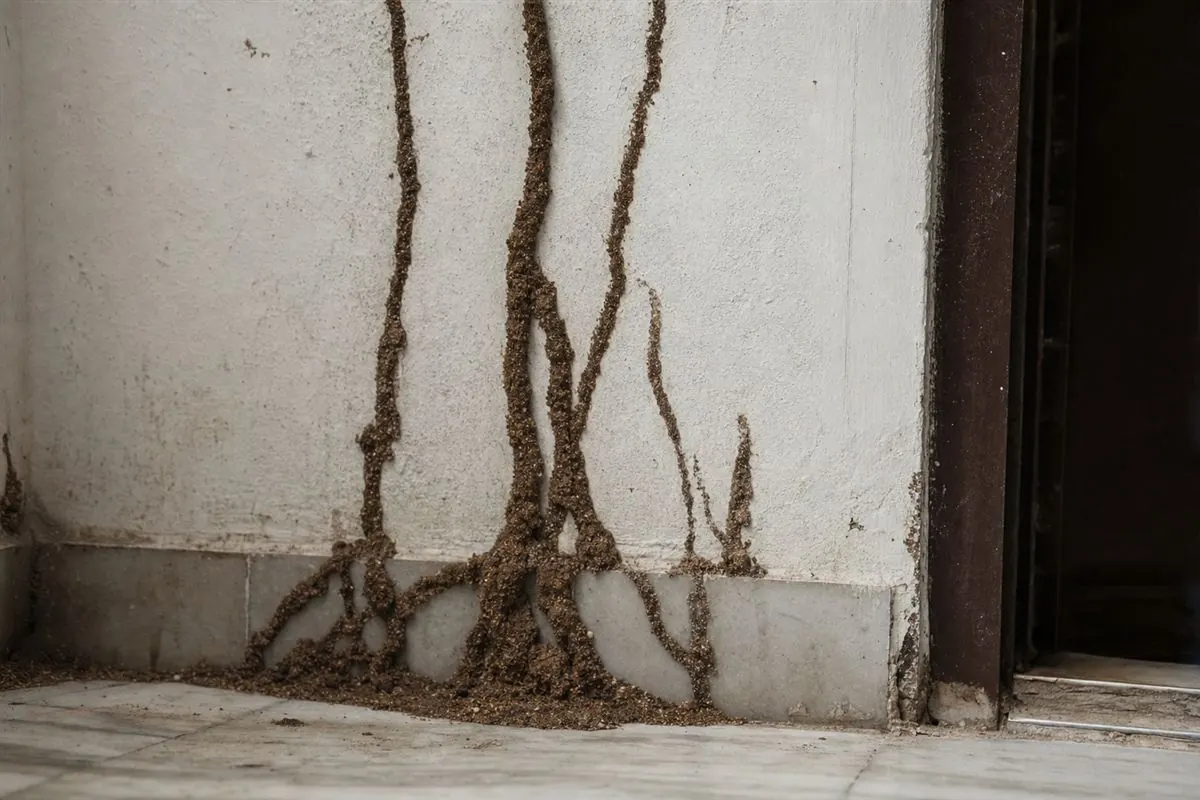
- Mud tubes (the biggest giveaway). Pencil-thin to finger-wide tunnels of dried mud running up walls, across the floor-wall joint, along skirting or up a pillar. Subterranean termites build these to travel from the soil to your wood while staying hidden and moist. Break a bit open — if it’s re-sealed in a day or two, the colony is active.
- Wood that sounds hollow or looks blistered. Tap your door frames, skirting and window beadings with a knuckle or a coin. A dull, papery, hollow sound means the inside has been eaten away. The surface may also look blistered, rippled or bubbled under the paint — that’s termites just beneath the veneer.
- Discarded wings. After the first monsoon rains, winged termites (“alates” or swarmers) fly out to start new colonies, then shed their wings. Little piles of identical, translucent wings on a windowsill, near a tubelight or by the balcony door are a classic sign — people mistake them for flying ants every single year.
- Doors and windows that suddenly stick. When termites tunnel through frames, the wood warps and swells. A door that started jamming for no obvious reason, or a window that won’t shut cleanly, is worth a second look — especially if it’s on the ground floor.
- Frass (drywood termite droppings). Tiny piles of what looks like coarse coffee grounds or sawdust pellets under furniture or near skirting are the droppings of drywood termites pushed out of their galleries.
- Faint papery or hollow patches in walls. Sometimes you’ll see thin mud lines under the paint, or a section of wall that sounds different when tapped — termites working behind the plaster.
One honest caveat: spotting a single sign doesn’t tell you how big the problem is, and the absence of obvious signs doesn’t mean you’re clear. That’s exactly the gap a professional inspection fills.
| What you see | What it usually means | How urgent |
|---|---|---|
| Mud tubes on walls / skirting | Active subterranean termites travelling from soil | High — inspect now |
| Hollow-sounding or blistered wood | Wood already eaten from the inside | High |
| Piles of discarded wings | A colony swarmed nearby, often post-monsoon | Medium–high |
| Doors / windows sticking | Frames tunnelled and warped | Medium |
| Frass / pellet droppings | Drywood termites inside furniture | Medium |
Subterranean vs drywood termites in Delhi homes
Not all termites behave the same, and the treatment differs, so it’s worth knowing which one you’re dealing with. In Delhi, the overwhelming majority of cases — I’d say nine in ten — are subterranean termites. These live in the soil under and around your home, need constant moisture, and build those telltale mud tubes to reach the wood above ground. Because they’re tied to the soil, the treatment for them is a chemical barrier — treating the soil and the foundation so the colony can’t reach your structure.
Drywood termites are the less common cousin. They don’t need contact with soil — they live entirely inside the wood they eat, which means they can set up home in a wardrobe, a wooden bed, a door or imported furniture, even on an upper floor with no ground contact at all. The giveaway is frass — the little pellet droppings — rather than mud tubes. Treating drywood termites is more about targeting the infested item: injection, and for furniture sometimes fumigation or heat. A good inspection tells you which you have, because spraying a soil barrier does nothing for a drywood colony living in your almirah, and vice versa.
| Subterranean (most common) | Drywood | |
|---|---|---|
| Where they live | In the soil; tunnel up to your wood | Entirely inside the wood / furniture |
| Tell-tale sign | Mud tubes on walls & foundations | Frass (pellet droppings) |
| Need soil contact? | Yes — tied to moisture | No — can be on any floor |
| Typical treatment | Soil / foundation chemical barrier | Targeted injection or fumigation |
Not sure if those marks on your wall are termites?
Get a trained technician to inspect your home — mud tubes, hollow wood, the lot. Inspection is free or nominal, and treatment starts at ₹2,499 (GST 18% extra).
How a professional termite inspection actually works
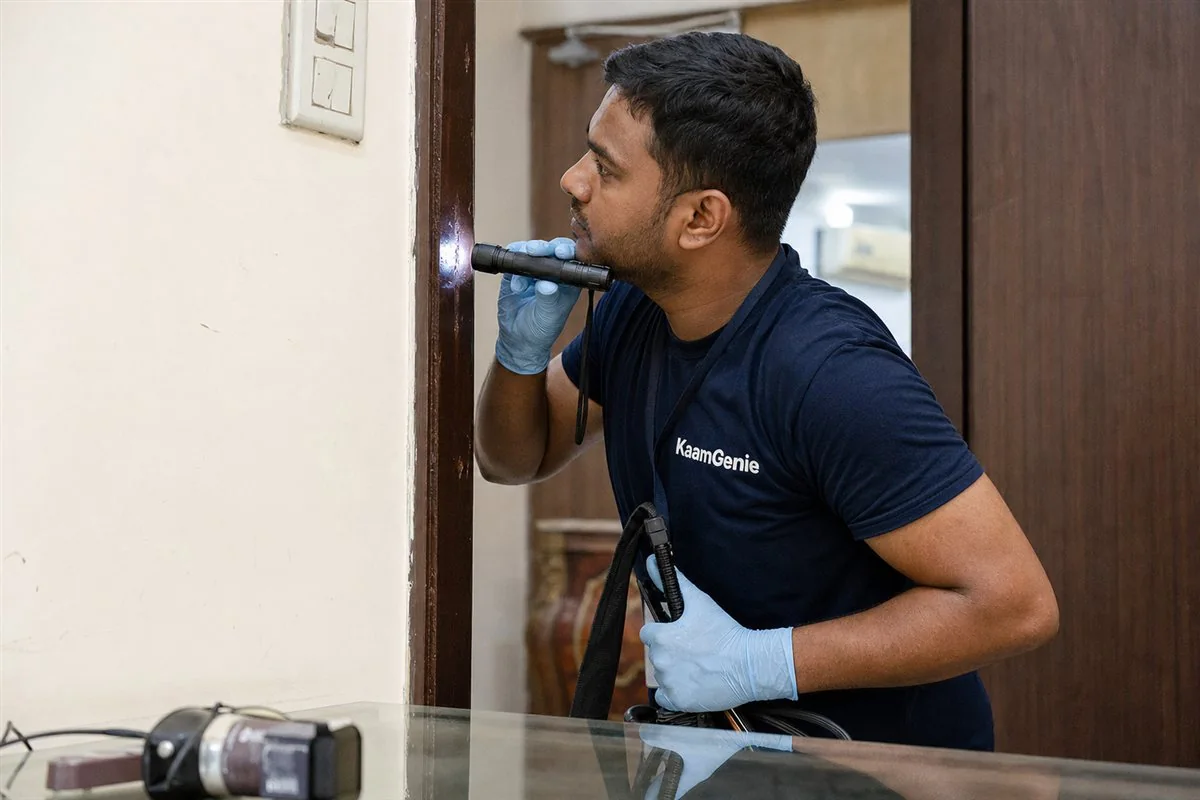
A proper inspection is not someone glancing at one wall and quoting a number. When we send a technician — or when any serious firm does it right — it’s a methodical walk-through that takes anywhere from 30 minutes for a flat to over an hour for an independent house. Here’s what it actually involves.
- A full visual sweep of the vulnerable zones. The technician checks the floor-to-wall joints, skirting, door and window frames, the back and underside of wooden furniture, the store room, kitchen cabinets, the puja unit, staircase woodwork and any damp patches. Ground floors and basements get extra attention because that’s where subterranean termites enter.
- Tapping and probing. Wood gets tapped to listen for that hollow sound, and suspect timber is gently probed to feel whether it’s been eaten out behind the paint. This is where a trained ear earns its keep.
- Tracing the source. Finding a mud tube is only half the job — the technician traces it back towards where the termites are entering, usually a foundation crack, a plumbing penetration, or a damp wall. You can’t treat what you haven’t located.
- Moisture and entry-point check. Leaking pipes, seepage, and soil contact points get noted, because moisture is what keeps a colony alive. Often the inspection flags a plumbing leak the family didn’t know about.
- A clear, written finding. At the end you should get a straight account — what was found, where, which species, how far it’s spread, and a quote for treatment with the warranty terms. You should get before-and-after photos with the work, and a proper GST invoice. Anyone who won’t put the findings in writing is one to avoid.
One thing I’ll stress: a good inspector is honest about uncertainty. Termites hide, and no visual inspection can promise it has found every last gallery behind every wall. What it can do — reliably — is tell you whether there’s active infestation, roughly how serious, and what it’ll take to deal with it.
What a termite inspection costs in Delhi (2026)
Here’s the part people are most relieved to hear. A termite inspection in Delhi is usually free or nominal — most reputable firms, us included, inspect at no charge or for a small visit fee that’s adjusted into the treatment if you decide to go ahead. The money is in the treatment, not the looking, so a good company is happy to come and assess honestly. Be a little wary of anyone charging a heavy “inspection fee” up front with no adjustment — and equally wary of anyone who “finds” a catastrophe in two minutes and pressures you to pay on the spot.
The treatment that may follow is where real numbers come in. Anti-termite treatment in Delhi starts from ₹2,499 and scales with the size of the home and the severity. For the full breakdown by home size and the drill-fill-inject method, see our detailed guide on termite treatment cost for existing homes in Delhi. If you’re building or about to lay foundations, the cheaper and far more effective route is pre-construction anti-termite treatment, done before the floor goes down.
| Service | What you get | Price (2026) |
|---|---|---|
| Termite inspection | Full home survey, species ID, written finding | Free or nominal |
| Treatment — 1–2 BHK flat | Drill-fill-inject chemical barrier | From ₹2,499 |
| Treatment — 3–4 BHK / large flat | Same, larger area | From ₹4,999 |
| Treatment — independent house | Whole-structure barrier, more drill points | Custom quote |
| Pre-construction treatment | Soil & foundation barrier before flooring | Per sq ft (custom) |
Inspect early or pay later — the real Delhi maths
The single best argument for inspecting early isn’t the inspection price — it’s what you avoid. Catch termites when the only sign is a mud tube and a treatment from ₹2,499 sorts it. Ignore it for a year and you’re not just paying for treatment, you’re replacing a door frame, re-doing skirting, rebuilding a wardrobe carcass, sometimes redoing flooring. I’ve seen families spend ₹50,000 and more on carpentry that an early ₹2,499 treatment would have prevented entirely. The chart below is the honest difference between catching it early and catching it late.
Catch it early vs catch it late — typical Delhi cost (2026)
Early treatment versus treatment plus structural carpentry repairs once damage is visible.
Buying or renovating a home in Delhi?
Get it checked before you sign or before the carpenters start. A pre-purchase termite inspection can save you lakhs in hidden repairs.
When should you get a termite inspection?
Timing turns an inspection from a nice-to-have into a genuinely smart move. These are the moments I’d push any Delhi homeowner to book one.
- Before you buy a home. This is the big one. A flat or house can look immaculate and be riddled with termites behind the polish. A pre-purchase inspection costs you almost nothing and can save you from inheriting a five-figure repair bill the previous owner quietly painted over. Make it a condition before you sign.
- Before you renovate or do interiors. About to spend lakhs on new modular wardrobes, panelling and woodwork? Get the place checked first. There is no sense building beautiful new plywood on top of an active colony — treat first, then build.
- After the monsoon (September–October). The rains drive termite activity and trigger the winged swarms. Post-monsoon is when signs surface, so an autumn inspection catches a lot. It’s the natural season to check.
- If you’ve spotted any one of the signs above. A mud tube, a hollow door frame, a pile of wings — don’t wait to see if it “gets worse.” It will.
- Every couple of years as routine, especially for ground-floor flats and independent houses, even with no symptoms — the same way you’d service anything you want to last.
If your last treatment came with a warranty, keep those papers — many treatments are guaranteed for one to five years, and a periodic re-inspection within that window is usually part of the deal.
Found termites? Here’s what treatment follows — we cover Delhi
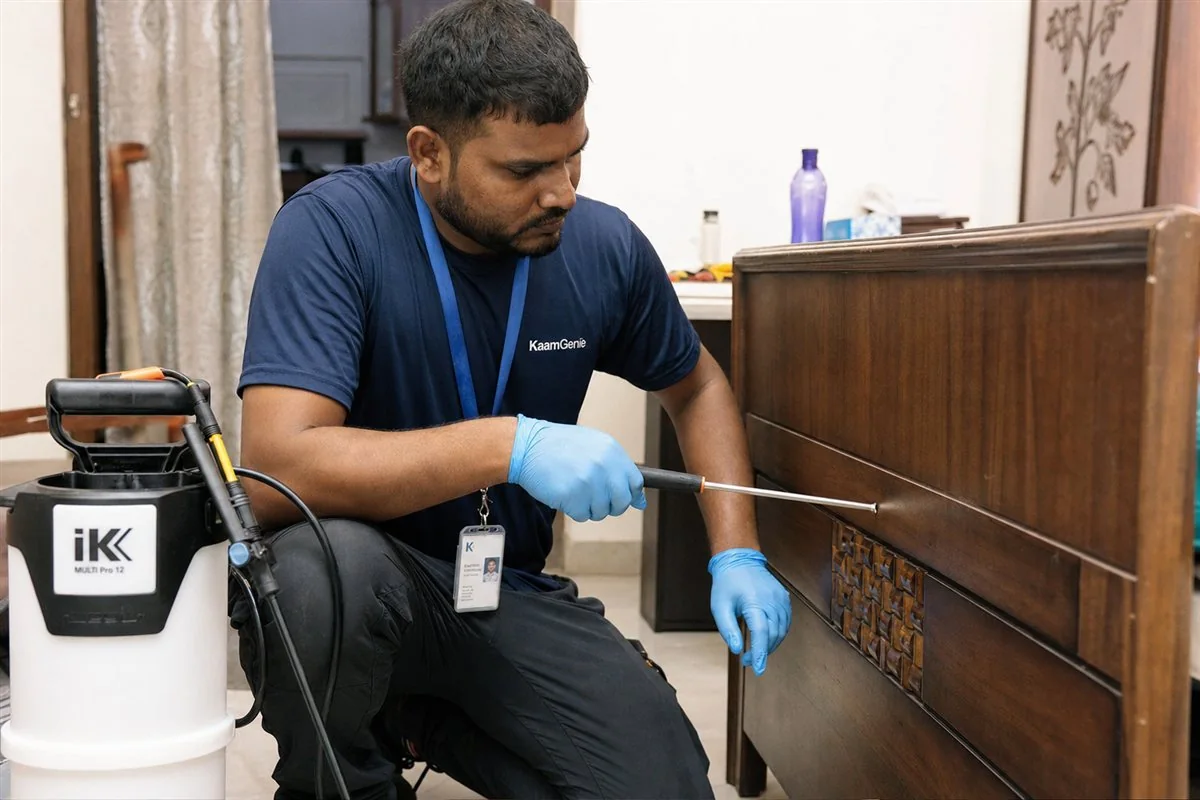
If an inspection turns up active termites, don’t panic — this is a solved problem. For the usual subterranean case, treatment means a chemical barrier: the technician drills small holes at the floor-wall joints and along the affected areas, injects a CIB&RC-approved termiticide to saturate the soil and foundation, and seals the holes back up. Done properly, that barrier cuts the colony off from your home and comes with a written warranty, before-and-after photos and a GST invoice. Drywood infestations in furniture get targeted injection or fumigation instead. Treatment starts at ₹2,499, and we’ll always show you the findings before quoting — no surprises, no scare tactics.
We inspect and treat homes and societies across Delhi — from Dwarka, Janakpuri and Rohini in the west and north, to Saket, Lajpat Nagar and Greater Kailash in the south, to Mayur Vihar, Preet Vihar and Laxmi Nagar in the east, plus Central and North Delhi. Coming soon: Gurgaon, Noida, Faridabad and Ghaziabad. If you’ve seen something that worries you, or you’re buying or renovating in 2026, call 95603 66362 and book an inspection before small termites become a big bill.
Frequently asked questions
What are the early signs of termites in a Delhi home?
The main ones are pencil-thin mud tubes running up walls and skirting; wood that sounds hollow when tapped or looks blistered under the paint; little piles of discarded translucent wings near windows and lights after the monsoon; doors or windows that suddenly start sticking; and fine pellet droppings (frass) under wooden furniture. Spotting any one of these is reason enough to book an inspection.
How much does a termite inspection cost in Delhi in 2026?
A termite inspection is usually free or nominal in Delhi. Most reputable firms, including us, inspect at no charge or for a small visit fee that is adjusted into the treatment if you go ahead. Be cautious of anyone charging a heavy non-adjustable inspection fee, or anyone who pressures you to pay for treatment on the spot.
How much does termite treatment cost in Delhi?
Anti-termite treatment in Delhi starts from ₹2,499 for a 1–2 BHK flat and scales with home size and severity — from around ₹4,999 for a 3–4 BHK and a custom quote for an independent house. GST 18% is extra. Pre-construction soil treatment for new buildings is usually priced per square foot.
What is the difference between subterranean and drywood termites?
Subterranean termites live in the soil, need moisture, build mud tubes to reach your wood, and are by far the most common in Delhi — treated with a soil and foundation chemical barrier. Drywood termites live entirely inside the wood or furniture they eat, need no soil contact, leave pellet droppings instead of mud tubes, and are treated with targeted injection or fumigation.
What does a professional termite inspection involve?
A full visual sweep of vulnerable zones — floor-wall joints, skirting, door and window frames, the back of furniture, store room and kitchen cabinets; tapping and probing wood to find hollow sections; tracing mud tubes back to the entry point; checking for moisture and leaks that feed the colony; and a clear written finding with species, spread and a treatment quote. You should also get before-and-after photos and a GST invoice with any treatment.
How long does a termite inspection take?
Anywhere from about 30 minutes for a flat to over an hour for an independent house, depending on size and how much furniture and woodwork there is to check. A thorough technician will not rush it — a two-minute glance and an instant quote is a red flag.
Should I get a termite inspection before buying a house in Delhi?
Yes — it is one of the smartest things you can do. A home can look spotless and still be riddled with termites behind the polish and paint. A pre-purchase inspection costs almost nothing and can save you from inheriting a five-figure repair bill. Make it a condition before you sign.
When is the best time to inspect for termites in Delhi?
Right after the monsoon, around September and October, is ideal — the rains drive termite activity and trigger winged swarms, so signs surface then. Also inspect before buying or renovating a home, whenever you spot a warning sign, and every couple of years as routine for ground-floor flats and houses.
Are those flying insects after the rain termites?
Quite possibly. After the first monsoon rains, winged termites called alates swarm out to start new colonies and then shed their wings, leaving little piles of identical translucent wings on windowsills and near lights. People often mistake them for flying ants. If you see this in or around your home, get it inspected.
Can I inspect for termites myself?
You can do a useful first check — tap door frames and skirting for a hollow sound, look for mud tubes along walls and the floor joint, check behind and under wooden furniture for droppings, and look for discarded wings. But a DIY check cannot tell you the species, how far it has spread, or where the colony is entering. If you find anything, get a professional inspection to confirm and scope it.
Does a termite inspection come with a guarantee that the home is clear?
An honest inspector will not promise it has found every last gallery — termites hide behind walls and no visual check can guarantee 100%. What a good inspection reliably tells you is whether there is active infestation, roughly how serious it is, and what treatment it needs. The treatment itself comes with a written warranty, typically one to five years.
What treatment follows if termites are found?
For the common subterranean case, treatment is a chemical barrier: the technician drills small holes at the floor-wall joints, injects a CIB&RC-approved termiticide to saturate the soil and foundation, then seals the holes. Drywood termites in furniture get targeted injection or fumigation instead. Treatment starts at ₹2,499, comes with before-and-after photos, a GST invoice and a warranty.
Worried about termites? Get it checked
A trained technician will inspect your home, identify the species and tell you straight what’s going on. Inspection free or nominal; treatment from ₹2,499. We cover all of Delhi.
Sources & references
- Central Insecticides Board & Registration Committee (CIB&RC) — the Indian regulator that approves the termiticides and concentrations used in licensed anti-termite work.
- Bureau of Indian Standards (BIS) — publishes IS 6313 on anti-termite measures for buildings, including pre- and post-construction soil treatment.
- Indian Council of Medical Research (ICMR) — publishes research on structural pest biology and integrated pest management protocols in India.
Last verified: 30 June 2026. If you find any of these links broken, please let us know.