
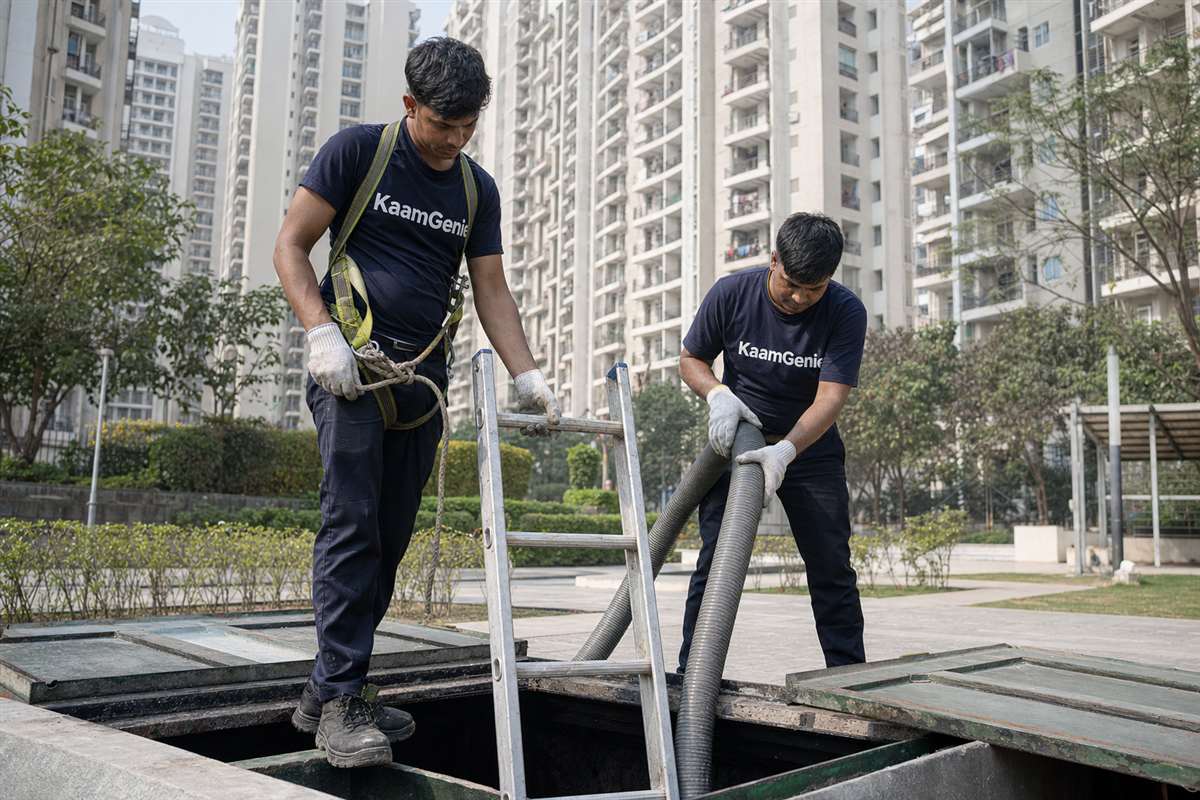
The short version
- The underground sump (UGR) is the first chamber tanker and borewell water enters — so it catches the heaviest sand, grit and silt before any of it reaches your taps.
- Gurgaon runs a two-stage system: water fills the underground reservoir, then a pump lifts it to the rooftop tower tanks. Cleaning only the rooftop tank leaves the dirty source untouched.
- A sump is a confined space — it needs ventilation, a spotter, and proper procedure, not a casual two-person crew.
- The real work is dewatering, desludging, jet washing and vacuuming a far larger volume than an overhead tank — plus dealing with RCC porosity and hard-water scale.
- Sumps are priced on capacity, quoted custom; standard residential overhead tanks start at ₹699 onwards.
If your building only ever cleans the rooftop tank, you are polishing the last step and ignoring the first.
Stand in the basement of almost any tower on Golf Course Road, Sohna Road or the Southern Peripheral Road and you will find a large concrete chamber set into the ground — the underground reservoir, what engineers call the UGR and most residents just call the sump. It is the single most important and most ignored part of a building’s water system. Every conversation we have about water tank cleaning in Gurgaon eventually comes back to it, because the sump is where the water story really begins.
Gurgaon’s water reality makes the sump matter more here than in most cities. Large parts of the Millennium City lean heavily on private water tankers and hard borewell groundwater, and both of those land in the underground reservoir before anything else happens. The sump is the building’s shock absorber — and that means it absorbs the dirt too.
| Factor | Underground sump (UGR) | Rooftop tower tank |
|---|---|---|
| What feeds it | Raw tanker & borewell water, unfiltered | Water already settled in the sump |
| Silt & sand load | Heaviest — grit drops out and settles here | Lighter — most coarse matter left behind below |
| Typical capacity | 5,000–30,000L+ (condo UGRs much larger) | 500–2,000L per tank |
| Material | RCC (porous concrete), in-ground | Usually plastic / Sintex, sometimes RCC |
| Access | Confined space — manhole entry, ventilation needed | Open lid, rooftop, easy access |
| Cleaning effort | High — dewatering + desludging dominate | Moderate — standard 8-step process |
Get your sump cleaned properly
Confined-space trained crew, full desludge and disinfection, custom quote by capacity. Residential overhead tanks ₹699 onwards.
The two-stage system: how water actually moves through a Gurgaon building
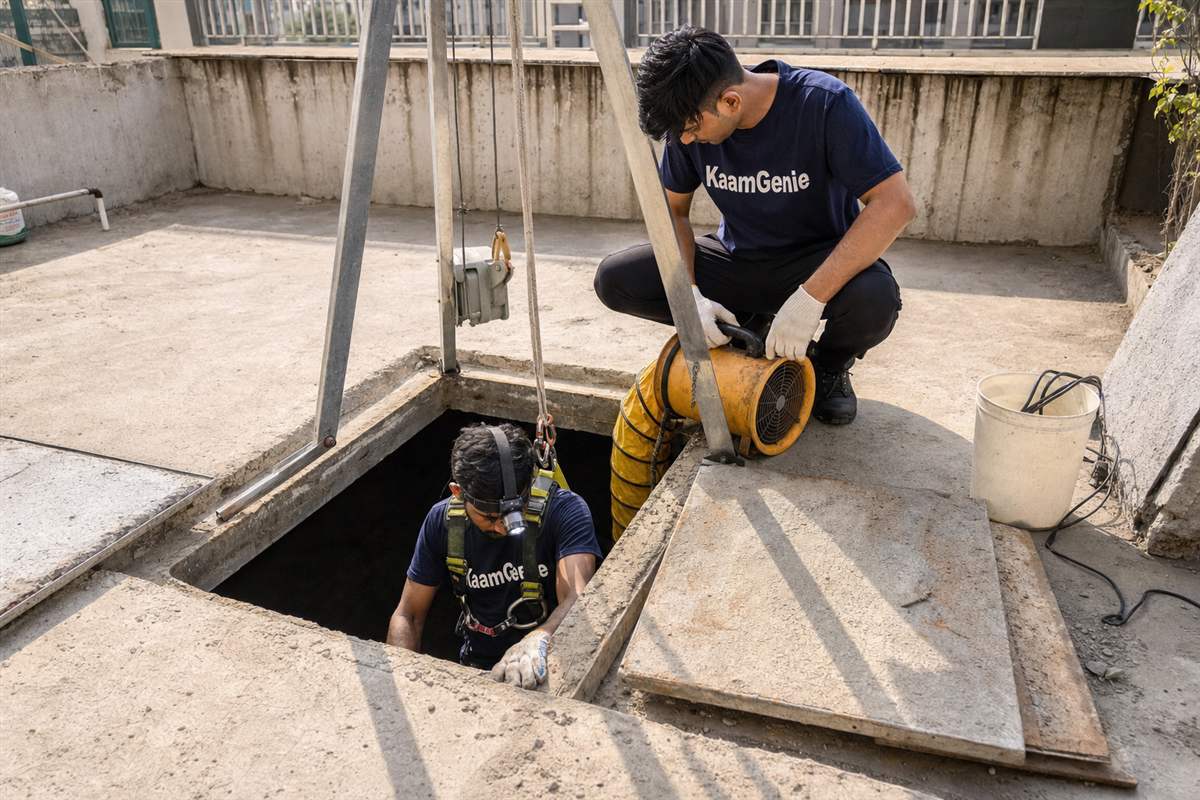
Most condominiums, high-rises and even independent builder floors in Gurgaon run a two-stage water system, and understanding it is the whole point of this article.
Stage one is the underground reservoir. A tanker reverses up to the building and discharges thousands of litres into the sump, or the borewell pump fills it, or the municipal supply trickles in — in many buildings, all three at different times. Everything pools here first.
Stage two is the lift. A booster pump draws water out of the sump and pushes it up to the overhead tower tanks on the roof, which then gravity-feed the flats below. By the time water reaches your kitchen, it has already spent hours sitting in the sump.
This is why cleaning only the rooftop tank is half a job. The rooftop tank is downstream of the sump — it receives water that the sump has already partly clarified. If the source chamber is carrying a sludge bed and scaled walls, you are lifting that water upstairs every single day. We get into the trade-offs between the two in our companion guide on overhead vs underground tank cleaning; the short version is that they are different jobs and the sump is the harder, more important one.
Why the sump collects the worst silt
There is straightforward physics behind why the underground reservoir is always the dirtiest part of the system, and it comes down to settling.
When a tanker discharges, the water arrives carrying suspended sand, fine grit and dissolved minerals — especially from borewell sources drawing on Gurgaon’s hard aquifer. The moment that water stops moving and sits in a large sump, gravity goes to work. The heavy particles drop out of suspension and settle on the floor. The longer and stiller the water sits in a big chamber, the more completely it clarifies — which is good for the rooftop tank above, but it means every bit of that grit ends up bedded on the sump floor.
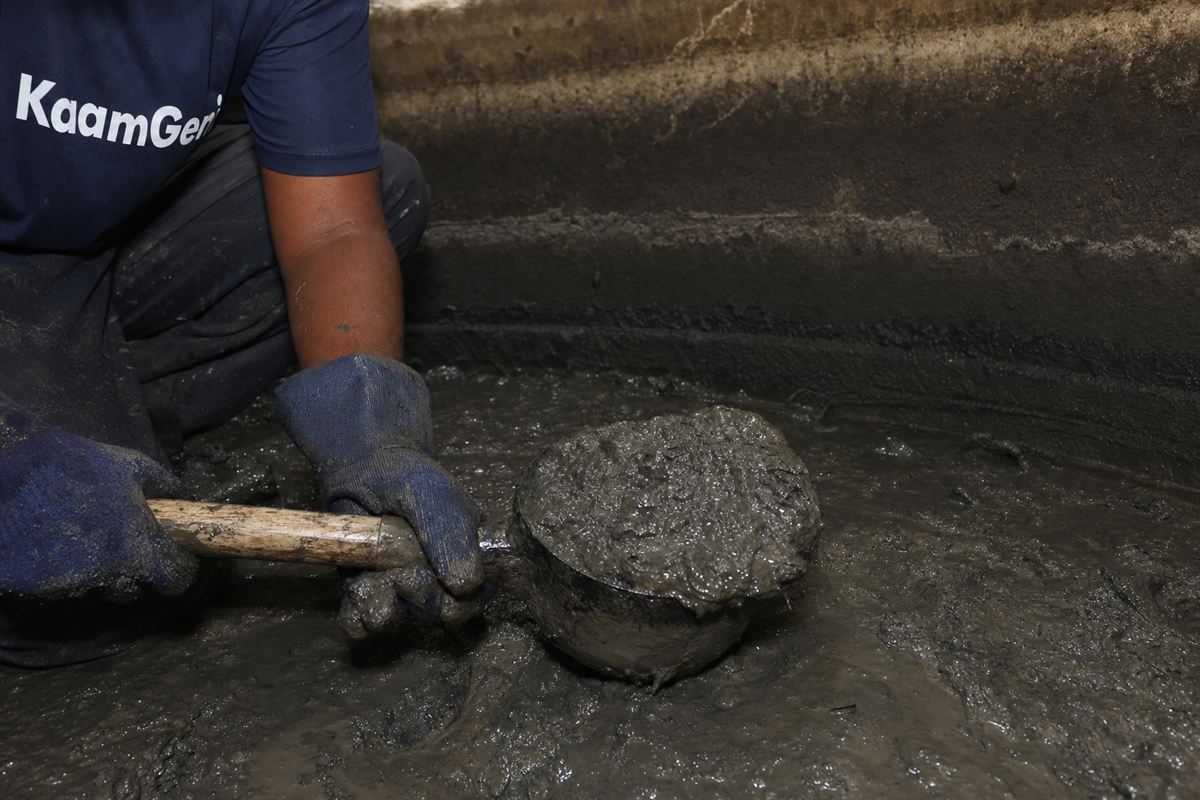
Over months, this builds into a sludge layer that can be one to three inches thick in a neglected condo UGR: a paste of sand, silt, calcium scale, rust off old fittings, and organic matter. It sits below the pump intake most of the time, which is exactly why residents never see it — until the level runs low, the pump stirs it up, and suddenly the taps run cloudy across the whole building. The same buildings on heavy tanker dependence that we cover in our society water tank cleaning notes tend to have the deepest sludge beds, because more raw water means more settled grit.
Confined-space safety: why a sump is not a rooftop tank
This is the part that separates a real sump cleaning from a dangerous shortcut. An overhead plastic tank is open-topped, at roof level, with fresh air all around. An underground reservoir is a sealed concrete chamber that a person has to climb into through a manhole. That is a confined space, and confined spaces carry real risks.
A sump that has been shut up can hold low oxygen levels or trapped gases from decomposed organic matter. Working inside one without procedure is genuinely hazardous — this is the kind of job where cutting corners is not just a bad clean, it is a safety failure. Our crews handle it the way it should be handled:
- Ventilate first. The chamber is opened and aired out before anyone goes near the manhole.
- Never work alone. One technician works inside; a spotter stays at the opening the entire time, in constant contact.
- Light and footing. Proper lighting goes in, and the crew accounts for wet, slippery RCC floors.
- Right gear. Gloves, boots and protection appropriate to a wet confined chamber, not just a bucket and a torch.
If a vendor sends two people to drop into your basement sump with no spotter and no ventilation, that is the wrong vendor. This is also why sump cleaning is not something we ever rush or treat as an add-on to a quick rooftop visit.
What a proper UGR cleaning actually involves
The headline stages are the same family as any tank cleaning, but in a sump each one is bigger, slower and more physical. Here is what the work really looks like:
Dewatering. The sump has to be fully emptied to reach the floor sludge. We pump the bulk of the water out — saving usable water in drums for non-drinking use where the building wants it — then bring the level right down. This alone takes far longer than draining a rooftop tank because the volume is so much larger.
Desludging. Once the water is gone, the settled sludge bed on the floor is scooped out by hand into sealed buckets and carried off-site. We never flush sludge into the building drains, because it just resettles in the plumbing downstream. This is the dirtiest, most important stage, and the one cheap operators skip entirely.
Scrubbing and jet washing. The RCC walls and floor are scrubbed, then blasted with a high-pressure jet. Concrete is porous — bio-film and scale work their way into the textured surface, and only pressure clears them out of the pores. Brushes alone cannot do it on an aged sump wall.
Vacuuming. A wet vacuum lifts the last few inches of dirty rinse water and dislodged debris so none of it is left to redistribute when the sump refills.
Disinfection. Every interior surface is treated with food-grade sodium hypochlorite at the correct concentration, given proper contact time, then rinsed. This is what makes the chamber safe to store drinking water again, not just visually clean.
Because a sump is the source, getting this right protects everything downstream — which is exactly why it sits at the core of our wider water tank cleaning services across NCR. We follow the same documented method whether we are in a builder floor near Sector 65 or a large condominium tower on Sohna Road.
Where the time goes — cleaning a 15,000L condominium UGR
Dewatering and desludging dominate, because the sump holds far more than a rooftop tank
Illustrative timings for a mid-size 15,000L underground reservoir — roughly 4–4.5 hours end to end. Stages overlap in practice, and larger society UGRs run longer with two crews.
RCC porosity and hard-water scale — the Gurgaon double problem
Two things conspire against a Gurgaon sump in particular. The first is the material. Almost all underground reservoirs are RCC — reinforced cement concrete — and concrete is porous. Its surface is microscopically rough, full of tiny pits where bio-film anchors and where scale gets a foothold. A plastic rooftop tank wipes relatively clean; an RCC wall holds on to its deposits.
The second is the water. Gurgaon’s borewell groundwater is genuinely hard, loaded with dissolved calcium and magnesium. As it sits in the sump, those minerals precipitate out and bond to the concrete as scale — a chalky, rough lining that grows thicker every year it is left. Scale is not just ugly; it gives bacteria and bio-film even more surface area to colonise, and it traps the contaminants you are trying to remove. We go deeper into this in our piece on hard water tank cleaning in Gurgaon, but the takeaway for sumps is simple: porous concrete plus hard water means scale compounds, and a sump left for years needs jet washing and sometimes descaling, not a quick rinse.
This is the strongest argument for a regular schedule. Clean the sump twice a year and the scale never gets a chance to build into a hard lining. Leave it for three or four years and you are paying for a heavy-duty restoration instead of routine maintenance.
What sump cleaning costs in Gurgaon — and why it is custom
We are upfront that we cannot put a single sticker price on sump cleaning the way we can on a standard rooftop tank. Residential overhead tanks start at ₹699 onwards because they are broadly similar in size and access. Sumps are not. A small builder-floor sump and a 30,000-litre condominium UGR are completely different jobs.
The price of a sump cleaning depends on three things: capacity (the litreage drives the dewatering, desludging and chemical volume), access (manhole size, depth, and how easy the chamber is to enter and ventilate), and silt load (a sump cleaned regularly is quick; one neglected for years is a much bigger job). We confirm those on a quick assessment and give you a fixed figure before we start — never an hourly meter that runs while the crew works. For condominiums and societies, the UGR is usually quoted alongside the tower tanks as a package, which is how the buildings we serve around DLF Phase 5 typically schedule it.
Have a sump or UGR that needs attention?
Tell us the capacity and we’ll give you a fixed quote — confined-space safe, fully desludged and disinfected, with photos before and after.
Clean the source, not just the last step
The lesson under all of this is simple. In a Gurgaon building, water quality is decided in the basement, not on the roof. The underground sump is where tanker and borewell water lands first, where the silt settles deepest, and where scale and bio-film get the most surface to cling to — and it feeds every tower tank and every tap above it. Cleaning the rooftop tank while ignoring the UGR is polishing the last step of a chain that starts with a dirty source.
If your sump has not been opened and properly desludged in over a year — or you genuinely do not know when it last was — that is the place to start. Browse all of our coverage and book through the water tank cleaning Gurgaon hub, and we will handle the sump the way a confined space deserves: safely, fully, and documented.
To book, call +91 95603 66362 or use the booking form on this site — tell us the capacity and we’ll confirm a fixed quote shortly.
Frequently asked questions
What is an underground sump or UGR, and why does it matter in Gurgaon?
A UGR (underground reservoir), also called a sump or storage tank, is the big RCC water chamber built into the ground or basement of a Gurgaon building. It is the first place tanker water and borewell water lands before pumps lift it to the rooftop tower tanks. Because almost every drop your home uses passes through the sump first, its cleanliness sets the baseline for the whole building’s water.
Why does the underground sump collect more silt than the overhead tank?
Three reasons. First, raw tanker and borewell water is dumped straight into the sump with all its suspended sand and grit, which settles to the floor. Second, the sump is large and the water sits still long enough for fine particles to drop out. Third, the rooftop tank only receives water that has already been partly clarified by sitting in the sump, so the sump takes the hit. The result is that the UGR floor carries the thickest sludge layer in the building.
How does the two-stage UGR-to-tower system work in Gurgaon condos?
Most Gurgaon condominiums and builder floors run a two-stage system. Stage one: tanker and borewell water fills the underground sump (UGR). Stage two: a pump lifts water from the sump up to the rooftop overhead tower tanks, which then gravity-feed your taps. Cleaning only the rooftop tank while ignoring the sump means you are filtering at the top while the source chamber stays dirty.
Is confined-space entry into a sump safe?
It is safe only with the right procedure, which a basement sump absolutely requires. A sealed underground chamber can hold low oxygen or trapped gases. Our crew ventilates the sump, tests the air where required, never lets one person work alone, keeps a spotter at the manhole, and uses proper lighting and footing. Confined-space sump cleaning is not a job for an untrained two-person crew with a bucket.
How long does it take to clean an underground reservoir in Gurgaon?
A residential sump up to about 5,000 litres takes roughly 2 to 2.5 hours. Larger condominium UGRs of 10,000 to 30,000 litres take 3 to 5 hours, and very large society reservoirs can run a half-day with two crews. The dewatering and desludging stages are what stretch the timeline, because the sump holds far more water and silt than a rooftop tank.
How much does underground sump cleaning cost in Gurgaon?
Standard residential overhead tanks start at ₹699 onwards, but sumps are priced on capacity because they vary so widely. A small builder-floor sump is modest; a large condominium UGR or society reservoir is quoted custom after we confirm the litreage, access, and how heavy the silt load is. We give a fixed figure before starting, not an hourly meter.
How often should an underground sump be cleaned?
Because the sump takes the raw tanker and borewell load first, we recommend cleaning it at least twice a year in Gurgaon — more often for buildings on heavy tanker dependence or very hard borewell water. Many societies put the UGR and tower tanks on a six-monthly schedule so the source chamber never builds up a thick sludge bed.
Do you drain the whole sump, and where does the water go?
Yes — a proper cleaning needs the sump fully dewatered so the floor sludge can be reached. We pump the bulk down the building drain, save usable water in drums for non-drinking use where possible, then vacuum the last few inches. The thick bottom sludge is scooped into sealed buckets and removed off-site, never flushed back into the building plumbing where it would settle downstream.
Can hard borewell water damage an RCC sump over time?
Hard Gurgaon groundwater leaves calcium and magnesium scale that bonds into the porous RCC walls and floor of a sump, giving bio-film more surface to cling to. The concrete itself is porous, so neglected sumps develop a rough scaled lining that ordinary rinsing cannot clear — it needs jet washing and, in bad cases, descaling. Keeping the sump on a regular cleaning schedule stops scale from compounding year after year.
Sources & references
- Bureau of Indian Standards (BIS) — IS 10500:2012 is the canonical Indian Standard for drinking water specification, defining acceptable limits for physical, chemical, and biological parameters.
- WHO Guidelines for Drinking-water Quality, 4th edition — the global reference for water quality standards, including guidance on storage and disinfection.
- Food Safety and Standards Authority of India (FSSAI) — defines water quality requirements for food businesses, including hygiene standards for stored water and acceptable disinfection chemicals.
- WHO Fact Sheet on Drinking Water — overview of safe drinking water requirements and contamination risks.
- CPHEEO — Manual on Water Supply and Treatment — the Government of India’s engineering manual covering tank design, cleaning protocols, and disinfection practices.
Last verified: 29 June 2026. If you find any of these links broken, please let us know.