
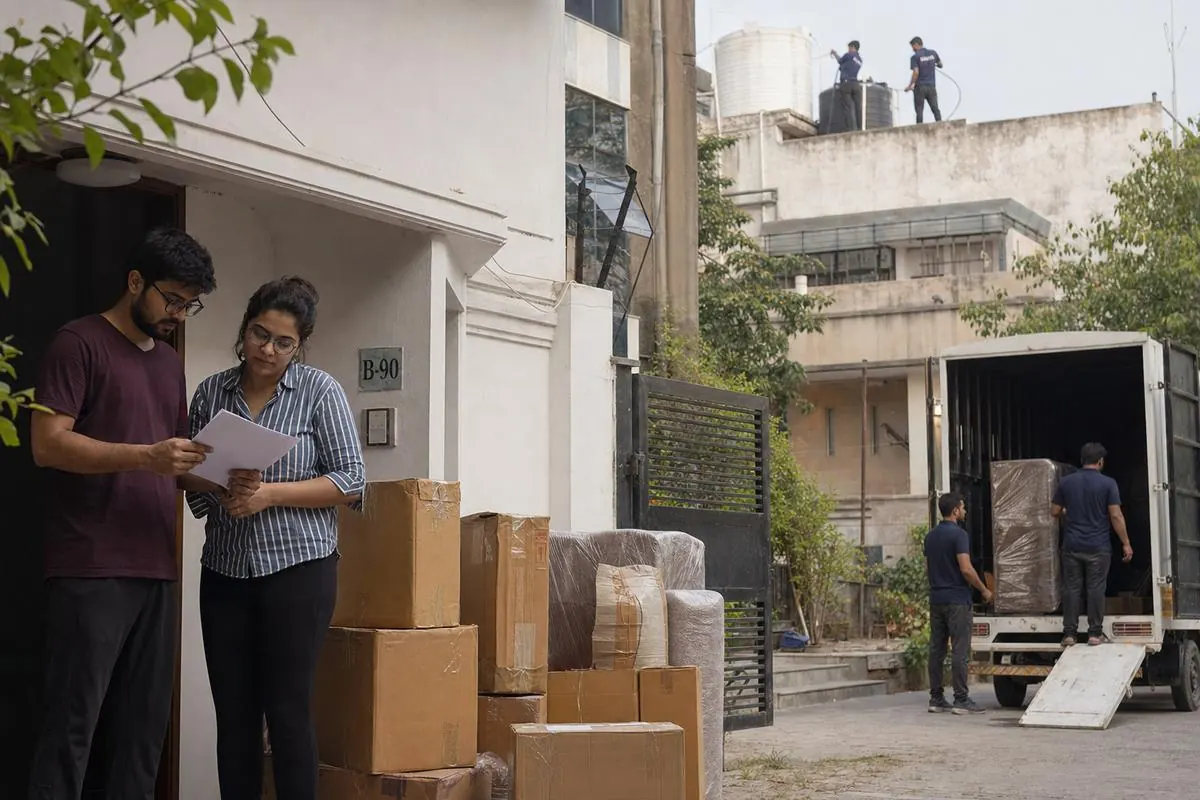
Quick answer — tenant’s moving-in checklist
- Book the cleaning for 1-3 days BEFORE move-in — not after. Fresh tank, fresh start.
- Who pays? Grey zone. Model Tenancy Act 2021 leans toward landlord for structural maintenance, tenant for routine consumption. In real Delhi practice, 80% of tenants end up paying it themselves — ₹599-1,499.
- Ask the landlord BEFORE signing: when was the tank last cleaned, what’s the tank material, water source (DJB or borewell), any recent water quality issues.
- Telltale signs the tank is overdue: faint smell from taps, brown stains in the toilet bowl, algae-like taste, sediment in the geyser tank.
- Pricing (2026): 1 BHK ₹599, 2 BHK ₹799, 3 BHK ₹999, 4 BHK ₹1,299, builder floor ₹1,499, independent house ₹1,999.
- If landlord refuses to pay: offer to split, deduct from first month’s rent with written confirmation, or do it yourself and keep the receipt.
Why the water tank should be the first thing you book before moving in
Most Delhi tenants think of move-in day as a packing problem. Get the truck booked. Get the kids’ school transfer sorted. Find someone to put up the curtains. Argue with the cable guy about the wifi date. The water tank doesn’t enter the picture until weeks later, when somebody in the family says “the water tastes funny” or the toilet bowl develops a brown ring you cannot scrub off. By then you’ve been drinking, bathing in, and cooking with that water for a month.
This is the wrong order. The water tank on your new rental should be on the same checklist as the gas connection transfer and the electricity meter reading. Here’s why.
A Delhi rooftop tank that hasn’t been opened in 18 months has between 1-3 inches of soft sediment sitting at the bottom. That sediment is a mix of mineral scale from hard DJB water, organic debris that washed in through the inlet, dust that fell in past a poorly sealed lid during summer, and bio-film — a thin slimy layer where bacteria, fungi and algae grow happily. None of this is visible from the kitchen tap. The water looks clear because the heavier sediment stays at the bottom and the bio-film coats the walls. What reaches your glass is just the top 70% of the water with the worst stuff suspended through it.
The previous tenants ignored this because tenants almost always do. People put up with whatever water situation they walked into, especially if rent is already on the high side. They don’t want to spend money cleaning a tank they’re going to leave in 18 months. When they leave, they take their habit of ignoring it with them. The tank stays.
The smart move is to book a move-in tank cleaning 1-3 days before move-in — ideally on the same day the painter finishes — so you start your new life on clean water. Cost is ₹599 for a 1 BHK overhead tank, takes 60-90 minutes, and the crew gives you photo proof. It is the single cheapest health investment you will make in the move, and the one tenants regret skipping the most.
The “landlord vs tenant” question — who actually pays?
This is the part everyone wants a clean answer to and there isn’t one. Here’s the honest version.
The Model Tenancy Act 2021, drafted by the Ministry of Housing and Urban Affairs, lays out a general framework for rental responsibilities in India. The simple version: the landlord bears structural maintenance (the building itself, the tank as a fixture, plumbing, walls, roof), and the tenant bears routine consumption-linked expenses (water bill, electricity, gas, day-to-day upkeep). Tank cleaning sits awkwardly between these two. It’s not a structural repair, but it’s not exactly consumption either. The Act doesn’t spell it out.
States can adopt or modify the Model Tenancy Act, and Delhi has not formally adopted it as of 2026 — the older Delhi Rent Control Act still governs most disputes. Which means in practical legal terms, water tank cleaning responsibility is whatever your rental agreement says it is. Most rental agreements in Delhi don’t mention it at all.
So you’re left with the practical reality: who actually pays in Delhi rentals in 2026? In our booking data, about 80% of move-in tank cleanings are paid by the tenant. About 15% are split, usually informally over WhatsApp. About 5% are paid in full by the landlord, almost always when the tenant specifically negotiated it into the rental agreement or asked for it in writing before move-in.
The landlords who agree to pay tend to fall into three groups: new owners who just bought the flat and want to start the rental on a good note; premium-property landlords (DLF, GK, Defence Colony) where the rent is high enough that ₹800 doesn’t register; and repeat landlords who’ve learned that a clean tank prevents tenant complaints later. The landlords who refuse tend to be older owners renting out a flat they once lived in, where “we never cleaned it and we were fine” is the default mental model.
Our recommendation: ask, but don’t expect. If the landlord agrees, great. If they don’t, pay it yourself, treat it as a one-time move-in cost like the deposit on the gas cylinder, and don’t lose sleep over the principle of it. The downside of waiting six months for the landlord to come around is six months of dirty water for your family.
What to ASK the landlord BEFORE signing the lease
Most Delhi tenants tour the flat, like the kitchen, agree the rent, sign within 48 hours. The water tank conversation never happens. That’s the wrong order. These four questions, asked during the second visit (after you’ve decided you like the flat but before you’ve signed), tell you almost everything you need to know about your future drinking water.
1. When was the tank last cleaned? The honest answers vary. “Last month” means the landlord cleaned it before showing the flat to attract tenants — great news, no cleaning needed for 4-6 months. “6-12 months ago” is common and means schedule a cleaning within your first month. “I don’t remember” or “the previous tenants would have done it” both mean it has not been cleaned in 18+ months — book before move-in. “It doesn’t need cleaning” is a red flag that the landlord has never thought about it; treat it as “never cleaned.”
2. What is the tank made of, and what size? Plastic overhead tanks (the standard 500L-1000L black or white plastic ones on the roof) are easiest to clean and most common in builder floors and individual flats. Concrete sumps (underground reservoirs in kothis and independent houses) cost more to clean because they need confined-space safety gear. Stainless steel rooftop tanks (less common, mostly in upmarket builder floors) clean quickly. Size matters because it sets the price: 1 BHK with a 500L tank is ₹599; a 3 BHK with a 1000L tank is ₹999; a kothi with a 3000L sump runs ₹1,500+.
3. Is the water from Delhi Jal Board or borewell? DJB water is treated and lower in scale build-up but has higher organic load — cleaning frequency every 6 months is fine. Borewell water is mineral-heavy and leaves visible scale on the tank walls; cleaning every 3-4 months is closer to right. Mixed supply (some areas of South Delhi, parts of Saket, Vasant Kunj) is the most variable and usually needs the more frequent schedule. Knowing the source helps you plan ongoing cleanings, not just the move-in one.
4. Have there been any recent water quality issues? If the landlord pauses or hedges (“the previous tenants mentioned the water tastes a bit metallic sometimes”), book the cleaning before move-in. If the landlord says “no issues, the water is fine” with confidence, you can wait two weeks after move-in and judge for yourself. If the landlord says “there was a problem but we fixed it” without explaining what was fixed, ask follow-up questions — sometimes “fixed it” means “installed a 5-stage filter,” which doesn’t solve the tank problem at all.
Telltale signs the previous tenants didn’t clean the tank
Even if you haven’t asked the right questions, your senses can tell you within 48 hours of moving in. Here are the five signs Delhi tenants notice most often.
The faint smell from the kitchen tap. Not a strong sewage smell — that would mean something much worse. More like a stale, slightly earthy smell when you first turn the tap on in the morning, before the line flushes. This is biofilm releasing volatile compounds overnight. By the third glass of water poured, the smell is gone, which is why it’s easy to dismiss. But it’s a real signal.
Brown or yellow staining in the toilet bowl. Within 7-10 days of move-in, if the toilet bowl is developing a ring at the water line that wasn’t there when you took possession, the tank has heavy iron or scale content. The previous tenants either scrubbed it weekly or had become blind to it. Either way, the source is the tank, not the toilet.
The algae taste in cold water. Hard to describe but unmistakable once you notice it. Slightly bitter, vegetal, almost like the water has been sitting in a stagnant pond. Cooked food can mask it; cold drinking water doesn’t. If anyone in the family says “the water tastes funny” in the first week, take it seriously and check the tank.
Sediment in the geyser tank. When you turn the geyser on for the first time and run hot water for 30 seconds, look at what comes out into the bucket. If there are visible particles, brown swirls, or a cloudy first 5-10 seconds before clearing, the cold-water tank upstream has sediment that’s settled into the geyser. The geyser will need draining within a month if you don’t clean the source tank first.
Skin or scalp dryness that wasn’t there at the old place. If three weeks after moving in your skin is itching, your scalp is flaking, or the kids are developing rashes after bathing — and nothing else has changed in your routine — the water is the most likely cause. Hard water plus old biofilm is rough on skin even when the bacterial count is within technical “safe” limits.
If you tick two or more of these in your first 10 days, stop reading and book the cleaning. The pattern almost never improves on its own — it gets worse as the tank sits.
Just signed a Delhi rental? Book your move-in cleaning
Same-week service, ₹599 onwards. Photo proof every time. Start your new home on clean water.
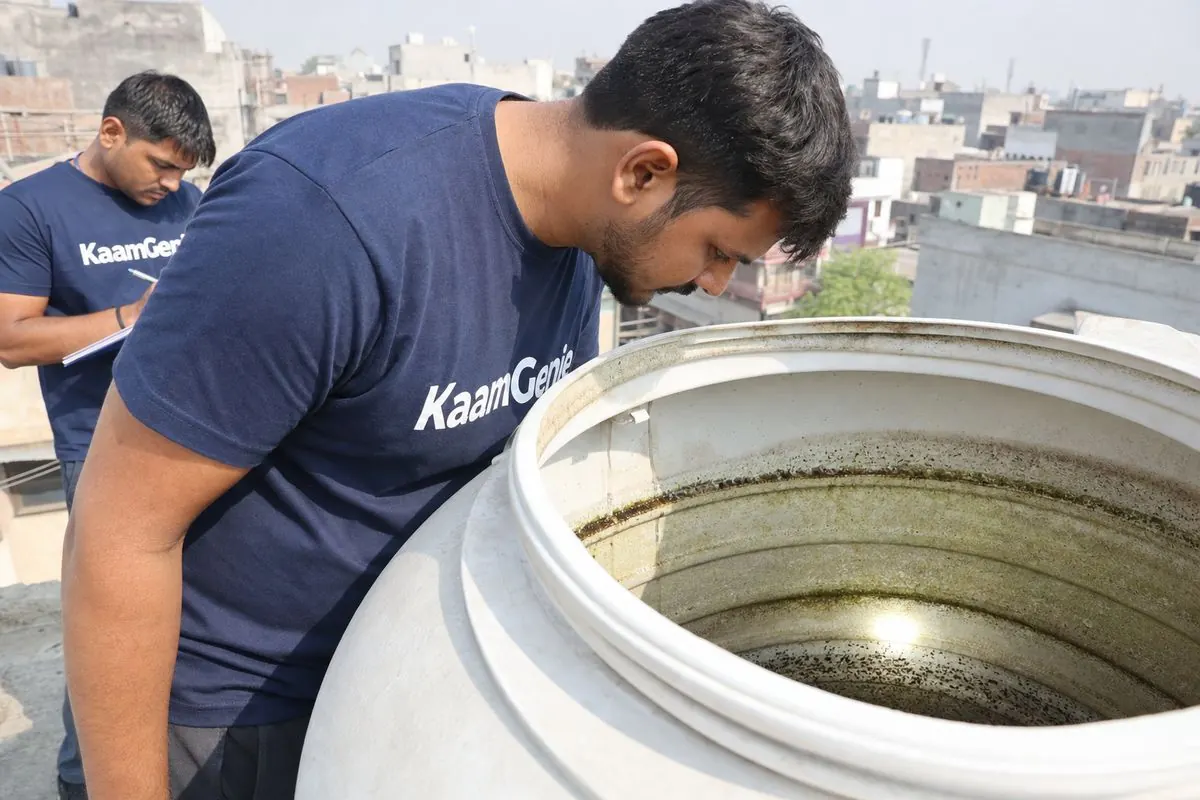
The “moving in” cleaning protocol — what KaamGenie does differently for new tenants
A move-in cleaning is not the same job as a routine 6-month cleaning. The tank has been sitting longer, the sediment is heavier, and you have specific concerns no other customer has — you don’t know the previous tenants’ habits, you don’t know what got flushed down or what the landlord skipped. So the protocol shifts in three ways.
Pre-cleaning inspection with photos sent to you. Before any chemical or water goes anywhere, the crew opens the tank, takes 6-8 photos of the inside walls, base sediment, inlet condition, and outlet pipe. These go to your WhatsApp before work starts. You can see what you walked into. This matters for tenants because if you ever need to argue with a landlord later about water-related damage or a deposit deduction, you have a date-stamped baseline of how the tank looked the day you moved in.
Deeper sediment removal. Routine 6-month cleanings can sometimes skip the heavy bottom-sludge step if the tank has been maintained. For a move-in cleaning, that step is always included because the tank almost certainly has 12-18 months of sediment. The crew uses a wet-vacuum to extract sludge first, then physically scrubs the walls and base, then jets the corners with high-pressure water before the disinfection step. Add 10-15 minutes to a standard job.
Stronger disinfection cycle. Standard maintenance cleanings use a food-grade chlorine solution at the BIS-recommended residual level with a 15-minute contact time. Move-in cleanings extend the contact time to 25-30 minutes because the bio-film load is heavier and the unknown history means we don’t want to assume the previous bacterial population was normal. After the contact time, the tank is fully drained, rinsed twice with fresh water, and refilled.
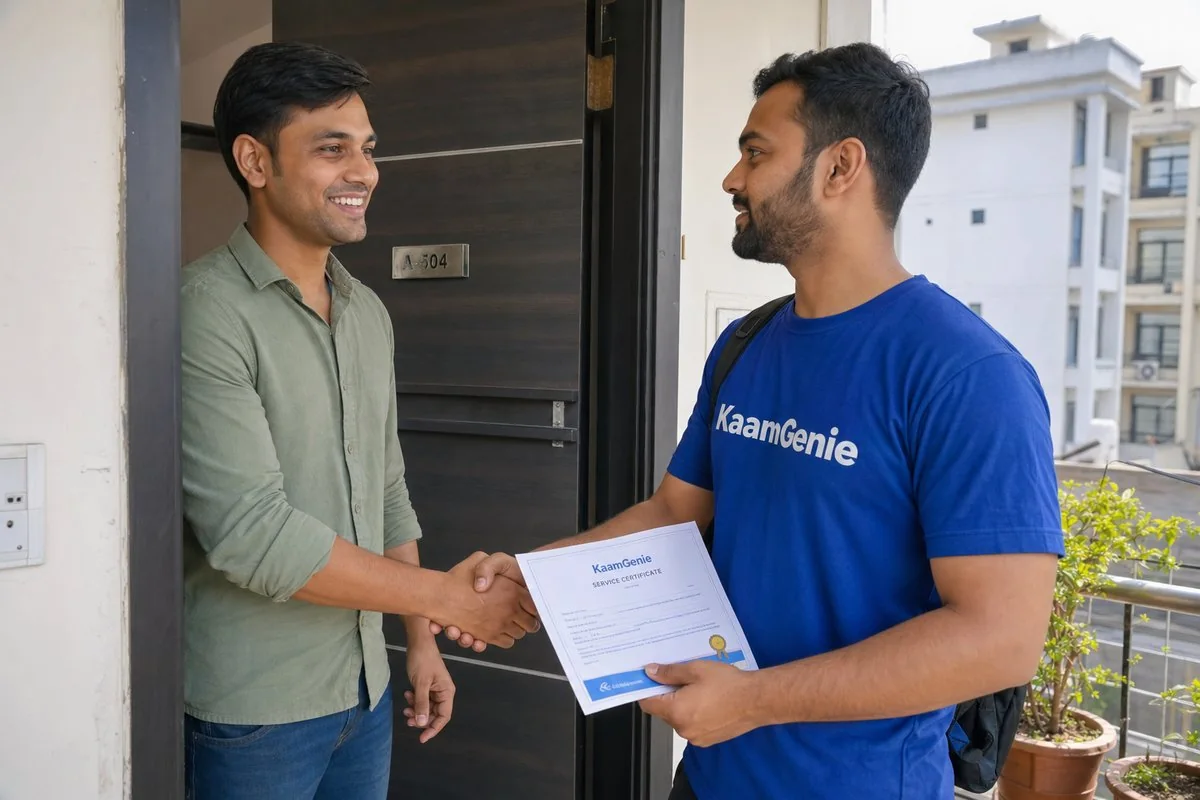
Dated cleaning record for your move-in. You get an emailed record noting the date of cleaning, chemicals used, BIS reference, and the crew lead’s name. This becomes your tenant baseline document. Every future cleaning you book gets stapled to this one. If you renew the lease or move out, you have a clean paper trail showing you maintained the water hygiene throughout your tenancy.
Time on site: 75-90 minutes for a 1 BHK overhead tank, 90-120 minutes for a 2-3 BHK with a larger tank, 2-2.5 hours for a kothi with a sump. We arrange for our crew to come 1-2 days before your move-in day so the tank fills overnight and the water is settled and ready when you arrive with the boxes.
Pricing for a tenant-funded one-time cleaning
Here’s the honest 2026 pricing for a move-in tank cleaning paid by the tenant. No platform markup, GST 18% extra, no hidden visit fee within standard Delhi zones.
| Property type | Tank size (typical) | One-time price | Time on site |
|---|---|---|---|
| 1 BHK flat / studio | 500L overhead | ₹599 | 60-75 min |
| 2 BHK flat | 500-1000L overhead | ₹799 | 75-90 min |
| 3 BHK flat | 1000L overhead | ₹999 | 90-105 min |
| 4 BHK flat / penthouse | 1000-1500L overhead | ₹1,299 | 105-120 min |
| Builder floor | 1000L overhead + utility | ₹1,499 | 105-120 min |
| Independent house / kothi | 1000L overhead + 3000L sump | ₹1,999 | 2-2.5 hrs |
| Annual AMC (any of above) | 2 cleanings/year | ~20% off list | Per-visit time |
Why we publish tenant-specific prices instead of just one residential rate: tenants ask different questions than owners. You want to know exactly what it will cost before you decide whether to pay or push the landlord. You don’t want a custom quote conversation. Above is the firm price you’ll be charged, plus GST. If anyone in Delhi quotes you significantly less for a real cleaning — not a 10-minute rinse — it’s probably an unregistered freelance crew with no documentation. If anyone quotes significantly more, you’re paying a platform markup.
What to do if the landlord refuses to pay
Most landlords will say no the first time you ask. Don’t take it personally — it’s a default reflex, not a considered position. Here’s how Delhi tenants we work with have handled it over the years.
Option 1: offer to split. “The cleaning is ₹799 for our 2 BHK — would you be willing to share half, ₹400 each?” This often works because the landlord is no longer being asked to absorb the full cost and the gesture of splitting feels fair. A surprising number of landlords agree to this when they would have refused the full amount. Use WhatsApp for the agreement so you have a written record.
Option 2: deduct from the first month’s rent with written confirmation. Ask the landlord by WhatsApp: “I’m planning to get the tank cleaned before move-in for ₹799. Can I deduct this from the first month’s rent and share the receipt with you?” Get a thumbs-up or a typed yes in writing before doing it. Don’t deduct without written approval — that becomes a deposit dispute later.
Option 3: pay it yourself and treat it as a move-in cost. This is what 80% of tenants end up doing and there’s no shame in it. ₹599-1,999 is less than what most families spend on the truck and the loaders for move-in day. Keep the cleaning record — it’s a useful document for two reasons: if your landlord later disputes water-related damage, you have proof the tank was clean on day one; and if you ever want to push for the next cleaning to be landlord-funded (after 6 months), the receipt is your “I’ve already paid for one” opening line.
Option 4: include it in the rental negotiation BEFORE signing. If you haven’t signed yet and the landlord is being firm, ask: “Would you be open to including one-time tank cleaning at move-in as part of the agreement?” A landlord will often agree to a ₹800 expense to close a high-rent flat that they’d otherwise have to keep showing for another two weeks. Time is on your side at the negotiation stage.
The one thing we’d advise against: letting it slide. Six months of bad water adds up in subtle ways — stomach issues your family blames on outside food, dry skin you blame on the AC, recurring infections your kid’s doctor never quite explains. The tank is a small fix that prevents a long list of small problems.
The “first 30 days” water hygiene checklist — beyond just cleaning
A cleaned tank is the foundation but it isn’t the whole answer. Five more things to do in your first month for actually-safe drinking water.
1. Flush every tap for 5 minutes on day 1. Pipes that have been sitting unused for a few weeks between tenancies accumulate sediment and bacteria in the dead-leg sections. Open every tap in the flat — kitchen, all bathrooms, the balcony tap, the washing machine inlet — and let them run for 5 minutes each into a bucket so you’re not wasting water. The water that comes out in the first 30 seconds is usually visibly worse than what comes after.
2. Replace the water filter cartridges immediately. If the flat came with a RO/UV filter under the kitchen sink, assume the cartridges are at end-of-life. RO membranes and carbon filters degrade faster when sitting unused than when running daily — the same bio-film problem that affects the tank affects the filter housing. Get the cartridges replaced in the first week. Cost: ₹1,500-3,000 depending on the filter brand.
3. Get a basic water quality test in week 2. Labs in Delhi (the DJB lab in Okhla, private labs in most areas) will test a 1L water sample for the BIS IS 10500:2012 parameters — pH, TDS, total hardness, chloride, iron, coliform — for ₹500-1500. This gives you objective data on whether your water meets drinking standards. If anything is out of range, you have a concrete problem to take to the landlord that’s harder to brush off than “the water tastes funny.”
4. Don’t drink tap water directly for the first 2-3 weeks. Even after a cleaning, give the new water lines time to settle. Boil for drinking water, or use the (newly replaced) filter, for the first 2-3 weeks. After that, judge based on the water test results whether direct drinking is safe.
5. Schedule the next cleaning in your calendar. 6 months out for DJB-supplied flats, 3-4 months out for borewell-supplied. Don’t leave it to memory — the next cleaning is the one most tenants forget, and you end up back where you started.

Delhi area context — tank cleaning by rental pocket
Different parts of Delhi NCR have different rental dynamics and that affects how you should approach the tank conversation. Here’s the short version by zone.
South Delhi (Lajpat Nagar, GK-1, GK-2, Defence Colony, Hauz Khas, Saket). High-rent flats, mostly builder floors and independent houses. Landlords are usually responsive to specific maintenance requests because the rent is high enough that retention matters. Many of these flats use a mix of DJB water and borewell, with the borewell water causing visible scale build-up. Move-in cleaning is almost always worth pushing the landlord to fund here — the price is small relative to your monthly rent and the response rate is the highest of any zone.
East Delhi (Mayur Vihar, Patparganj, Preet Vihar, Laxmi Nagar). Older DDA building stock with shared society tanks alongside individual flat tanks. Society overhead tanks are technically the RWA’s responsibility, but individual flat tanks (where present) are between landlord and tenant. Water is mostly DJB but supply is intermittent in some pockets — intermittent supply means the tank refills more frequently and sediments turn over faster, but bio-film still accumulates on idle days. Pricing is firm here, no platform markup needed.
Dwarka and West Delhi (Janakpuri, Tilak Nagar, Rajouri Garden, Dwarka Sectors). Lots of newer builder floors and society flats. Many newer buildings have rooftop community tanks rather than individual flat tanks — the cleaning is then the society’s job, paid through monthly maintenance. If you’re in a builder floor with an individual tank, the move-in cleaning is fully your own decision. Borewell-heavy in some pockets, DJB-heavy in others.
Noida (Sectors 50-100, Greater Noida West). Apartment-heavy market with society-managed central tanks in most buildings. Move-in tank cleaning is often unnecessary because the building does it quarterly or biannually. Check with the security guard or the AOA before booking your own crew — you may end up paying for what the society already covers in your maintenance charges. For independent houses and villas (Sector 41, 30A, etc.), the calculation is the same as South Delhi kothis.
Gurgaon (DLF Phase 1-5, Sushant Lok, Sohna Road). Premium rental market with sophisticated landlords and full-service apartments. Society tanks are well-maintained in most condominiums. Independent floor rentals (very common in old DLF and Sushant Lok) usually have individual tanks — same approach as South Delhi works here. Water sources vary widely; ask specifically about the source rather than assuming.
Wherever you’re moving in, the principle stays the same: ask before you sign, book the cleaning before the truck arrives, keep the certificate. Costs across all of Delhi NCR are the same on our pricing sheet above — the cleaning protocol doesn’t change by neighbourhood, only the conversation with the landlord does.
Moving in next week? We can clean before then
Same-week slots across Delhi NCR. We coordinate around your packers and movers schedule. Photo proof every time.
Frequently asked questions
Should the landlord pay for water tank cleaning or the tenant?
It’s a grey zone. The Model Tenancy Act 2021 suggests landlords bear structural maintenance and tenants bear routine consumption, but tank cleaning sits between the two. Delhi hasn’t formally adopted the Act, so it depends on what your rental agreement says — and most agreements don’t mention it. In practice in Delhi 2026, about 80% of move-in tank cleanings are paid by the tenant, 15% are split informally, and 5% are paid in full by the landlord (usually when negotiated in writing before move-in).
Who should book the cleaning — me or the landlord?
You should. Even if the landlord agrees to pay, you should be the one booking the crew, coordinating the date with the packers and movers, and receiving the photos and cleaning record. That dated cleaning record becomes your tenant baseline document — useful if there’s ever a water-related dispute about the deposit later. If the landlord books and pays, ask for the receipt and cleaning record to be forwarded to you.
When should I book it — the week before move-in or after?
Before, ideally 1-3 days before the day you take possession. The tank refills overnight after cleaning and the water settles, so by the time you bring the boxes in, the water is ready to use. Booking after move-in means you and the family are drinking bad water for whatever days it takes to schedule the crew, which defeats most of the point.
What if the landlord refuses to pay anything towards the cleaning?
Four options. Offer to split 50/50 by WhatsApp — the gesture of fairness often gets a yes. Ask in writing if you can deduct it from the first month’s rent and share the receipt. Pay it yourself and treat it as a move-in cost like the gas cylinder deposit (most tenants end up here). Or, if you haven’t signed yet, negotiate it into the rental agreement before you sign — this has the highest success rate because the landlord has incentive to close the deal.
Can I deduct the cleaning cost from my first month’s rent?
Only if the landlord has agreed in writing first. Sending a WhatsApp message saying “I’m planning to clean the tank for ₹799, can I deduct from rent and share the receipt?” and waiting for a thumbs-up or a typed yes protects you. Deducting unilaterally without written approval can come back at you during deposit settlement at the end of tenancy — not worth the risk over ₹800.
What about society water tanks vs individual flat tanks — who handles those?
Society overhead tanks and main reservoirs are the RWA or AOA’s responsibility, paid through the monthly maintenance fee. If you’re in a society building with a community tank, check with security or the AOA office before booking your own — you may already be covered quarterly. Individual flat tanks (where each flat has its own tank on the roof) are between you and the landlord, same rules as anywhere else.
How do I test the water quality after moving in?
Labs in Delhi will test a 1L sample for BIS IS 10500:2012 parameters — pH, TDS, total hardness, chloride, iron, coliform bacteria — for ₹500-1500 turnaround in 2-5 days. The DJB lab in Okhla is the cheapest official option; private labs in most major neighbourhoods are faster. Test in week 2 after move-in, after the tank has been cleaned and the pipes have been flushed. Results give you objective data to take to the landlord if anything’s off.
I’m renting a builder floor — does that change anything?
Builder floors usually have an individual rooftop tank serving just your floor, which means the cleaning is unambiguously your floor’s responsibility — between you and the landlord, no RWA involvement. Builder floor tanks tend to be larger (1000-1500L) and the rooftop access is sometimes shared with the floor above, so coordinate the cleaning day with the other tenants if possible. Pricing for a builder floor move-in cleaning is around ₹1,499.
What about PG accommodations — should I worry about the tank there?
PGs almost universally have a shared society or building-level tank, cleaned (or not) by the building owner or RWA. As a PG resident you have very little leverage to push for an individual tank cleaning. The realistic move is to use a personal water filter or boil drinking water, and check with the PG owner about when the building tank was last cleaned. If the answer is vague, that’s your signal to assume worst-case.
What about Airbnbs and short-stay rentals — is it worth cleaning the tank?
For a stay shorter than a month, generally no — the cost-to-benefit doesn’t work. Use bottled or filtered water for drinking and cooking, and accept that bathing water is what it is. For a longer corporate-rental or one-to-three-month furnished apartment stay, it can be worth asking the property manager about the tank cleaning history. Some upmarket service apartments do this as part of pre-arrival prep; most don’t.
Will the cleaning crew need access to the roof — how does that work?
Yes, for overhead tanks. The crew needs roof access via the building’s normal route. For independent houses and builder floors, you or your landlord provides the access. For society flats, the security guard or RWA caretaker usually opens the roof on request — most are familiar with cleaning crews. Underground sumps don’t need roof access but do need the sump cover unlocked, usually by the landlord or caretaker.
Do I need to be physically present at move-in for the cleaning?
Not always. We can coordinate with the landlord, caretaker, or building security to access the tank, and send you photos and the certificate by WhatsApp. Most of our move-in cleanings happen 1-2 days before the tenant arrives. If you’d prefer to be present to oversee, just tell us the date and time slot when you book and we’ll match it.
Sources & references
- Bureau of Indian Standards (BIS) — IS 10500:2012 — the Indian drinking water specification covering pH, TDS, hardness, chloride, iron, coliform and other parameters cited in the “first 30 days” water testing checklist.
- WHO Drinking Water Guidelines — global framework on safe drinking water and household water management; supports the case for tank cleaning before sustained household use.
- Model Tenancy Act 2021, Ministry of Housing and Urban Affairs — the central government framework on landlord-tenant responsibilities referenced in the “who pays” section of this guide. Note: Delhi has not formally adopted the Model Tenancy Act, so the older Delhi Rent Control Act still governs local disputes.
- CPHEEO Manual on Water Supply and Treatment — the Central Public Health and Environmental Engineering Organisation’s reference manual on water supply systems, storage tank maintenance, and cleaning frequency recommendations.
Last verified: 7 June 2026. If you find any of these links broken, please let us know.
Just moved in? Book your move-in tank cleaning today
Start your new Delhi home on clean water. ₹599 onwards, same-week slots, photo proof every time. We coordinate around your packers and movers.