
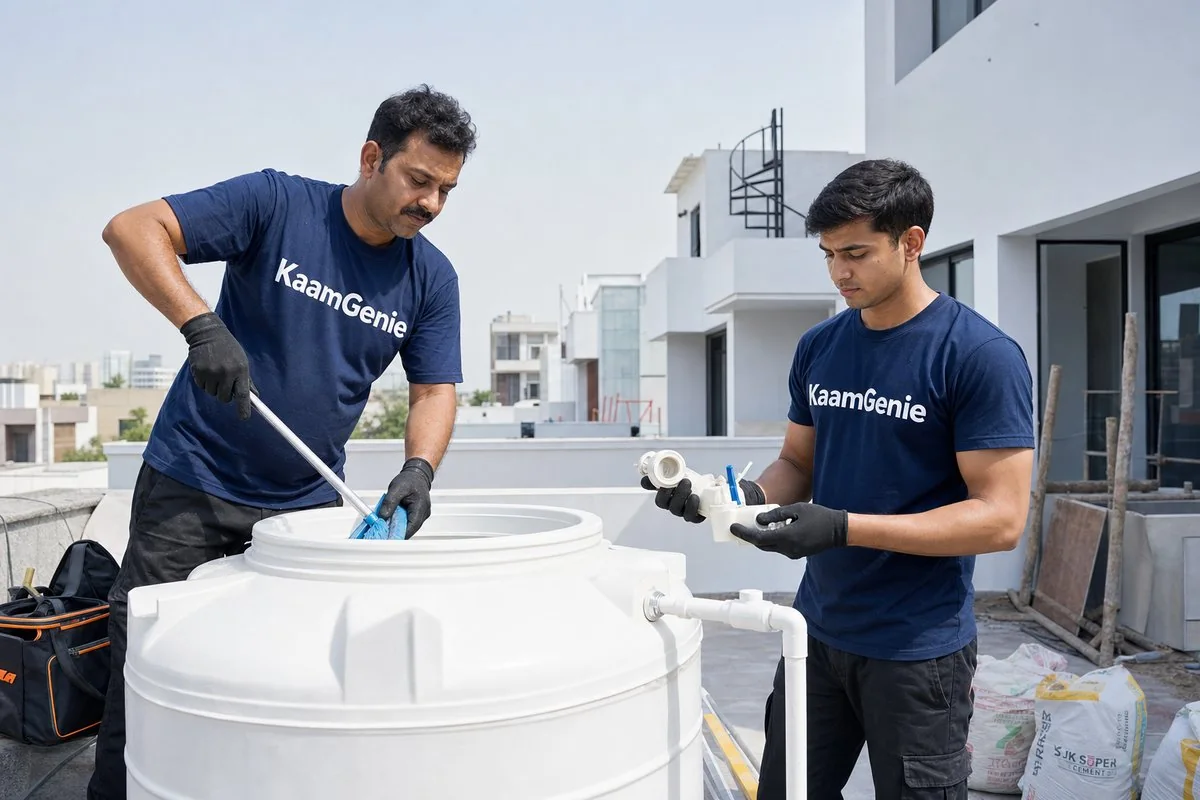
Post-construction essentials (the short version)
- Don’t drink from a new tank without cleaning it first — even if it looks spotless and the builder says they cleaned it.
- Construction debris — cement chunks, sand, plastic shavings, sealant offcuts — settle at the bottom and don’t leave with a pump-out.
- Plasticizer residue from new plastic and fibreglass tanks leaches into water for the first 6-10 weeks.
- Builder handover cleaning is almost always inadequate — usually one bucket of water and a wipe.
- Plumbing flush matters as much as the tank itself — pipes carry teflon shreds, PVC shavings and solvent residue.
- Clean twice in the first 3 months — first within a week of moving in, second around day 90.
- Cost: ₹1,800-3,500 for a typical Delhi flat or bungalow first cleaning, only ₹300-500 more than a routine one.
If you’ve already moved in and have been using the water, you’re not in danger — but book the cleaning this week, not next month.
Why your brand-new tank needs cleaning before you use it
The instinct that a brand-new tank should be clean is reasonable. It just isn’t how construction works in Delhi. Three things turn even the shiniest just-installed tank into something you wouldn’t want to drink from on day one.
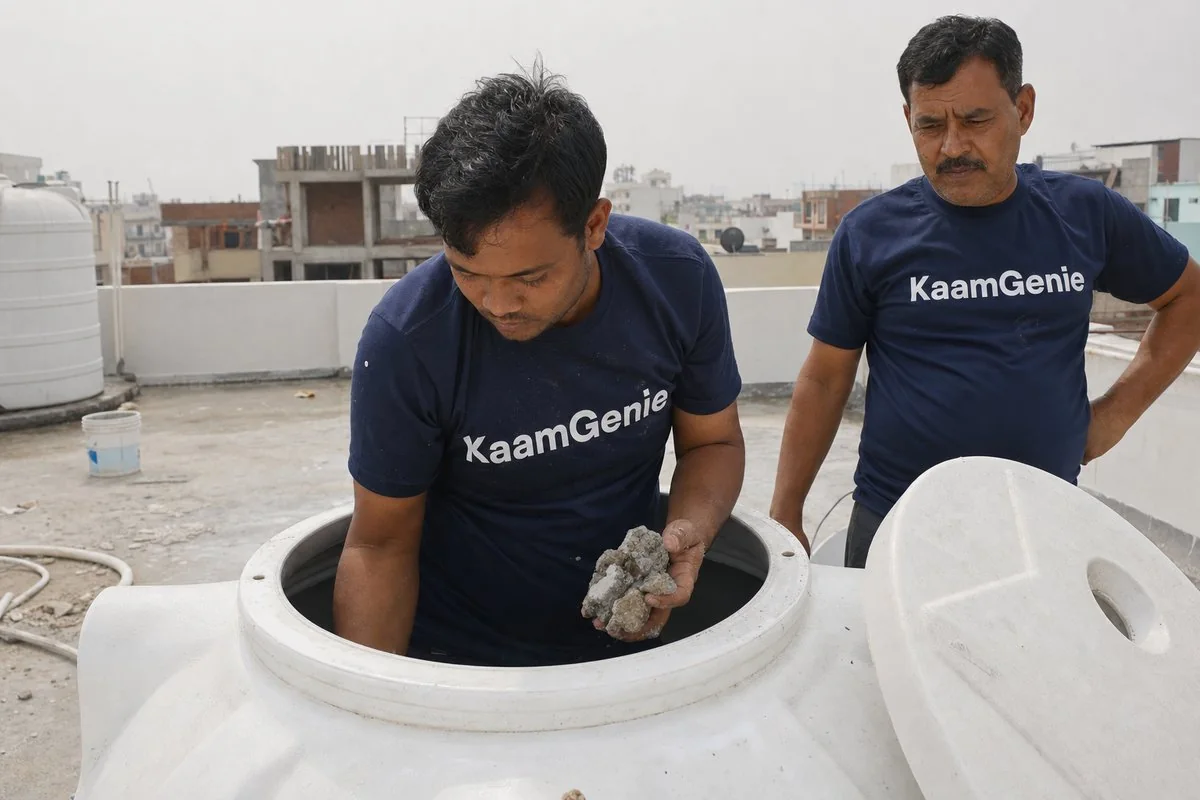
Construction debris doesn’t leave with a pump-out. While the building was going up, that tank was sitting open or lightly covered for weeks or months. Masons, plumbers, electricians and tilers walked past it carrying cement, sand and offcuts. A lot of that fell in. Even when the contractor pumps out the tank at handover, the heavier debris sinks and stays. Pumps lift water; they don’t lift cement chunks at the bottom.
Plasticizer residue leaches for weeks. Plastic and fibreglass tanks are manufactured with plasticizers and mould-release agents. The factory does a basic rinse but most of the residue is still on the inner surface when the tank arrives at your site. For the first 6-10 weeks, that residue slowly dissolves into whatever water sits in the tank. You can taste it sometimes — a slightly chemical, plasticky note — and it doesn’t go away by itself.
Builder shortcuts are the norm, not the exception. Builders are under pressure to hand over. Tank cleaning sits at the bottom of the punch list. In a typical Delhi handover, the “cleaning” is one person pouring a bucket of water in, swishing it around with a cloth on a stick, and pumping it out. That removes nothing meaningful. We’ve been called to inspect tanks within hours of builder handover and found visible cement at the bottom, plastic ring offcuts floating, and in one memorable case in a Gurgaon project, an empty cigarette packet.
None of this means your builder cheated you. It means tank cleaning is a specialist job and builders are not specialists. Treating the first proper cleaning as part of moving in — the same way you’d schedule a deep clean of the floors — is the sensible approach.
What gets left in new tanks during construction
Across the last two years, we’ve done the first cleaning for hundreds of newly handed-over Delhi properties — DLF flats, DDA blocks, private bungalows, builder floors. The contents of a new tank are remarkably consistent. Here’s what you’ll typically find:
- Cement chunks and slurry. Small concrete fragments, sometimes the size of a coin, sometimes finer than sand. Cement raises pH significantly — new-tank water can come out at pH 9-10 instead of the normal 7-7.5, which tastes bitter and isn’t great for skin or stomach.
- Sand and grit. Fine masonry sand sinks to the bottom and stays there. You only notice it because the first time you clean a filter cartridge in a new home, it’s loaded with gritty deposits within days.
- Plastic shavings and ring offcuts. When pipes are cut with a hacksaw or PVC cutter, shavings fall in. The threaded ring around the inlet is often trimmed on site — those offcuts go straight to the bottom of the tank.
- Teflon tape shreds. Plumbers wrap teflon tape around every threaded joint. Whatever overhangs gets trimmed and discarded, and a fair amount ends up inside the tank or in the pipes.
- PVC solvent residue. Solvent cement is used to glue PVC joints. The excess gets pushed inside the pipe — and into your water — until it cures and slowly weathers out.
- Sealants and mastics. Silicone or polyurethane sealants around the tank lid edge often have small offcuts that fall in during application.
- Dust and concrete particulates. Just from being open during dusty construction days. Delhi air loads up tanks fast.
- Worker debris. Honestly, we’ve found bidi stubs, plastic wrappers, paan masala sachets, dried paint flakes from rollers being washed near the tank, broken tile pieces, and once a hard hat liner. It’s rare but it happens.
- Plasticizer film. Greasy, slightly cloudy film on the inner walls of new plastic tanks. Cement tanks have their own version — a fine cement bloom on the inner surface.
Is brand-new tank water safe to drink? Honest answer: no, not without cleaning
We get this question constantly from new homeowners, and we always give the same straight answer: no, not safely.
The water itself — the Delhi Jal Board supply that comes into the new tank — is the same water your neighbours have been drinking for years. The problem is everything the water touches between the inlet and your kitchen tap. In a new tank, that includes a layer of cement dust on the walls, debris on the floor, plasticizer film on plastic surfaces, and the inside of pipes that were cut, glued and wrapped within the last few months.
The early symptoms of drinking from an uncleaned new tank are mild and easy to miss: a chemical aftertaste, occasional mild stomach upset for the first week, skin that feels a bit drier than usual after a bath, the odd taste of plastic in the morning’s first glass. None of this is dramatic, which is why people ignore it. Over weeks of cumulative exposure to plasticizer leachate and alkaline cement-affected water, it’s not great for you, especially for children and older family members.
The fix is straightforward — get the tank professionally cleaned before you start using the water, and a second time in 90 days. After that, you’re on the normal 6-month routine like every other Delhi household.
Builder/developer “handover cleaning” — why it’s usually inadequate
Almost every builder handover document mentions tank cleaning. In writing, you’d think the work was done properly. In practice, here’s what “handover cleaning” looks like on a typical Delhi site:
- One bucket of water, swished around with a stick-mop. Total time: 4-5 minutes per tank. No descent, no scrubbing of walls, no jet wash.
- Done by the masons who built the tank. Not a cleaning crew. No safety gear, no chemicals, no idea what biofilm or plasticizer residue is.
- Often not done at all. The tank gets “flushed” by the first DJB fill-up, which the builder then counts as cleaning. That isn’t cleaning, that’s just filling.
- No chlorine, no scrubbing brush, no documentation. No before/after photos, no record of what was used, no inspection of the result.
- Pipes never get flushed. The builder cleans (or pretends to clean) the tank but leaves the plumbing untouched, which means even a properly cleaned tank gets re-contaminated the first time water flows through the lines.
Some bigger builders and a few branded developers do better than this, but they are the exception. Don’t assume your tank was cleaned just because a checklist says so. Ask for photos and a dated cleaning record. If they can’t produce both, the cleaning didn’t happen meaningfully.
Book before you move in / drink the water
Booking the first cleaning a day or two before the family shifts is the cleanest way to start. We work weekends and can coordinate with your builder for handover-day cleaning across DLF, DDA and private projects.
Post-construction cleaning protocol (extended 10-step)
A first cleaning for a brand-new tank uses the same fundamentals as routine cleaning, but with two extra steps at the start (heavy debris removal, plumbing flush) and an extra chlorine pass at the end. Here’s the full sequence we follow on every post-construction job:
| # | Step | Time | Why critical for new tanks |
|---|---|---|---|
| 1 | Inspection & documentation | 10 min | Photograph the inside before touching anything — useful if the builder needs to be held accountable for a debris-filled handover. |
| 2 | Drain remaining water | 15-30 min | Pump out, then wet-vacuum the last few centimetres so debris isn’t suspended during scrubbing. |
| 3 | Heavy debris removal | 20-30 min | Scoop out cement chunks, plastic offcuts, foreign objects by hand. Skipping this clogs the next steps. |
| 4 | Sludge & sediment vacuum | 15 min | Wet-vac the finer sand, grit and cement bloom from the floor. |
| 5 | Wall scrubbing | 20-30 min | Food-grade nylon brushes on all inner surfaces to break the plasticizer/cement film on walls. |
| 6 | High-pressure jet wash | 15-20 min | 80-120 bar jet removes whatever scrubbing couldn’t reach — corners, ribs, around the inlet. |
| 7 | First chlorine disinfection | 20 min contact | Food-grade sodium hypochlorite 5%, full 20-minute contact time. MSDS available. |
| 8 | Plumbing flush | 15-20 min | Run every outlet for 60-90 seconds to clear teflon shreds, PVC shavings and solvent residue from the pipes. |
| 9 | Final rinse & refill | 15-30 min | Flush all disinfectant residue, refill with fresh DJB supply. |
| 10 | Before/after photos + invoice | 5 min | WhatsApp photo report + GST invoice. Useful for builder reimbursement claims. |
Total time on site for a typical Delhi flat with one overhead tank: about 2 hours. For a bungalow with overhead + sump combo: 3-4 hours. We bring everything — you don’t need to provide water, brushes, chemicals or anything else.
Why you should clean twice within the first 3 months
One cleaning is good. Two cleanings in the first 90 days is the right answer, and it’s the single most common piece of advice we give to new homeowners.
The first cleaning gets the obvious stuff — debris, the bulk of the cement bloom, the first wave of plasticizer film. It’s the heavy lifting and it makes the water genuinely safe to drink immediately.
But new concrete keeps releasing fine particles for several weeks. New plastic keeps leaching plasticizer for 6-10 weeks. New pipes keep shedding solvent residue and small particulates for similar periods. The first cleaning can’t catch what hasn’t leached out yet. By day 90, all of that secondary release has happened and a second cleaning catches it definitively.
After the second cleaning, you’re fully stabilised and can switch to the normal routine — once every 6 months for most Delhi households, twice a year if you have a sump as well as an overhead. We typically schedule the second visit at booking time so it doesn’t get forgotten in the chaos of settling into a new home.
Plumbing flush — the often-skipped step that catches builder debris
This is the step almost every cheap cleaning skips, and the reason a lot of new homeowners end up cleaning the tank a second time within weeks — not because the tank got dirty again, but because builder debris from the pipes washed back into the freshly cleaned tank.
Here’s what happens. The tank gets cleaned. Water sits in it overnight. The next morning, water starts flowing through pipes that haven’t been used since construction. Those pipes contain teflon tape shreds at every joint, PVC shavings where pipes were cut, solvent residue at every glued joint, and assorted small debris that fell in during installation. The first flow of water carries all of that — partly out through your taps, partly back into the tank through any return paths, and into your filter cartridges, taps and showerheads.
The fix is simple but takes time: open every outlet in the house — kitchen tap, bathroom taps, showers, washing machine inlet, RO inlet, balcony tap — and run each one for 60-90 seconds with the strainer removed. The first 10-20 seconds will produce visibly dirty water in many outlets; this is the debris that would otherwise have ended up in your filter (and in you). Once each outlet runs clean, replace the strainers, run another 10 seconds each, and the plumbing is properly flushed.
This adds 15-20 minutes to the job. It’s the single highest-value thing in a post-construction cleaning that a routine cleaning doesn’t include.
What’s in a new tank we typically find
Here’s a frequency table from our last 200 post-construction jobs across Delhi NCR — flats, builder floors, kothis and small society blocks. “Common in” indicates where this type of debris shows up most often.
| Debris type | Risk level | How we remove it | Common in |
|---|---|---|---|
| Cement chunks & slurry | Medium — raises pH, gritty taste | Hand-scoop + wet vacuum | Kothi, society (concrete tanks) |
| Fine sand & masonry grit | Low — clogs filters fast | Wet vacuum + jet wash rinse | All property types |
| Plastic shavings & offcuts | Low-Medium | Hand-scoop + scrubbing | Flats with plastic tanks |
| Teflon tape shreds | Low | Wet vacuum + plumbing flush | All property types |
| PVC solvent residue | Medium — chemical taste | Wall scrub + chlorine + flush | All property types |
| Sealant / mastic offcuts | Low | Hand-scoop | Kothi, society |
| Plasticizer film | Medium-High — cumulative exposure | Scrubbing + chlorine + 2nd clean at day 90 | Flats with new plastic tanks |
| Concrete bloom on inner walls | Medium — raises pH | Jet wash + chlorine | Kothi (concrete tanks) |
| Construction dust & particulates | Low | Drain + scrub + jet wash | All property types |
| Worker debris (wrappers, stubs) | Variable | Hand-scoop, photograph for record | Mostly society, occasional flat |
| Hardware (screws, washers, offcut rings) | Low — but blocks outlet | Hand-scoop, magnet sweep if iron | Society, kothi |
Real Delhi post-construction scenarios
Three patterns we see most weeks. If any of these sounds like you, you know what to do.
The new DLF Gurgaon flat owner. Took possession of a 3BHK in DLF Phase 5 last month. Builder handed over paperwork claiming “tank cleaning completed.” The new owner moved in over a weekend, used the water for cooking and bathing for a week, then noticed a slight plasticky taste in the morning’s first glass and called us. We opened the tank and found visible cement dust on the walls, plastic ring offcuts at the bottom, and a noticeable plasticizer sheen. Did the full 10-step clean, scheduled the day-90 repeat clean at the same time. Took 2 hours. Family hasn’t mentioned the taste since.
The new Vasant Kunj bungalow owner. Bought a freshly built two-storey kothi with overhead tank + underground sump. Builder claimed both were cleaned at handover. Reality: the sump still had construction debris including a brick fragment and a long offcut of plastic strapping; the overhead had a thick cement bloom on the walls. We did the sump (with full confined-space safety setup) and the overhead in a single 4-hour visit, flushed every outlet in the house, gave them a documented before/after report. Booked AMC for twice-yearly going forward.
The new Noida apartment buyer. 2BHK on the 14th floor of a recently completed Noida sector tower. Building had a centralised storage tank for each block, cleaned (so the RWA claimed) before occupation began. We were called by three owners independently after they noticed the water tasted “chemical-y.” We coordinated with the RWA to do the building’s shared tanks plus the individual flat tanks for the three owners in one coordinated visit. Builder reimbursed for the shared tanks; individual owners paid for their flats. Now on the building’s quarterly contract.
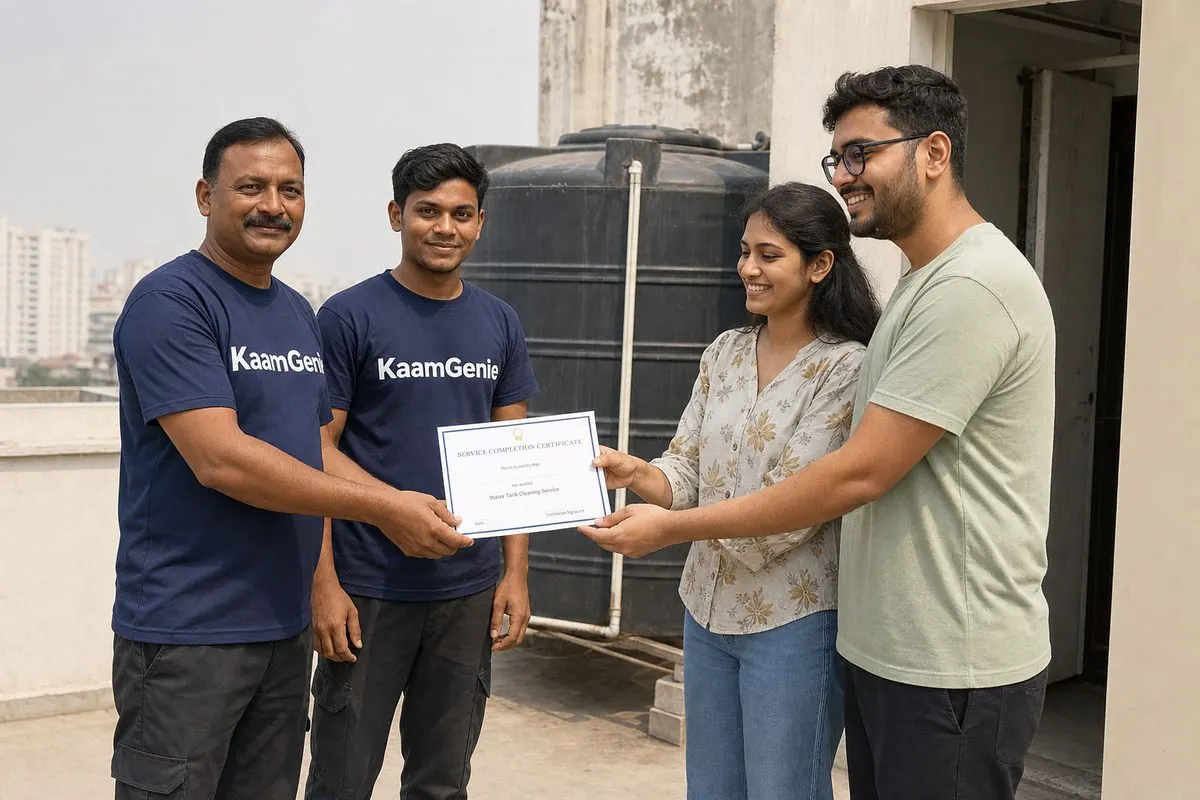
First-year tank schedule for new homes
For a new flat or bungalow, here’s the simple year-one schedule that catches construction residue properly and gets you onto a normal long-term routine.
| Timeline | Recommended action | Why |
|---|---|---|
| Month 0 (move-in week) | Full post-construction clean + plumbing flush | Removes the bulk of debris, sludge, plasticizer film. Makes water genuinely drinkable from day one. |
| Month 3 | Second clean (lighter, no debris stage) | Catches plasticizer and concrete particulates that continued to leach after the first clean. |
| Month 6 | Routine cleaning begins | Same cycle as every other Delhi household. Establish a fixed calendar reminder. |
| Month 12 | Second routine cleaning + annual water quality test | Anniversary of move-in is a natural cadence. TDS + chlorine residual + visual. |
From year two onwards, you’re on the standard cadence: twice-yearly for most Delhi households, quarterly if you have a sump and an overhead, or if the property is in a high-dust outer Delhi area like Bawana or industrial Najafgarh.
Cost — slightly higher than routine cleaning but essential
A post-construction first cleaning costs a little more than routine cleaning because it includes the extra debris stage and the mandatory plumbing flush, and because the second clean at day 90 is often booked at the same time. Here’s the honest range:
- Flat with one overhead tank (500-1,000L): ₹1,800-2,200
- Bungalow with overhead tank only (1,500-2,500L): ₹2,200-2,800
- Bungalow with overhead + sump combo: ₹3,000-3,500
- First clean + day-90 second clean booked together: 15-20% off the second visit
- Builder reimbursement claim support: GST invoice + photo report included free
Most builders won’t reimburse, but it’s worth asking with a documented report. Some bigger developers have set up reimbursement processes precisely because the complaint about debris-filled handover tanks is so common.
What KaamGenie includes in post-construction packages
Everything in the standard post-construction package — no add-ons, no surprises:
- Pre-cleaning inspection with photographs
- Full pump-out and wet vacuum of the floor
- Heavy debris removal (cement chunks, plastic offcuts, foreign objects)
- Hand-scrub of every inner wall with food-grade nylon brushes
- 80-120 bar high-pressure jet wash of all surfaces
- Food-grade sodium hypochlorite disinfection with 20-minute contact (MSDS on request)
- Full plumbing flush at every outlet in the property
- Final rinse and refill from your DJB supply
- Before/after photo report on WhatsApp within 24 hours
- GST invoice for builder reimbursement claims
- 90-day follow-up reminder for the second cleaning
- Sump cleaning add-on with full confined-space safety setup if applicable
Detailed pricing on our water tank cleaning service page. For underground sumps in bungalows, see the dedicated sump cleaning page. For new society handovers, the society / RWA service page covers larger contracts.
Book first cleaning today
Same-week appointments available across Delhi NCR. Fixed prices, documented photo report, GST invoice. We coordinate directly with builders for handover-day cleaning when needed.
Frequently asked questions
Should I clean a brand-new tank before using it?
Yes, absolutely. Brand-new tanks contain construction debris (cement chunks, sand, plastic shavings), plasticizer residue from the manufacturing process, and often a layer of dust and workmen handprints. None of this is removed at the factory or during installation. Drinking from an uncleaned new tank in the first week is one of the most common preventable causes of stomach trouble in new homeowners in Delhi.
Is the builder's handover cleaning enough?
Usually no. In practice, builder handover cleaning means a bucket of water poured in and pumped out, often by the same masons who installed the tank. There is no scrubbing, no chlorine disinfection, no plumbing flush. We have inspected hundreds of just-handed-over tanks in DLF, DDA and private builder projects and the majority still had visible debris on the floor and a cement bloom on the walls.
How much does post-construction cleaning cost in Delhi?
A post-construction first cleaning runs ₹1,800 to ₹3,500 for a typical Delhi flat or bungalow overhead tank, depending on size and number of tanks. That is ₹300-500 higher than a routine cleaning because it includes extra debris removal, a plumbing flush and a second chlorine pass. We offer a fixed-price first-clean package.
What’s the difference from regular cleaning?
Three things. First, much heavier debris removal — cement chunks and stones rather than just biofilm. Second, a mandatory plumbing flush so builder debris in the pipes does not re-contaminate the cleaned tank. Third, an extra chlorine pass because plasticizer residue continues to leach for the first few days.
Should I clean twice in the first 3 months?
Yes, we strongly recommend it. The first cleaning catches the bulk of construction debris, but new concrete and plastic continue to release fine particles and residues for 6-10 weeks. A second cleaning around the 90-day mark catches whatever the first one could not, and resets the tank to a normal 6-month routine after that.
What about flushing the plumbing too?
Critical and often skipped. Builder pipes contain teflon tape shreds, PVC shavings, solvent residue and small stones. If you only clean the tank but leave the pipes, the first flow of water after cleaning carries that debris straight into your taps and filters. Our post-construction package always includes a flush of every outlet for 60-90 seconds.
When should I clean after moving in?
Ideally before you move in — book the cleaning a day or two before the family shifts. Second best is within the first week. If the family is already drinking and bathing in the water and nobody is sick, you have some grace, but don’t push it past the first month. The longer construction residue sits, the more it bonds to the tank walls.
What if the builder already claims to have cleaned it?
Ask for before-and-after photos and a dated cleaning record. Most builders cannot produce either. We open the tank with you on arrival — if it is genuinely clean and debris-free, we tell you so and you only pay an inspection fee instead of a full clean. In our experience this happens in fewer than 5% of cases.
What about new society/apartment shared tanks?
These are even higher-risk because they are larger, harder to inspect, and the builder typically hands them over without any documented cleaning. New RWAs should commission an independent post-construction cleaning before the first occupants move in. We do this regularly for DLF, Godrej, ATS and DDA society handovers across Delhi NCR.
Can KaamGenie handle builder-floor / DLF / DDA projects?
Yes. We have done post-construction cleaning across DLF Phase 1-5 in Gurgaon, DDA flats in Dwarka, Vasant Kunj and Rohini, and private builder-floor projects throughout South and West Delhi. We can coordinate with builders for handover-day cleaning, or arrive after the keys are with you. GST invoice provided for builder reimbursement claims.
Sources & references
- Delhi Jal Board (DJB) — municipal water supply authority and recommended cleaning cadence for residential storage.
- Bureau of Indian Standards (BIS) — IS 10500 drinking water specification and tank maintenance guidelines.
- Food Safety and Standards Authority of India (FSSAI) — commercial kitchen water storage and inspection requirements.
- National Building Code (NBC) of India — building services and plumbing standards including water storage and tank handover requirements.
Last verified: 4 June 2026. If you find any of these links broken, please let us know.