
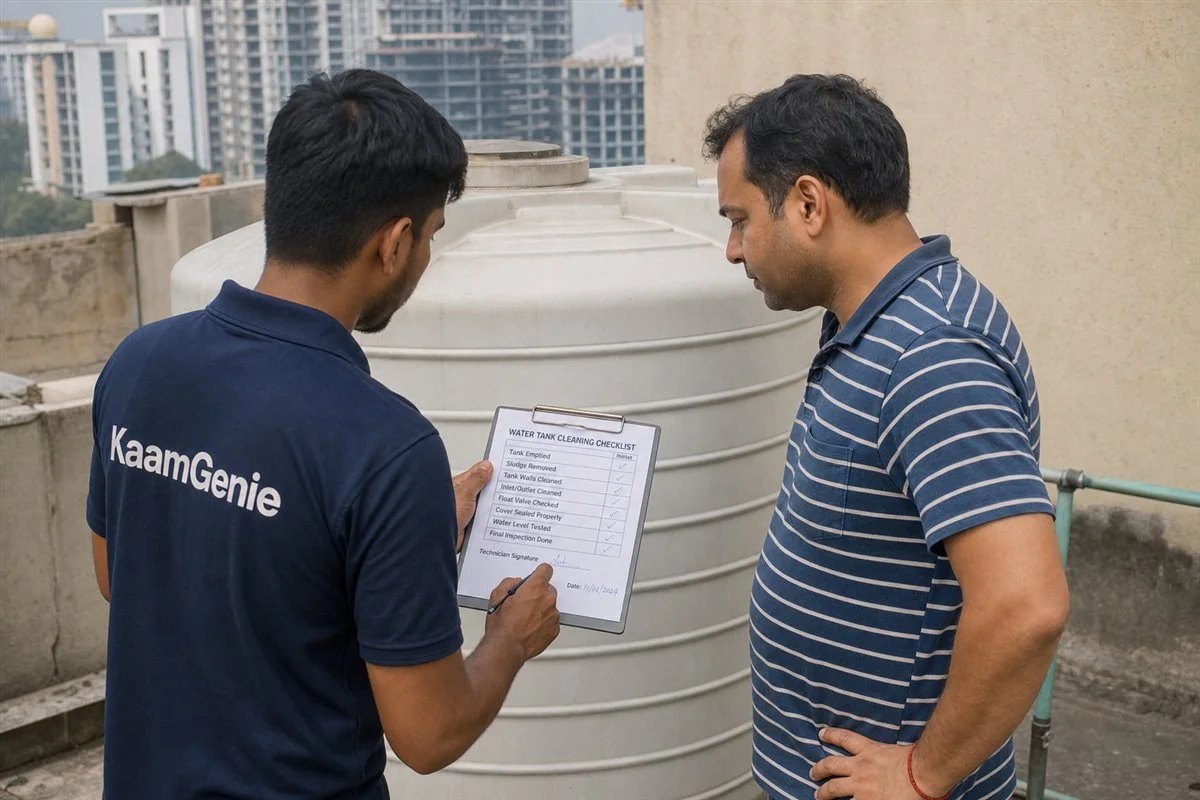
The checklist in plain English
- Before — agree the scope, confirm they drain fully, insist on before-photos
- Drain check — the tank goes empty, not half-full
- Sludge check — someone scoops the bottom by hand and carries it away
- Scrub check — a person reaches in and hand-scrubs the walls
- Vacuum check — a wet vacuum removes the dirty rinse water
- Disinfectant check — food-grade chemical, applied and left to sit
- After — clear, odour-free water; lid sealed; after-photos
- Paperwork — signed cleaning certificate and a GST bill
If a Noida operator can’t tick the drain, scrub, vacuum and disinfectant boxes, you paid for a rinse — not a cleaning.
Noida and Greater Noida are full of tanks that get “cleaned” on paper. The Authority-planned sectors, the IT and corporate belt around Sector 62 and the Expressway, the tanker-fed high-rise townships of Greater Noida West — all of them run on stored water, and a lot of that storage gets a quick spray-and-go that leaves the sludge exactly where it was. The problem is that a corner-cut job and a proper job produce an identical-looking receipt. The only protection a resident or RWA has is to know what a real clean looks like and verify it, step by step.
This is that checklist. Print it, keep it on your phone, or hand it to your building caretaker. It works for a single plastic tank on a builder floor, a villa sump in Sector 44, or a row of tower tanks at a Sector 137 society. If you only remember one line: a genuine home-tank clean takes about 75–90 minutes and involves a person physically inside or reaching into the tank. Everything below is how you confirm that.
| Stage | What to verify | How you check it | ✓ |
|---|---|---|---|
| Before | Scope agreed in writing | Price, tank count and full process confirmed on call/WhatsApp | ☐ |
| Before | Tank drained fully | Inlet shut, water pumped/drained right down to the floor | ☐ |
| Before | Before-photos taken | Crew photographs the open, dirty tank interior | ☐ |
| During | Sludge removed by hand | Sediment scooped into a bucket and carried away | ☐ |
| During | Walls hand-scrubbed | A person reaches in with food-grade brushes — not just a hose | ☐ |
| During | Jet wash + wet vacuum | You hear the jet, then a vacuum suck out dirty water | ☐ |
| During | Food-grade disinfectant | Sodium hypochlorite applied, left 15–30 min, then rinsed | ☐ |
| After | Water runs clear | A glass from the tap is clear — not cloudy or yellow | ☐ |
| After | No bad smell | No musty/earthy odour; only a faint chlorine trace at most | ☐ |
| After | Lid sealed | Lid sits flush on its gasket; no gap for dust or lizards | ☐ |
| After | After-photos + certificate | Same-angle photos and a signed cleaning record | ☐ |
| After | GST bill | A proper tax invoice from a registered business | ☐ |
Book a clean you can actually verify
Full drain, hand-scrub, vacuum, food-grade disinfection, before/after photos and a signed certificate — every job, fixed price. ₹699 onwards.
Before the crew starts — the questions that filter out corner-cutters
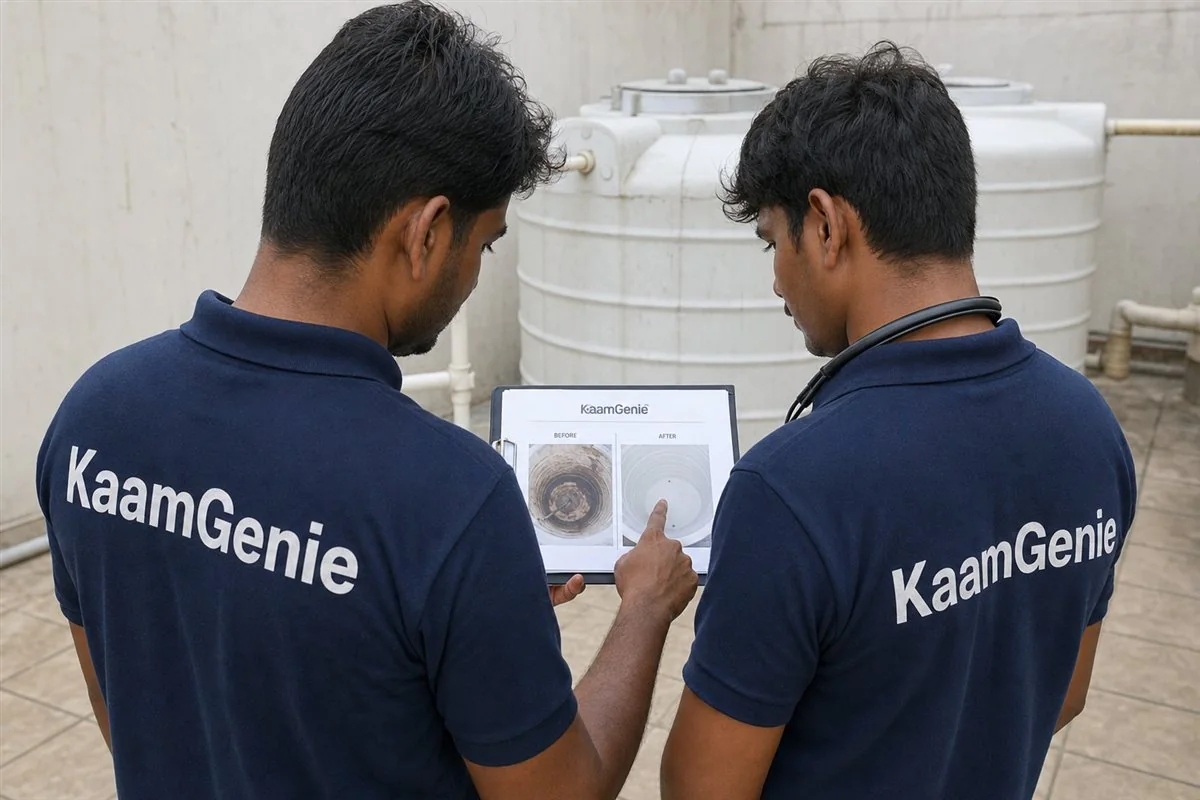
Most of the verification happens before anyone climbs to the roof. The way a cleaner answers a few direct questions tells you almost everything. Ask these six on the call, and listen for hesitation:
- Do you drain the tank completely? The correct answer is yes — with usable water pumped into a drum first so it isn’t wasted. “We clean it with the water in it” is a fail.
- Does someone physically go in and scrub by hand? A real clean is manual. “We pressure-spray from the top” means the floor and corners never get touched.
- Do you vacuum out the sludge and dirty water? Gravity alone leaves a contaminated film that re-mixes on refill. A wet vacuum is non-negotiable.
- What disinfectant do you use — is it food-grade? You want food-grade sodium hypochlorite, not hardware-shop bleach or pool chlorine.
- Will I get before-and-after photos and a signed certificate? If they balk at photos, they don’t want a record of what the tank looked like.
- Will I get a GST bill? A registered, billable business is one you can hold accountable.
Then agree the scope clearly: the price, how many tanks (rooftop, plus any underground sump), and confirmation that the full process is included — not an add-on. In Noida this matters most for builder floors with a shared sump and for societies where one quote is meant to cover several tower tanks. Get it in a WhatsApp message so there’s no “that’s extra” conversation at the end. If you want the going rates first, our Noida tank cleaning cost guide breaks down what a fair price actually buys.
During the job — what to watch with your own eyes
You don’t need to supervise every minute, but five moments tell you whether the job is real. If you’re paying for water tank cleaning in Noida, these are the things to glance up and confirm:
- The tank actually empties. Look in once the draining is done. The floor should be visible — not under several inches of water. You can’t scrub what you can’t reach.
- Sludge comes out by hand. This is the dirtiest, most-skipped step. In a Noida tank fed by hard borewell groundwater you’ll often see iron-stained sediment and scale scooped into a bucket. If no bucket of muck leaves the roof, step three was skipped.
- Someone reaches in to scrub. Food-grade brushes on the walls, floor, corners and the underside of the lid. A hose pointed in from above is not scrubbing.
- You hear the jet wash, then the vacuum. Two different sounds. The jet is loud for 10–15 minutes; the wet vacuum follows to suck out the dirty rinse water so it doesn’t redistribute on refill.
- Disinfectant is applied and left to sit. A 15–30 minute pause after spraying is normal — that contact time is what actually kills bacteria. A crew that disinfects and refills in the same breath skipped the part that matters.
This is the same standard whether it’s a plotted Authority house in Sector 62 or an Expressway tower in Sector 137. The tank gets bigger and the timings stretch, but the steps never change. We keep the full sequence and timings in our step-by-step Noida process guide if you want to see exactly how long each stage should take.
After the job — proving the water is genuinely clean
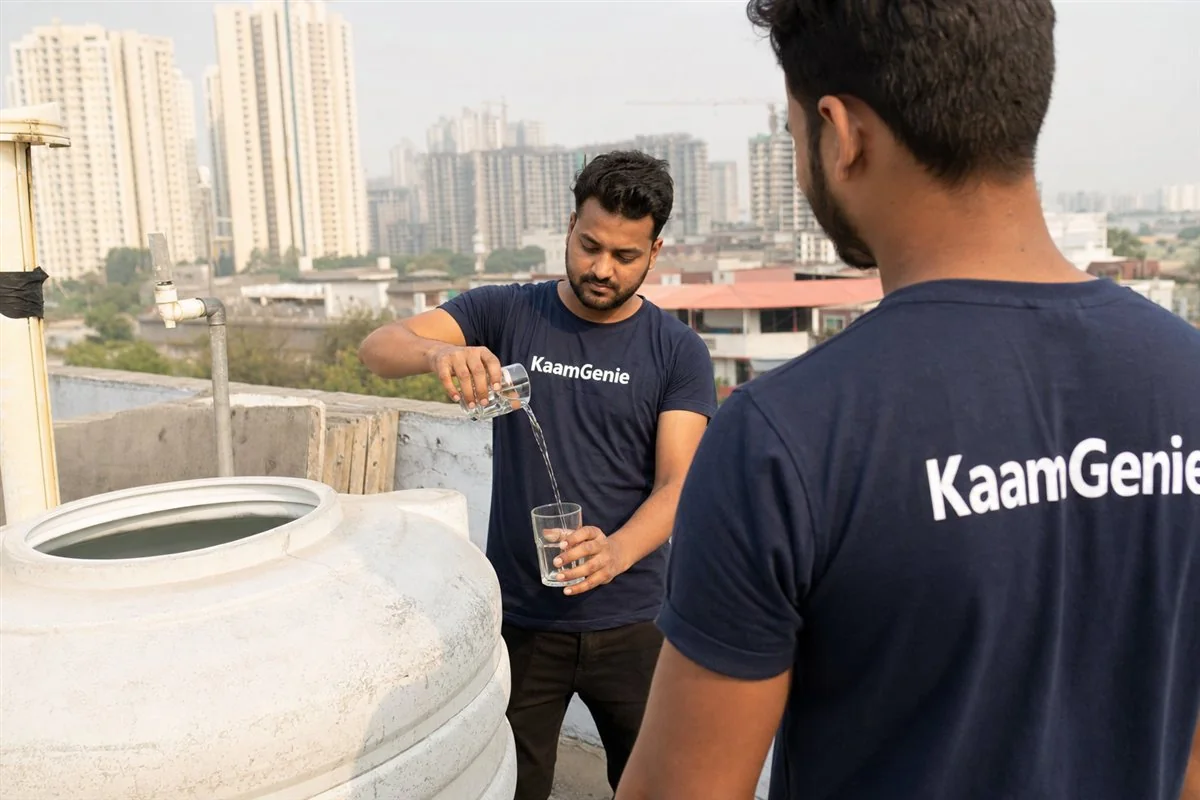
When the tank has refilled, do a 60-second sensory check at a tap it supplies. You’re looking for three things:
- Clarity. Hold a glass to the light. Clean water is visibly clear. Cloudiness, a yellow tint, or settling particles means sediment is still in the system.
- Smell. No musty, earthy or sewage-like odour. A faint chlorine smell is fine and normal right after disinfection — it fades within a few hours. A strong chemical reek, though, suggests the rinse was rushed.
- No floating grit. Nothing should be drifting on the surface or settling at the bottom of the glass.
Then climb up and check the lid one last time: it should sit flush against its gasket with no gap. An unsealed lid is how a freshly cleaned tank gets re-contaminated within weeks — dust, lizards, insects and monsoon runoff all get in through a loose cover. Finally, collect the paperwork. The before-and-after photos, the signed cleaning certificate (tank type, capacity, chemical used, date and crew), and the GST bill are your proof and your recourse. For a society or RWA, that certificate is the document the committee files; if your building runs shared tanks, our society and RWA tank cleaning guide covers how to keep records across multiple towers.
Checklist items typically completed, by type of cleaner (out of 12)
Illustrative — the gap between a rinse and a real clean is mostly the “during” steps
Typical pattern, not a survey statistic. The cheapest tiers usually tick the “before” and a couple of “after” boxes but skip the drain, hand-scrub, vacuum and disinfection — the four checks that decide whether your water is actually safe.
Special cases in Noida and Greater Noida
A few local situations deserve extra attention on the checklist:
- Tanker-fed towers (Greater Noida West, Noida Extension, parts of the Expressway). Tanker water carries more suspended sediment, so the sludge-removal and vacuum checks matter even more, and the cycle should run every 3–4 months rather than six.
- Hard borewell supply. Much of Greater Noida runs on hard groundwater that leaves iron staining and scale. Expect to see that sediment come out — if the walls still look scaled in the after-photos, the scrub was light.
- Underground reservoirs feeding tower tanks. Many Noida high-rises store water in a large UGR that pumps up to rooftop tanks. Both need cleaning; a quote that covers only the rooftop tanks leaves the dirtiest reservoir untouched.
- Builder floors with a shared sump. Confirm whose responsibility the shared sump is before booking, so it doesn’t get skipped because “the ground-floor owner handles it.”
- Institutions and food businesses near the Sector 62 and Sector 18 belts have FSSAI and inspection obligations — for them the certificate isn’t optional paperwork, it’s the audit trail.
If you spot warning signs between cleanings — a smell, a tint, sediment in the filter — don’t wait for the calendar. Our guide to the signs a Noida tank needs cleaning covers what to act on. And you can compare any local quote against KaamGenie’s standard water tank cleaning services across the NCR.
Want every box on this checklist ticked?
That’s our default job, not an upgrade — full drain, hand-scrub, vacuum, food-grade disinfection, photos and certificate. Residential ₹699 onwards; society, UGR and commercial quoted on site.
Hold every cleaner to the same standard
The checklist isn’t about distrust — it’s about consistency. A good cleaner welcomes it, because the steps it asks for are exactly the steps they already do. A corner-cutter dislikes it for the same reason. Keep the tick-list and your certificates in one place, repeat the checks every cleaning, and you turn a vague service into something you can actually audit. If you’d rather just book a crew that ticks all twelve boxes by default, see water tank cleaning in Noida for areas we cover, fixed pricing, and same-day slots where available — from Sector 18 across to the Expressway high-rise belt.
Frequently asked questions
How do I know if my Noida tank was actually cleaned or just rinsed?
A real clean takes 75-90 minutes for a home tank, not 20. Watch for four things: the tank drained fully and someone scooped sludge from the floor, a person physically reached in to hand-scrub the walls, you heard a wet vacuum at the end, and they applied disinfectant and waited 15-30 minutes before refilling. If a cleaner is done in 25 minutes with a bucket and a bottle, you paid for a rinse, not a cleaning.
What should a proper tank cleaning checklist include?
Twelve checks across three stages. Before: agreed scope, full drain, before-photos. During: sludge removed by hand, walls hand-scrubbed, jet wash, wet vacuum, food-grade disinfectant with contact time. After: clear odour-free water, sealed lid, after-photos, a signed cleaning certificate and a GST bill. Tick all twelve and you have proof; miss the during steps and the job is cosmetic.
Should the cleaners drain the tank completely before cleaning?
Yes. The worst contamination — sludge, sand, iron sediment from Noida borewell water, biofilm — sits in the bottom layer, and you cannot reach or scrub it with water on top. Honest crews pump usable water into a drum for non-drinking use so it is not wasted, then drain the dirty bottom layer out completely. A clean done over half-full water is not a clean.
What disinfectant should a tank cleaner use in Noida?
Food-grade sodium hypochlorite at roughly 50-100 PPM, the same family of chemical used in municipal treatment and acceptable under FSSAI norms for potable water systems. Ask to see the container. Avoid anyone using hardware-shop bleach, pool chlorine or fragranced cleaners — those carry additives that are unsafe in drinking water and leave residue you do not want in your kitchen supply.
Do I really need before-and-after photos and a certificate?
Yes — they are your only proof the job happened. Before-photos show the original condition, after-photos at the same angle show the result, and a dated cleaning certificate records the tank type, capacity, chemical used and crew. For a society or RWA the certificate is the document the committee files; for any home it is your recourse if water quality dips a week later.
What questions should I ask before booking a tank cleaner in Noida?
Ask six things: Do you drain the tank fully? Does someone go in and hand-scrub, or only spray from the top? Do you vacuum out the sludge and dirty rinse water? What disinfectant do you use — is it food-grade? Will I get before-and-after photos and a signed certificate? And will I get a proper GST bill? Honest operators answer all six without hesitation; corner-cutters get vague or defensive.
How can I check the water is actually clean after the job?
Once the tank has refilled, draw a glass from a tap it feeds and check three things: clarity (the water should be visibly clear, not cloudy or yellow), smell (no musty, earthy or strong chlorine odour — a faint chlorine trace is normal and fades in a few hours), and no floating particles or grit. Also confirm the lid sits flush on its gasket so dust, lizards and insects cannot get back in.
Is a GST bill important for water tank cleaning?
Yes. A GST invoice means you are dealing with a registered business that stands behind the work, not an untraceable cash operator. It also matters for RWAs and commercial premises that need the expense on the books, and for any food business facing an FSSAI inspection. If a cleaner refuses a bill, treat it as a red flag about accountability.
How often should this checklist be repeated for a Noida tank?
Run the full checklist every time the tank is cleaned. For most Noida homes that means every six months; for tanker-fed towers in Greater Noida West and the Expressway high-rise belt, every three to four months because tanker water carries more sediment. Keep each certificate so you can see the service history at a glance and hold contractors to the same standard each visit.
Who should keep the cleaning record in a society or RWA?
The managing committee or facility manager should keep a single file with the certificate, before-and-after photos and GST bill for every underground reservoir and tower tank cleaned. It proves the maintenance schedule to residents, supports the annual budget, and protects the committee if a water-quality complaint ever arises. Individual flat owners on shared tanks can ask for a copy.
Sources & references
- Bureau of Indian Standards (BIS) — IS 10500:2012 is the canonical Indian Standard for drinking water specification, defining acceptable limits for physical, chemical, and biological parameters.
- WHO Guidelines for Drinking-water Quality, 4th edition — the global reference for water quality standards, including guidance on storage and disinfection.
- Food Safety and Standards Authority of India (FSSAI) — defines water quality requirements for food businesses, including hygiene standards for stored water and acceptable disinfection chemicals.
- WHO Fact Sheet on Drinking Water — overview of safe drinking water requirements and contamination risks.
- CPHEEO — Manual on Water Supply and Treatment — the Government of India’s engineering manual covering tank design, cleaning protocols, and disinfection practices.
Last verified: 30 June 2026. If you find any of these links broken, please let us know.