
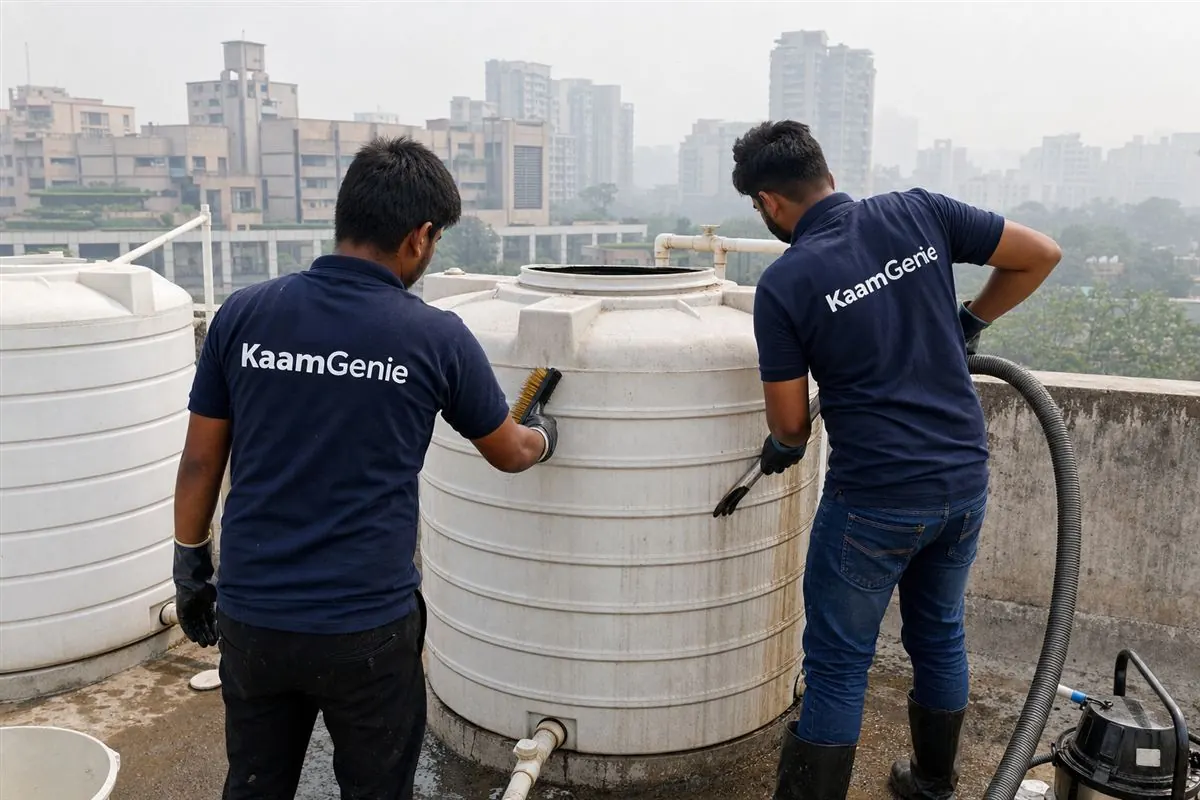
The process in plain English
- Drain the old water — underground reservoir (UGR) first, then rooftop
- Inspect the inside, fittings and scale; take “before” photos
- De-sludge & vacuum the sediment off the floor
- Hand-scrub walls, floor and corners with food-grade brushes
- High-pressure jet wash to lift bio-film and hard-water scale
- Anti-bacterial wash, then wet-vacuum the dirty water out
- Food-grade chlorine disinfection, let it sit, then rinse
- Refill, before/after photos, certificate
In a Noida high-rise the order matters: clean the UGR before the tower tanks, or the next pump cycle pushes basement sludge straight back up to your flat.
Ask ten people in a Noida sector what “tank cleaning” means and most picture someone emptying the rooftop tank and hosing it out. That is a rinse, not a cleaning — and in this city the difference shows up fast, because the water here is unusually hard on storage tanks. Outer sectors and Greater Noida run on borewell groundwater that leaves chalky calcium and iron scale; the Authority-piped Ganga Jal supply carries its own fine sediment; and the tanker-fed townships of Noida Extension take in whatever settles in the tanker. All of it ends up at the bottom of your tank.
This post walks through the actual professional sequence we follow on every job, from a single Sintex drum on a plotted Authority house to a 50,000-litre underground reservoir feeding a tower in Sector 137. It is the Noida version of our wider step-by-step cleaning process guide. If you want pricing or to book, the water tank cleaning in Noida hub has the details; this page is about what genuinely happens between the doorbell and the certificate.
| # | Step | Time | Key equipment |
|---|---|---|---|
| 1 | Drain (UGR then rooftop) | 10-20 min | Submersible pump, transfer drum |
| 2 | Inspect + before-photos | 5-10 min | Torch, camera |
| 3 | De-sludge + vacuum bottom | 10-20 min | Scoop, sealed bucket, wet vacuum |
| 4 | Hand-scrub walls & floor | 15-30 min | Food-grade nylon brushes, detergent |
| 5 | High-pressure jet wash | 10-15 min | 100-150 PSI industrial jet |
| 6 | Anti-bacterial wash + vacuum | 10-15 min | Wet/dry industrial vacuum |
| 7 | Chlorine disinfection (contact) | 20-30 min | Food-grade sodium hypochlorite (50-100 ppm) |
| 8 | Rinse, refill, photos, certificate | 10-15 min | Fresh water, WhatsApp + clipboard |
Book the real step-by-step cleaning in Noida
Every step documented, before/after photos, fixed price. Anything short of this is a rinse. ₹699 onwards for residential.
Step 1 — Drain the old water (UGR first, then rooftop)
Most Noida buildings store water in two stages: an underground reservoir or sump in the basement, then tower tanks on the terrace that get filled by a pump. That layout decides where we start. We close the inlet so no fresh water enters mid-job, then drain the underground reservoir before the rooftop tanks. The logic is simple — if you clean the rooftop tank but leave a sludged UGR below it, the very next pump cycle lifts that basement sediment straight back up to the flats.
For a plotted Authority house with a single rooftop drum, this is just opening the outlet valve. For an Expressway tower, draining the UGR can take a while because it holds tens of thousands of litres. Where the water is recently filled and usable, we pump it into a transfer drum so it can still serve non-drinking uses rather than being wasted — relevant in tanker-dependent pockets where every load is paid for.
Step 2 — Inspect and photograph before we touch anything
With the tank empty, one of the crew torches the inside and checks three things: how heavy the scale and sediment really are, whether the fittings (inlet, outlet, overflow, lid gasket) are intact, and whether there is anything unusual — cracks in an old RCC reservoir, a broken lid that has let in dust, or insect contamination. In Noida the inspection almost always reveals hard-water scale; the question is how much, because that decides how long the scrub and descaling will take.
We shoot four to six “before” photos at this stage. They go into your service report, and for tanks you can’t safely climb into yourself, they are the only honest record of what the inside looked like.
Step 3 — De-sludge and vacuum the bottom
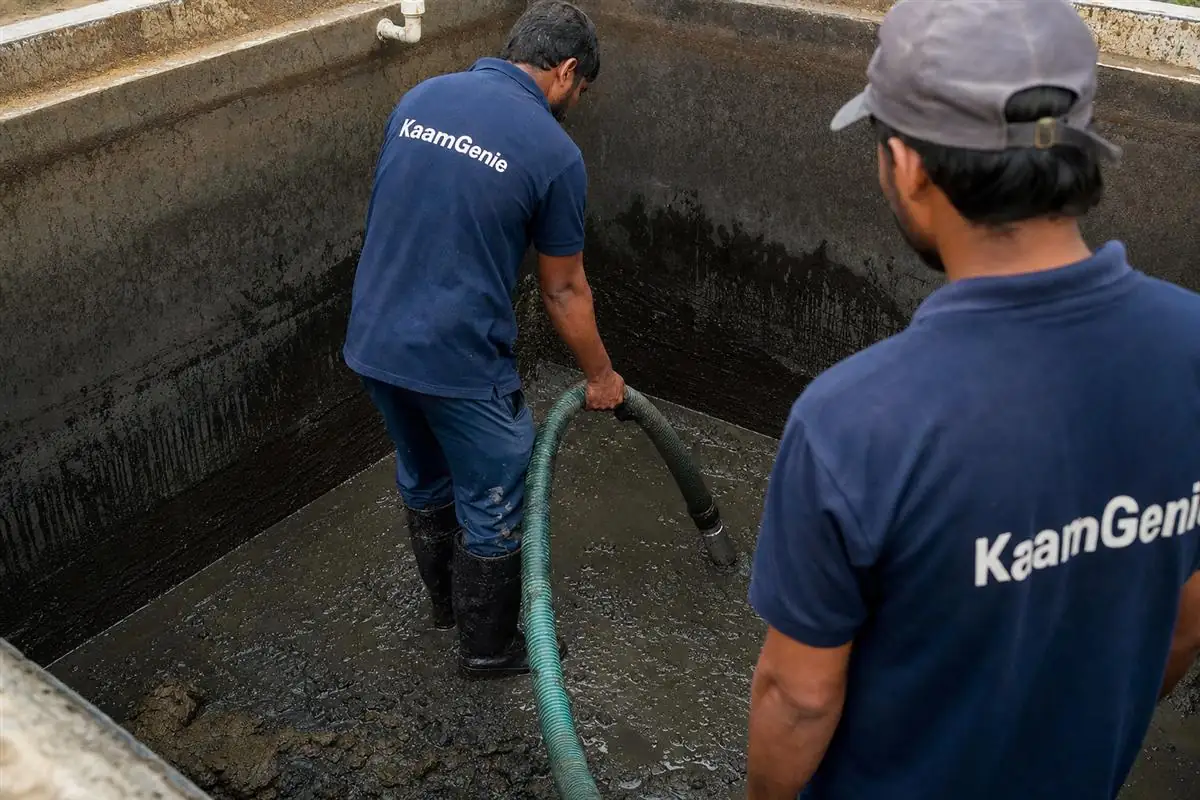
Once the water is gone, the floor of every Noida tank carries a layer of sediment your filter never caught: fine sand, iron and calcium from borewell groundwater, rust off older fittings, dried algae, and the silt that tanker water drops as it sits. In a tank that has not been opened in two or three years — or a Greater Noida West sump that runs entirely on tankers — you can be looking at half an inch of dark sludge.
The crew scoops this out by hand into a sealed bucket and finishes with a wet vacuum, then disposes of it off-site — never flushed back down the building drain, where it would just settle in the plumbing. This is the dirtiest step and the one cheap operators skip entirely. Skip it, and the disinfectant in step 7 never even reaches the worst contamination. If you want to understand how this plays out below ground, our underground sump cleaning in Noida guide goes deeper on reservoir work.
Step 4 — Hand-scrub the walls and floor
With the sediment gone, the walls still hold a thin film — bio-film, organic deposits, and the chalky scale that hard water leaves. None of it comes off with water alone. The crew goes in with food-grade brushes (stiff nylon bristles, never metal, because metal scratches both plastic and concrete and gives bacteria fresh places to lodge) and a food-grade detergent solution, and works every surface:
- All four walls, top to bottom
- The floor in overlapping passes
- Corners and seams, where bio-film hides
- Around the inlet and outlet pipes
- The underside of the lid, where condensation breeds bacteria
This is the slowest step — 15 to 30 minutes for a 1,000-litre rooftop tank, well over an hour for a society reservoir — and the single clearest difference between a real cleaning and a 20-minute fake. Noida’s hard water makes that difference visible: scrub properly and the scale lifts, rinse only and it stays welded to the wall.
Step 5 — High-pressure jet wash
After scrubbing, we run a 100-150 PSI water jet across the surfaces to blast off whatever the brush could not fully dislodge — into corners, behind the inlet pipe, into the lid threads. On Noida’s older RCC underground reservoirs this matters even more than on plastic tanks: concrete develops a porous, textured surface over the years and the chalky hard-water scale grips into those pores. Only pressure clears it. The jet also flushes loosened debris toward one spot so the next step has less to lift.
Step 6 — Anti-bacterial wash, then vacuum out the dirty water
We apply an anti-bacterial wash over the cleaned surfaces and then wet-vacuum out all the residual water — the inch or two at the bottom carrying dislodged scale and bio-film flakes. The reason this is not optional: if you only open the drain, gravity leaves a thin contaminated film on the floor, and refilling redistributes everything you just loosened back into the fresh water. The vacuum gets the floor as close to dry as possible before disinfection.
Step 7 — Food-grade chlorine disinfection
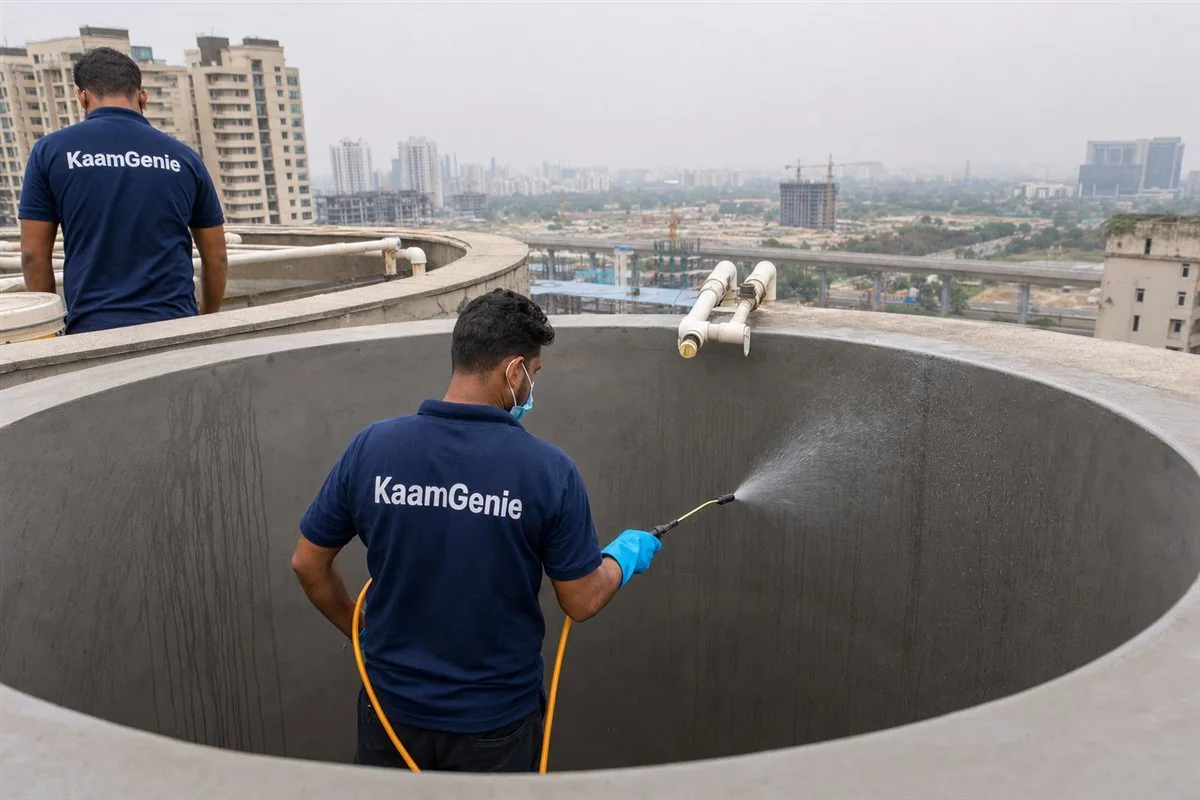
This is the step that actually kills bacteria, and the one corner-cutters get wrong most often — either skipping it or using the wrong chemical. We use food-grade sodium hypochlorite at 50-100 PPM, the same chlorine family used in municipal treatment and acceptable for potable water under FSSAI norms. We never use hardware-shop bleach or pool chlorine; those carry fragrances and stabilisers that have no business in a drinking-water tank.
The disinfectant is sprayed across every interior surface — walls, floor, lid, the inlet and outlet area — and left for a 15-30 minute contact time. That dwell is what kills E. coli, salmonella and the other organisms behind the stomach upsets and skin complaints that flare up in buildings with neglected tanks. If you want the chemistry in detail, see our note on water tank cleaning services and the disinfection standards behind them.
Step 8 — Rinse, refill, photos and certificate
After contact time we rinse the surfaces with fresh water, vacuum once more, then close the drain, restore the inlet and let the tank refill. While it fills we confirm the inlet valve seals, the outlet runs clean at the taps below, the lid closes flush against the gasket, and there are no new leaks. Then we take four to six “after” photos from the same angles as the “before” set, and hand over a cleaning certificate listing the date, tank type and capacity, the chemicals used, and the crew.
That certificate matters more than people expect. A Noida RWA or society management asks for it as proof your flat’s tank is on a maintenance schedule; an FSSAI inspection at a café or cloud kitchen expects exactly this document. Water is safe for washing and bathing within about 30 minutes of refill, and fine for drinking after a couple of hours through your usual RO/UV.
Time spent per step — 1,000L rooftop tank, full process
Disinfection is the longest because chemistry needs contact time
Total: ~88 minutes for a 1,000L rooftop tank including setup and pack-up — within the typical 75–90 minute range. UGR reservoirs and Expressway tower jobs scale the de-sludge, scrub and disinfection steps proportionally.
How the process changes by building type in Noida
The eight steps stay the same; the time and emphasis shift with where you live:
- Plotted Authority houses & builder floors (Sectors 44, 50, and the older numbered sectors): usually one or two rooftop drums plus a small shared sump. 75-120 minutes. The scrub step does the heavy lifting against borewell scale.
- Expressway high-rise towers (Sector 137, Sector 150, 168, 75, 76, 78, 100): large UGR plus multiple tower tanks. Half-day, two-person crew, scheduled tower-by-tower so flats lose supply only briefly.
- Greater Noida West / Noida Extension townships: tanker-fed, so the de-sludge step dominates. A six-month schedule is sensible here rather than stretching to a year.
- IT-belt offices, colleges and hospitals (Sectors 62, 125-135): big institutional reservoirs, after-hours cleaning, full documentation for compliance.
If a building sits in the Sector 75 mid-rise belt or anywhere the supply mixes Authority piped water with borewell top-ups, the inspection in step 2 is what tells us which way the job will lean. Whether a high-rise or a plotted home needs a different approach is covered in our high-rise vs plotted tank cleaning comparison, and the scale problem itself in our Noida hard-water tank cleaning guide.
What corner-cutters skip — and why it shows in Noida
The cheap end of the market typically drops the same three steps: de-sludging (step 3), real hand-scrubbing (step 4), and the disinfection contact time (step 7). Each shortcut saves them 10-30 minutes, which is why a fake cleaning takes 20 minutes and a real one takes 90. In most cities you might not notice for months. In Noida you notice within weeks, because the hard-water scale a rinse leaves behind keeps feeding cloudy, mineral-heavy water back to your taps. If a cleaner finishes a rooftop tank in 25 minutes with no bucket of sludge carried away and no pause for disinfectant to work, you paid for a rinse.
Want this done properly at your Noida tank?
All eight steps, before/after photos, certificate at the end. Standard residential cleaning ₹699 onwards; UGR and society jobs quoted on site.
Book the real process across Noida
If your tank has never been opened by a proper crew — or it has been more than six months — this is the sequence you should be getting: drain, inspect, de-sludge, scrub, jet, disinfect with food-grade chlorine, rinse, photograph, certify. No shortcuts. For pricing, coverage and to book across every sector, start at the water tank cleaning in Noida hub, or call +91 95603 66362 and we’ll confirm a slot shortly.
Frequently asked questions
How long does a full water tank cleaning take in Noida?
A single 1,000L rooftop tank in a Noida sector home takes about 75-90 minutes. A builder-floor terrace with several drums runs 2-3 hours. A high-rise tower on the Noida Expressway belt, where we clean the underground reservoir plus tower tanks together, is usually a half-day with a two-person crew. The bigger the UGR and the harder the scale, the longer the scrub and disinfection contact phases take.
Do you clean both the underground reservoir (UGR) and the rooftop tanks?
Yes, and in most Noida buildings they have to be done together. Water enters the UGR or sump first, then gets pumped up to the rooftop tower tanks. If we clean only the rooftop tank and leave a sludged UGR below it, the next pump cycle pushes that sediment straight back up. The correct sequence is UGR first, then rooftop, so clean water fills a clean tank.
What disinfectant do you use, and is it safe for drinking water?
Food-grade sodium hypochlorite at 50-100 PPM — the same family of chlorine used in municipal treatment and FSSAI-acceptable for potable water systems. We never use hardware-shop bleach or pool chlorine, which carry fragrances and additives you do not want in a drinking-water tank. After the contact time we rinse and vacuum, so no chemical residue is left behind.
My building is on the Noida Expressway high-rise belt — can you reach tower tanks on the top floor?
Yes. The Expressway belt — Sectors 137, 150, 168, 75, 76, 78 and 100 — is mostly 15-30 storey towers with tanks on the terrace head-room above the lift. We carry our own pump, hose and jet machine up, work off the terrace, and coordinate access through the facility manager. For societies we schedule tower-by-tower so individual flats lose supply only briefly.
Noida borewell water leaves hard scale — can your process remove it?
Much of it, yes. Greater Noida and the outer sectors run on hard borewell groundwater that leaves a chalky calcium and iron scale on tank walls. Plain rinsing does nothing to it. Our hand-scrub plus high-pressure jet lifts the bulk of the scale; very heavy mineral crust on an old tank may need an extra descaling pass, which the crew flags on arrival rather than pretending the rinse alone fixed it.
Do I need to be present during the cleaning?
Not the whole time, but someone has to give us terrace or sump access — the owner, a family member, household help, or the building caretaker. Many Noida customers, especially working couples in the IT-belt sectors, simply hand over access and review the before/after photos and certificate we send on WhatsApp afterwards.
What proof do I get that the tank was actually cleaned?
Before-and-after photos shot from the same angles, plus a cleaning certificate listing the date, tank type and capacity, the chemicals used, and the crew. That record is what a Noida RWA or society management asks for as proof of a maintenance schedule, and what an FSSAI inspection expects from a food business. If you ever can’t reach the inside of your tank yourself, those photos are your evidence the job was real.
How often should a Noida tank be cleaned?
Every six months for most homes, and that is the line BIS and WHO storage guidance points to. In Noida we’d push tanker-fed buildings in Greater Noida West and hard-water borewell homes toward that six-month mark rather than stretching to a year, because sediment builds faster when the source water carries more solids.
Greater Noida West / Noida Extension runs on tanker water — does that change the cleaning?
The steps are the same, but the de-sludge stage does more work. Tanker-fed townships in Noida Extension and along the Expressway take in whatever settles in the tanker, so the UGR collects a thicker sediment layer than a piped-supply building. We spend longer on vacuuming and scooping the bottom, and we recommend a tighter six-month schedule for these societies.
Sources & references
- Bureau of Indian Standards (BIS) — IS 10500:2012 is the canonical Indian Standard for drinking water specification, defining acceptable limits for physical, chemical, and biological parameters.
- WHO Guidelines for Drinking-water Quality, 4th edition — the global reference for water quality standards, including guidance on storage and disinfection.
- Food Safety and Standards Authority of India (FSSAI) — defines water quality requirements for food businesses, including hygiene standards for stored water and acceptable disinfection chemicals.
- WHO Fact Sheet on Drinking Water — overview of safe drinking water requirements and contamination risks.
- CPHEEO — Manual on Water Supply and Treatment — the Government of India’s engineering manual covering tank design, cleaning protocols, and disinfection practices.
Last verified: 30 June 2026. If you find any of these links broken, please let us know.