
The short answer
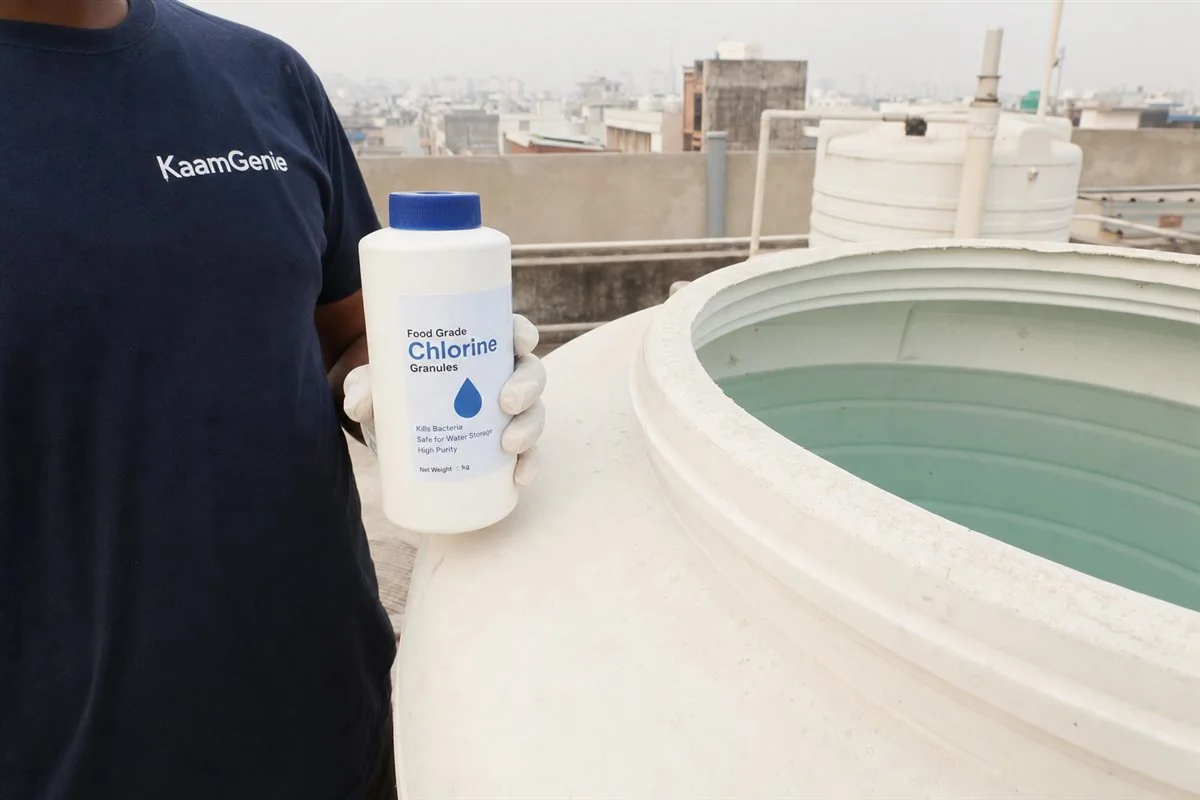
- Food-grade sodium hypochlorite (chlorine) — the main disinfectant, BIS & FSSAI-acceptable for drinking water
- Mild food-grade detergent — a small, fully-rinsed amount to lift bio-film during scrubbing
- Food-grade descaling agent — only for stubborn hard-water scale, after mechanical removal
- Food-grade hydrogen peroxide — an alternative disinfectant for premium / no-chlorine-taste jobs
- Never: muriatic acid, surf / washing powder, industrial or pool bleach, phenyl, room cleaner
The chemical only does its job if it gets contact time. A spray-and-instant-rinse disinfects nothing — that is the most common shortcut in cheap Noida cleanings.
Noida and Greater Noida sit on hard borewell groundwater, topped up by Ganga Jal piped supply and, in the newer Expressway and Noida Extension high-rise belts, a heavy reliance on water tankers. All of that water sits in rooftop tanks and big underground reservoirs (UGRs) before it reaches your tap. Warm terraces, partial sunlight and long storage times make those tanks a perfect home for bio-film, algae and bacteria — which is why the disinfection chemical matters as much as the scrubbing. If you want the practical, no-nonsense booking side of things, our water tank cleaning in Noida hub covers prices and coverage; this article is purely about what we put in the tank and why.
| Agent | What it does | Used on | What corner-cutters use instead |
|---|---|---|---|
| Food-grade sodium hypochlorite | Kills bacteria, algae & fungal film (disinfection) | All walls, floor, lid, fittings | Industrial / pool bleach |
| Mild food-grade detergent | Lifts greasy bio-film during scrubbing | Walls & floor, then fully rinsed | Surf / washing powder |
| Food-grade descaling agent | Softens stubborn calcium / magnesium scale | Hard-water patches near fittings | Muriatic (hydrochloric) acid |
| Food-grade hydrogen peroxide | Disinfects with no chlorine taste | Premium / sensitive jobs | (skipped entirely) |
| Fresh rinse water | Removes all residue before refill | Whole tank, twice | Rushed single rinse |
Want it done with food-grade chemicals?
Food-grade disinfection, before/after photos, and a record of exactly what went in your tank. No acid, no surf powder. ₹699 onwards.
The main one: food-grade chlorine (sodium hypochlorite)
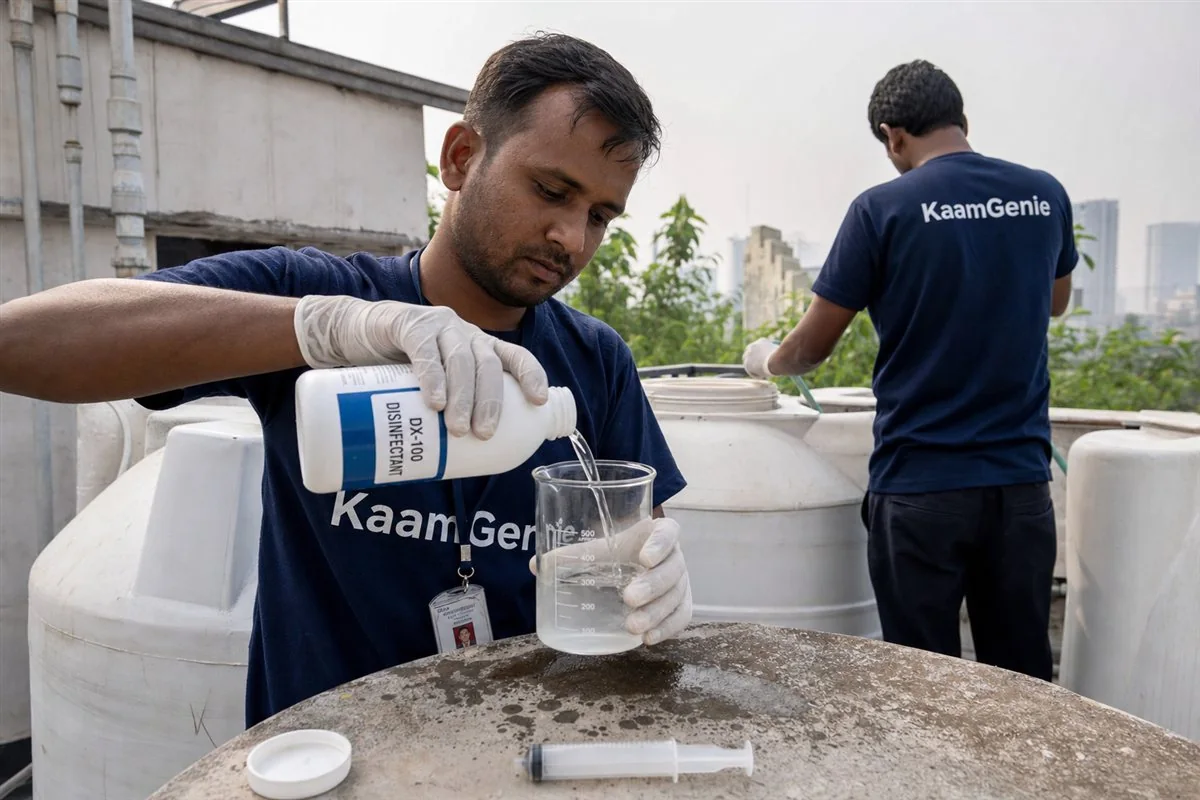
If a tank cleaning uses just one chemical, it is chlorine — specifically food-grade sodium hypochlorite. It is the workhorse of safe water everywhere: the same family of compound that the treatment plants feeding Noida add to make tap water safe, and the disinfectant the WHO and BIS reference for storage tanks. We bring it as a concentrated food-grade stock and dilute it down to a working solution before it touches the tank.
The important thing is that it is food-grade. That word is doing real work here. Food-grade hypochlorite is certified for contact with drinking water — no perfumes, no dyes, no thickeners, no heavy-metal contaminants. The cheap bleach in a hardware shop, or the chlorine sold for swimming pools, often carries those extras. They are perfectly fine in a pool but you do not want them in the water you cook dal in. We do not quote exact bottle-cap dosages here because the right amount depends on tank size and how dirty it is — we follow the concentration ranges in BIS IS 10500 and WHO guidance rather than eyeballing it.
For households that dislike even a faint chlorine smell — common in premium flats along the Noida Expressway (Sectors 137, 150, 168) — we can disinfect with food-grade hydrogen peroxide instead. It breaks down into water and oxygen and leaves no taste. It costs a little more, which is why it is an on-request option rather than the default.
The anti-bacterial, anti-fungal wash — and why contact time is everything
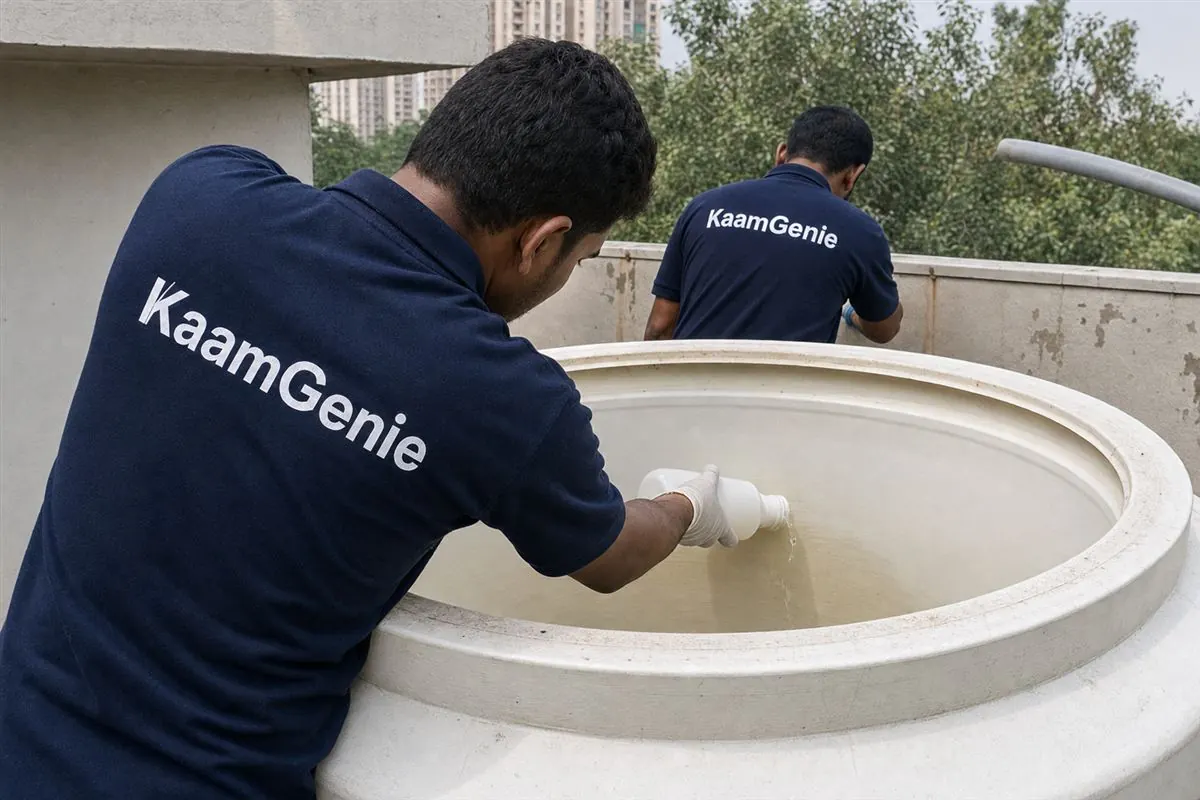
People often picture “anti-bacterial wash” as a special branded product. It is really just the disinfection stage done properly. Once the tank is scrubbed and rinsed, the chlorine or peroxide solution is applied to every interior surface — all four walls, the floor, the underside of the lid where condensation breeds bacteria, and around the inlet and outlet. That coating kills E. coli, salmonella and the black or pink fungal and algal slime that loves Noida’s warm rooftop drums.
Here is the part that separates a real job from a fake one: the chemical has to sit. Disinfection works on contact time, not on how strong the solution smells. For a home tank that means roughly 20 to 30 minutes of dwell time; a large society reservoir or UGR needs longer. The most common shortcut we see across Noida is the operator who sprays disinfectant and rinses it off thirty seconds later so he can finish and leave. The tank looks wet and “treated”, but the bacteria were never given enough time to die. We go deeper into this in our guide to water tank disinfection in Noida, but the one-line version is: no contact time, no disinfection.
Hard-water scale: descaling without acid
Noida’s borewell groundwater is hard. If you have ever seen chalky white crust around a tap or a powdery ring inside your tank, that is calcium and magnesium scale. Plotted Authority houses, builder floors with shared sumps, and the tanker-fed towers of Greater Noida West / Noida Extension all see it. Sectors that lean more heavily on borewell supply build it up faster than sectors on consistent Ganga Jal piped water.
The lazy way to remove scale is to pour in muriatic (hydrochloric) acid and watch it fizz away. It is fast, it is cheap, and it is genuinely dangerous in a drinking-water tank. Strong acid:
- eats into the tank walls and corrodes metal fittings and the reinforcement in concrete reservoirs;
- leaves an acidic residue that is then sitting in your stored water;
- gives off fumes inside a confined tank — a real hazard for whoever is working in there;
- does nothing at all to kill bacteria, so it is not even a substitute for disinfection.
We handle scale the slow, safe way instead: scrape and high-pressure jet the bulk of it off mechanically, then use a mild food-grade descaling agent only on the stubborn patches, followed by a full rinse. It takes more effort than a splash of acid, which is exactly why budget operators avoid it. If your tank is heavily scaled, our note on hard water tank cleaning in Noida explains what to expect.
Recommended minimum disinfectant contact time, by tank type
The chemistry needs time — bigger storage means a longer wait, not just more solution
Indicative dwell times in line with WHO / BIS disinfection guidance. The bottom bar is the spray-and-instant-rinse shortcut — the chemical is gone before it can work.
The chemicals that should never go near your tank
It is worth being blunt about what gets misused, because a cheap quote in Sector 62 or Sector 128 often means one of these is coming out of the van:
- Muriatic / hydrochloric acid — for scale. Corrosive, leaves residue, gives off fumes, kills nothing.
- Surf / washing powder — foams uncontrollably, near-impossible to fully rinse from a big tank, leaves a soapy taste for days.
- Industrial or pool bleach — not food-grade; the additives that are fine for a pool are not fine for drinking water.
- Phenyl, floor cleaner, room freshener — occasionally splashed in to make a tank “smell clean”. None are potable-safe and the smell is masking, not cleaning.
A clean-smelling tank is not the same as a safe one. The goal is water that is microbiologically safe and chemically neutral — not water that smells of perfume or pool. This matters most for food businesses and shared buildings, where stored-water hygiene is a compliance issue; our note on FSSAI water tank cleaning in Noida covers what inspectors actually look for.
Different tanks, same food-grade family
Whether it is a single Sintex drum on a plotted house in Sector 75, a shared sump under a builder floor, or a large UGR feeding a tower in the Expressway belt, the chemical family is the same — food-grade chlorine, a mild detergent, and a descaler only where needed. What changes is the quantity, the contact time, and the paperwork. A society reservoir needs more solution, a longer dwell, and a written cleaning record for the RWA or AOA showing what was applied and when. The commercial and institutional belt around Sector 62, Amity and the IT/corporate offices expects that documentation as standard, and we provide it on every job — the same way we do across our wider water tank cleaning services.
Not sure what your last cleaner used?
If nobody told you what went in your tank, it is worth a fresh, documented clean. Food-grade chemicals only, record handed over. ₹699 onwards residential.
Book a food-grade clean anywhere in Noida
The chemistry is genuinely simple when it is done honestly: food-grade chlorine to disinfect, a touch of food-grade detergent to lift the grime, mechanical descaling for hard water, and a thorough rinse — with enough contact time in between for the disinfectant to actually work. Everything else on the “never” list is a shortcut that trades your water’s safety for the cleaner’s convenience. To book a documented, food-grade clean for your home, society or commercial tank, start at our water tank cleaning in Noida hub and we will take it from there.
Frequently asked questions
What chemical is used to disinfect a water tank in Noida?
The standard disinfectant is food-grade sodium hypochlorite — chlorine. It is the same family of compound that Noida’s water treatment plants and the GNIDA/Jal Nigam supply use, and it is BIS and FSSAI-acceptable for potable water contact. We apply it as a dilute solution to every interior surface and let it dwell for a set contact time before rinsing. For premium or sensitive jobs we sometimes use food-grade hydrogen peroxide instead, which leaves no chlorine taste.
Why not just use acid to clean a Noida water tank?
Because acid is the wrong tool and a genuine hazard. Hardware-shop muriatic (hydrochloric) acid is sometimes splashed in by cheap operators to make hard-water scale disappear quickly, but it attacks tank walls and fittings, can corrode the metal in concrete reservoirs, leaves an unsafe residue, and gives off fumes in a confined tank. It also does nothing to kill bacteria. We remove Noida’s hard-water scale mechanically and with mild food-grade descaling agents — never with strong mineral acid in a drinking-water tank.
Is detergent or surf powder safe to clean a drinking-water tank?
No. Household detergent and surf powder are made for clothes and dishes, not potable water systems. They foam heavily, are very hard to rinse out of a large tank, and leave a soapy residue that you then drink and bathe in for days. We use a mild food-grade detergent specifically rated for potable-water contact, applied in small controlled amounts and fully rinsed, not a scoop of washing powder from the kitchen.
What is an anti-bacterial and anti-fungal tank wash?
It is the disinfection stage of the cleaning. After scrubbing and rinsing, every wall, the floor, the lid underside and the inlet/outlet area are coated with a food-grade chlorine or peroxide solution that kills bacteria (E. coli, salmonella) and the black or pink fungal and algal film that grows in warm, poorly-lit Noida rooftop tanks. The chemical needs contact time to work — a quick spray-and-wipe does not disinfect anything.
How does KaamGenie handle hard borewell water scale in Noida tanks?
Much of Noida and Greater Noida runs on hard borewell groundwater, which leaves chalky white calcium and magnesium scale on tank walls and around fittings. We remove it mechanically first — scraping and high-pressure jetting — and only then use a mild food-grade descaling agent on stubborn patches, followed by a thorough rinse. We never pour strong acid into the tank to dissolve scale, because the cure is worse than the problem.
Are the chemicals safe to drink after the tank is refilled?
Yes, once the tank has been rinsed and refilled. The disinfectant is applied, given its contact time, then rinsed off, and the tank is refilled with fresh water. A small, safe residual of chlorine remains — the same kind that is intentionally present in any treated municipal supply. For non-drinking use (bathing, washing) the water is fine almost immediately; for drinking, give it a couple of hours and run it through your RO/UV purifier as usual.
What does food-grade actually mean for these chemicals?
Food-grade means the product is manufactured and certified for contact with potable water and food surfaces — no added fragrances, dyes, stabilisers or heavy-metal contaminants. Pool chlorine and industrial bleach often contain such additives, which are fine for a swimming pool but not for water you cook with. Food-grade sodium hypochlorite costs more than hardware-shop bleach, which is exactly why corner-cutters avoid it.
How long does the disinfectant need to sit before it works?
Disinfection is about contact time, not strength. The chlorine solution is left on the surfaces for roughly 20-30 minutes for a residential tank, and longer for large society reservoirs and underground sumps. Skipping this wait is the single most common shortcut in cheap Noida cleanings — the operator sprays, immediately rinses, and the bacteria are never actually killed.
Do you use the same chemicals for a society reservoir as for a home tank?
The chemicals are the same food-grade family, but the quantities, contact time and documentation scale up. A large underground reservoir feeding a Noida high-rise needs more solution, a longer dwell time, and a written record of what was used for the RWA or AOA. We keep dosing in line with BIS IS 10500 and WHO guidance rather than guessing, and we hand over a cleaning certificate noting the chemicals applied.
How will I know which chemicals were actually used on my tank?
We tell you and we write it down. Every job ends with before/after photos and a cleaning record that lists the tank type, the food-grade disinfectant and any descaling agent used, and the date of service. If a cleaner cannot or will not tell you what they put in your drinking-water tank, that is a clear sign to stop and ask questions before they refill it.
Sources & references
- Bureau of Indian Standards (BIS) — IS 10500:2012 is the canonical Indian Standard for drinking water specification, defining acceptable limits for physical, chemical, and biological parameters.
- WHO Guidelines for Drinking-water Quality, 4th edition — the global reference for water quality standards, including guidance on storage and disinfection.
- Food Safety and Standards Authority of India (FSSAI) — defines water quality requirements for food businesses, including hygiene standards for stored water and acceptable disinfection chemicals.
- WHO Fact Sheet on Drinking Water — overview of safe drinking water requirements and contamination risks.
- CPHEEO — Manual on Water Supply and Treatment — the Government of India’s engineering manual covering tank design, cleaning protocols, and disinfection practices.
Last verified: 30 June 2026. If you find any of these links broken, please let us know.