
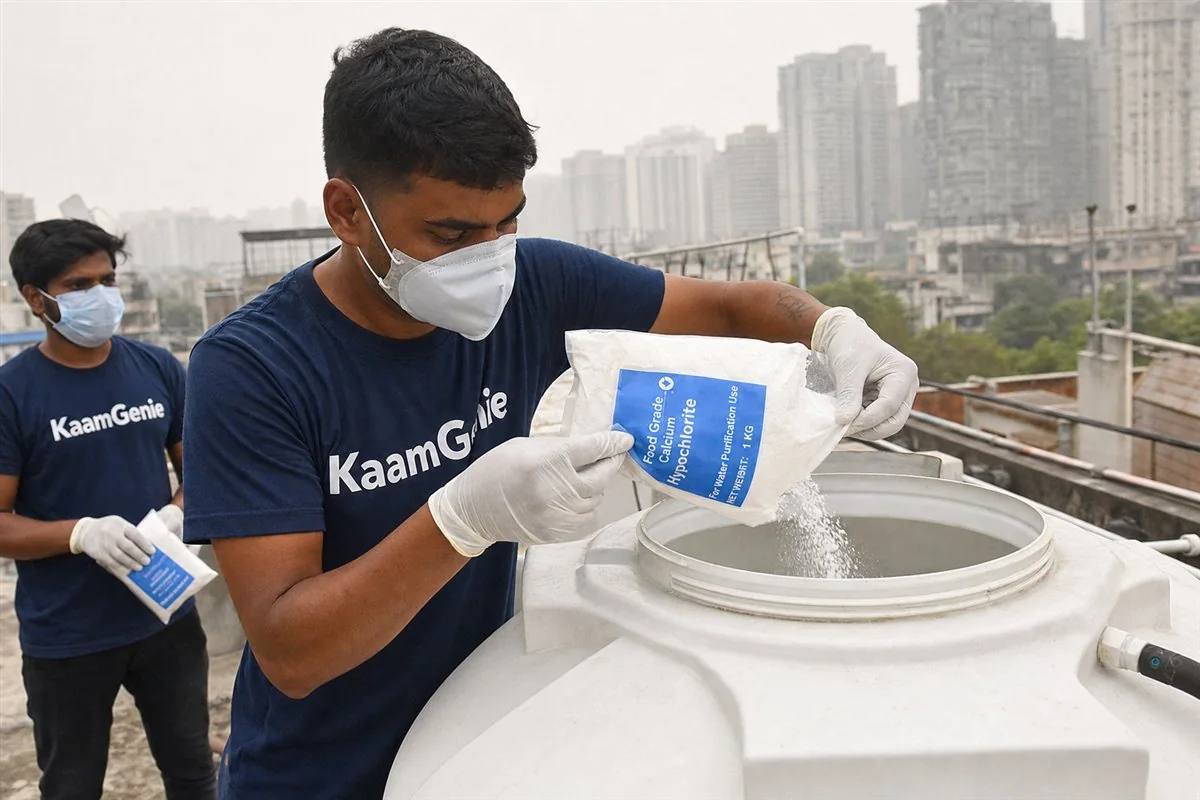
The short version
- Cleaning and disinfection are two different jobs. Scrubbing removes sludge and scale; disinfection kills the bacteria left behind. You need both, in that order.
- Food-grade chlorine is the workhorse. Food-grade sodium hypochlorite, measured — never hardware-shop bleach or pool chlorine.
- Contact time is everything. Chlorine needs minutes on the surface, not a quick splash. Rushing this is why a “disinfected” tank can still test dirty.
- A small residual protects the water. The goal is a tiny free residual chlorine at your taps — BIS points to a minimum around 0.2 mg/L — enough to protect, little enough to barely notice.
- UV and ozone don’t replace it. They’re great at the kitchen tap but leave no residual, so they can’t protect water sitting in a storage tank.
If a cleaner skips disinfection — or sprays chlorine and leaves before it can act — you paid for a wash, not a safe tank.
Across Noida and Greater Noida, most homes don’t drink straight from the municipal line. Water arrives — piped Ganga Jal in the Authority sectors, hard borewell groundwater in much of the high-rise and Extension belt, tanker deliveries in the newer townships — and then it sits. It sits in a big underground reservoir, gets pumped up to rooftop tower tanks, and waits there for hours or days before it reaches your tap. Every hour it sits, it is only as safe as the tank it’s sitting in. That is why disinfection, not just scrubbing, is the part of water tank cleaning in Noida that decides whether the water is genuinely safe.
| Cleaning (scrub & flush) | Disinfection (chlorination) | |
|---|---|---|
| What it does | Removes sludge, scale, bio-film, debris | Kills bacteria and pathogens on clean surfaces |
| Tools | Brushes, jet wash, wet vacuum | Food-grade chlorine, measured dose, contact time |
| Visible result | You can see it — clean walls | Invisible — you have to trust the method |
| If skipped | Chlorine can’t reach shielded bacteria | Clean-looking tank, still microbially unsafe |
| Order | First | Last — the critical final step |
Book a clean-and-disinfect, done properly
Full scrub, jet wash, vacuum — then measured food-grade chlorination with real contact time. Photos and a record every job. ₹699 onwards.
Why disinfection is the step that actually makes water safe
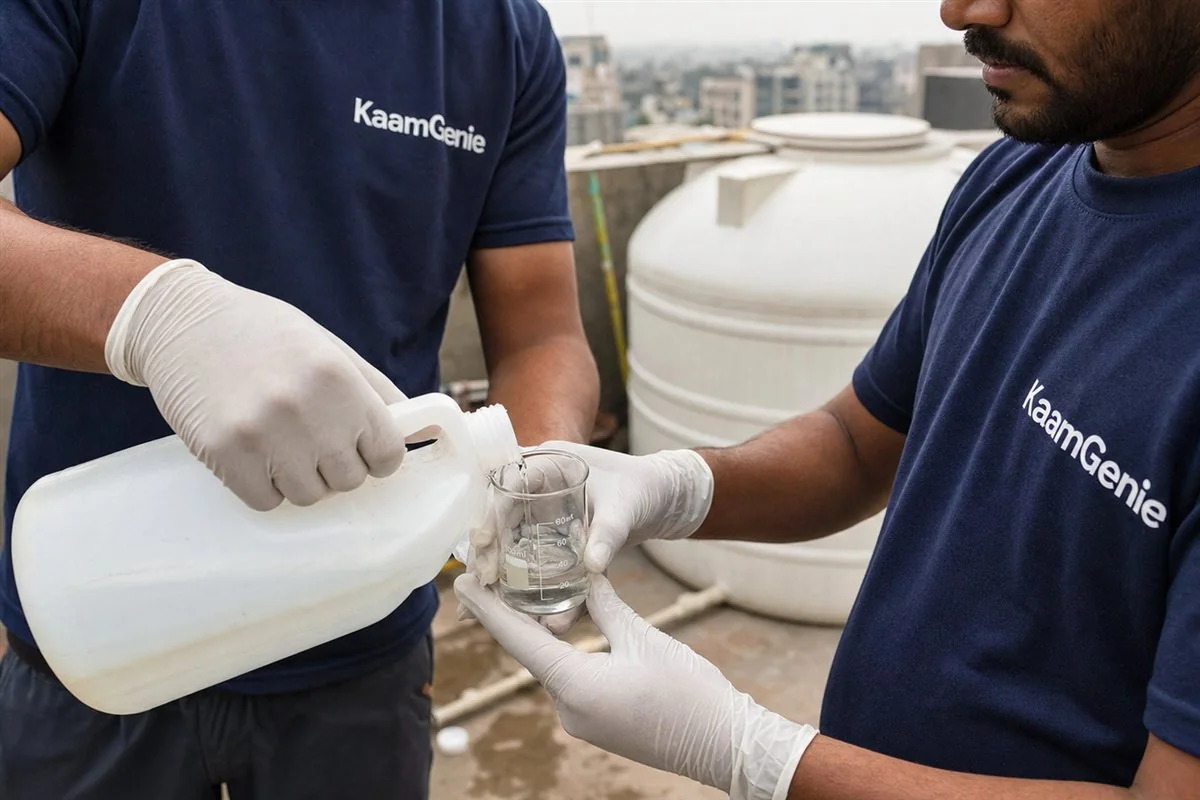
Think of a freshly scrubbed tank as a clean operating table. It looks spotless, but “looks clean” and “is sterile” are different claims. A scrubbed wall still carries an invisible microbial load — E. coli, other coliforms, and the slimy precursors of bio-film that regrow within days if nothing kills them. Disinfection is the step that crosses that gap. It is the difference between a tank that is tidy and a tank that is safe.
The reason chlorine sits at the centre of this is simple: it keeps working after we’ve packed up and gone. A measured dose leaves behind a tiny residual in the water, and that residual is a standing guard — it mops up small recontaminations from a slightly loose lid, a bit of dust, or the first signs of regrowth, in the hours and days before you actually use the water. No other common method gives you that lingering protection inside a storage tank.
This is also why order matters. Disinfection only works on a surface that is already clean. Bio-film and the calcium-iron scale so common on Noida’s hard-water tanks act like armour — chlorine simply can’t reach the bacteria sheltering underneath. Chlorinate a dirty tank and you sterilise the top millimetre while the colony below shrugs and carries on. Clean first, disinfect last. There is no shortcut around that sequence, and anyone who offers one is selling you a smell, not safety.
Chlorination: how food-grade chlorine actually does the work
When chlorine meets water it forms hypochlorous acid, which slips through the cell walls of bacteria and viruses and shuts them down. That’s the whole mechanism — and it’s the same chemistry your local utility uses on piped supply before it ever reaches Noida. The art isn’t in the chemical; it’s in using the right chemical, at the right dose, for the right time.
The right chemical. We use food-grade sodium hypochlorite — a grade certified for potable-water contact. The bottle of bleach from the hardware shop is not the same thing: it can carry fragrances, thickeners and stabilisers that are perfectly fine for floors and perfectly wrong for drinking water. Pool chlorine is in the same banned category. The food-grade product costs more; on a tank that feeds your kitchen, it is non-negotiable.
The right dose. There is no universal number, which is exactly why we don’t print one for people to copy. Surface disinfection of cleaned walls uses a strong chlorine solution — the standard practice is a high available-chlorine concentration applied across every surface — while the water you actually store needs only a whisper of residual. Hard borewell water consumes some of the chlorine through reaction with dissolved minerals, so the dose is nudged up on the day. We measure with a vessel and, where it matters, confirm with test strips. Under-dose and you fail to disinfect; over-dose and you’re left with water that tastes like a swimming pool.
The right time. Contact time is the part corner-cutters quietly drop. Chlorine doesn’t act instantly — it needs minutes of dwell on the surface to do its job. We leave the solution on the walls and floor through a proper contact window before rinsing. A crew that sprays chlorine and immediately refills has skipped the only part that mattered.
| Method | Kills on contact | Leaves a residual? | Best use |
|---|---|---|---|
| Chlorine (sodium hypochlorite) | Yes | Yes — protects stored water | Tank disinfection (whole home / society) |
| UV light | Yes | No | Point-of-use at the tap / RO unit |
| Ozone | Yes (very fast) | No (breaks down quickly) | Inline treatment, specialist setups |
| Hydrogen peroxide | Yes | Short-lived | Premium / taste-sensitive jobs |
Noida water: why local conditions change the disinfection plan
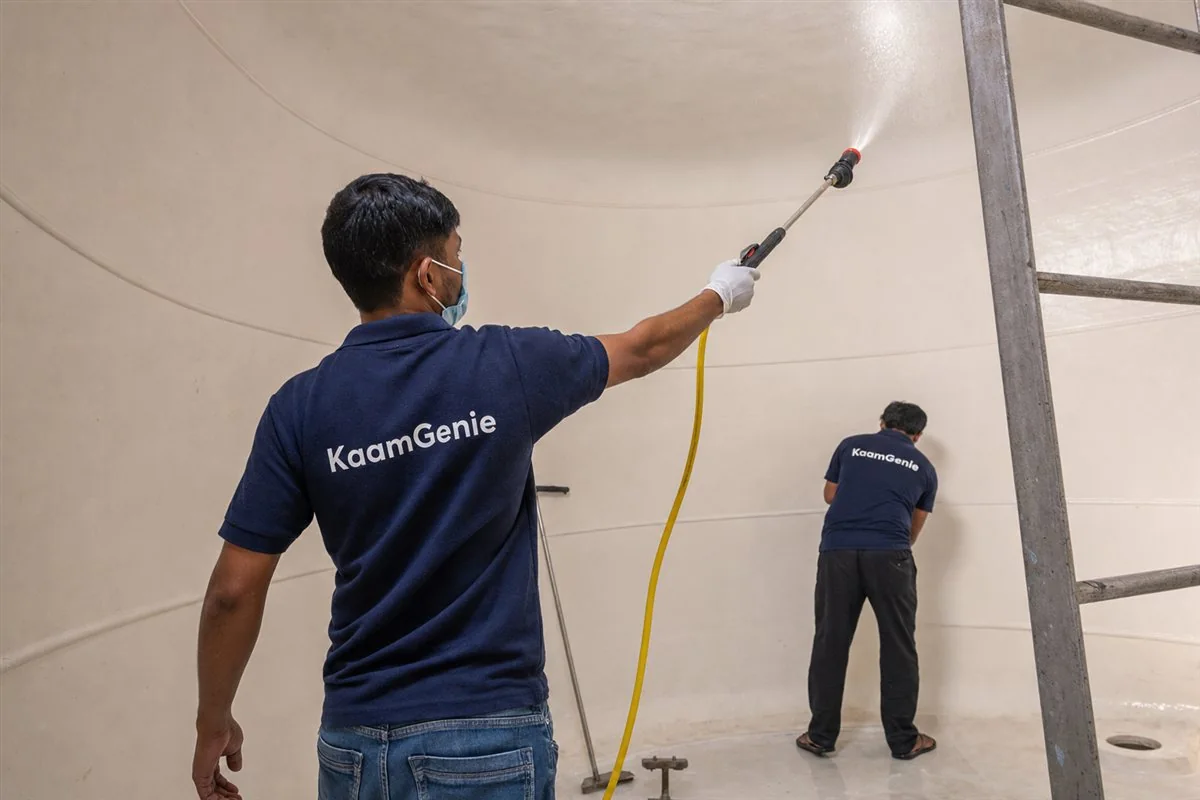
Disinfection isn’t one-size-fits-all in Noida because the water itself isn’t. A few local realities shape how we approach it:
- Hard borewell groundwater. Across the high-rise belt and Greater Noida West / Noida Extension, much of the supply is hard groundwater that lays down calcium and iron scale. That scale shelters bacteria from chlorine, so thorough de-scaling has to come first — we cover this in detail in our guide to hard-water tank cleaning in Noida. Hard water also “eats” chlorine, so dosing is adjusted upward.
- Tanker-fed townships. The newer towers along the Noida Expressway and out toward Greater Noida West rely heavily on tanker deliveries into large underground reservoirs. Tanker water quality varies load to load, which makes a reliable residual chlorine in the tank more important, not less.
- Big UGR-to-tower systems. In Sector 137 and the surrounding Expressway high-rises, water moves from a deep underground reservoir up to dozens of rooftop tower tanks. Each tank is its own little ecosystem and each needs disinfecting — something we plan tower-by-tower for societies, as described in our note on society and high-rise tank cleaning in Noida.
- IT and institutional belt. Around Sector 62’s corporate parks and the Sector 128 campuses, hospitals and colleges, the volumes are large and the tolerance for risk is low — these tanks are disinfected with documentation that an FSSAI or facility audit will accept.
The common thread: the messier and more variable the source water, the more the residual from chlorination earns its keep. That’s the case across nearly all of Noida.
UV, ozone and the limits of “no-chemical” disinfection
People sometimes ask for a chemical-free disinfection — UV or ozone instead of chlorine. Both are genuinely powerful. UV light scrambles the DNA of organisms as water flows past the lamp; ozone is an even faster oxidiser. Neither leaves a taste. So why don’t we use them on the tank?
Because they leave no residual. UV and ozone only act at the instant water passes through them. The moment that water flows out and sits in a storage tank, it has zero ongoing protection — any recontamination from then on goes unchecked. That makes them excellent point-of-use technologies: your kitchen RO/UV unit treats water right before you drink it, which is exactly where they belong. For a tank that holds water for hours or days before use, chlorination’s lingering residual is the practical answer. The two are partners, not rivals — chlorinate the tank, polish at the tap. If you want help deciding what makes sense for your building, our wider water tank cleaning services page lays out the options, and our complete Noida tank-cleaning guide walks through the full picture.
Free residual chlorine — where the target sits
Enough to protect stored water, low enough that taste stays acceptable (indicative, per BIS / WHO guidance)
Indicative only. BIS IS 10500 indicates a minimum free residual chlorine of about 0.2 mg/L at the point of use; WHO guidance supports keeping a low residual without exceeding taste-acceptable limits. Actual dosing is measured on site.
Worried about your tank after a tanker delivery or the rains?
Re-chlorination is quick and worth it after any contamination scare. Tell us your sector and we’ll advise honestly. ₹699 onwards residential; society and UGR custom.
After disinfection: when the water is safe, and when to re-chlorinate
Once the surface solution has had its contact time, we rinse it out, vacuum the floor and refill the tank with fresh water. For everyday uses — bathing, washing, cleaning — the refilled water is fine within roughly half an hour. For drinking, give it a couple of hours, run it through your usual RO or UV purifier, and let any faint chlorine smell fade. That trace of smell isn’t a fault; it’s the residual doing exactly what it should.
Because disinfection is the closing step of every cleaning, it naturally follows your cleaning schedule — for most Noida homes, about every six months. But there are moments when re-chlorination ahead of schedule is the smart call:
- After the monsoon — if rainwater or contaminated runoff may have entered through a loose or broken lid.
- After a doubtful tanker load — especially in the Expressway and Greater Noida West townships that lean on tanker supply.
- After any illness in the building — a stomach bug doing the rounds is reason enough to reset the tank.
- After plumbing work — any repair that opened the tank or the line can introduce contamination.
Societies and food businesses on tanker-fed supply often build a more frequent re-chlorination rhythm into their maintenance, simply because their source water is more variable and the number of people relying on it is higher.
Book disinfection that’s done right, anywhere in Noida
A real clean-and-disinfect isn’t a spray and a smile. It’s a proper scrub and de-scale first, then a measured food-grade chlorination with genuine contact time, finished with a residual you can rely on and a record you can keep. We do exactly that across Noida and Greater Noida — from plotted Authority houses and builder floors to the big UGR-and-tower societies of the Expressway belt. See pricing, coverage and how to book on our water tank cleaning in Noida hub, or just tell us your sector and we’ll take it from there.
Frequently asked questions
Is disinfecting a water tank the same as cleaning it?
No. Cleaning is the physical removal of sludge, scale and bio-film by draining, scrubbing, jet-washing and vacuuming. Disinfection is the chemical step that kills the bacteria left behind on the cleaned surfaces. A tank that is scrubbed but not disinfected still carries a microbial load; a tank that is chlorinated without first being scrubbed only kills organisms on the surface while bio-film underneath shields the rest. You need both, in that order — clean first, then disinfect.
What chlorine do you use to disinfect a water tank in Noida?
Food-grade sodium hypochlorite — the same class of compound municipal utilities use to treat piped supply. It is acceptable for potable water contact under FSSAI norms. We do not use hardware-shop industrial bleach or pool-grade chlorine, which can carry fragrances, stabilisers or heavy-metal traces that have no place in drinking water. Calcium hypochlorite (bleaching powder) is sometimes used for surface disinfection where a measured, food-safe grade is available.
How much chlorine is needed to disinfect a water tank?
There is no single number that fits every tank — it depends on tank volume, surface condition and water quality. For surface disinfection of cleaned walls we use a high-concentration chlorine solution (the standard practice is roughly 50 ppm available chlorine) applied to all interior surfaces. For the refilled water, the goal is a much lower level that leaves a small safe residual at your taps. We measure rather than guess, and we never publish a fixed dose to be copied blindly, because under-dosing fails to disinfect and over-dosing leaves an unpleasant taste.
How long does the chlorine need to stay in contact with the tank?
Contact time is what actually does the disinfecting — chlorine needs minutes on the surface, not seconds. For surface disinfection we leave the chlorine solution on the cleaned walls and floor for a dwell period (typically in the 15–30 minute range) before rinsing. For chlorinating a full tank of water, a longer hold of around 30 minutes or more is used before the water is flushed and the tank refilled. Rushing this step is the single most common reason a “disinfected” tank still tests positive for bacteria.
Is the water safe to drink straight after chlorination?
Not immediately after a strong surface chlorination. The high-concentration solution used to disinfect the walls is rinsed out, and the tank is refilled with fresh water. After refill, the small residual settles within roughly half an hour for general use such as bathing and washing. For drinking we suggest giving it a couple of hours, running your normal RO or UV purifier, and using the water once any chlorine smell has faded to barely noticeable — that faint smell is actually a sign a protective residual is present.
What level of residual chlorine should be in the water?
Indian and global guidance points to keeping a small free residual chlorine in stored drinking water so it stays protected against recontamination. BIS IS 10500 indicates a minimum free residual chlorine of about 0.2 mg/L at the point of use, and WHO guidance broadly supports keeping a low residual (commonly in the 0.2–0.5 mg/L range) without exceeding taste-acceptable limits. The aim is enough to protect the water, little enough that you barely notice it.
Do you offer UV or ozone disinfection instead of chlorine?
UV and ozone are excellent at killing organisms at the moment water passes through them, and they leave no taste — but they leave no lasting residual either, so they do not protect water that then sits in a storage tank for hours or days. That makes them point-of-use technologies (your RO/UV unit at the kitchen) rather than tank-disinfection methods. For a storage tank that feeds a whole home or society, chlorination remains the practical choice because the residual keeps working after we leave. We are happy to advise on combining both.
Does Noida’s hard borewell water affect disinfection?
Yes, indirectly. Much of Noida and Greater Noida runs on hard borewell groundwater that leaves calcium and iron scale on tank walls. Chlorine cannot penetrate that scale, so bacteria hide underneath it. This is exactly why we scrub and de-scale thoroughly before disinfecting — on a heavily scaled tank, disinfection alone is close to useless. Hard water also consumes some chlorine through reaction with minerals, so dosing is adjusted on the day.
How often does a tank need re-chlorination?
Disinfection is done as the final step of every cleaning, so for most homes it follows the cleaning schedule — roughly every six months. Re-chlorination sooner is worth it after a contamination event: a monsoon ingress through a broken lid, a tanker delivery of doubtful quality, a waterborne-illness scare in the building, or a plumbing repair that opened the system. Societies and food businesses on tanker-fed supply often re-chlorinate more frequently as a precaution.
Will chlorinated water smell or taste bad?
A correctly dosed tank gives water with at most a very faint chlorine smell that most people stop noticing within a day, and an RO purifier removes it entirely. A strong, swimming-pool smell means over-dosing or a strong surface solution that was not rinsed properly — that is a sign of a rushed job, not a thorough one. We measure the dose and rinse the surface solution before refill specifically so the water is protected without being unpleasant.
Sources & references
- Bureau of Indian Standards (BIS) — IS 10500:2012 is the canonical Indian Standard for drinking water specification, including guidance on minimum residual free chlorine at the point of use.
- WHO Guidelines for Drinking-water Quality, 4th edition — the global reference for water quality, including disinfection and the role of residual chlorine in stored water.
- Food Safety and Standards Authority of India (FSSAI) — defines water quality requirements for food businesses, including hygiene standards for stored water and acceptable disinfection chemicals.
- WHO Fact Sheet on Drinking Water — overview of safe drinking water requirements and contamination risks.
- CPHEEO — Manual on Water Supply and Treatment — the Government of India’s engineering manual covering tank design, cleaning protocols and disinfection practices.
Last verified: 30 June 2026. If you find any of these links broken, please let us know.