
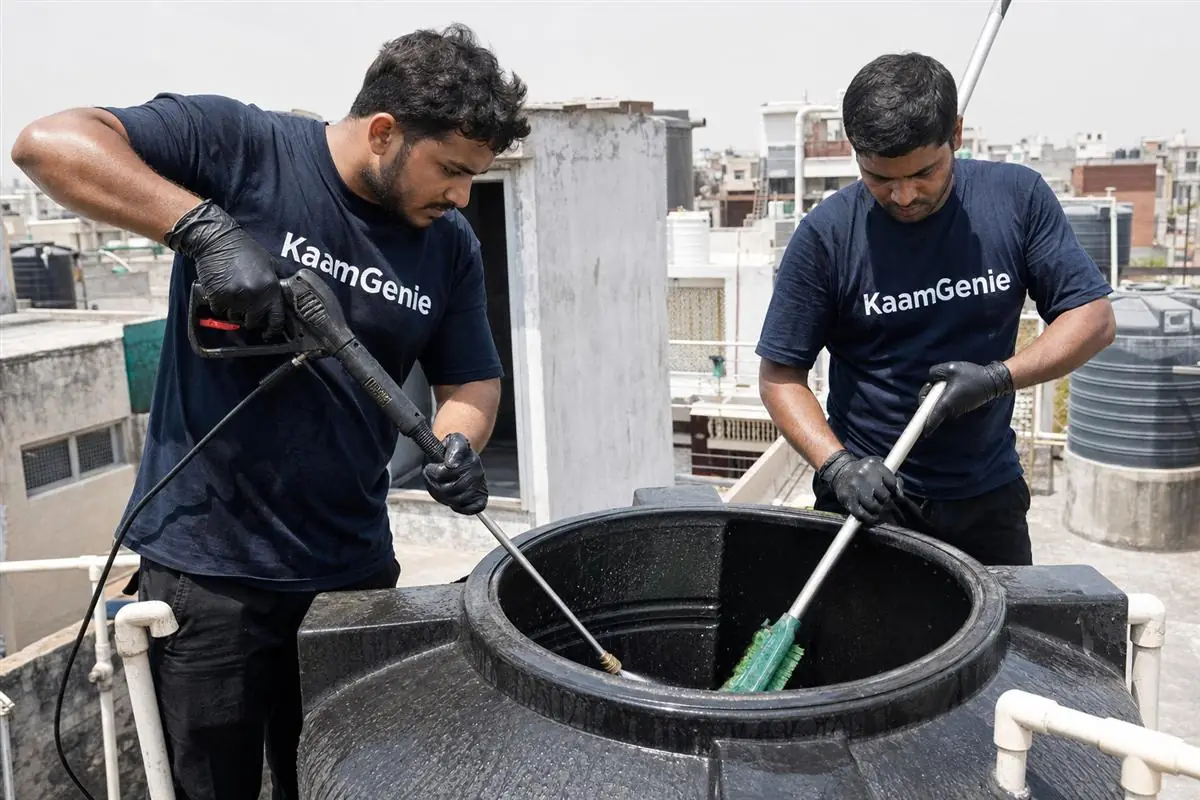
The methods at a glance
- Manual scrubbing — the irreplaceable core. Food-grade brushes on walls, floor and corners. Nothing else loosens stuck-on biofilm.
- High-pressure jet wash (100-150 PSI) — reaches corners, fittings and concrete pores a brush physically can’t.
- Wet-vacuum extraction — sucks out the loosened sludge and dirty water so it doesn’t resettle on refill.
- Mechanized / “automatic” rigs — powered jet-plus-vacuum units for big industrial tanks. There is no true one-button machine for home tanks.
- Disinfection — food-grade chlorine, hydrogen peroxide, or UV/ozone for premium jobs. This is what kills the bacteria.
The key takeaway: a real cleaning combines these methods in sequence — it is never one machine or one technique. If a cleaner offers only “jet” or only “automatic,” you’re getting part of the job.
| Method | What it actually is | Best for | Main limitation |
|---|---|---|---|
| Manual scrubbing | A person inside the tank with food-grade nylon brushes and mild detergent, working walls, floor and seams | Every tank — the core step; essential for smooth plastic/Sintex walls | Brushes can’t reach corners, fittings or concrete pores |
| High-pressure jet wash | A 100-150 PSI water lance that blasts loosened biofilm and scale off surfaces and out of crevices | RCC concrete tanks, corners, behind inlet/outlet pipes, lid threads | Too much pressure can stress old/brittle plastic; doesn’t remove water itself |
| Wet-vacuum extraction | An industrial wet/dry vacuum that removes dislodged sludge and dirty rinse water from the floor | Finishing every job; sumps where sludge pools heavily | Removes debris but doesn’t clean or disinfect on its own |
| Mechanized / “automatic” systems | Powered jet-plus-vacuum rigs (sometimes rotating nozzles) run by a technician on large tanks | Large society reservoirs and industrial tanks (10,000L+) | No genuine hands-free machine exists for home tanks; still needs an operator |
| Disinfection (chemical / UV / ozone) | Food-grade sodium hypochlorite (50-100 PPM), hydrogen peroxide, or UV/ozone for premium jobs | Any tank supplying drinking or kitchen water | Kills bacteria but does nothing about sludge, scale or biofilm physically |
Want all the methods, not just one?
Scrub, jet, vacuum and disinfect — the full combination, before/after photos, fixed price. ₹699 onwards.
Manual scrubbing — the irreplaceable core
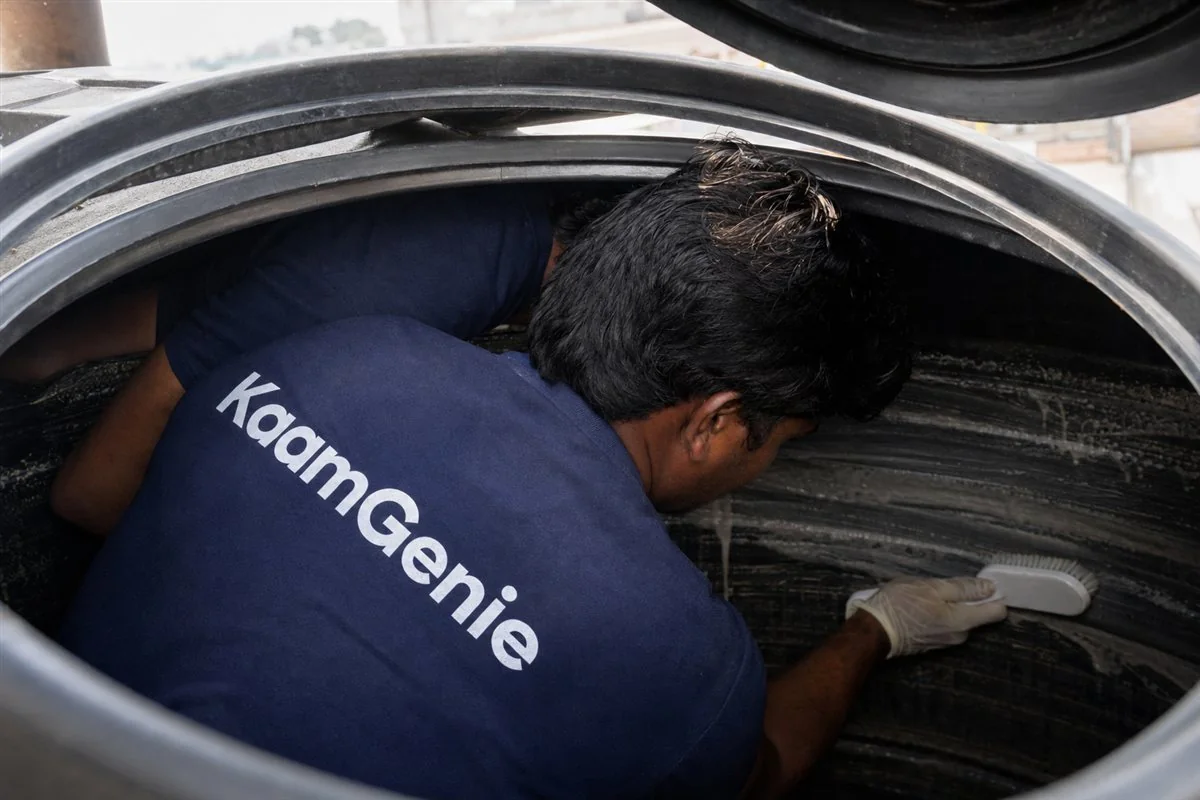
Start with the truth most equipment sellers won’t tell you: nothing replaces a human scrubbing the tank by hand. Biofilm — the slippery bacterial layer that builds on every tank wall in Delhi’s warm storage conditions — physically sticks to the surface. It doesn’t rinse off, and a jet alone glances over it. You have to break the bond with a brush, and that means a person, gloved and inside (or reaching fully in), working every wall and the floor in overlapping passes.
The non-negotiable rule here is the brush. We use food-grade nylon brushes, never metal. A wire or metal brush scratches plastic and Sintex walls, and those scratches become micro-grooves where bacteria settle and re-grow faster than before — so a metal-brushed tank actually gets dirtier between cleanings. Stiff food-grade bristles and a mild food-grade detergent loosen the film without scoring the surface.
Manual scrubbing is also the step corner-cutters skip first, because it’s the slowest and most physical: 25-40 minutes for a 1,000L plastic tank, an hour-plus for a society reservoir. If a “cleaning” involved nobody going in with a brush, it wasn’t a cleaning. For where manual scrubbing sits in the full job, see our 8-step cleaning process.
High-pressure jet wash — reaching what a brush can’t
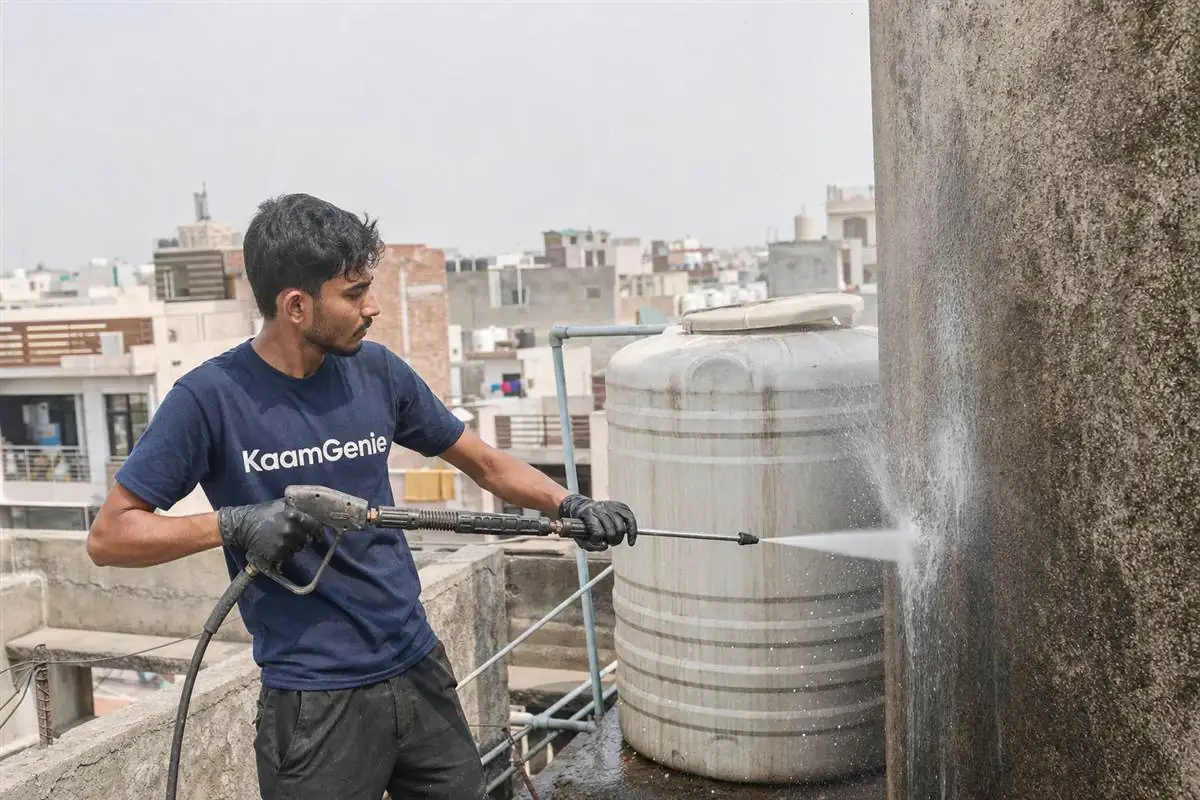
A brush is wide and flat. A tank is full of places that aren’t: the tight corners where walls meet the floor, the gap behind the inlet pipe, the threads under the lid, the seam around the outlet fitting. Biofilm and calcium scale hide exactly there. The fix is a high-pressure water jet, run at 100-150 PSI, that blasts those crevices clean and flushes the loosened debris toward the floor for the vacuum to collect.
Jet wash matters most on RCC concrete overhead tanks. Unlike smooth plastic, concrete is porous — over years its surface develops a fine texture, and biofilm clings down into those pores where no brush reaches. Only directed pressure clears it. This is the single biggest reason a concrete tank that was only scrubbed still smells off a week later: the scrubbing never touched what was living in the pores.
One caution worth stating plainly: pressure must match the tank. New plastic handles 100-150 PSI fine, but an old, sun-brittle Sintex tank on a Delhi rooftop can stress-crack at a weak seam if you blast it close-range. A competent crew checks tank age and dials the pressure down to 80-100 PSI rather than risk a crack. Note these are tank-cleaning jet pressures — nothing like the 2,000+ PSI of a driveway pressure washer.
Wet-vacuum extraction — so the dirt doesn’t come back
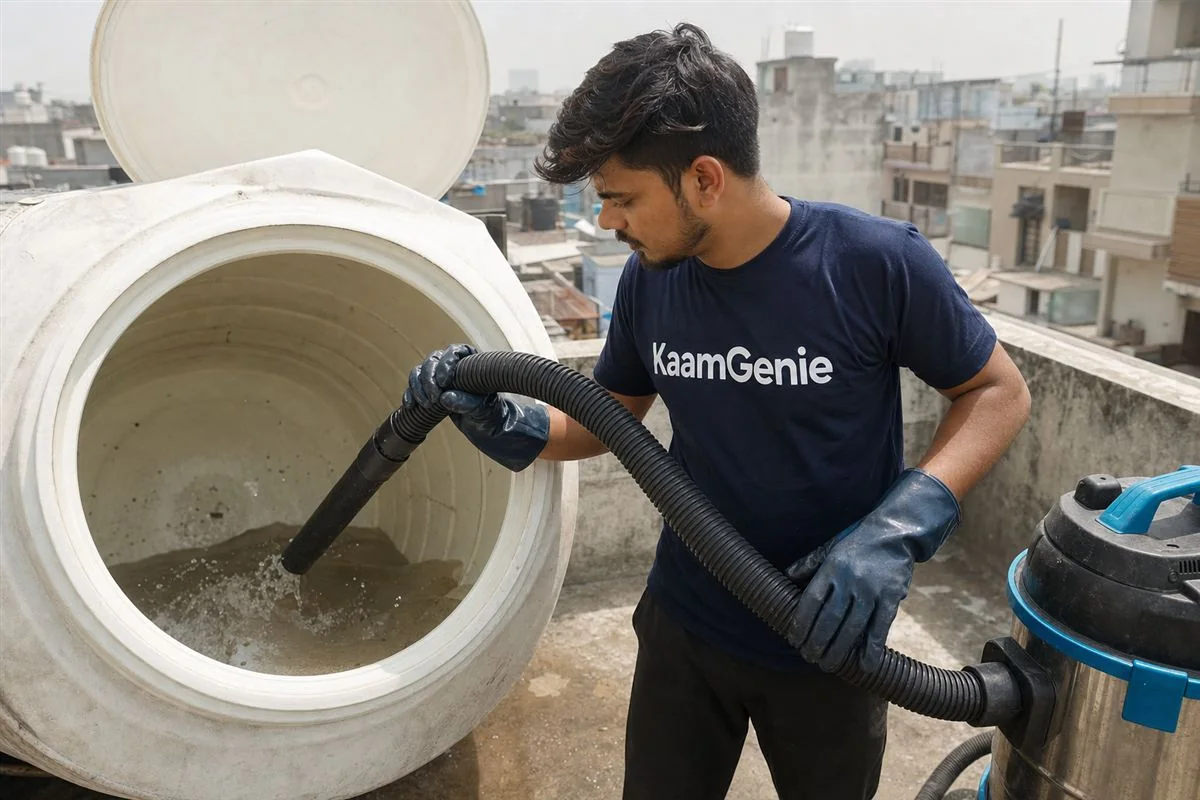
After scrubbing and jetting, the tank floor holds a layer of dirty water — one to three inches of it — carrying everything you just dislodged: biofilm flakes, scale, sediment. Here’s the trap: if you just open the drain, gravity removes most of it but leaves a thin film on the floor. When the tank refills, that thin film redistributes the dirt right back into your fresh water. All the scrubbing was undone in the last five minutes.
That’s what the wet-vacuum prevents. An industrial wet/dry vacuum suctions the floor as close to dry as possible, removing the loosened sludge and rinse water completely before disinfection. It does no cleaning itself — it’s purely extraction — but skipping it quietly cancels the value of everything before it. In underground sumps, where far more sludge collects, the vacuum step is even more important and takes longer.
Mechanized / “automatic water tank cleaning machine” — the honest version
This is the section we get asked about most, so let’s be direct. People search for an “automatic water tank cleaning machine” hoping there’s a device you drop in, press a button, and walk away while it cleans the tank. For home tanks, that machine does not exist. There is no consumer or service device that drains, scrubs, jets, vacuums and disinfects a residential Sintex or RCC tank on its own.
What the word “automatic” usually means in this trade is a mechanized rig — a powered unit that combines a high-pressure jet and a vacuum (sometimes with a rotating spray head) into one operator-controlled system. These genuinely exist and are useful, but they’re built for large society reservoirs and industrial tanks (10,000L and up), where a person can’t practically scrub thousands of square feet of wall by hand. Even then, a technician operates the rig, directs it, and still does manual finishing on corners and fittings. It’s mechanized, not autonomous.
For a rooftop home tank, the honest answer is that it’s still hands-in-the-tank work: a person scrubbing, then jetting, then vacuuming, then disinfecting. So when an ad promises “fully automatic” cleaning for your residential tank, read it as marketing language for the normal jet-and-vacuum equipment a good crew already carries — not as a robot doing the job. The method that matters isn’t the machine; it’s whether all the steps actually get done. If you’re weighing doing it yourself, our DIY vs professional comparison walks through exactly what equipment changes the outcome.
Disinfection methods — what actually kills the bacteria
Scrubbing, jetting and vacuuming get the tank physically clean. None of them sterilise it. Disinfection is the separate method that kills the surviving bacteria — E. coli, salmonella, legionella — and it’s the step most cheap operators either skip or get wrong. There are three approaches, in rough order of how common they are:
- Food-grade sodium hypochlorite (chlorine), 50-100 PPM — the workhorse. The same compound used in municipal water treatment, FSSAI-acceptable for potable systems, applied to all interior surfaces and left for a 15-30 minute contact time before rinsing. Cheap, reliable, proven. The critical detail: it must be food-grade, not hardware-shop industrial bleach, which carries additives you don’t want in drinking water.
- Hydrogen peroxide — used on premium jobs and where a no-chlorine-taste finish is wanted. Breaks down into water and oxygen, leaving no chlorine residual. More expensive, equally FSSAI-acceptable for potable use.
- UV / ozone — the premium upgrades. Ozone leaves no residual taste and is a powerful oxidiser; UV sanitises without any chemical. Both are excellent add-ons for commercial and high-end residential jobs, but they treat water rather than scrub surfaces — so they supplement the physical cleaning, never replace it.
Whichever method is used, the contact time is what does the work — a quick spray-and-rinse doesn’t disinfect anything. For a fuller breakdown of which agents are safe at what concentration, see our guide to the safe chemicals and disinfectants used in tank cleaning.
Which method does YOUR tank need?
The methods don’t change much, but the emphasis does depending on what you have. Here’s how the mix shifts by tank type — and if you’re comparing materials in depth, our plastic vs concrete cleaning guide goes deeper.
- Plastic / Sintex overhead tank — smooth walls, so careful manual scrubbing does most of the work. Jet wash at 100-150 PSI (lower for old tanks), vacuum, then food-grade chlorine. The watch-point is pressure: don’t over-jet brittle plastic.
- RCC concrete overhead tank — porous walls, so the jet wash carries the load. Scrub first to loosen, then jet hard into the pores, vacuum the heavier debris, disinfect. Concrete tanks reward the jet step more than any other type.
- Underground sump — same four methods, but it’s a confined space: ventilation, sometimes harness and gas checks, more vacuuming because more sludge collects, and a stronger initial chemical pass because damp sumps grow more biofilm. Always slower and more involved than an overhead tank. If you’re weighing the two, our overhead vs underground guide covers the differences.
- Large society / industrial reservoir (10,000L+) — this is where mechanized jet-vacuum rigs earn their place, because hand-scrubbing the whole surface isn’t practical. Crews work in teams, the rig handles the bulk, and manual finishing handles corners and fittings. Disinfection volumes scale up accordingly.
Method effectiveness on stuck-on biofilm
No single method wins — the combination does
Illustrative comparison of how well each approach removes stuck-on biofilm. Each single method tops out around half the job because it can’t reach what the others handle. Only the combination gets close to a fully clean, disinfected surface.
What to insist your cleaner actually uses
Because “water tank cleaning” covers everything from a real four-method job to a 15-minute hose-down, it pays to be specific when you book. Insist on — and watch for — the following:
- Hands-in-the-tank manual scrubbing with food-grade nylon brushes, not a top-down spray. Confirm nobody’s using metal brushes.
- A high-pressure jet (100-150 PSI), with pressure adjusted for old plastic. You’ll hear it — it’s loud.
- A wet/dry vacuum at the end, before refill. Different sound from the jet; without it, dirt resettles.
- Food-grade disinfectant (sodium hypochlorite 50-100 PPM or hydrogen peroxide) with a genuine 15-30 minute contact pause — not a quick spray-and-rinse, and never hardware-shop bleach.
- Sludge carried away in a sealed bucket, not flushed down your building’s plumbing.
- Before-and-after photos and a cleaning record listing the chemical and concentration used.
- Confined-space safety gear if it’s a sump — ventilation, harness where needed.
If a crew shows up with just a bucket and a bottle of bleach, you already know which methods you’re not getting.
Not sure which method your tank needs?
Tell us your tank type and we’ll bring the right kit — scrub, jet, vacuum and food-grade disinfection. ₹699 onwards.
The bottom line — book the full method, not a fragment
No single method cleans a water tank, and no machine does it hands-free for your home. A genuine cleaning combines manual scrubbing, jet wash, wet-vacuum extraction and food-grade disinfection — in that order, every time — with mechanized rigs only making sense on the largest reservoirs. That’s exactly how we work. See pricing and book on our water tank cleaning service in Delhi page. Curious how long the combined job takes? Our sibling guide on how long water tank cleaning takes breaks it down by tank size.
To book, call +91 95603 66362 or use the booking form on this site — we’ll confirm shortly.
Frequently asked questions
Is there a fully automatic water tank cleaning machine?
Not for home tanks. There is no one-button machine that drains, scrubs, jets, vacuums and disinfects a residential tank on its own. What gets advertised as “automatic water tank cleaning” is usually a powered jet-plus-vacuum rig operated by a technician on large industrial or society reservoirs. For a Sintex or RCC home tank it’s still hands-in-the-tank work — a person scrubbing with food-grade brushes, then jetting and vacuuming. Anyone promising a fully automatic clean for your rooftop tank is selling marketing, not method.
Which method is best for plastic vs concrete tanks?
Plastic and Sintex tanks have smooth walls, so manual scrubbing plus a 100-150 PSI jet wash does most of the work — you don’t want excessive pressure on old or sun-brittle plastic. RCC concrete tanks are porous, so jet wash matters far more: biofilm clings into the surface pores and only pressure clears it. Both still need the same sequence — scrub, jet, vacuum, disinfect — but concrete leans harder on the jet, plastic leans harder on careful manual scrubbing at safe pressure.
Do I really need jet wash and vacuum, or is manual scrubbing enough?
Manual scrubbing alone is not enough. Brushes can’t reach corners, behind the inlet pipe, into lid threads or into concrete pores — that’s what the jet wash is for. And after scrubbing and jetting, the floor holds dirty water full of dislodged biofilm flakes; without a wet-vacuum that layer resettles into your fresh water on refill. The three methods do different jobs. A real cleaning combines them; it isn’t a choice between one or the other.
Is chemical disinfection necessary every time?
Yes, for any tank that supplies drinking or kitchen water. Scrubbing and jetting remove the visible dirt and most biofilm, but disinfection is what actually kills the surviving bacteria — E. coli, salmonella, legionella. We use food-grade sodium hypochlorite at 50-100 PPM with a contact time of 15-30 minutes. Skipping disinfection turns a cleaning into a wash. The only time it’s reduced is on tanks used purely for non-potable purposes, and even then we recommend it.
What pressure is safe for an old plastic tank?
For an aged or sun-brittle Sintex tank, keep the jet at the lower end — around 80-100 PSI — and hold the lance back from the wall. New plastic tanks tolerate 100-150 PSI fine, but UV exposure on a Delhi rooftop makes old plastic stress-crack, and a close-range high-pressure blast can find a weak seam. A good crew assesses tank age first and dials the pressure down rather than risking a crack to save a few minutes.
Is UV or ozone better than chlorine?
For routine residential cleaning, food-grade chlorine (sodium hypochlorite) is the proven, FSSAI-acceptable standard and is hard to beat on cost and reliability. UV and ozone are useful add-ons for premium or commercial jobs — ozone leaves no residual taste and UV sanitises without chemicals — but both treat water in flow or need equipment, and neither replaces the physical scrub-jet-vacuum work on the tank surface. They are upgrades to the disinfection step, not substitutes for cleaning the tank itself.
Can the same method clean overhead tanks and sumps?
The same four methods apply, but the mix and the safety setup change. An overhead plastic tank is a quick scrub-jet-vacuum-disinfect job. An underground sump is a confined space — it needs ventilation, sometimes harness and gas checks, more vacuuming because more sludge collects, and a stronger initial chemical pass because sumps sit damp and grow more biofilm. So yes, same methods; no, not the same job. The sump always takes longer and demands confined-space precautions.
How do I know my cleaner used all the methods, not just a rinse?
Watch for four sounds and one pause: someone physically inside or reaching in to scrub, the loud jet washer running, the different note of a wet-vacuum afterwards, and a 15-30 minute disinfection contact pause before refill. If a residential job is done in 20-30 minutes with no jet, no vacuum and no chemical wait, you paid for a rinse from the top. Ask for before-and-after photos and a cleaning record listing the chemical and concentration used.
Does jet wash damage the tank?
Not at the right pressure. Industrial tank-cleaning jets run 100-150 PSI — far below the 2,000+ PSI of a pressure washer used on driveways. On sound plastic and concrete this is safe. The only real risk is using too much pressure too close on an old, cracked or brittle plastic tank, which is why pressure is matched to tank age. Used correctly, jet wash is gentler on the surface than aggressive metal-tool scraping.
How often should the full method combination be done?
For most Delhi homes, every 6 months — the full scrub, jet, vacuum and disinfect each time, not a partial wash in between. Hard borewell water, society reservoirs serving many flats, and food businesses often need it every 3-4 months because scale and biofilm build faster. The method doesn’t change with frequency; what changes is how much sludge and scale the crew has to remove.
Sources & references
- Bureau of Indian Standards (BIS) — IS 10500:2012 is the canonical Indian Standard for drinking water specification, defining acceptable limits for physical, chemical, and biological parameters.
- WHO Guidelines for Drinking-water Quality, 4th edition — the global reference for water quality standards, including guidance on storage and disinfection.
- Food Safety and Standards Authority of India (FSSAI) — defines water quality requirements for food businesses, including hygiene standards for stored water and acceptable disinfection chemicals.
- WHO Fact Sheet on Drinking Water — overview of safe drinking water requirements and contamination risks.
- CPHEEO — Manual on Water Supply and Treatment — the Government of India’s engineering manual covering tank design, cleaning protocols, and disinfection practices.
Last verified: 23 June 2026. If you find any of these links broken, please let us know.