
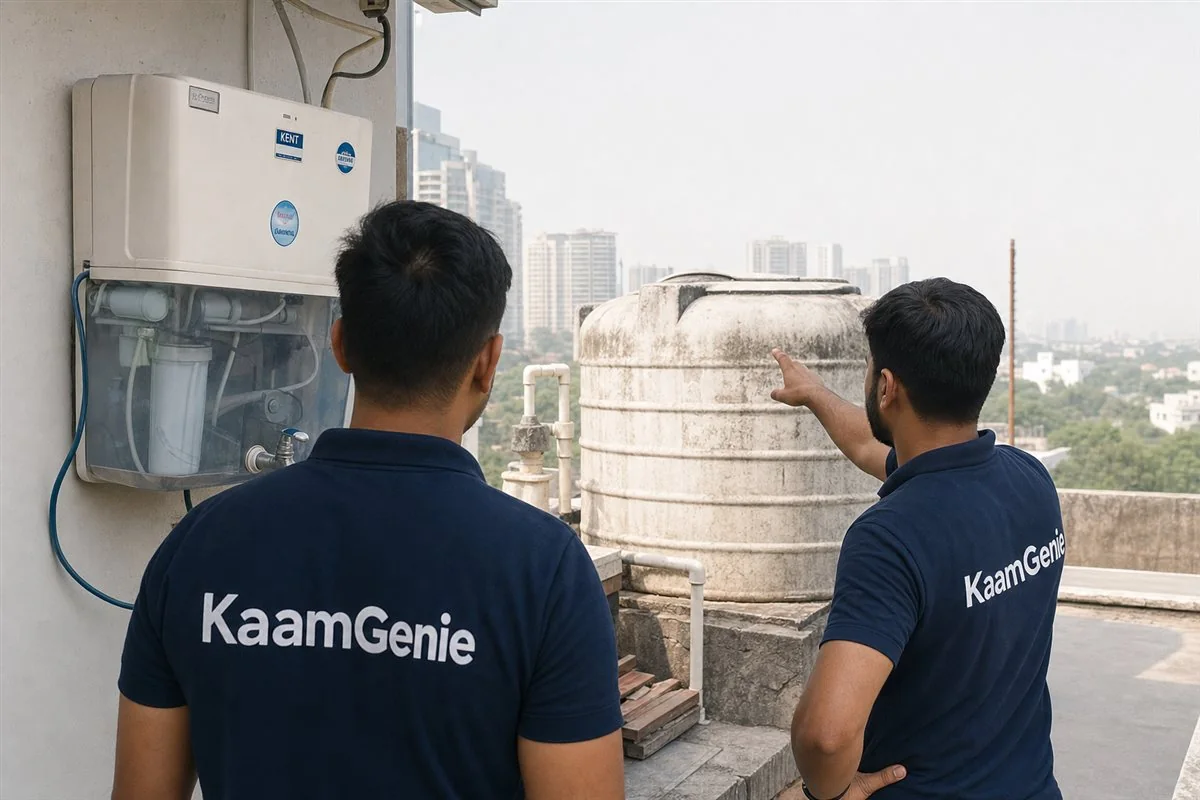
The short version
- A water purifier (RO/UV) treats only the small stream of drinking water at one tap, right before you drink it.
- A clean tank protects all the water in your home — bathing, washing, cooking, and the water that feeds the purifier itself.
- In Gurgaon, hard borewell water and heavy tanker reliance dump sediment and scale into the tank that the purifier never touches.
- A dirty tank recontaminates water downstream and clogs your RO filters faster, raising your maintenance bills.
- The honest answer is not “tank vs purifier” — it’s both. Clean the tank, then purify the drinking water.
If you only do one, you’re leaving roughly 90% of your home’s water unprotected.
We get asked this on almost every job. A homeowner in Sushant Lok or a condo resident on Golf Course Road points at the shiny RO unit under the kitchen sink and says, in effect, “Why do I need you? My water is already filtered.” It’s a fair question, and it comes from a genuine misunderstanding of what each device actually does. So let’s clear it up properly — not to sell you something, but because the two solve different problems and most homes need both.
| Water purifier (RO/UV) | Tank cleaning | |
|---|---|---|
| What it treats | The last glass of drinking water at one tap | Every litre stored for the whole home |
| Where it sits | Under the kitchen sink | The rooftop tank and underground reservoir |
| Covers bathing & washing? | No | Yes |
| Removes tank sludge & biofilm? | No — never touches the tank | Yes — that’s the entire point |
| Handles hard-water scale in storage? | No | Yes — physically scrubbed out |
| How often | Filter changes every few months | Cleaning every 4–6 months |
Clean the tank that feeds your whole home
A purifier protects one tap. We protect everything upstream of it. Fixed price, photos before and after. ₹699 onwards.
The myth: “I have an RO, so my water is clean”
A water purifier is a point-of-use device. That phrase matters. It treats water at the point where you use it — in almost every Gurgaon home, that point is a single kitchen tap. Water flows in, passes through a sediment pre-filter, then the RO membrane (and a UV chamber on many units), and comes out clean enough to drink. Brilliant, for that one job.
But think about where that water came from one second earlier. It travelled from your municipal connection or borewell into an underground reservoir, got pumped up to the rooftop tank, sat there for hours or days, then ran down through your plumbing to the kitchen. The purifier is the very last few seconds of a long journey. Everything before it — including a tank that may not have been opened in two years — is untouched.
So the RO isn’t wrong. It’s just doing a much smaller job than people imagine. It cleans the last glass. It cannot, and was never designed to, clean the tank.
What your purifier never sees
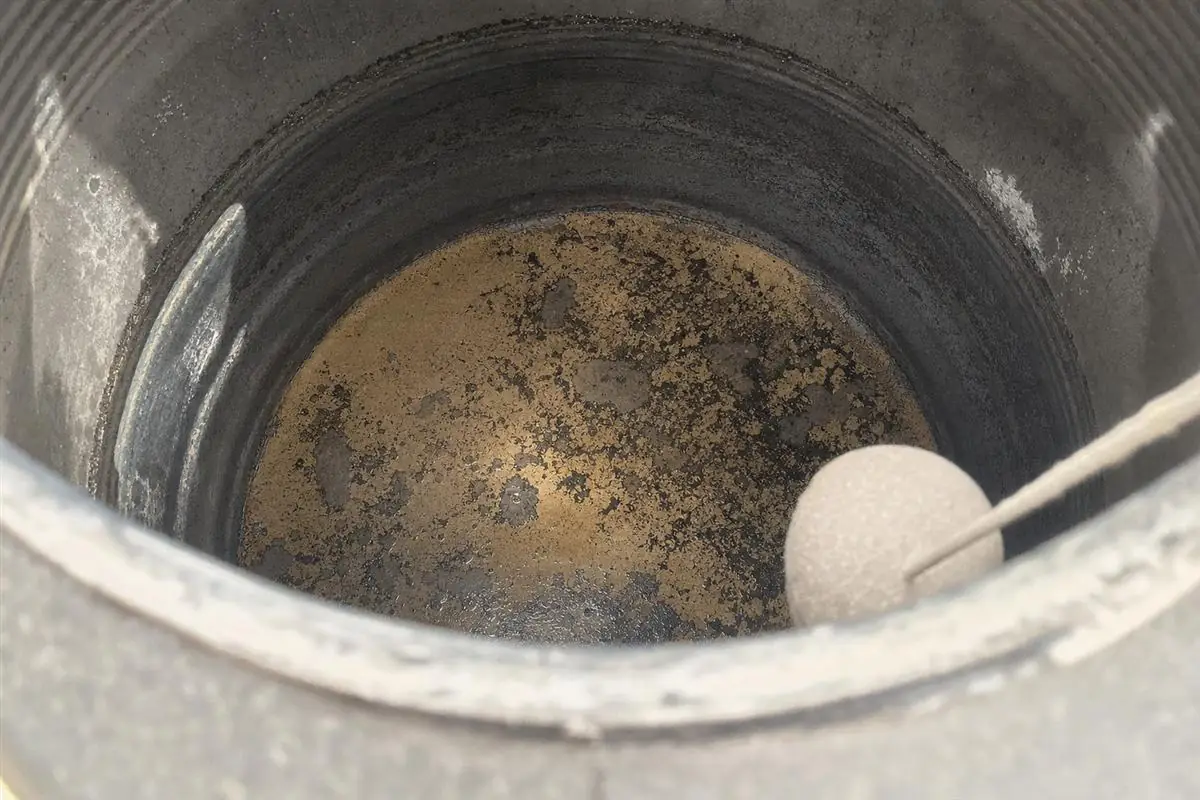
Open a neglected Gurgaon tank and this is what you find at the bottom: a layer of fine silt, rust flecks, hard-water scale, and a slimy biofilm clinging to the walls. In tanks fed by tankers, there’s often sand and grit too. None of this is visible from your tap, and none of it registers on a purifier under the sink.
Here’s the part that surprises people. That same tank feeds:
- Every shower and bucket bath — water on your skin, scalp and eyes, daily
- Every wash basin where you brush your teeth and rinse your face
- The kitchen tap you use to wash vegetables, dal and rice before they ever reach a pot
- The washing machine that cleans your clothes and bedsheets
- And the cold-water line that supplies the RO itself
Only the last of those gets purified, and only the drinking fraction of it. Everything else is tank water, straight, no filter in between. If the tank is dirty, you are bathing in, cooking with, and rinsing food in contaminated water — while feeling completely protected because the drinking glass looks fine.
The Gurgaon reality: hard water and tankers make the tank the weak link
This isn’t a generic argument. Gurgaon’s water situation makes the storage tank the single most important thing to keep clean. The Millennium City runs heavily on hard borewell groundwater, and across the new-tower belt — Sohna Road, Southern Peripheral Road, Dwarka Expressway, New Gurgaon’s Sectors 76 to 95 — daily life depends on water tankers topping up big underground reservoirs that then feed rooftop tower tanks.
Both of those facts hurt the tank, not the purifier:
- Hard water leaves mineral scale on the tank walls and floor. Scale is rough, and biofilm and bacteria love clinging to a rough surface. The harder your supply, the faster this builds — something we cover in detail in our guide to hard water tank cleaning in Gurgaon.
- Tanker water is variable in quality. Every fill can introduce fresh sediment and, occasionally, microbial contamination. That settles in your storage, where it sits and multiplies between cleanings. If you depend on tankers, this load only accumulates.
A purifier shrugs at all of this because it’s downstream and tiny. The reservoir and tower tank absorb the entire hit. That’s why, in this city, a clean tank is not optional even in homes with the most expensive RO money can buy. If you live in a builder colony or condominium, the shared underground reservoir matters just as much — see how that plays out in a DLF condominium water tank cleaning job.
A dirty tank quietly recontaminates your “clean” water
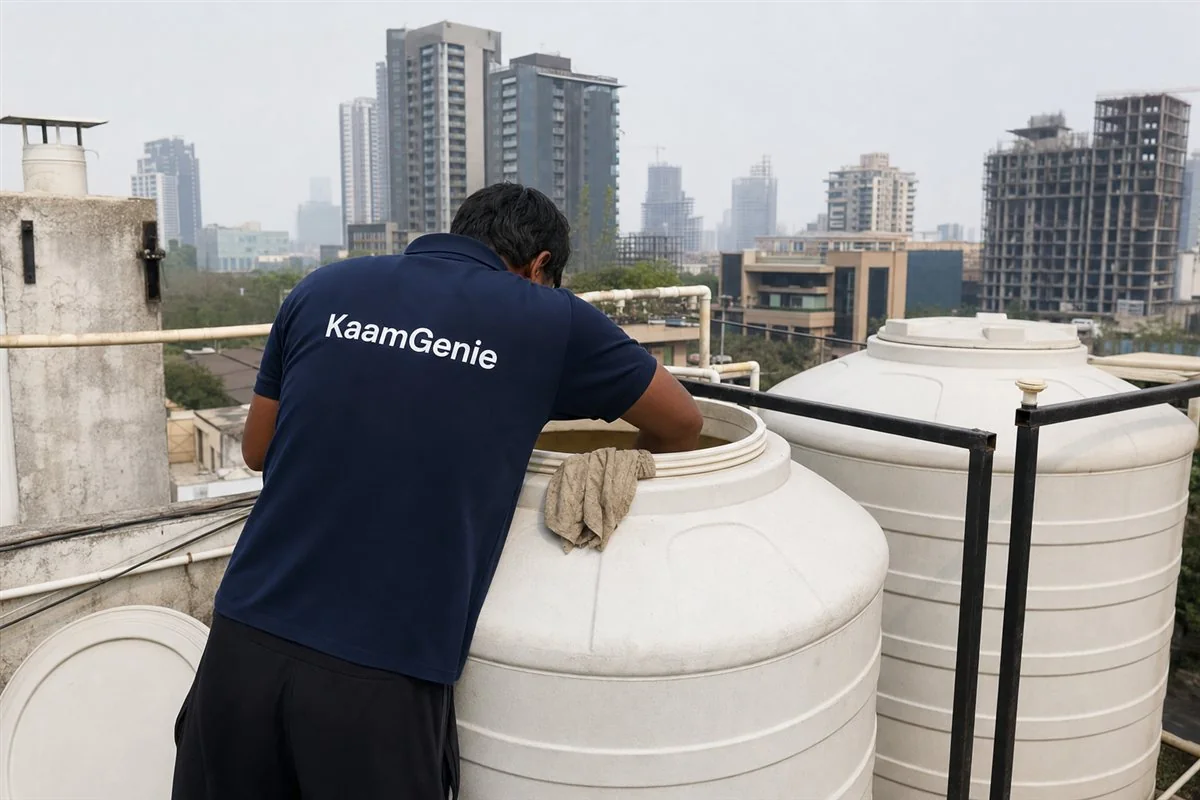
There’s a feedback loop most people miss. Even if your RO produces perfectly clean drinking water today, that water came from a dirty tank and your next glass will too. The tank is a continuous source. You can’t filter your way out of a contaminated reservoir — you have to clean the reservoir.
And the dirt doesn’t stay put. Sediment stirred up when the tank refills travels down the pipes. Biofilm sheds into the flow. Some of that reaches the purifier’s pre-filter, and the rest reaches every other tap untreated. The cleaner you keep the tank, the less your whole system has to fight.
Where your home’s water actually goes
Illustrative split of daily household use — only the drinking slice passes through the purifier
Illustrative only, to show the principle: the purifier protects a small slice of total use, while the tank governs the rest. Actual proportions vary by household.
The hidden cost: a dirty tank wears out your purifier
Here’s the angle that even RO loyalists care about. A purifier is not cheap to run — pre-filters, membranes and UV lamps all need periodic replacement, and an annual service contract isn’t free. The single biggest factor in how fast those parts wear out is the quality of the water feeding them.
Feed an RO with water from a clean tank and the filters do their rated job for their rated life. Feed the same RO with water carrying sediment, hardness and biofilm from a neglected tank, and the pre-filter chokes early, the membrane scales up, and you’re calling for cartridge replacements far more often than you should. People blame the purifier brand. Usually the real culprit is the tank upstream.
Put plainly: cleaning your tank twice a year is one of the cheapest ways to protect a purifier that cost you tens of thousands of rupees. The two aren’t competitors fighting for your budget — one makes the other last longer.
So which do you actually need?
Both, and in this order of logic:
- Clean the tank to protect all your water — bathing, washing, cooking and the feed to your RO — and to stop the slow recontamination that no filter can fix.
- Keep the purifier to polish the final drinking and cooking water to a safe standard, removing dissolved impurities the tank cleaning isn’t meant to address.
One is mechanical and periodic (open, drain, scrub, disinfect — every 4 to 6 months). The other is electronic and continuous (filter at the tap, change cartridges on schedule). They cover different parts of the same problem. Skipping the tank because you own a purifier is like dry-cleaning your shirt collar and leaving the rest of the shirt dirty.
Already have an RO? Now sort the tank.
We’ll show you before-and-after photos of what your purifier never sees. Standard residential cleaning ₹699 onwards; society and reservoir jobs quoted on site.
Book the tank cleaning your purifier can’t do
If you’ve invested in a good RO, you already care about your family’s water. The tank is the other half of that same decision. We clean overhead tanks and underground reservoirs across the city — book water tank cleaning in Gurgaon and we’ll handle the part the purifier can’t reach. We’re regularly on rooftops in Sushant Lok, Sector 56 and the premium towers along Golf Course Road, and you can see how we work and what it costs in our Gurgaon cost guide. The same care applies right across our NCR water tank cleaning services.
Frequently asked questions
Does a water purifier clean my water tank?
No. An RO or UV purifier sits at one tap — usually the kitchen — and treats only the small amount of water that passes through it just before you drink it. It has no connection to your overhead tank or underground reservoir and does nothing to the sludge, biofilm or algae sitting inside them. The tank still has to be physically opened, drained, scrubbed and disinfected.
If I have an RO purifier, do I still need to clean my tank in Gurgaon?
Yes, and arguably more so in Gurgaon. Most of your home’s water — every shower, every wash basin, the washing machine, the kitchen tap before it reaches the RO — never touches the purifier. All of it comes straight from the storage tank. A dirty tank means dirty water for roughly 90 percent of your daily use, regardless of how good your RO is.
Why do my RO filters clog so fast in Gurgaon?
Because the water reaching your purifier is already loaded with sediment, hardness and biofilm from an unclean tank. The RO membrane and pre-filters are designed to polish reasonably clean water, not to act as the first line of defence against tank sludge. Cleaning the tank reduces the dirt load hitting the filters, so cartridges and membranes last closer to their rated life instead of choking early.
Is my bathing and cooking water safe if only my drinking water is purified?
Only as clean as your tank. Bathing, brushing teeth, washing vegetables and rinsing utensils all use unpurified water straight from the tank. If the tank carries algae or bacteria, you are exposed through your skin, eyes and the food you rinse — none of which the kitchen RO protects. This is exactly why purifying drinking water alone is not enough.
Does a water purifier remove the hardness in Gurgaon borewell water?
An RO membrane reduces dissolved hardness in the drinking water it produces, but it does nothing about the hard-water scale building up inside your tank, geyser and pipes. In Gurgaon’s hard borewell belt, that scale keeps accumulating in the tank and traps biofilm. Cleaning the tank physically removes the scale layer; the purifier never sees it.
Can a dirty tank actually damage my water purifier?
Indirectly, yes. Heavy sediment and hardness from an unclean tank overwork the RO pre-filters and membrane, shortening their life and pushing up your annual maintenance cost. Some homes replace cartridges twice as often as they should simply because the feed water is dirty. A clean tank is the cheapest way to protect an expensive purifier.
How often should I clean my tank in Gurgaon if I already have a purifier?
Every 4 to 6 months for most Gurgaon homes — sooner if you rely heavily on tanker water or are on hard borewell supply. Having a purifier does not change this schedule, because the purifier and the tank do completely different jobs. The tank needs cleaning on its own merits no matter what is fitted at the kitchen tap.
Does tanker water make tank cleaning more important than a purifier?
Tanker water makes both matter, but the tank especially. Tanker supply is variable in quality and dumps fresh sediment and sometimes bacteria into your storage every time it fills. That settles in the tank, not the purifier. If you depend on tankers — as much of new Gurgaon does — regular tank cleaning is the step that keeps that load from building up and recontaminating everything downstream.
What about a whole-house RO — does that replace tank cleaning?
No. Even a whole-house or point-of-entry system treats water as it leaves the tank toward your taps; it cannot reach inside the tank to remove sludge, scale and biofilm already sitting there. That buildup keeps recontaminating water and clogging the system’s filters. The tank still needs to be opened and cleaned physically. The two are complementary, never substitutes.
Sources & references
- Bureau of Indian Standards (BIS) — IS 10500:2012 is the canonical Indian Standard for drinking water specification, defining acceptable limits for physical, chemical, and biological parameters.
- WHO Guidelines for Drinking-water Quality, 4th edition — the global reference for water quality standards, including guidance on storage and disinfection.
- Food Safety and Standards Authority of India (FSSAI) — defines water quality requirements for food businesses, including hygiene standards for stored water and acceptable disinfection chemicals.
- WHO Fact Sheet on Drinking Water — overview of safe drinking water requirements and contamination risks.
- CPHEEO — Manual on Water Supply and Treatment — the Government of India’s engineering manual covering tank design, cleaning protocols, and disinfection practices.
Last verified: 29 June 2026. If you find any of these links broken, please let us know.